
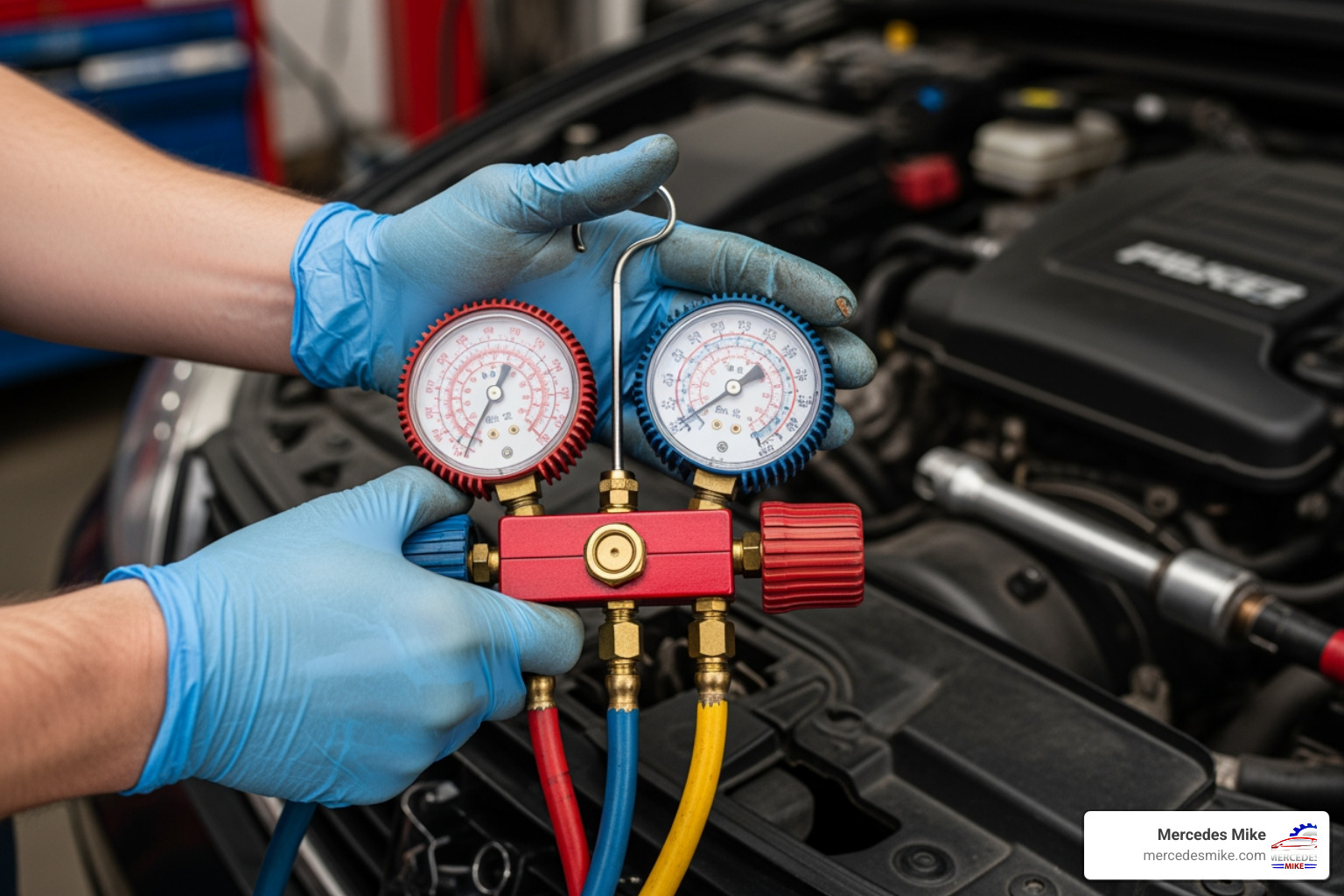
The Essential Guide to Air Conditioning Recharge Services
Why an Air Conditioning Recharge Can Make or Break Your Summer Drive
An air conditioning recharge is the process of restoring your vehicle's refrigerant to the correct level so the system can cool your cabin effectively again.
Here's what you need to know at a glance:
What it is - Refilling or replacing the refrigerant in your car's AC system
When you need it - When vents blow warm air, cooling is weak, or the compressor isn't engaging
Who can do it - Simple top-offs can be DIY; full evacuation and recharge should be done professionally
Cost range - DIY kits run around $60; professional service typically starts at $150-$300
How long it takes - A professional recharge usually takes 30 to 60 minutes
If you drive a German luxury vehicle — a Mercedes, BMW, or Audi — a failing AC system isn't just uncomfortable. It's a sign that something in a complex, precision-engineered system needs attention. On a hot day in South Florida, warm air blowing from your vents can go from a minor annoyance to a real problem fast.
The good news? Most AC cooling issues come down to one thing: low refrigerant. And that's fixable.
This guide walks you through everything — from spotting the warning signs to understanding when a DIY kit is enough and when your car needs a professional hands-on service.

The Science Behind an Air Conditioning Recharge
To understand why your car needs an air conditioning recharge, you first have to understand that your AC doesn't actually "create" cold air. Instead, it’s a heat-removal machine. It uses a chemical called refrigerant to soak up the heat inside your cabin and dump it outside.
The system is a closed loop consisting of several key players:
The Compressor: The "heart" of the system that pressurizes the refrigerant.
The Condenser: Located at the front of your car, it looks like a small radiator and sheds the heat into the atmosphere.
The Evaporator: Located behind your dashboard, this is where the cold magic happens as the refrigerant absorbs cabin heat.
When the refrigerant level drops, the cycle breaks. There isn't enough fluid to carry the heat away, leaving you sweating in the Pompano Beach humidity. According to the Options for Recharging Your Air Conditioner, maintaining the correct charge is vital for both cooling performance and the longevity of these expensive components.
Identifying the Correct Refrigerant for Your Vehicle
Not all "freon" is created equal. In fact, using the wrong gas can destroy your compressor instantly. As of May 2026, there are three main types you’ll encounter:
R134a: The industry standard for most vehicles built between 1994 and 2014. It’s widely available in DIY kits like the A/C Pro R134a Refrigerant Recharge Kit 18 oz Mfr# AC001KA18A-1US - Ace Hardware .
R1234yf: The newer, environmentally friendly standard found in most cars manufactured after 2014. It’s much more expensive and requires specialized equipment to service.
R12: Found in classic cars (pre-1994). This stuff is now illegal to manufacture and incredibly rare. Most owners of vintage Mercedes or Porsches in South Florida choose to retrofit their systems to R134a.
Pro Tip: Always check the yellow or white sticker under your hood or consult your owner's manual to verify which gas your car uses before attempting a refill.
Why Systems Lose Pressure Over Time
You might wonder, "If it's a closed system, where did the gas go?" While your AC is designed to be airtight, the reality is that cars are subjected to constant vibration, heat cycles, and road debris.
Research shows that the average new model economy car naturally leaks about 0.41 ounces of refrigerant per year through microscopic pores in rubber hoses and seals. Over five or six years, that loss adds up to a system that no longer blows ice-cold. However, if your AC went from "arctic" to "desert" overnight, you likely have a more significant leak that needs a Mercedes Air Conditioning Service rather than just a quick top-off.
Signs Your Vehicle Needs a Refrigerant Refill
The most obvious sign is, of course, warm air coming from the vents. But before the system fails completely, it often sends out "cries for help."
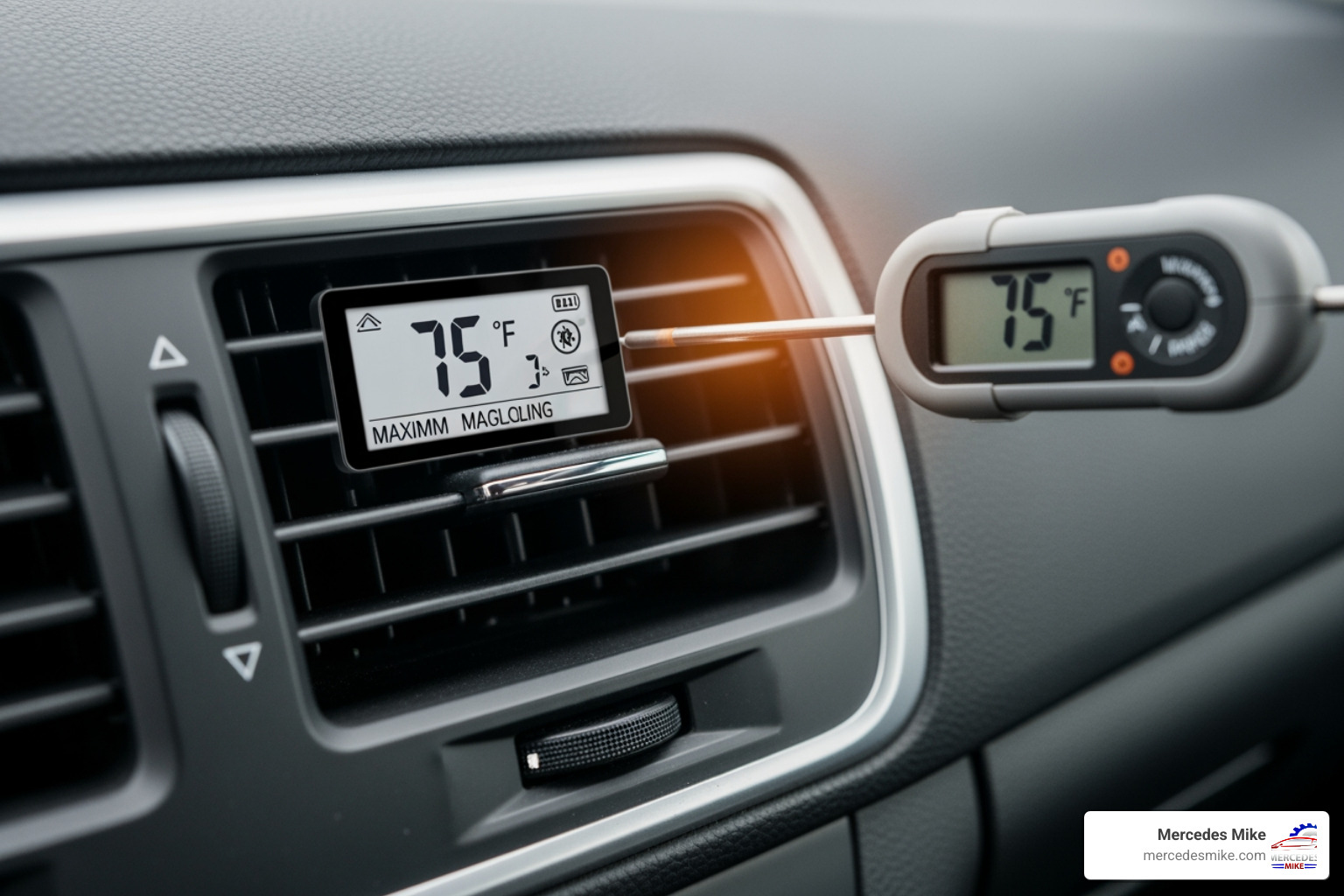
Visual and Auditory Indicators of Failure
Keep your eyes and ears open for these common symptoms:
The "Click-Clack" Dance: When you turn on the AC, you should hear the compressor clutch engage with a distinct click. If you hear it clicking on and off every few seconds (short-cycling), your refrigerant is likely low.
Hissing Sounds: A noticeable hissing sound from behind the dashboard often indicates gas escaping through the expansion valve.
Oily Residue: Refrigerant travels with a special oil to lubricate the compressor. If you see oily spots on AC hoses or connections, that’s a "smoking gun" for a leak.
Frozen Coils: Ironically, low refrigerant can cause the evaporator to freeze over into a block of ice, eventually blocking all airflow.
The Role of the Cabin Air Filter
Sometimes the problem isn't the refrigerant at all. If your airflow feels weak or you notice a musty, "old gym locker" smell, your cabin air filter might be clogged with South Florida dust and mold. We recommend checking this every 15,000 miles. For those driving high-end Mercedes models, you might also consider a Mercedes Benz Air Balance Refill to keep the interior smelling as luxury as it looks.
Step-by-Step Guide to a DIY Air Conditioning Recharge
If you’ve determined your car uses R134a and you're dealing with a gradual loss of cooling, a DIY kit can be a cost-effective temporary fix. Products like the A/C Pro R-134a Refrigerant Kit with Stop Leak and Charging Hose 18oz | AutoZone are popular for a reason—85% of reviewers recommend them for their ease of use.
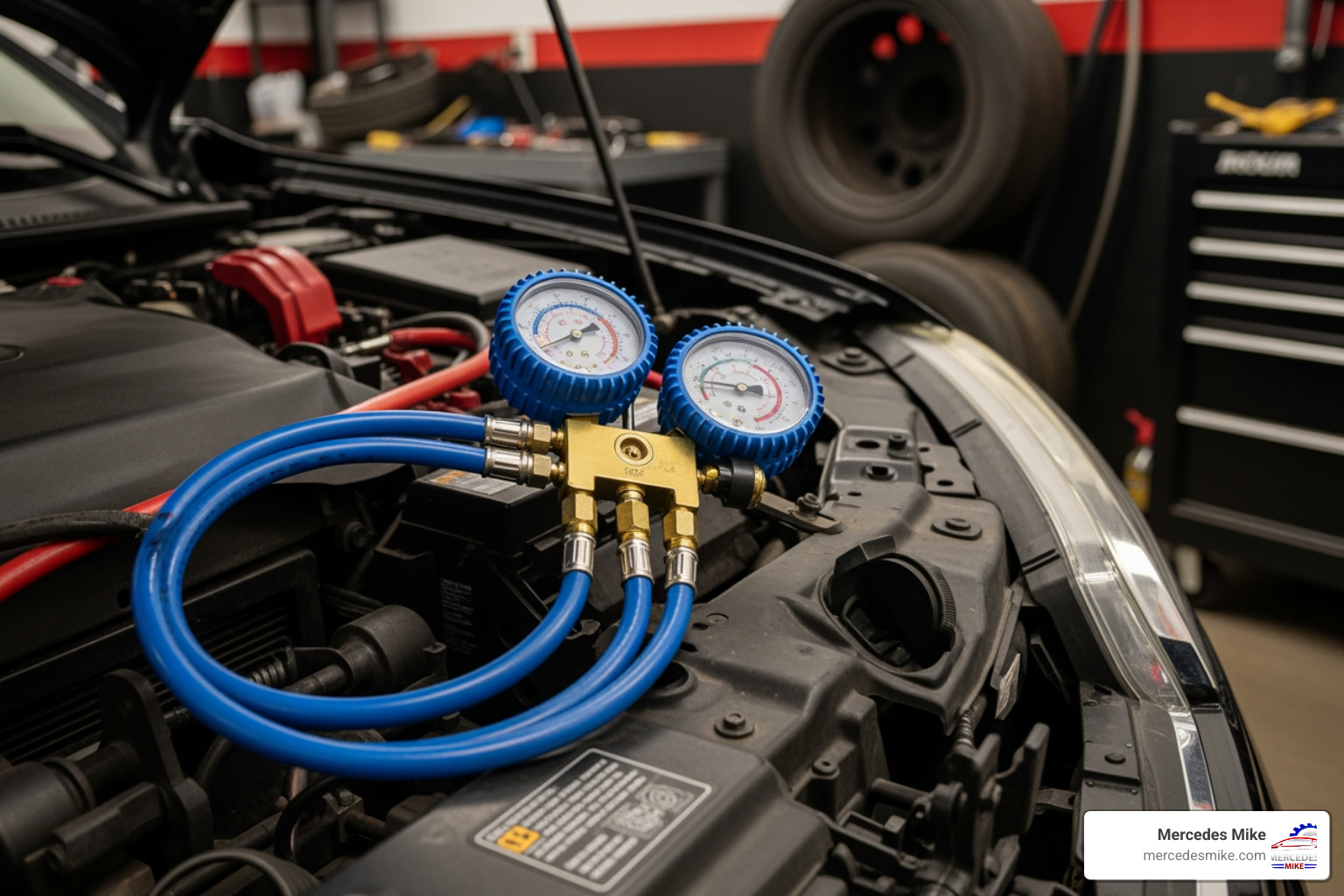
Tools and Materials Required
To do this safely, you’ll need:
An air conditioning recharge kit (refrigerant, hose, and gauge).
Safety glasses and heavy-duty gloves (refrigerant can cause instant frostbite if it touches your skin!).
A vent thermometer.
A flashlight to locate the ports.
Executing the Recharge Safely
Locate the Low-Pressure Port: This is usually on the wider of the two aluminum pipes. The DIY kit will only fit this port; it physically cannot attach to the high-pressure port (which is a good thing, as the high-pressure side can explode a DIY can).
Prep the Car: Start the engine and turn your AC to "Max Cool" with the fan on high. Make sure the compressor is running.
Check the Baseline: Attach the gauge to the port without opening the refrigerant can yet. Read the pressure.
Add Refrigerant: Shake the can, attach it to the hose, and squeeze the trigger in 15-second bursts. Shake the can while you do it.
Monitor the Gauge: Stop frequently to check the pressure. Do not let it enter the "Red" zone.
For a deeper dive into the technical side, check out these Safety Tips for Handling Refrigerant.
Common Mistakes During an Air Conditioning Recharge
The biggest mistake is overcharging. More is not better. If you add too much refrigerant, the pressure becomes too high for the compressor to move, and the system will actually blow warmer air or shut down entirely to prevent a catastrophic failure.
Another mistake is ignoring a leak. If you have to recharge your system every month, you are venting chemicals into the atmosphere and wasting money. It’s time to see a professional.
Professional vs. DIY: When to Seek Expert Help
While a DIY kit is great for a 10-year-old economy car, it’s often not the best choice for a precision-tuned German machine.
Feature DIY "Top-Off" Professional Recharge (Mercedes Mike) Accuracy Estimated via pressure gauge Precise weight to manufacturer specs Leak Detection Visual only Vacuum testing & UV dye diagnostics Moisture Removal None Full system evacuation (Vacuum) Oil Balance Guessed Correct oil type and amount added Warranty None Guaranteed parts and labor
The Importance of System Evacuation
When we perform a professional AC Evacuation and Recharge Services - Jiffy Lube (or a similar high-level service at our Pompano Beach shop), we don't just add gas. We use a machine to suck out every bit of old refrigerant, air, and moisture.
Moisture is the "AC killer." When water enters the system, it combines with refrigerant to create an acid that eats your components from the inside out. A professional vacuum pump is the only way to boil that moisture out before refilling the system with pure, clean refrigerant.
Specialized Requirements for German Luxury Vehicles
If you drive an Audi, BMW, or Porsche, your AC system is likely more complex than a standard domestic vehicle. Many modern German cars use variable displacement compressors. These don't just click on and off; they constantly adjust their output based on the cabin temperature.
Standard DIY gauges often give false readings on these systems because the pressure doesn't behave like a traditional "on/off" compressor. At Mercedes Mike, we use factory-level diagnostic tools to communicate with your car's computer, ensuring the sensors and actuators are working in harmony before we ever touch the refrigerant.
Frequently Asked Questions about AC Maintenance
How often should I recharge my car's AC?
There is no set schedule. Unlike an oil change, you only need an air conditioning recharge when the cooling performance drops. However, we recommend a "performance check" every two years to catch small leaks before they turn into a $2,000 compressor replacement.
Is it safe to use stop-leak products?
We generally advise against them, especially for luxury vehicles. "Stop-leak" works by hardening when it hits air. The problem? It can also harden inside the tiny orifices of your expansion valve or clog your condenser. It makes future professional repairs much more difficult and expensive.
Why is my AC still warm after a recharge?
If you've added refrigerant and it's still warm, you might have a:
Blown Fuse or Relay: The compressor isn't getting power.
Failed Expansion Valve: The refrigerant can't flow into the evaporator.
Broken Blend Door: Your AC is cold, but the car is accidentally mixing it with heat from the engine.
Electrical Sensor Issue: Common in BMW and Mercedes models where a faulty ambient temperature sensor tells the car it's 40 degrees outside when it's actually 95.
Conclusion
Restoring your car's cooling performance is about more than just comfort—it's about protecting a vital system of your vehicle. While a DIY kit might get you through a week, a professional diagnostic ensures your car stays "South Florida cold" for years to come.
Whether you need a simple pressure check or a complex compressor repair, our team at Mercedes Mike is here to help. We combine decades of experience with the latest tools to service your German luxury vehicle right the first time.
Don't spend another afternoon sweating in traffic on Dixie Hwy. Contact us for Expert German Auto Services and let’s get your AC back to peak performance.