
The Luxury Car Owner Guide to Audi Q5 AC Repair
Why Audi Q5 AC Repair Deserves Your Attention Before Summer Hits
Audi Q5 AC repair is one of the most common service needs for Q5 owners, especially as temperatures climb. Here is a quick summary of what you need to know:
Most common causes of Audi Q5 AC failure:
Refrigerant leak — accounts for roughly 37% of cases
Electrical climate control issue — around 21% of cases
AC compressor failure — roughly 12% of cases
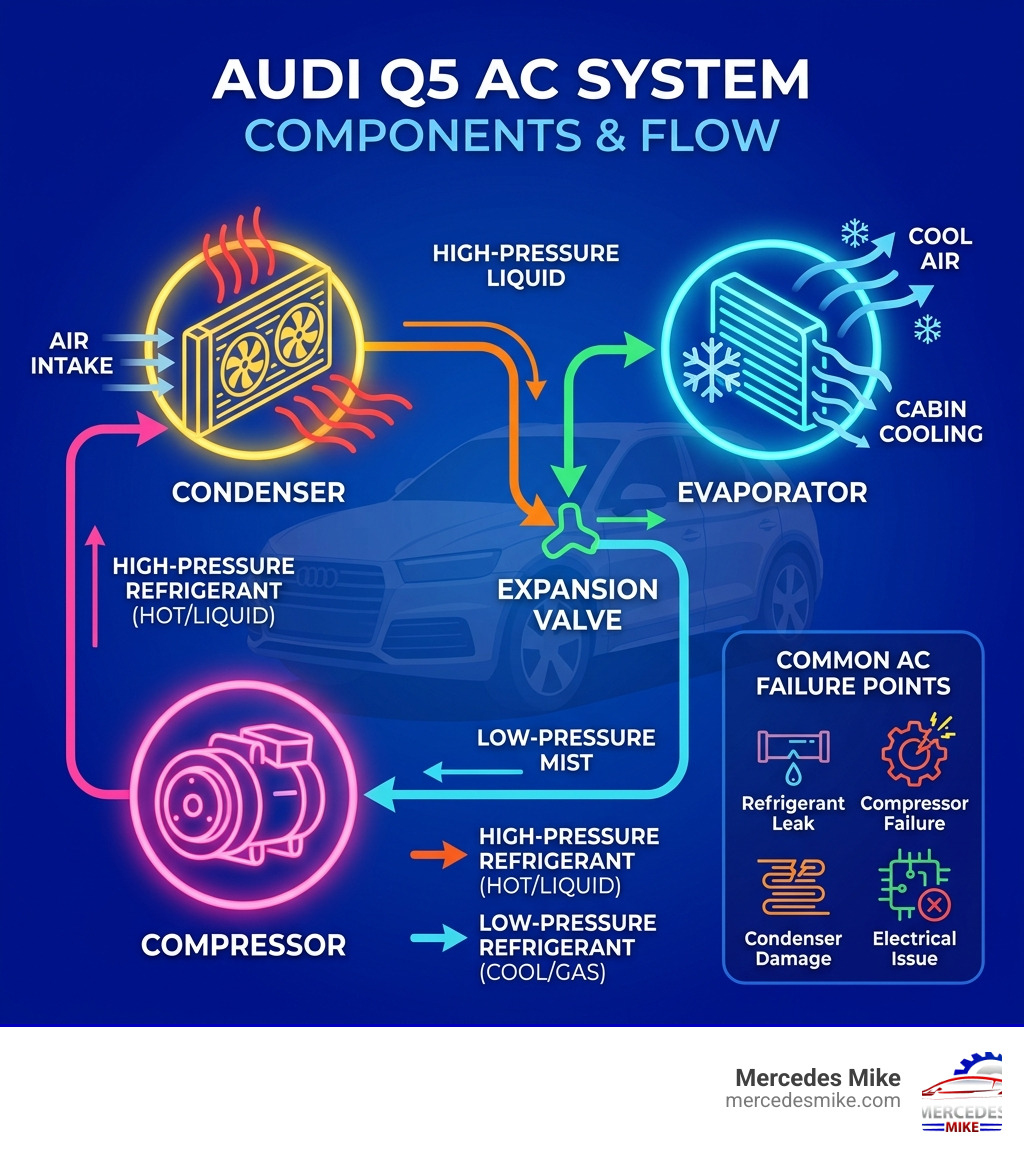
Other causes — condenser damage, clogged expansion valve, blend door actuator failure, or a faulty condenser fan module
Typical repair costs:
Repair Estimated Cost Range General AC repair ~$372 average AC condenser replacement $681 – $935 AC compressor replacement $1,170 – $1,601 AC recharge $261 – $340
Your Audi Q5 is built for comfort. A climate system that blows warm air or cuts out mid-drive is not just annoying — it can be a sign of a deeper problem that gets more expensive the longer you ignore it.
The Q5's AC system is more complex than a standard car. It uses sophisticated electronic controls, dual-zone climate management, and — on 2019 and newer models — a newer refrigerant type that requires specialized equipment. That means a quick stop at a general shop or a DIY recharge kit from an auto parts store is rarely the right answer.
In this guide, you will learn exactly what causes AC failure in the Audi Q5, how proper diagnosis works, what repairs realistically cost in 2026, and how to protect your system going forward.
Common Causes and Symptoms of Audi Q5 AC Failure
When the air conditioning in your Audi Q5 fails, it is rarely a mystery to a trained eye, but for the owner, it can be incredibly frustrating. Based on our experience in South Florida, these systems are under constant load. The most frequent culprit is a refrigerant leak. Since the AC is a sealed system, any loss of "gas" means there is a breach—often in the rubber seals, hoses, or the condenser itself.

Another significant issue is compressor seizure. The compressor is the heart of the system; if it fails mechanically, it can no longer circulate refrigerant. In some cases, the internal control valve fails first, which is a slightly less expensive fix but still requires professional Audi Q5 AC repair. Electrical faults, such as a blown fuse or a faulty climate control module, can also prevent the system from engaging.
Identifying Audi Q5 AC Repair Needs Through Symptoms
You don't need to be a mechanic to know something is wrong. Your Audi will usually give you several warning signs:
Warm Air: This is the most obvious symptom. If you set the MMI to "Max AC" and the air remains at ambient temperature, you likely have a leak or a compressor issue.
Clicking or Grinding Noises: A failing compressor often makes a rhythmic clicking or a harsh grinding sound when the AC is engaged.
Musty Smells: In humid areas like Pompano Beach, moisture can build up on the evaporator core, leading to mold growth. If your vents smell like vinegar or old socks, it's time for a cleaning.
Weak Airflow: If the air is cold but barely blowing, your cabin filter might be clogged or a blower motor could be failing.
For a deeper look at why your car might be blowing hot, check out this guide on Audi Q5 AC blowing hot air.
The Role of the Condenser Fan Control Module in Hot Climates
In South Florida, the condenser fan control module is a notorious troublemaker. This module regulates the cooling fans that pull air through the condenser when the vehicle is stationary. When this module fails, your AC might work perfectly while driving on the highway but turn warm the moment you hit traffic in Deerfield Beach.
This is frequently misdiagnosed as "low refrigerant" because the symptoms are similar. However, adding more refrigerant to a system with a bad fan module can actually cause over-pressurization and damage the compressor. In high-humidity environments, these modules are prone to voltage drops and internal corrosion, making them a top priority for inspection during any Audi Q5 AC repair.
Professional Diagnosis and the Audi Q5 AC Repair Process
Properly fixing an Audi isn't about guesswork; it's about data. When you bring your Q5 to us, we don't just "top it off." We perform a comprehensive Mercedes Air Conditioning Service protocol adapted for Audi's specific engineering.

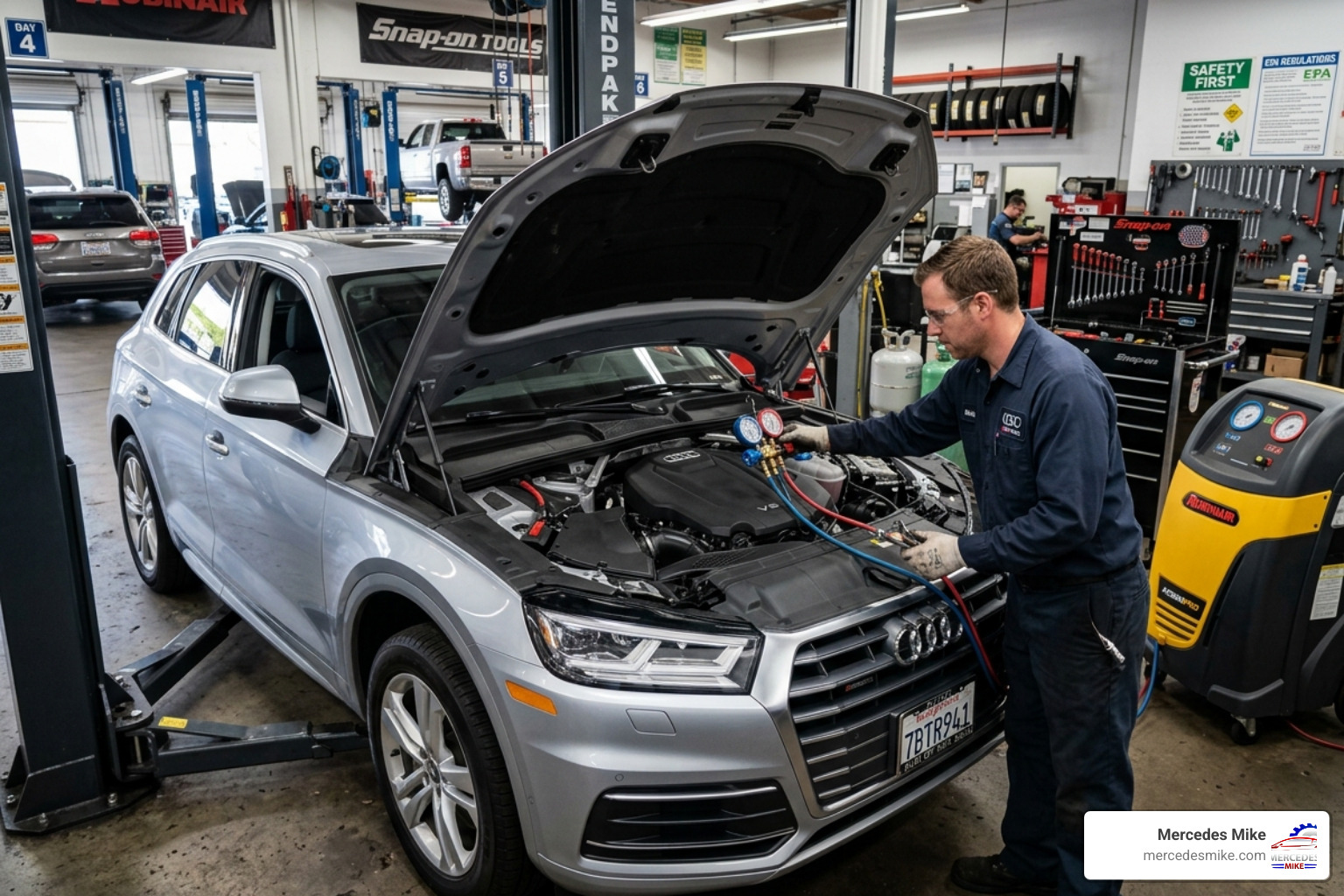
Our process starts with a VCDS (Vag-Com Diagnostic System) scan. Unlike generic OBDII scanners, VCDS allows us to talk directly to the Audi climate control module. We can see real-time data from pressure sensors and flap actuators. We then use a manifold gauge set to check the pressure-temperature relationship. If we suspect a leak, we inject UV dye or use an electronic "sniffer" to find the exact point of escape.
Refrigerant Types: R134a vs R1234yf
As of April 2026, it is vital to know which refrigerant your Q5 uses. Older models (2009–2017) almost exclusively use R134a. However, newer models (2018+) have transitioned to R1234yf to meet environmental regulations.
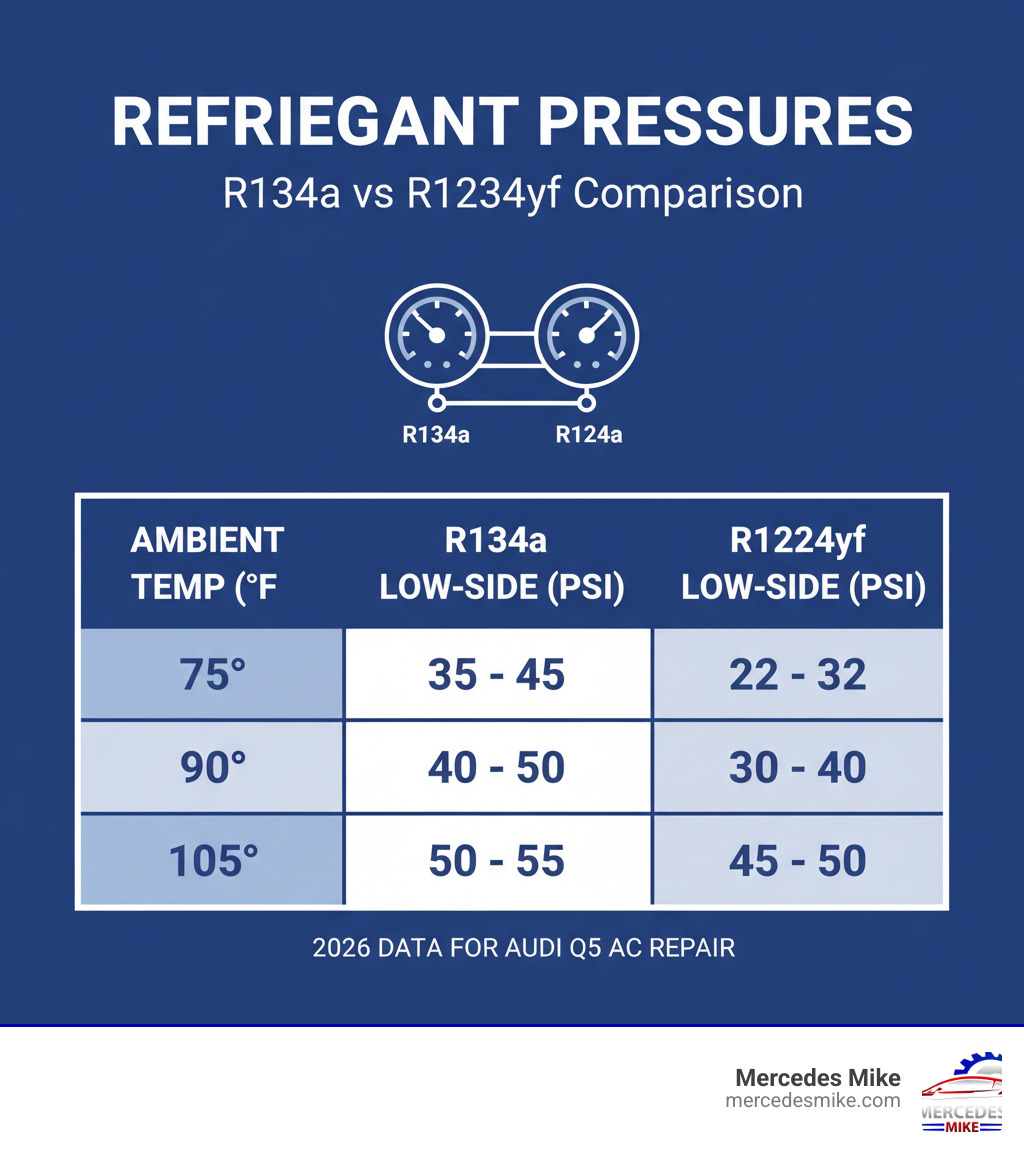
Ambient Temp (°F) R134a Low-Side (PSI) R1234yf Low-Side (PSI) 75° 35 – 45 22 – 32 90° 40 – 50 30 – 40 105° 50 – 55 45 – 50
Using the wrong refrigerant or mixing them will destroy your AC system. R1234yf is more expensive and requires specialized recovery machines, which is why professional service is mandatory for newer Audi models.
Why DIY Recharging Your Audi Q5 AC Repair is Risky
We see it all the time: an owner buys a "recharge in a can" from a local store. This is one of the riskiest things you can do to your luxury SUV. These cans often contain "stop-leak" sealants that can gum up the expansion valve and ruin professional recovery equipment.
Furthermore, without gauges, it is incredibly easy to over-pressurize the system. Too much refrigerant is just as bad as too little; it can lead to "slugging," where liquid refrigerant enters the compressor and destroys it instantly. There is also the risk of chemical burns or frostbite if the pressurized gas escapes during a DIY attempt. Always leave refrigerant handling to certified professionals who use proper recovery systems to protect both your car and the environment.
Understanding Repair Costs and Model Variations
The cost of Audi Q5 AC repair varies significantly based on the generation of your vehicle. The first-generation Q5 (2009–2017) has a massive catalog of aftermarket parts available, which can keep costs lower. The second-generation (2018+), however, uses more integrated electronics and the pricier R1234yf refrigerant, leading to higher service totals.
Cost Breakdown for Condenser and Compressor Replacement
If your diagnosis points to a major component, here is what you should expect to invest in April 2026:
AC Condenser Replacement: The average cost is between $681 and $935. Parts usually make up about $517–$694 of that, with labor ranging from $164–$241. Because the condenser is located at the very front of the car, it is highly susceptible to rock damage.
AC Compressor Replacement: This is the big one. Expect to pay between $1,170 and $1,601. The parts for an Audi compressor are premium, often costing $1,000 or more, while labor is typically $137–$200.
While dealerships often charge a premium, an expert independent shop like Mercedes Mike provides the same high-level German car expertise with more personalized service standards.
Related Repairs and Blend Door Actuator Failures
Often, when a compressor fails, it sends metal debris through the system. This means you can't just replace the compressor; you must also replace the receiver drier and the expansion valve to prevent the new part from failing immediately.
Another common "hidden" issue is the blend door actuator. If your AC is cold but only coming out of certain vents—or if you hear a clicking sound behind the dash—this small motor is likely the cause. Replacing these can be labor-intensive, sometimes requiring partial dashboard removal, but it is essential for restoring dual-zone climate functionality.
Frequently Asked Questions about Audi Q5 AC Repair
Can I drive my Audi Q5 with a faulty AC system?
Technically, yes, you can drive with a broken AC, but it isn't recommended. In South Florida, the heat can quickly become a safety hazard for children or pets. More importantly, if the compressor is grinding, it could eventually seize and snap the serpentine belt. If that belt snaps, you lose your alternator and power steering, leading to an immediate engine stall.
How can I prevent future AC problems in humid environments?
Prevention is much cheaper than repair. We recommend:
Park in the shade or use a high-quality reflective sunshade to reduce the initial heat load.
Change your cabin filter every 10,000 to 15,000 miles to prevent the blower motor from straining.
Run the AC regularly, even in winter, to keep the seals lubricated.
Get an annual inspection to catch small leaks before they starve the compressor of oil.
Why is my AC blowing cold on one side but warm on the other?
This is almost always a failure of the blend door actuator. The Audi Q5 uses a dual-zone system where separate flaps control the air temperature for the driver and passenger. If one actuator gets stuck or its plastic gears break, you'll get inconsistent temperatures. A VCDS scan can usually recalibrate these or confirm if a replacement is necessary. For more details on airflow issues, see this weak airflow guide.
Conclusion
Owning an Audi Q5 means enjoying a certain standard of luxury, and a functional AC system is at the heart of that experience. Whether you are dealing with a simple refrigerant leak or a complex compressor failure, getting a precise diagnosis is the only way to ensure a lasting repair.
At Mercedes Mike, we specialize in the maintenance and repair of German luxury vehicles across Pompano Beach and South Florida. Our technicians bring decades of experience and the latest diagnostic tools to every Audi Q5 AC repair we perform. Don't suffer through another humid afternoon with a failing climate system. Schedule your Audi AC service with us today and get back to driving in comfort.