
Don't Let Your BMW Choke on Bad O2 Sensors
Why BMW 325i Oxygen Sensor Replacement Matters for Your Engine
BMW 325i oxygen sensor replacement is one of the most impactful maintenance jobs you can do to restore fuel economy, fix a check engine light, and keep your emissions system healthy.
Quick answer: Here's what you need to know
The BMW 325i has 2 to 4 oxygen sensors depending on the model year (E30 has 1, E46 has 4)
Sensors are located before and after the catalytic converter on each exhaust bank
Common symptoms of a bad sensor: check engine light, poor MPG, rough idle, stalling
DIY cost: $33–$256 per sensor in parts; professional replacement runs $386–$771 total
Replacement interval: every 60,000 miles on pre-1996 models; 100,000+ miles on 1996 and newer
Top brands: Bosch (part #15510), NTK (part #23162), DENSO (part #234-4668)
Your BMW's oxygen sensors do one critical job: they tell the engine computer how much oxygen is in the exhaust. The engine uses that data to balance the air-fuel mixture in real time. When a sensor fails, your engine is essentially flying blind — burning too much fuel, producing excess emissions, and potentially damaging your catalytic converter.
The good news? With the right tools and about 3 hours, this is a repair many BMW owners can handle at home.
Understanding the BMW 325i Oxygen Sensor System
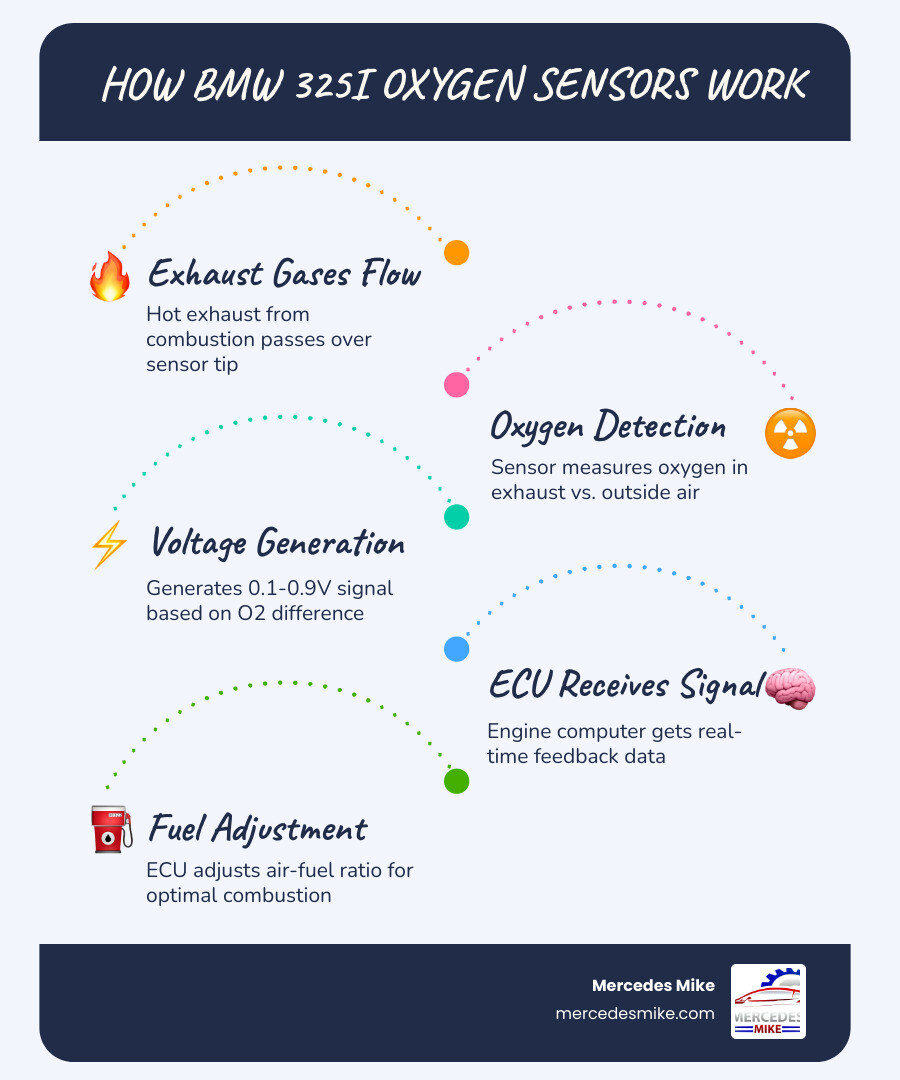
To master a bmw 325i oxygen sensor replacement, we first need to understand how these little components talk to your car's brain. An oxygen sensor (or O2 sensor) is a chemical generator. It creates a small voltage based on the difference between the oxygen in the exhaust and the oxygen in the outside air.
When your 325i is running, it enters what we call "closed-loop" operation. This means the Engine Control Unit (ECU) is actively listening to the oxygen sensors to fine-tune the fuel being sprayed into the cylinders. If the sensor detects too much oxygen (a "lean" mixture), the ECU adds more fuel. If it detects too little oxygen (a "rich" mixture), it dials the fuel back.
You can find a wide variety of compatible parts at BMW 325i Oxygen Sensors - Advance Auto Parts to see the different styles available for your specific year.
Role of Upstream vs. Downstream Sensors
On modern BMWs, sensors are divided into two categories:
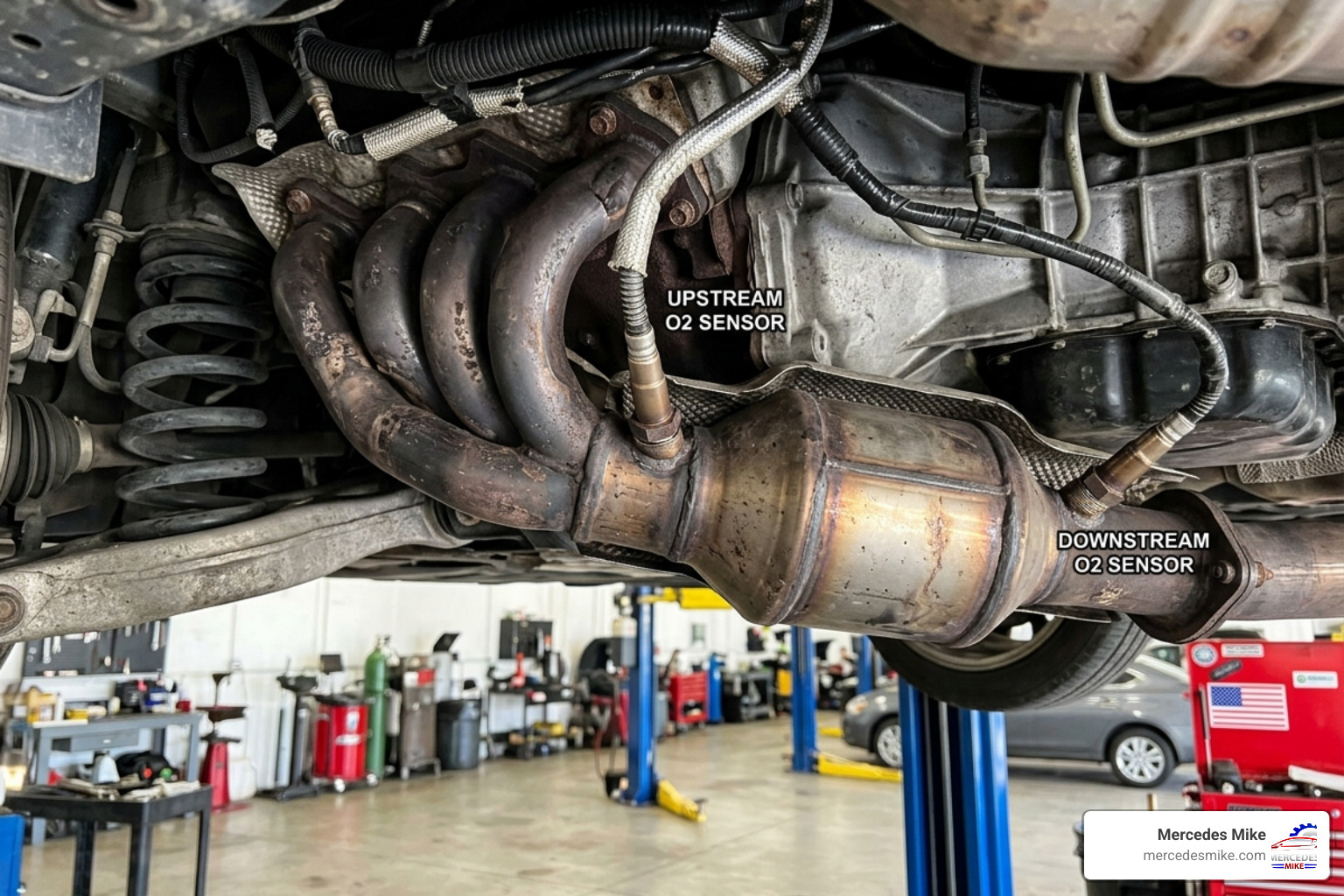
Upstream (Pre-Catalytic): These are located before the catalytic converter. They are the "workhorses" that manage fuel trim and air-fuel ratios. They oscillate rapidly between high and low voltage to keep the engine running efficiently.
Downstream (Post-Catalytic): These live after the catalytic converter. Their main job is to act as a "tattletale" for the emissions system. They monitor how well the catalytic converter is cleaning the exhaust. If the downstream signal looks too much like the upstream signal, the ECU knows the converter is failing.
Identifying Sensor Locations by Model Year
BMW changed the 325i significantly over the decades, and the sensor count changed with it.
E30 Models (1984-1991): These early 325i models are much simpler. They typically utilize a single oxygen sensor located in the exhaust downpipe, about a foot past the manifold.
E46 Models (1999-2006): These use a more complex "quad-sensor" setup. Because the engine is an inline-six, BMW splits the exhaust into two "Banks."
Bank 1: Covers cylinders 1, 2, and 3 (the front of the engine).
Bank 2: Covers cylinders 4, 5, and 6 (the rear of the engine).
Model Generation Total Sensors Location Breakdown E30 (1984-1991) 1 Single upstream sensor in downpipe E36 (1992-1995) 1 Single upstream sensor E46 (1999-2006) 4 2 Pre-cat (B1S1, B2S1), 2 Post-cat (B1S2, B2S2)
Symptoms and Fault Codes of a Failing Sensor

How do you know it’s time for a bmw 325i oxygen sensor replacement? Your car will usually tell you, though sometimes the signs are subtle. Since the O2 sensor is vital for fuel management, a failure often results in the engine "guessing" the fuel mixture, which is never as accurate as the real data.
Common symptoms we see at our South Florida shop include:
The Check Engine Light (CEL): This is the most common indicator.
Poor Fuel Economy: You might notice you're visiting the gas station more often as the car runs "rich" to stay safe.
Rough Idle or Hesitation: The engine may stumble at stoplights or feel sluggish when you step on the gas.
Emissions Failure: If you're in an area requiring smog testing, a bad sensor is a guaranteed fail.
According to data from BMW 325i Oxygen Sensor Replacement Cost Estimate - RepairPal, these symptoms are often the first sign of a repair that can range significantly in cost depending on whether you catch it early.
Common OBD-II Fault Codes
If you plug a scan tool into your BMW, look for these specific codes:
P0135 / P0155: O2 Sensor Heater Circuit Malfunction (Bank 1 or Bank 2). Sensors have internal heaters to get them up to temp quickly; when these fail, the sensor takes too long to start working.
P0141 / P0161: Downstream heater circuit issues.
P0171 / P0174: System Too Lean (Bank 1 or Bank 2). This means the sensor is detecting too much air.
P0420 / P0430: Catalyst System Efficiency Below Threshold. This often points to the catalytic converter, but a lazy downstream sensor can sometimes trigger it.
Impact on Catalytic Converter Longevity
Ignoring a bad oxygen sensor is a dangerous game for your wallet. When a sensor fails and causes the engine to run rich, unburnt fuel travels down the exhaust and into the catalytic converter. This fuel can ignite inside the "cat," causing it to overheat and melt the internal ceramic honeycomb. Replacing an O2 sensor is a few hundred dollars; replacing a BMW catalytic converter can easily cost thousands. You can read more about preventing these expensive cascades in our guide on The Most Common Problems with German Cars and How to Prevent Them.
Step-by-Step bmw 325i oxygen sensor replacement Guide
Ready to get your hands dirty? Replacing these sensors is a straightforward "bolt-off, bolt-on" job, but the tight spaces in a BMW engine bay can make it a bit of a puzzle.
Safety Warning: Exhaust components get extremely hot. Always perform this work on a cold engine that has sat for several hours. If you are working under the car, always use high-quality jack stands. Never trust a hydraulic jack alone.
Tools Required for bmw 325i oxygen sensor replacement
Before you start, gather these essentials:
Specialized O2 Sensor Socket: This has a cutout for the wire so you don't crush it.
22mm (7/8") Crowfoot Wrench: Useful for the tight spaces on the E36 and E46 manifolds.
Ratchet and Long Extensions: You'll need some reach to get to the upstream sensors.
PB Blaster or Liquid Wrench: These sensors live in a high-heat environment and love to rust in place.
High-Temp Anti-Seize: To ensure the next replacement is easier (note: many new Bosch sensors come with this pre-applied).
OBD-II Scan Tool: To clear the codes and reset adaptations once you're done.
For older models, you can follow the specific 1984-1991 BMW 3 Series Oxygen Sensor Replacement - iFixit Repair Guide for more vintage-specific nuances.
Upstream and Downstream Installation Procedure
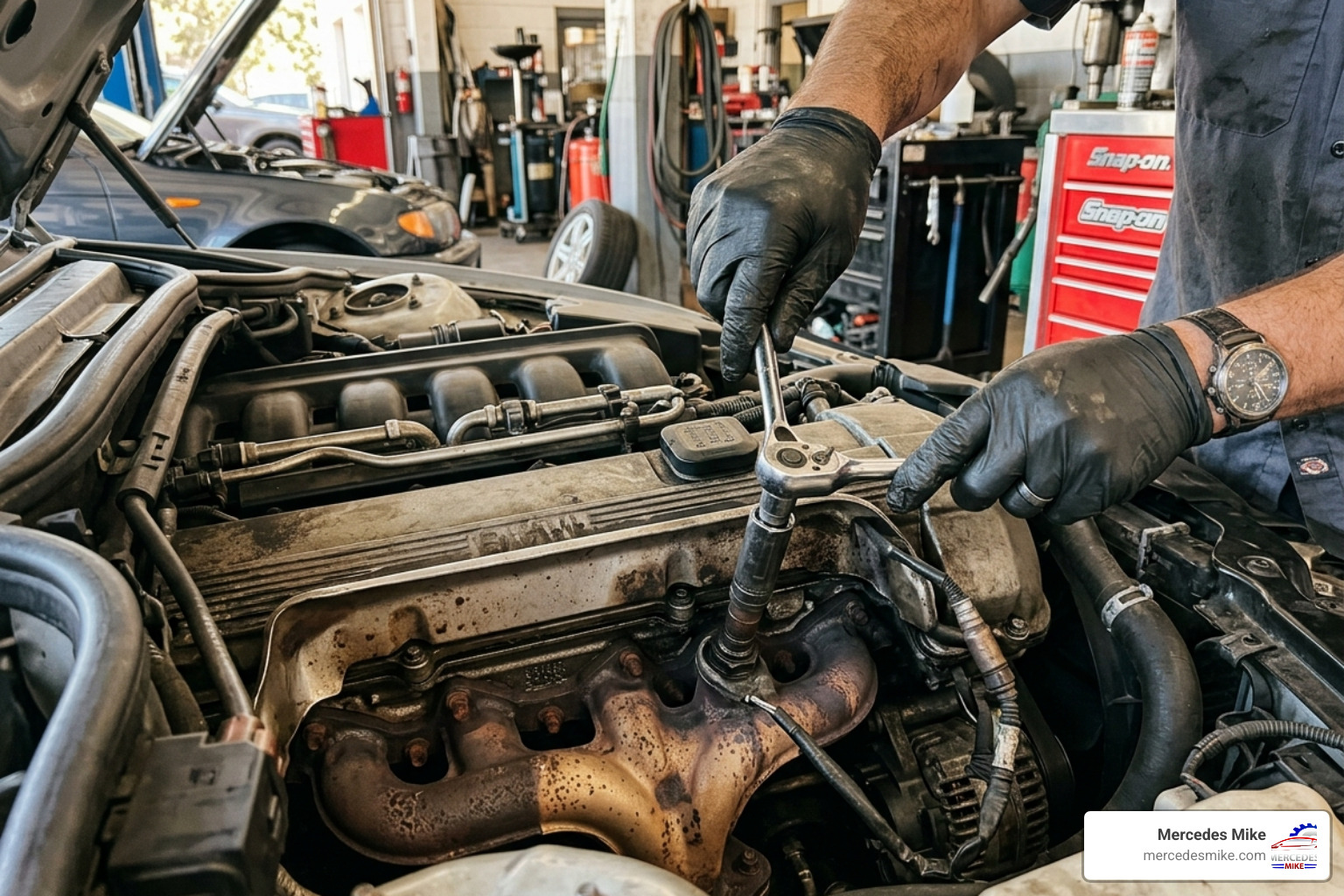
Locate and Label: On an E46, the upstream sensors are visible from the top of the engine bay near the exhaust manifolds. The downstream sensors require lifting the car. Label your connectors! You don't want to plug Bank 1's sensor into Bank 2's harness.
Disconnect the Harness: Unclip the plastic electrical connector first. This prevents the wires from twisting and breaking as you unscrew the sensor.
The "Big Break": Use your O2 sensor socket and ratchet to loosen the sensor. If it's stuck, spray it with penetrant and let it sit for 20 minutes. A quick "snap" of force is usually better than a slow pull.
Prepare the New Sensor: Remove the protective cap. Do not touch the sensor tip. If it didn't come with anti-seize, apply a very small amount to the threads only. If you get it on the sensor tip, you'll ruin it before you even start the car.
Thread by Hand: Always start the threads by hand to avoid cross-threading the expensive exhaust manifold. Once snug, torque it to approximately 30 lb-ft (40 Nm).
Cable Management: Reroute the wire exactly as the old one was. Use zip ties to keep the wire away from the hot exhaust pipes. A melted wire will cause an immediate short and a new check engine light.
Final Steps for bmw 325i oxygen sensor replacement
Once the sensors are in, the job isn't quite over. Your BMW's ECU has "learned" to compensate for the old, failing sensors. Use your scan tool to clear the fault codes. On newer models, it is also highly recommended to "Reset Fuel Adaptations." This tells the computer to start fresh with the new data. Take the car for a 15-minute test drive to ensure the "Emissions Readiness" monitors set to green.
Maintenance Intervals and Brand Recommendations
We are often asked how long these parts should last. In BMW, we follow two general rules of thumb:
Pre-1996 Models: These unheated or early-heated sensors are less efficient and should be replaced every 60,000 miles.
1996 and Newer (OBD-II): These advanced sensors can last 100,000 miles or more, though they often begin to "slow down" and lose accuracy around the 90k mark.
Treating this as preventative maintenance can actually save you money in fuel costs over time. For more ways to keep your Bimmer at peak performance, check out The Top 5 Performance Upgrades for Your German Car.
Recommended Brands and Part Numbers
BMW doesn't make their own sensors; they source them from top-tier manufacturers. We recommend sticking with these OEM-equivalent brands to ensure the ECU recognizes the signal:
Bosch: The inventor of the O2 sensor. Part #15510 is a very popular fitment for the 325i.
NTK (NGK): The world’s largest OEM supplier. Part #23162 is a highly reliable choice.
DENSO: Known for extreme resistance to contamination. Part #234-4668 is a great aftermarket alternative.
Avoid "universal" sensors that require you to cut and splice wires. These often have different resistance levels that can drive the BMW ECU crazy.
Cost Breakdown: DIY vs. Professional
Is it worth doing yourself? Let’s look at the numbers.
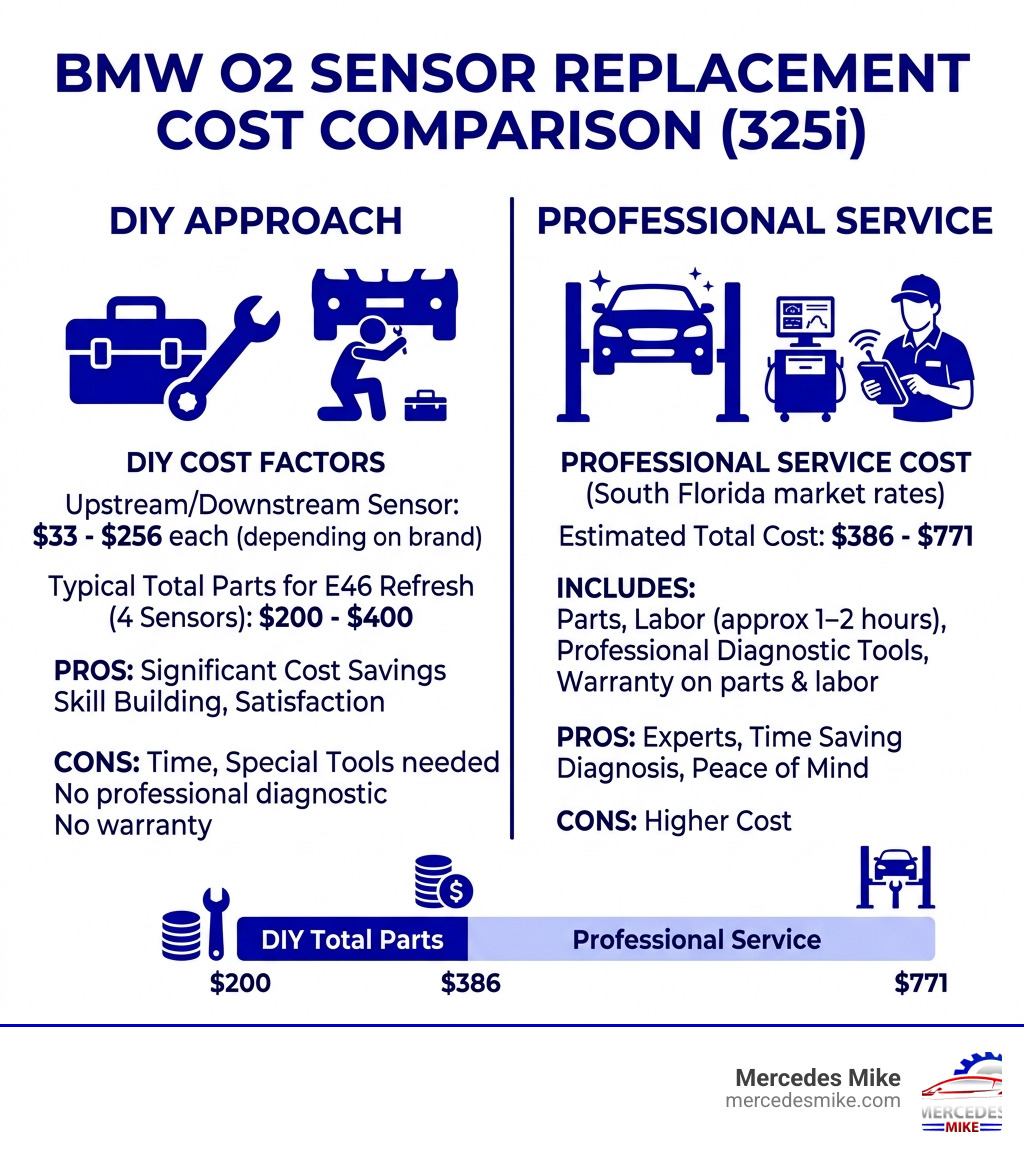
DIY Path: You can find sensors ranging from $33 to $256 depending on the brand and whether it's upstream or downstream. Total parts for a full E46 refresh (4 sensors) usually land between $200 and $400.
Professional Path: According to South Florida market rates, a bmw 325i oxygen sensor replacement typically costs between $386 and $771. This includes parts, labor (usually 1–2 hours), and the peace of mind that comes with professional diagnostic tools and a warranty.
Frequently Asked Questions about BMW O2 Sensors
Can I drive my 325i with a bad oxygen sensor?
Yes, the car will still drive, but it’s not ideal. The ECU will enter a "limp" or "default" mode where it uses pre-set fuel maps rather than real-time data. This results in poor performance, wasted fuel, and increased pollution. Long-term, you risk clogging your catalytic converter.
How do I know if it's the sensor or the catalytic converter?
This is where a professional scan tool is vital. We look at the "live data" graph. An upstream sensor should oscillate like a wave (0.1V to 0.9V). A downstream sensor should show a relatively steady voltage if the catalytic converter is doing its job. If the downstream sensor is oscillating just like the upstream one, your catalytic converter is likely dead.
Why is my new oxygen sensor throwing a code?
This is a common frustration! If you just finished a bmw 325i oxygen sensor replacement and the light is still on, check these three things:
Adaptations: Did you reset the fuel adaptations?
Vacuum Leaks: BMWs are famous for cracked rubber intake boots. A vacuum leak will cause a "Lean" code that a new sensor cannot fix.
Contamination: Did you get anti-seize or silicone on the sensor tip? Even a tiny amount can "poison" the sensor immediately.
Conclusion
Your BMW 325i was engineered for a rewarding driving experience, but it needs accurate data to deliver that performance. Whether you are tackling a bmw 325i oxygen sensor replacement in your own driveway in Deerfield Beach or bringing it to us in Pompano Beach, keeping these sensors fresh is the key to a long-lived engine.
At Mercedes Mike, we specialize in German car maintenance for the South Florida community. Our decades-experienced technicians use the latest diagnostic tools to ensure your BMW runs exactly as the engineers in Munich intended. Don't let a $50 part turn into a $2,000 catalytic converter repair.
If you're feeling overwhelmed by fault codes or just want the job done right the first time, we're here to help. More info about BMW repair services can be found on our service page, or stop by our shop on NE 41st Court to chat with our team. Safe driving!