
Mercedes C350 CDI Tuning: Is a Stage 1 Remap Worth It?
What a C350 CDI Remap Can Do for Your Mercedes
A C350 CDI remap is one of the most cost-effective ways to unlock the hidden performance in your W204 Mercedes. From the factory, Mercedes deliberately leaves power on the table — and a Stage 1 ECU remap lets you take it back.
Quick answer: What does a C350 CDI remap deliver?
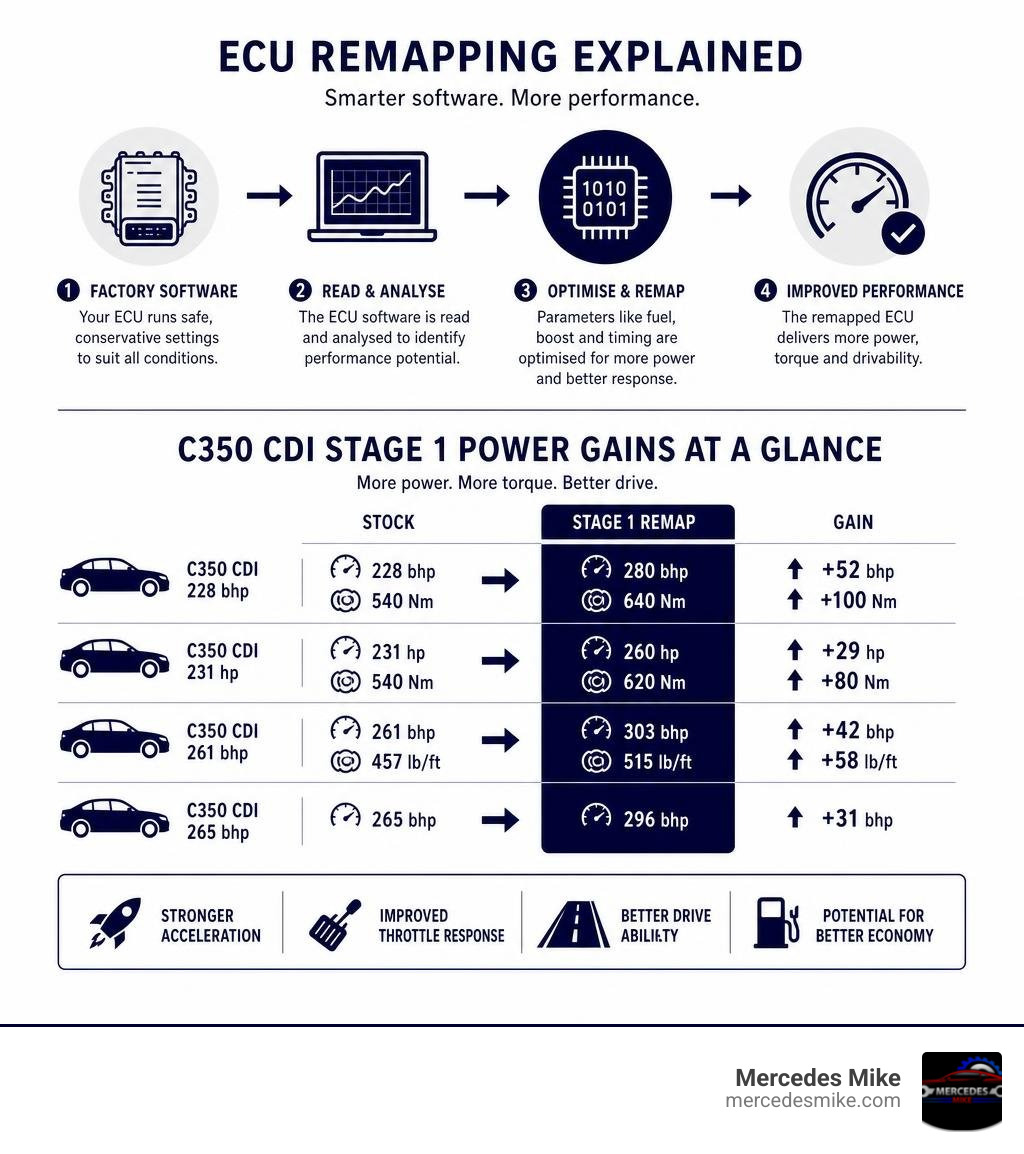
Variant Stock Power Remapped Power Gain C350 CDI 228 bhp 228 bhp / 540 Nm 280 bhp / 640 Nm +52 bhp / +100 Nm C350 CDI 231 hp 231 hp / 540 Nm 260 hp / 620 Nm +29 hp / +80 Nm C350 CDI 261 bhp 261 bhp / 457 lb/ft 303 bhp / 515 lb/ft +42 bhp / +58 lb/ft C350 CDI 265 bhp 265 bhp 296 bhp +31 bhp
A remap works by rewriting the software inside your car's ECU — adjusting fuel delivery, boost pressure, and other parameters to squeeze out the power the engine was always capable of producing.
The results go beyond raw numbers. Owners consistently report smoother acceleration, better throttle response, and — perhaps surprisingly — improved fuel economy on motorway runs. One owner documented 52.3 mpg on a 120-mile motorway run after a remap with zero hardware changes.
But is it worth it for your C350 CDI? And what are the real risks? That's exactly what this guide covers.
What is a c350 cdi remap and How Does It Work?
To understand how a c350 cdi remap transforms your car, we first have to look at how modern diesel engines are controlled. Your Mercedes-Benz W204 C350 CDI does not rely on mechanical linkages to decide how much fuel or air enters the combustion chambers. Instead, every single parameter is dictated by a specialized computer known as the Engine Control Unit (ECU).
Specifically, the C350 CDI models utilize highly sophisticated Bosch ECU systems, such as the Bosch EDC17CP01 or EDC17CP10. From the factory, these ECUs are loaded with software designed for a "lowest common denominator" market. Mercedes-Benz must ensure their cars run reliably whether they are operated on low-quality fuel in extreme sub-zero temperatures or driven hard in dusty desert environments. Additionally, vehicles are tuned to meet strict fleet emission categories and insurance brackets.
This means your engine is heavily detuned from the factory. ECU tuning, or remapping, is the process of modifying the software maps stored within this Bosch ECU. By recalibrating these digital maps, professional tuners can optimize several key operating variables:
Boost Pressure: Increasing the amount of air forced into the cylinders by the turbocharger.
Fuel Mapping: Adjusting the volume and timing of diesel injected into the combustion chamber to match the increased airflow.
Torque Limiters: Raising the software-enforced limits that restrict how much twisting force the engine is allowed to produce at specific RPM ranges.
Injection Timing: Optimizing exactly when the fuel is injected to ensure the most complete and efficient burn possible.
By safely altering these parameters, a custom remap releases the latent power of your engine without needing to swap out any physical components. To see where remapping fits in the broader landscape of vehicle modifications, take a look at our guide on The Top 5 Performance Upgrades for Your German Car.
The Mechanics of a c350 cdi remap
At the heart of the C350 CDI is the legendary OM642 engine. This is a 3.0-liter, 72-degree V6 diesel engine featuring a variable-geometry turbocharger (VGT) and a high-pressure common-rail injection system.
During a professional c350 cdi remap, a technician connects specialized hardware to your car—either through the OBD-II diagnostics port located under the dashboard or by directly interfacing with the Bosch ECU on a bench. The original software file is extracted and backed up so that the vehicle can always be reverted to 100% stock if necessary.
The tuner then modifies the specific maps controlling rail pressure, injection duration, turbo boost targets, and torque limits. Because the OM642 engine is built with incredibly robust internal components—including a forged crankshaft and heavy-duty pistons—it handles these software adjustments with ease. The variable-geometry turbocharger is commanded to spool slightly quicker, sharpening throttle response and virtually eliminating the frustrating turbo lag that plagues the stock vehicle.
Expected Power Gains and Tuning Methods
The OM642 engine was released in several different power outputs over its production run. Because of this, the performance gains you can expect from a Stage 1 remap depend heavily on which factory version of the C350 CDI you own.
Below is a detailed breakdown of the typical power and torque gains across the different variants:
Engine Version / Stock Output Stage 1 Remapped Power Average Horsepower Gain Average Torque Gain 211 HP / 540 Nm ~280 HP / 600 Nm +69 HP +60 Nm 224 PS / 510 Nm ~282 PS / 592 Nm +58 PS +82 Nm 228 BHP / 540 Nm ~280 BHP / 640 Nm +52 BHP +100 Nm 231 HP / 540 Nm ~260 HP / 620 Nm +29 HP +80 Nm 261 BHP / 457 lb/ft ~303 BHP / 515 lb/ft +42 BHP +58 lb/ft 265 BHP / 457 lb/ft ~296 BHP / 530 lb/ft +31 BHP +73 lb/ft
To see how these specific files are structured for different base power levels, you can explore the technical data sheet for the Remapping file for Mercedes-Benz C Meredes-Benz 350 DI 211hp | Puretuning . If you have the mid-generation 227 bhp variant, you can learn more about its specific file structures via Mercedes Benz C Class C350 CDI 227 bhp 2007-now Diesel Engine ECU Remap - The Remap Link .
For those running the 231 HP model, the software calibration details can be reviewed at Remapping Mercedes-Benz C 350 CDI 231HP 4346 | +29 CV . Finally, if you drive the older 228 BHP version, you can view the typical performance gains outlined by Mercedes-Benz C350 - 3.0 CDI - 228-BHP (04/2007 - 03/2011) | ECU Remap | DSG/TCU Tuning | Chip Tuning | DPF Solution | EGR Solution - Quantum Tuning .
Why a custom c350 cdi remap is superior to a tuning box
When researching how to add power to your Mercedes, you will undoubtedly run into plug-and-play tuning boxes. These devices connect inline with your engine's sensors—usually the fuel rail pressure sensor and the boost pressure sensor—and intercept the signals before they reach the ECU.

While options like the TDI Tuning - Mercedes-Benz C350 CDI CRTD4 TWIN Channel Diesel Tuning Box Chip offer an easy install process and are popular for leased vehicles due to their traceless removal, they have significant technical limitations compared to a true custom ECU remap:
Signal Manipulation vs. Direct Control: A tuning box works by "tricking" the ECU. For example, it might tell the ECU that fuel rail pressure is lower than it actually is, forcing the ECU to pump in more fuel. A custom remap directly recalibrates the ECU's internal logic, allowing for precise control over injection timing, boost targets, and torque limits.
Safety Margin Awareness: Because a tuning box hides the real sensor values from the ECU, the engine's built-in safety features may not know when parameters are getting dangerously high. A custom remap keeps all factory safety limits intact and active.
Transmission Protection: Modern Mercedes gearboxes communicate constantly with the engine ECU. A custom remap updates the torque values transmitted to the gearbox, ensuring smoother shifts and preventing clutch slippage. A tuning box cannot do this, which can cause rough shifting and premature transmission wear.
Real-World Performance and Dyno Results
On paper, horsepower and torque numbers are great, but how do they translate to the road?
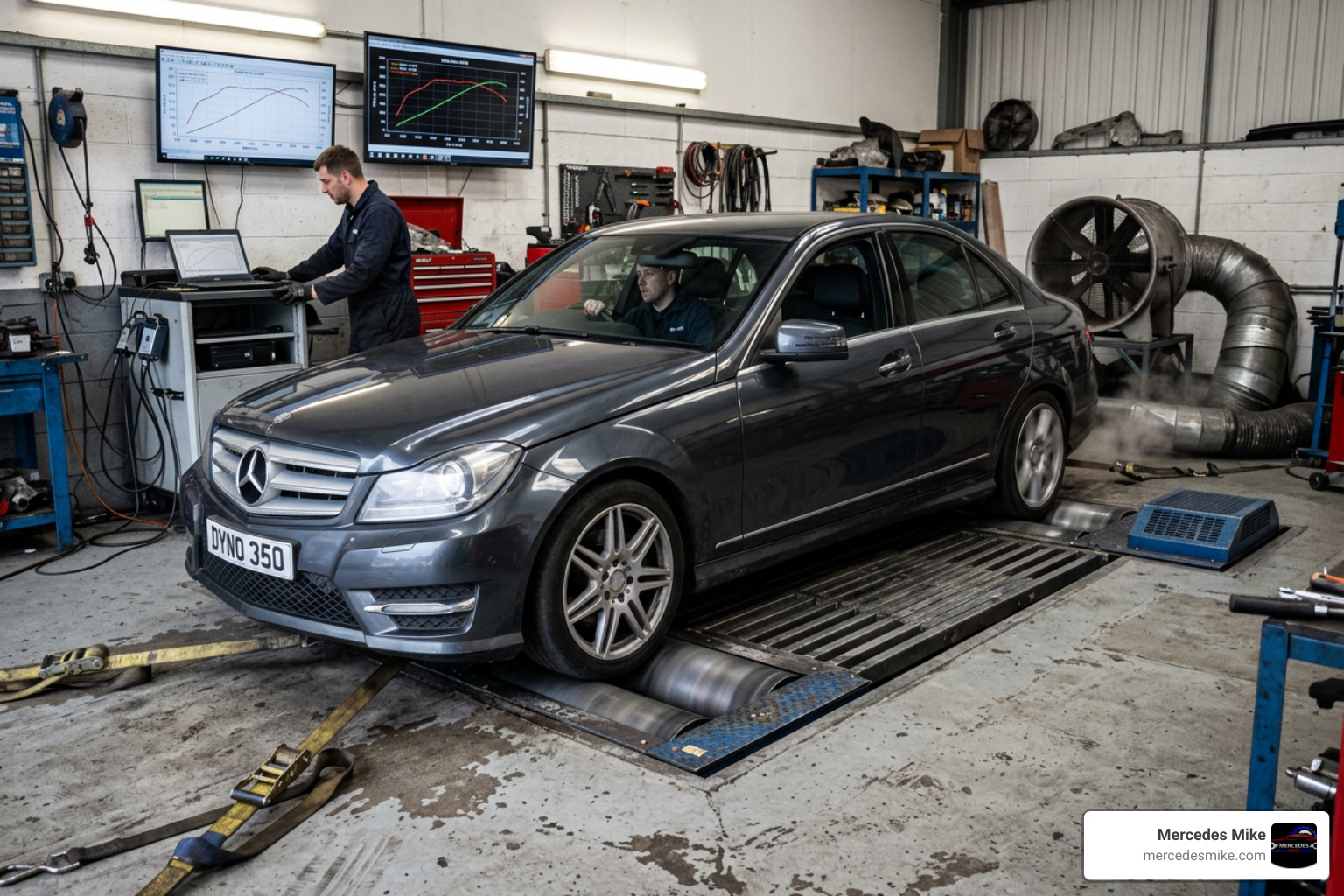
When measured on a professional rolling road chassis dynamometer (dyno), a stock 2012 C350 CDI (factory rated at 265 bhp and 457 lb/ft) often displays higher real-world figures than advertised. Enthusiasts on online forums have noted that these engines are frequently underrated by Mercedes. On the dyno, a healthy stock C350 CDI can put down close to 290 bhp at the flywheel.
With a professional Stage 1 software remap, these numbers climb dramatically. Real-world dyno sheets regularly show figures reaching 328 bhp and an astonishing 530 lb/ft of torque at the flywheel. This translates to roughly 278 wheel horsepower (WHP) and 450 lb/ft of wheel torque.
The result is a diesel sedan that pulls like a freight train, offering mid-range acceleration that can easily keep pace with serious sports cars while maintaining civil daily drivability.
Safety, Reliability, and Supporting Modifications
Is remapping a C350 CDI safe? The short answer is yes, provided the engine is in good health and the map is written by an experienced professional. However, pushing more power through any mechanical system will naturally increase stress on its components.
The OM642 engine itself is incredibly robust, but you must pay close attention to the auxiliary systems:
The Transmission: The 7G-Tronic and 7G-Tronic Plus automatic gearboxes are highly reliable, but they do have torque limits. A high-quality Stage 1 remap keeps torque levels within the safe mechanical limits of these transmissions (usually around 700 to 750 Nm).
The Emission System (DPF & EGR): Diesel Particulate Filters (DPF) and Exhaust Gas Recirculation (EGR) valves are common failure points on high-mileage diesels. If a remap is poorly written and injects too much fuel, it will produce excessive soot, quickly clogging the DPF. Keeping your DPF and EGR clean and functioning is critical. You can read more about managing these components at Mercedes C350 CDI W204 ECU Remap - DPF Removal .
General Maintenance: Before tuning your car, you must ensure it has no underlying issues. Weak sensors, worn injectors, or small boost leaks will be amplified once the engine is running higher boost pressures. To learn what else to keep an eye on, read our breakdown of The Most Common Problems with German Cars and How to Prevent Them.
Recommended Supporting Upgrades
While a Stage 1 remap is designed to run safely on an entirely stock car, there are a few supporting modifications that can elevate the driving experience and ensure long-term reliability:
Transmission Remap (TCU Tuning): Tuning the Transmission Control Unit (TCU) matches the shift points and clutch clamping pressures to the engine’s new torque curve, making gear changes faster and smoother.
Upgraded Braking Systems: With significantly more speed on tap, upgrading to high-performance brake pads and slotted rotors is a smart safety measure to prevent brake fade.
Suspension Upgrades: A set of quality lowering springs or sport dampers helps keep the chassis composed when deploying over 500 lb/ft of torque through the rear wheels.
Cabin Climate Comfort: While you are upgrading your vehicle's performance, do not overlook your driving comfort under the hot Florida sun. Ensure your air conditioning system is blowing ice-cold by scheduling a Mercedes Air Conditioning Service.
Frequently Asked Questions about C350 CDI Tuning
How does a remap affect the fuel economy of a C350 CDI?
One of the greatest benefits of remapping a large-displacement turbo-diesel is the impact on fuel efficiency. Because a remap optimizes the torque curve, the engine produces more low-end power. This allows the automatic transmission to shift into higher gears earlier and stay there longer, reducing overall engine RPMs during normal driving.
Under normal driving styles, owners frequently report seeing a noticeable increase in fuel economy. On long motorway runs, remapped C350 CDI vehicles regularly achieve between 49.6 and 52.3 mpg, making it a rare performance modification that can actually pay for itself over time. You can read real owner experiences regarding these efficiency gains in the C350 CDI remap | Performance Lounge | MBClub UK .
Will remapping my C350 CDI void my warranty or cause engine damage?
Yes, an ECU remap can potentially void a manufacturer or aftermarket vehicle warranty if the provider detects the modified software. If your vehicle is still under warranty, you should carefully weigh this risk.
In terms of physical engine damage, a properly calibrated Stage 1 remap that stays within the safe mechanical limits of the OM642 engine is highly unlikely to cause issues. However, generic "cheap" maps that simply dump fuel into the cylinders can cause excessive exhaust gas temperatures (EGTs), melted pistons, and clogged emission systems. For a deeper dive into the reliability of these vehicles and owner discussions on the topic, check out the C350 remap | Mercedes-Benz Owners' Forums .
How much does a professional Stage 1 remap cost?
The cost of a professional Stage 1 remap typically ranges from $400 to $800, depending on several factors:
Custom vs. Generic Software: A generic "flash" map is cheaper but does not account for your specific engine's wear or local fuel quality. A custom calibration written specifically for your car is highly recommended.
Dyno Time: Having your car tuned on a rolling road dyno with real-time data logging adds to the cost but guarantees that the air-fuel ratios, boost pressures, and exhaust temperatures are perfectly safe.
Tuner Reputation: Choosing an established shop with deep expertise in Mercedes-Benz vehicles ensures you are getting a reliable, thoroughly tested product.
Conclusion
A Stage 1 remap completely transforms the Mercedes C350 CDI, turning a sensible, comfortable cruiser into an absolute torque monster that still returns incredible fuel economy. When executed correctly by experienced professionals, it is hands-down the best performance investment you can make for the platform.
At Mercedes Mike, located in Pompano Beach, Florida, we specialize in high-quality maintenance, repairs, and performance optimization for German vehicles. Our team of decades-experienced technicians uses the latest diagnostic tools and software to ensure your Mercedes runs at its absolute peak.
Whether you need a trusted Certified Mercedes-Benz Mechanic to inspect your car before tuning, or you are looking for premier Independent Mercedes Repair services in South Florida (serving Pompano Beach, Deerfield Beach, and the surrounding areas), we are here to help.
Ready to experience your Mercedes the way it was truly meant to be driven? Schedule a professional consultation or service with our expert team today!