Why Custom Diesel ECM Tuning Beats a Standard FICM Flash
Your Diesel Engine Is Holding Back — ECM Tuning Changes That
Diesel ECM tuning is the process of modifying the software inside your engine's control module to unlock better power, fuel efficiency, and throttle response than your factory settings allow.
If you want the short version, here's what you need to know:
What You Want | What ECM Tuning Delivers |
|---|---|
More power | +40 to +150 HP gains |
Better torque | +100 to +400+ lb-ft across the RPM range |
Fuel savings | 0.8 to 1.2 MPG improvement on average |
Faster ROI | Break-even in as little as 3 to 6 months |
Cleaner combustion | Up to 40% reduction in NOx emissions |
The reason this matters is simple. Manufacturers program diesel engines conservatively from the factory. They build in wide safety margins to cover every driver, every climate, and every emissions standard in one single tune. That means your engine — whether it's a Cummins, a Detroit, or a Mercedes-Benz diesel — is almost certainly running below its real capability.
A standard FICM flash applies a generic fix. A custom ECM tune is calibrated specifically to your engine, your load, and how you actually drive.
The difference in real-world performance and long-term savings is significant — and that's exactly what this guide walks you through.
Understanding the Mechanics of Diesel ECM Tuning
To understand diesel ecm tuning, we first have to look at the Engine Control Module (ECM) as the "brain" of your vehicle. In modern diesel engines, this computer is responsible for every single heartbeat of the motor. It regulates how much fuel is sprayed into the cylinders, exactly when that fuel is ignited, and how much air the turbocharger forces into the system.

When we perform Expert ECM Tuning for Diesel Engines, we aren't physically changing parts; we are rewriting the logic that governs them. By adjusting the fuel mapping and turbo boost pressure, we can ensure that every drop of diesel is used as efficiently as possible. This is particularly vital in high-pressure common rail (HPCR) systems, where precision timing can be the difference between a sluggish response and a powerhouse performance.
We focus on several key parameters during a tune:
Fuel Injection Timing: Adjusting when the fuel enters the combustion chamber to ensure a more complete burn.
Air-Fuel Ratio: Optimizing the mix of oxygen and diesel to prevent "rich" or "lean" conditions that waste energy.
Turbo Boost Pressure: Increasing the volume of air to support higher power demands without overheating the engine.
Ignition Timing: Fine-tuning the start of the combustion cycle for maximum torque.
Common Methods for Diesel ECM Tuning
Not all tuning is created equal. Depending on your goals and your vehicle's make, we generally see four main methods used in the industry today:
Remapping/Flash Tuning: This is the gold standard. We connect directly to the OBDII port or the ECM itself to overwrite the factory software with a custom-engineered calibration. It is seamless, highly precise, and leaves no physical footprint under the hood.
Chip Tuning: An older method where the physical memory chip inside the ECM is replaced. While effective for older engines, it’s less common in the high-tech diesel units we service today.
Piggyback Modules: These are external boxes that sit between the ECM and the engine sensors. They "trick" the computer into providing more fuel or boost. While convenient, they lack the deep integration of a full remap.
Standalone ECUs: This involves replacing the factory computer entirely. This is usually reserved for extreme performance builds or racing applications where total control over every sensor is required.
Supporting Modifications for Diesel ECM Tuning
While diesel ecm tuning can work wonders on a stock engine, we often recommend supporting modifications to help you get the most out of your new software. If you're pushing for significant horsepower gains, your hardware needs to be able to handle the extra heat and flow.
Upgraded Intercoolers: More power means more heat. A high-efficiency intercooler keeps intake air temperatures low, protecting your engine.
High-Flow Injectors: For those seeking the +150 HP range, larger injectors ensure the fuel system can keep up with the new demand.
Exhaust Systems: Reducing backpressure allows the turbo to spool faster and helps lower Exhaust Gas Temperatures (EGTs).
Sensors and Gauges: We strongly recommend EGT sensors and boost gauges for anyone running aggressive tunes. Monitoring these levels ensures you stay within safe operating limits during heavy hauls.
Custom Tuning vs. Standard FICM Flashes: Why Precision Matters
In diesel performance, you’ll often hear about "FICM flashes." The Fuel Injection Control Module (FICM) is a specific component (common on Ford Powerstrokes, for example) that drives the injectors. A standard flash usually just updates the voltage or basic timing to fix cold-start issues or factory bugs.
However, a standard flash is a "one-size-fits-all" band-aid. It doesn't account for your specific driving habits, the weight you carry, or the terrain of South Florida. Diesel ecm tuning, specifically custom remapping, is a surgical approach.
Feature | Generic FICM Flash | Custom ECM Remapping |
|---|---|---|
Approach | Mass-produced software | Tailored to your VIN and Serial Number |
Throttle Lag | Often remains | Significantly reduced or eliminated |
Power Delivery | Peak-focused only | Smooth across the entire RPM range |
Adaptability | None | Accounts for mods like bigger turbos |
Efficiency | Minor improvement | Maximum possible MPG gains |
Tuning and ECU Remapping: Maximizing Diesel Engine Efficiency shows that factory detuning is real. Manufacturers often limit an engine's output so they can sell a higher-horsepower version of the same motor for more money. Custom tuning unlocks what you’ve already paid for.
Supported Engine Platforms
Whether you are running a heavy-duty truck for work or a high-end German diesel for daily commuting, most modern platforms are ripe for optimization. We see incredible results across a wide range of engines:
Cummins: Including the X15, ISX series, and the legendary 6.7L.
Mercedes-Benz: From the Sprinter vans to the high-torque OM series found in heavy trucks.
Caterpillar & Detroit Diesel: The backbones of American logistics, often seeing the highest ROI from fuel savings.
Paccar & International: Commonly tuned to improve reliability and hill-climbing torque.
The Economic Advantage: ROI and Fuel Efficiency
For fleet owners and independent operators in Pompano Beach and Deerfield Beach, diesel ecm tuning isn't just about going fast—it’s a financial strategy. With fuel prices constantly fluctuating, a 5-10% improvement in fuel efficiency can change your bottom line overnight.
Industry data shows that for a fleet of 100 trucks, a 5-10% fuel efficiency gain can translate to annual savings of $150,000 to $300,000 (assuming $3/gallon and 100,000 miles per truck). Even for a single truck, achieving an extra 0.8 to 1.2 MPG can result in $3,000 to $8,000 in additional annual revenue.
Most of our clients see a "break-even" point on their tuning investment within 3 to 6 months. After that, the fuel savings are pure profit. This happens because optimized combustion means the engine doesn't have to work as hard to move the same load. By adjusting the idling parameters and reducing engine load through smarter turbo management, we stop wasting energy as heat and start using it as motion.
Real-World Performance Gains
What does this feel like from the driver's seat? It's a "night and day" difference.
Horsepower: Expect gains from +40 HP for economy tunes up to +150 HP for performance builds.
Torque: This is where diesel shines. Increases of +100 to +400 lb-ft are common, allowing you to hold higher gears on inclines without downshifting.
Throttle Response: We remove the factory-programmed "dead spot" in the pedal. When you press the gas, the truck moves—no more waiting for the computer to decide if it's okay to give you power.
Towing: Heavily loaded trailers feel lighter, and merging into South Florida highway traffic becomes much safer and less stressful.
Safety, Compliance, and Engine Longevity
A common myth is that tuning "kills" engines. In reality, a well-optimized tune can actually extend engine life. By improving combustion efficiency, you reduce the amount of unburnt fuel (soot) that enters your oil and clogs your filters.
Modern diesel ecm tuning also focuses heavily on emissions. Properly optimized fuel injection can lower nitrogen oxides (NOx) emissions by up to 40%. While some "delete" tunes are illegal for street use, we focus on performance tuning that works with your emissions equipment, ensuring you stay EPA and CARB compliant while still enjoying the benefits of a custom map.
Furthermore, professional tuning reduces thermal stress. By managing the air-fuel ratio more precisely, we can actually lower peak combustion temperatures, protecting your head gaskets and pistons from the heat-related wear common in "stock" engines pushed to their limits.
The Professional Tuning Process
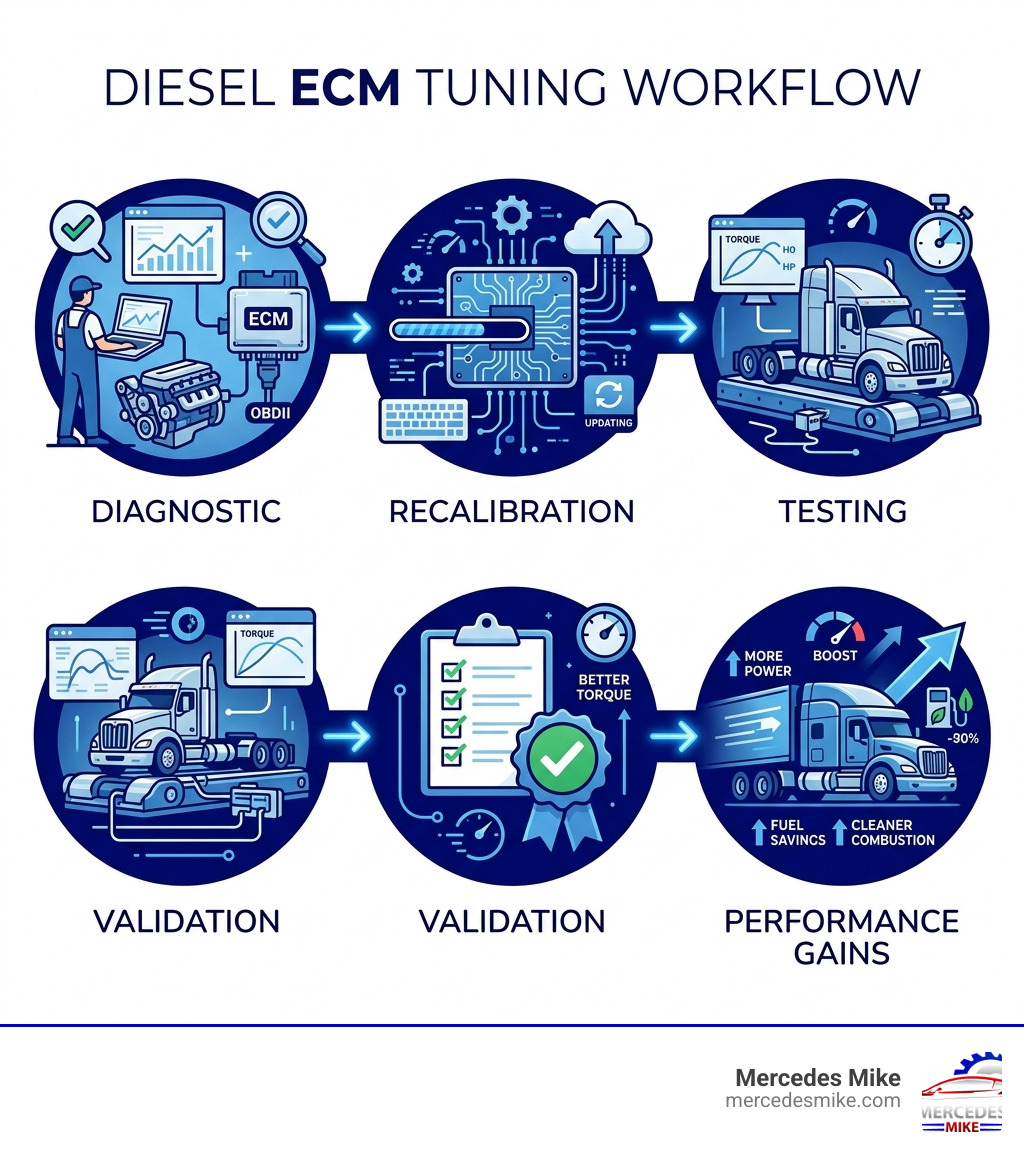
We don't just "plug and play." Our process is rigorous:
Diagnostic Assessment: We scan for existing codes. You should never tune an engine that has underlying mechanical issues.
Baseline Data Collection: We record how the truck performs in its current state, including fuel trims and boost levels.
Software Recalibration: Our technicians modify the maps based on your specific needs—whether that’s maximum MPG for long hauls or maximum torque for heavy equipment.
Real-World Testing: We verify the changes under load to ensure EGTs and pressures remain in the safe zone.
Final Validation & Documentation: We provide you with a record of the changes, and we always keep a backup of your original factory file.
Frequently Asked Questions about Diesel ECM Tuning
Is diesel ECM tuning reversible?
Yes, absolutely. Because diesel ecm tuning is software-based, it is entirely reversible. We maintain a secure backup of your original factory settings. If you ever need to return the vehicle to its stock configuration for resale or specific dealership service, we can flash the original file back onto the ECM in about 2-4 hours.
Does tuning void my manufacturer warranty?
This is a nuanced topic. While the Magnuson-Moss Warranty Act protects consumers, a manufacturer can deny a warranty claim if they can prove the tune specifically caused the failure. However, many of our custom tunes are designed to stay within the manufacturer's own component tolerances. We always recommend choosing a reputable provider who offers service guarantees and prioritizes engine safety over raw numbers.
How often should an ECM be re-tuned?
Most drivers only need to tune their vehicle once. However, you should consider a re-tune if you perform major hardware upgrades (like a larger turbo or different injectors) or if you notice a significant change in performance after a major repair. Some fleet owners also opt for seasonal adjustments if they move between significantly different climates or altitudes.
Conclusion
At the end of the day, your diesel engine is a masterpiece of German or American engineering that has been "detuned" for the masses. Custom diesel ecm tuning is the key to unlocking the power, efficiency, and longevity that the factory left on the table. Whether you're looking to save thousands on your annual fuel bill or you just want your truck to pull that trailer without breaking a sweat, a custom calibration is a wise investment.
At Mercedes Mike, we bring decades of experience and the latest diagnostic tools to every job. We specialize in the high-stakes world of German automotive performance, ensuring that your Mercedes-Benz, BMW, or Audi diesel gets the same precision care we give to heavy-duty commercial rigs.
If you’re in Pompano Beach, Deerfield Beach, or anywhere in South Florida and you're ready to stop settling for "stock" performance, come see us. We’ll help you transform your engine into the powerhouse it was always meant to be.