
A Guide to Fixing Steering Rack Play
When Your Steering Wheel Feels Loose: What It Means and What to Do
If you need to fix play in your steering wheel, here's the short answer:
Measure the play — more than 1 to 1.5 inches of wheel movement before the front wheels respond is excessive.
Check the easy stuff first — inspect tie rod ends, ball joints, and steering column bolts for wear or looseness.
Adjust or replace — tighten the steering gearbox adjustment screw, or replace worn tie rods, couplers, or ball joints.
Get an alignment — always perform a wheel alignment after any steering repair.
See a professional — steering rack replacement or EPS issues on German vehicles require expert diagnosis.
Steering is one of the most safety-critical systems on your car. Yet it's easy to ignore a little looseness — until it gets worse.
Here's the reality: any steering wheel movement that doesn't immediately turn your front wheels is called free play. A small amount is normal. But once that dead zone grows past about an inch at the rim of the wheel, something is worn out.
For owners of German luxury vehicles like Mercedes-Benz and BMW, this matters even more. These cars are engineered for precise, connected steering feel. When that sharpness fades — when the wheel feels vague or floaty — it's not just annoying. It's a warning sign.
The good news? Many causes of steering play are diagnosable at home, and some fixes are straightforward DIY jobs. Others, particularly on modern vehicles with electronic power steering, need professional attention.
This guide walks you through both.
Understanding Steering Wheel Play and Its Symptoms
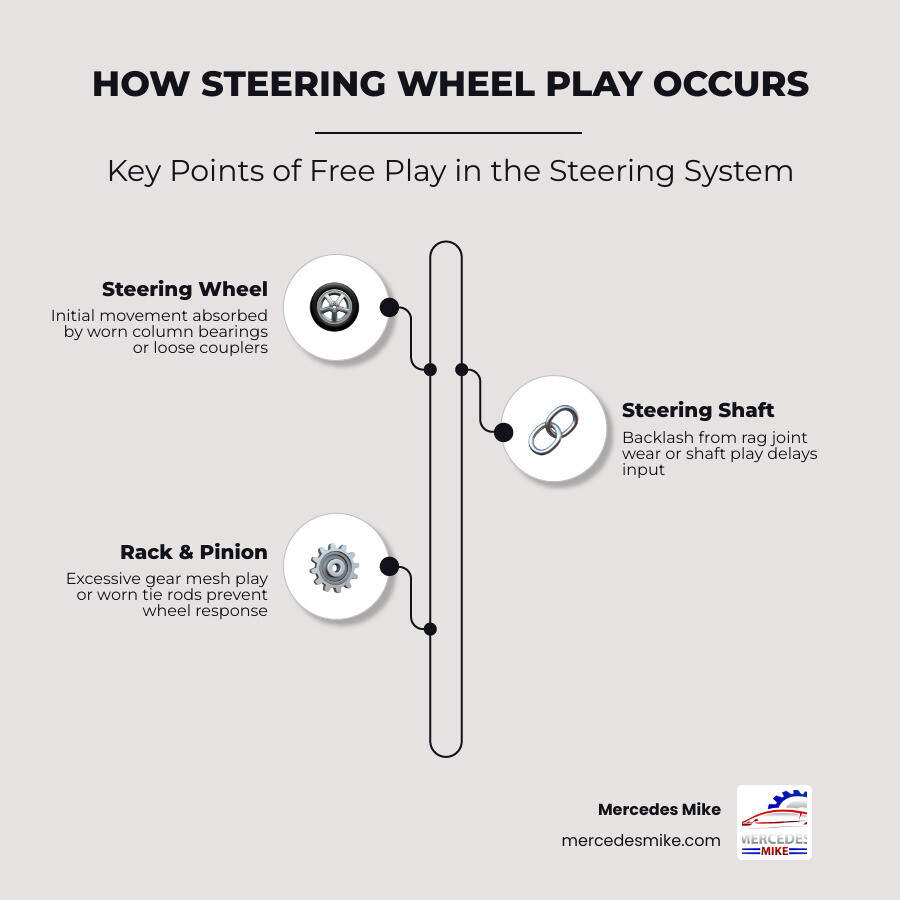
When we talk about "play," we are referring to the "dead zone" in your steering wheel. Imagine you are driving down N Dixie Hwy in Pompano Beach; you turn the wheel slightly to the left, but the car continues to track straight for a split second before finally responding. That delay is play.
The 1.5-Inch Threshold
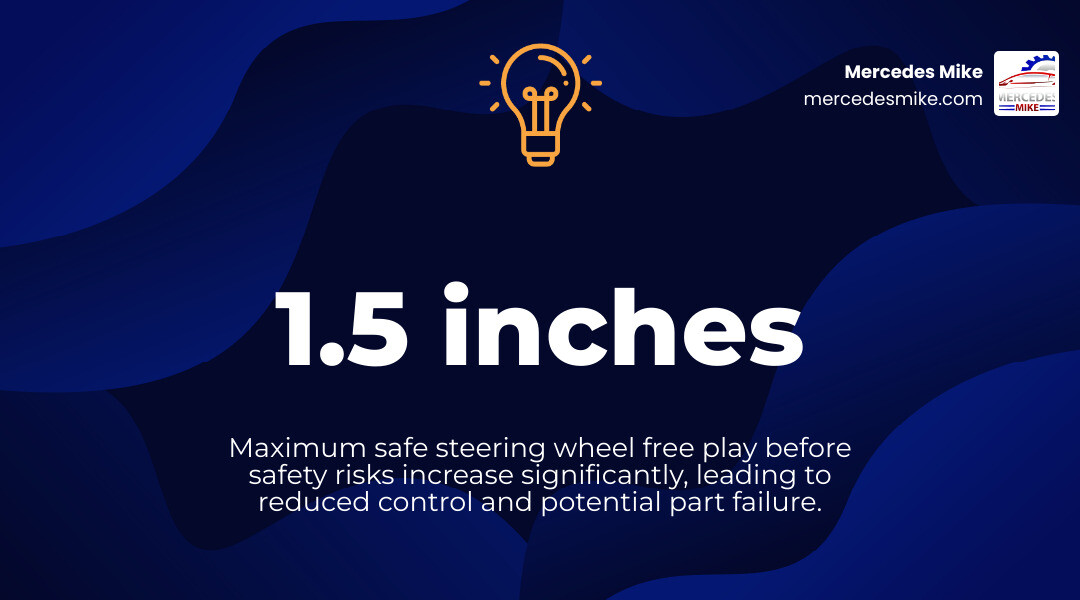
How much play is too much? In the automotive world, the industry standard is fairly clear: you should not be able to turn the steering wheel more than 1 to 1.5 inches (measured at the rim) without the front wheels moving. If you can wiggle the wheel two inches or more while the vehicle is stationary and the tires don't budge, you have a serious problem. Some drivers report "dead zones" of 4 to 5 inches, which is not just excessive—it is a recipe for a collision.
Common Symptoms to Watch For
Identifying the need to fix play in steering wheel usually starts with one of these symptoms:
Vehicle Wandering: This is the most common sign. You find yourself constantly "sawing" at the wheel just to keep the car in its lane. The car feels like it has a mind of its own, drifting left or right.
Uneven Tire Wear: If your steering components are loose, your tires won't maintain the correct angle against the road. You’ll often see "feathering" or excessive wear on the outside edges of the tread.
Steering Wheel Shimmy: A loose connection in the linkage can cause the wheel to vibrate or shake, especially at highway speeds.
Knocking or Popping Noises: If you hear a "clunk" when turning or hitting a bump, it’s a sign that a joint (like a tie rod or ball joint) has reached the end of its life.
Delayed Response: A feeling of disconnection between your hands and the road.
As we often discuss when looking at The Most Common Problems with German Cars and How to Prevent Them, precision is a hallmark of German engineering. When these symptoms appear, that precision is gone. According to Causes of Excessive Play on the Steering Wheel, Explained, ignoring these signs can lead to "part separation," which is a polite way of saying your steering could fail entirely while you're moving.

How to Safely Diagnose and Fix Play in Steering Wheel
Before you start buying parts, you need to know exactly where the "slop" is coming from. Steering systems are a chain of components—from the wheel in your hands to the rack on the axle—and any one of those links can break.
The "Dry Park Test"
The most effective way to diagnose steering play is with the vehicle's weight on its wheels. Many DIYers instinctively jack the car up first, but this is a mistake. Lifting the car "unloads" the suspension, which can actually wedge loose parts into a position where they feel tight.
Assistant Coordination: Have a friend sit in the driver's seat with the engine off (but the steering unlocked).
The Wiggle: Have them rock the steering wheel back and forth rapidly within that "dead zone" of play.
Visual Linkage Check: While they wiggle the wheel, you should be safely on the ground (use a flashlight!) looking at the steering components.
Identify the Lag: Look for the point where movement stops. If the steering shaft is turning but the tie rods aren't moving, the play is inside the steering rack or gearbox. If the tie rods are moving but the wheel isn't, the play is in the tie rod ends.
This method, often recommended in Steering Wheel Free Play: The Causes and The Fixes, allows you to see exactly which socket or joint has "slop."
Symptoms Comparison Table
Symptom Likely Culprit Repair Difficulty Clunking over bumps + Wandering Worn Tie Rod Ends Moderate (DIY-friendly) "Floaty" feel + Noises when turning Failing Ball Joints Moderate to High Large dead zone in center of wheel Steering Gearbox/Rack Play High (Requires Precision) Wobbly wheel + Vertical movement Steering Column Bearing High

Step 1: Inspecting Tie Rods and Ball Joints to Fix Play in Steering Wheel
Tie rod ends are the most frequent cause of steering looseness. They are essentially ball-and-socket joints that connect the steering rack to the wheels. Over time, the grease inside dries out, or the rubber boot tears, allowing grit to enter and grind away the metal.
Outer Tie Rods: Check the rubber boots. If they are torn or leaking grease, they are toast. Use a pry bar to gently see if there is vertical play in the joint.
Inner Tie Rods: These are hidden behind a rubber bellows on the steering rack. If you grab the tie rod and can pull it "in and out" with a clicking sound, the inner joint is worn.
Ball Joints: These connect the control arms to the steering knuckle. If these fail, you might experience a "popping" sound. In extreme cases, a failed ball joint can cause the wheel to collapse outward.
For those in South Florida, the heat and humidity can accelerate the degradation of these rubber components. If you suspect your tie rods are gone, you can find specialized help at Tie Rod and Steering Repair - AAMCO West Palm Beach, FL.
Step 2: Adjusting the Steering Gearbox or Rack to Fix Play in Steering Wheel
If your linkages (tie rods, etc.) are tight but you still have play, the issue might be "backlash" inside the steering gearbox or rack. Many older Mercedes-Benz models and heavy-duty trucks use a recirculating ball gearbox that features an adjustment screw.
How to adjust (with caution):
Locate the adjustment screw and jam nut on top of the steering box.
Loosen the jam nut.
Turn the adjustment screw clockwise in very small increments—no more than 1/8 of a turn at a time.
Tighten the jam nut and test the steering.
Warning: Do not over-tighten! If you go too far, the steering will become stiff and won't "return to center" after a turn, which is incredibly dangerous. This is a precision adjustment. While some consider this among The Top 5 Performance Upgrades for Your German Car to restore that "new car" feel, it must be done with an expert touch.
Common Causes of Steering Looseness in German Vehicles
German cars like Audi, BMW, and Porsche often utilize complex steering geometries that offer superior feedback, but they have specific failure points that differ from your average domestic truck.
The Steering Shaft Coupler (Rag Joint)
Between your steering wheel and the rack is an intermediate shaft with a coupler—often called a "rag joint." This is a rubber or reinforced disc designed to absorb road vibrations so they don't rattle your hands. In South Florida's heat, this rubber can crack and soften. When it fails, you get a "mushy" feeling in the wheel before the car actually turns.
Steering Column Bearings
If your steering wheel feels "wobbly" or you can move the actual wheel up and down or side to side, the internal column bearings are likely worn. This requires pulling the steering wheel (careful with the airbag!) and replacing the internal sleeve.
Electronic Power Steering (EPS) Calibration
Most modern German vehicles (post-2015) have moved away from hydraulic pumps to Electronic Power Steering. Sometimes, "play" isn't mechanical at all—it's a sensor calibration issue. If the torque sensor or the rack's internal motor isn't communicating correctly with the ECU, the steering can feel artificially light or "notched." This is where a Certified Mercedes-Benz Mechanic becomes essential, as they have the diagnostic software to reset these parameters.
Essential Tools and Safety Precautions for DIY Repairs
If you decide to fix play in steering wheel yourself, you need more than just a standard wrench set. Steering is a high-torque environment.
Safety First: Always use jack stands. Never trust a hydraulic jack while you are under the car.
Torque Wrench: This is non-negotiable. Every bolt in your steering system has a specific torque spec (usually measured in lb-ft or Nm). Under-tightening leads to parts falling off; over-tightening leads to snapped bolts.
Tie Rod Puller/Ball Joint Press: Don't use a hammer to "beat" joints out. You'll damage the steering knuckle. Use the proper press tool.
Safety Goggles: You’ll be working directly under the car where road grit, old grease, and potentially hydraulic fluid can fall into your eyes.
As noted in How To Fix Play In Steering Wheel? - ANSWERTICA, the risk of "part separation" is real. If you aren't confident in your ability to torque a pitman arm or tie rod to spec, let a professional handle it. While you're at it, it might be time to check other systems, such as a Mercedes Air Conditioning Service, especially during our Pompano Beach summers!
Frequently Asked Questions about Steering Play
Is it safe to drive with excessive steering play?
No. We cannot stress this enough. Excessive play means you have less control during emergency maneuvers. If you have to swerve to avoid an obstacle on I-95, that 2-inch "dead zone" could be the difference between a near-miss and a multi-car accident. Furthermore, play is usually a symptom of a part that is physically wearing down. Eventually, that part will snap or pop out of its socket, leaving you with zero steering control.
How much movement is considered normal in a steering wheel?
In May 2026, as in years past, the "one-inch rule" remains the gold standard. Most manufacturers build in a tiny amount of tolerance (usually less than 0.5 inches) so the steering doesn't feel "twitchy" at high speeds. Anything over 1 inch at the rim of the wheel is considered "free play" that needs investigation.
What should I do immediately after fixing steering play?
Professional Wheel Alignment: This is mandatory. Even if you measured your tie rods perfectly, you cannot replicate the precision of a laser alignment machine. Without an alignment, you’ll ruin a new set of tires in weeks.
Test Drive: Start in a quiet parking lot. Ensure the wheel returns to center and there are no new noises.
Re-torque: After about 50 miles of driving, go back and double-check the tightness of any bolts you adjusted.
Cabin Comfort: Once your car is handling like new, why not treat yourself? Consider a Mercedes-Benz Air Balance Refill to make the interior smell as good as the car drives.
Conclusion
At Mercedes Mike, we know that driving a German car is about the experience—the connection between the driver, the machine, and the road. When you have excessive play in your steering, that connection is broken. Whether it's a worn tie rod on your Audi or a gearbox adjustment on your classic Mercedes, addressing the problem early saves you money and keeps you safe.
We specialize in precision diagnostics for Mercedes, BMW, Audi, and Porsche right here in Pompano Beach and Deerfield Beach. Our technicians use the latest tools to ensure your steering is as sharp as the day it left the factory.
Don't gamble with your safety on South Florida roads. If your steering feels loose, schedule your professional steering inspection and service with us today. We’ll get you back on the road with the confidence that only a perfectly tuned steering system can provide.