
How to Find an Experienced Audi Specialist for Complex Engine Diagnostics
What Are the Most Common Complex Audi Engine Diagnostics Issues?
Modern Audi vehicles represent the pinnacle of German engineering, featuring sophisticated systems like Quattro all-wheel drive, advanced TFSI engines, and precision DSG transmissions. However, keeping these vehicles in peak condition takes more than basic auto care. Because of their advanced engineering, specific Audi engine families exhibit recurring, highly complex failure patterns that require specialized diagnostic approaches.
Direct Injection and Carbon Buildup
Audi's TFSI line relies on direct-injection technology, where fuel is sprayed directly into the combustion chamber rather than over the intake valves. While this design improves fuel efficiency and power output, it prevents fuel from washing over the backside of the intake valves. Over time, oil vapors and fuel byproducts bake onto the valves, creating heavy carbon deposits.
This carbon buildup typically restricts airflow, leading to:
Rough idling and cold-start hesitation
Engine misfires (often felt under acceleration)
A noticeable loss of engine performance and decreased fuel economy
An experienced Audi specialist will not simply clear the misfire codes. They will use specialized diagnostic scoping—inserting a tiny camera into the intake tract—to visually inspect the valves before recommending a walnut-blasting service to safely restore performance.
Timing Chain and Tensioner Failures
Timing chain issues are a notorious vulnerability in several Audi engine families, most notably the EA888 (2.0T) and the 3.0T supercharged V6. Despite being labeled as "lifetime" components by the manufacturer, timing chains commonly stretch, and plastic tensioners wear down or fail entirely, typically between 80,000 and 100,000 miles.
If left undiagnosed, a stretched chain can jump teeth, causing the pistons to strike the valves and resulting in catastrophic, irreversible engine damage. Early diagnostic signs include:
A distinct rattling noise coming from the front of the engine during cold starts
An illuminated check engine light with specific camshaft-to-crankshaft correlation trouble codes (such as P0016)
Rough idling or engine stalling
An experienced specialist knows how to measure timing chain stretch electronically using live data streams to catch the issue before the engine is destroyed.
Cooling System and Water Pump Leaks
Audi cooling systems require exact OEM specifications, yet they frequently develop leaks due to the extensive use of plastic components. The water pump housings and thermostats on modern Audi engines are notorious for cracking under the extreme heat cycles of the engine bay.
A coolant leak can start as a slow, hard-to-detect drip that pools on the engine block before evaporating, leading to a persistent sweet smell but no visible puddles. Diagnosing these pressure losses requires specialized cooling system pressure testers and block-test equipment to rule out head gasket issues and pinpoint the exact cracked plastic housing or failing gasket.
Turbocharger and EVAP System Faults
Turbocharged Audi models frequently experience drivability issues linked to underboost faults. A common example is the P0299 diagnostic trouble code, which indicates the turbocharger is not producing the commanded boost pressure. This can stem from a failing wastegate, a torn diverter valve diaphragm, or a boost leak in the charge-pipe plumbing.
Additionally, tracking down elusive Evaporative Emission Control (EVAP) system leaks requires advanced smoke-machine testing. These leaks trigger the check engine light, cause failed emissions inspections, and sometimes produce fuel odors. Understanding how these systems interact is key to preventing small issues from turning into major repairs. For more context on these vulnerabilities, read about The Most Common Problems with German Cars and How to Prevent Them.
Why Is Specialized Diagnostic Equipment Essential for Audi Vehicles?

Modern Audi vehicles integrate highly complex electronic systems and sophisticated data networks. When a warning light illuminates on your dashboard, a generic OBD-II scanner from a local auto parts store will only provide a surface-level, generic code. These basic tools cannot access the manufacturer-specific sub-systems or interpret the deep data streams required for accurate troubleshooting.
The Power of ODIS and VCDS Software
To accurately diagnose a modern Audi, a technician must use factory-level diagnostic software. The two primary systems used by true specialists are:
ODIS (Offboard Diagnostic Information System): This is the official, dealer-level diagnostic software used by Audi. It connects directly to Audi's central database to provide guided test plans, wiring diagrams, and software updates.
VCDS (VAG-COM Diagnostic System): A highly advanced, aftermarket diagnostic tool designed specifically for Volkswagen Audi Group (VAG) vehicles. It allows technicians to read manufacturer-specific codes, view real-time sensor data, and perform advanced adaptations.
Without these tools, a mechanic is simply guessing, which often leads to throwing unnecessary parts at your vehicle.
Network Integrity and Module Communication
An Audi is essentially a rolling computer network. It utilizes multiple communication protocols, including CAN Bus, FlexRay, and LIN Bus, to connect dozens of electronic control units (ECUs). For example, the MMI (Multi Media Interface) system, the engine control module, the transmission controller, and the adaptive air suspension must constantly communicate with one another.
A fault in one module can trigger warning lights in completely unrelated systems. A specialized diagnostic tool allows technicians to perform network integrity tests, tracing communication dropouts to find the exact module, wiring harness, or ground connection causing the fault.
Post-Repair Calibrations and Coding
In a modern Audi, replacing a physical part is only half the job. Many components require electronic calibration, adaptation, or coding before they will function correctly.
Battery Registration: When a new battery is installed, it must be registered with the vehicle's gateway module. This calibrates the charging system to match the age and chemistry of the new battery, preventing premature failure.
Throttle Body Adaptation: Replacing or cleaning the throttle body requires a basic setting alignment so the engine computer knows the exact closed and open positions of the valve.
Suspension Calibration: If any air suspension components are replaced, the ride height sensors must be electronically calibrated to ensure the vehicle sits level.
Without factory-grade diagnostic tools to complete these post-repair validations, your vehicle may continue to display warning lights or operate in a restricted "limp" mode.
How Do Independent Audi Specialists Compare to Dealerships?
When faced with a complex engine diagnostic issue, many owners assume the dealership is their only option. However, independent European specialists offer a highly compelling alternative, combining dealer-level expertise with significant cost and service advantages.
Significant Cost Savings
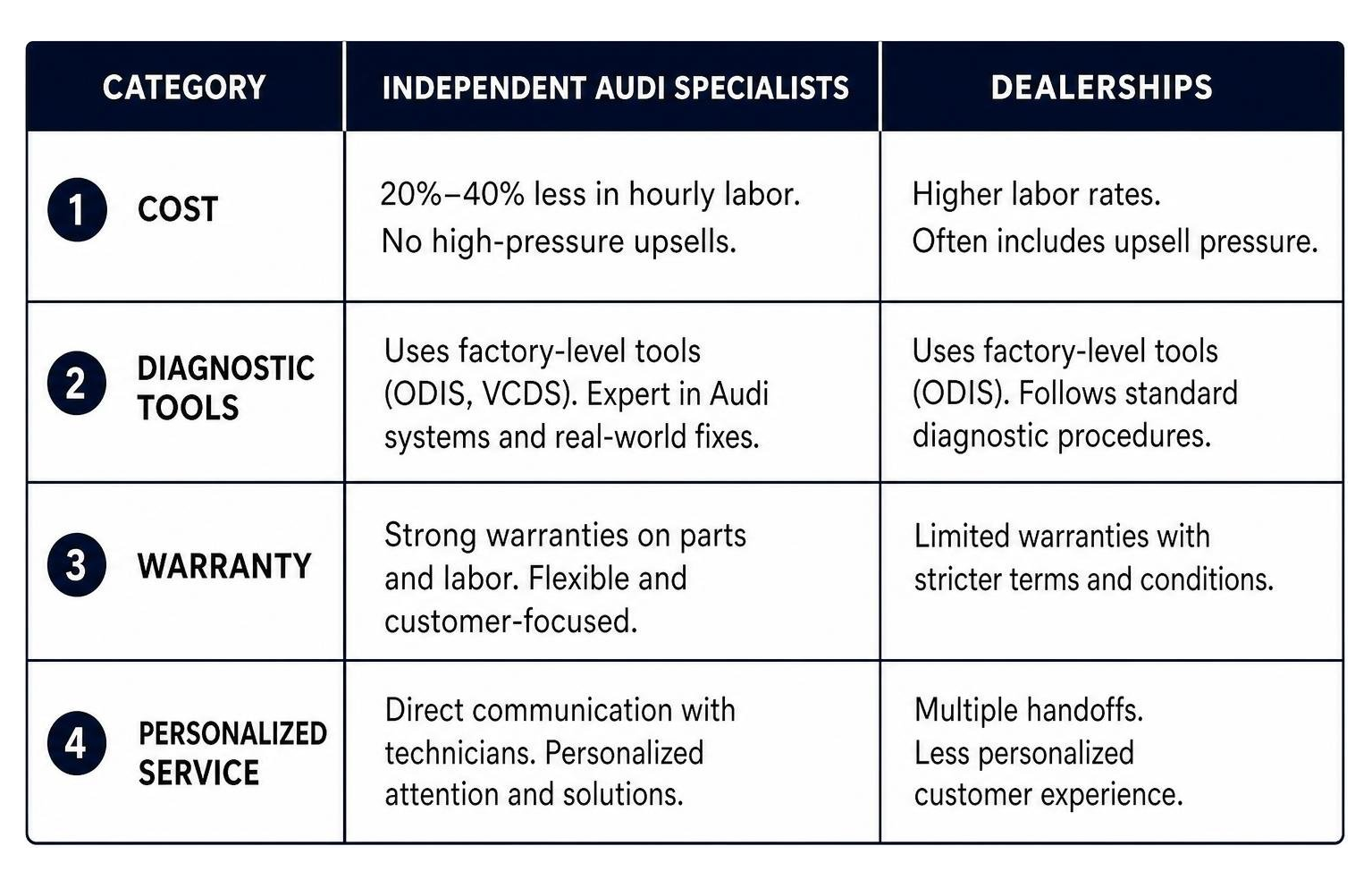
The most immediate benefit of choosing an independent Audi specialist is the cost savings. Independent specialists typically charge 20% to 40% less than dealership hourly labor rates. Furthermore, independent shops are not bound by corporate sales quotas, meaning you won't experience the high-pressure upsell tactics often encountered at dealership service centers. You receive an honest assessment of what your vehicle needs immediately versus what can wait.
Equal or Superior Diagnostic Capabilities
There is a common misconception that independent repair shops lack the advanced technology found at the dealership. While this may be true for general, multi-brand repair shops, dedicated European specialists invest heavily in the exact same factory-grade diagnostic software (ODIS) and hardware used by dealerships. Because independent specialists often work on a wider variety of German performance cars, their technicians frequently possess a broader troubleshooting perspective that helps them solve elusive drivability issues faster.
Personalized Customer Care and Warranties
At a dealership, you rarely get to speak with the person actually working on your vehicle; instead, your communication goes through a service advisor who acts as a middleman. At an independent specialist shop, you enjoy a much more personalized experience. You can often speak directly with the technician, who can explain the diagnostic process and show you the physical wear on your parts.
Additionally, top-tier independent shops stand behind their work with robust warranties. While dealerships typically offer a 12-month warranty, many leading independent specialists provide a 2-year/24,000-mile warranty on parts and labor, giving you complete peace of mind.
How Do You Verify an Independent Shop's Audi Expertise?
Not all independent repair shops are created equal. To ensure your vehicle is in safe hands, you must verify that the shop you choose has the proper training, experience, and commitment to quality.
Technician Certifications and Factory Training
When researching local shops, look for credentials that prove technical competence. The gold standard in the automotive industry is ASE (Automotive Service Excellence) certification. For complex engine diagnostics, look for technicians who hold the L1 Advanced Engine Performance Specialist credential, which demonstrates a high level of expertise in diagnosing complex powertrain issues. Additionally, ask if the technicians have undergone factory-authorized Audi/VW training or have prior dealership experience.
Evaluating Online Reviews and Reputation
Online reviews are an excellent resource, but you must know what to look for. Don't just look at the overall star rating; read the actual text of the reviews.
Search for Keywords: Look for reviews that mention "diagnostics," "electrical issues," "timing chain," "misfire," or "check engine light."
Look for Consistency: A shop that has hundreds of five-star reviews specifically praising their troubleshooting ability on European cars is a strong candidate.
Avoid Generalists: If all the positive reviews are for basic oil changes and tire rotations on domestic vehicles, that shop may not have the depth of experience required for your Audi.
For drivers in South Florida, finding a highly rated local specialist is key to protecting your automotive investment. Learn more about local service options by reading about German Auto Repair Pompano Beach.
Commitment to OEM Parts and Fluids
Audi engines are built to incredibly tight tolerances and require specific fluids and parts to operate reliably. Using cheap, generic aftermarket parts is a recipe for repeat failures and engine damage.
Verify that the shop is committed to using OEM (Original Equipment Manufacturer) or high-quality, OE-spec parts from trusted German brands (such as Bosch, Continental, or Lemförder). Furthermore, ensure they use fluids that meet strict VW/Audi oil specifications, such as VW 502.00 or 504.00. Using the wrong oil viscosity or specification can accelerate timing chain wear and increase oil consumption.
What Questions Should You Ask a Potential Audi Repair Shop?
Before committing to a diagnostic service, call or visit the shop and ask the service advisor these direct questions. Their answers will quickly reveal whether they have true Audi expertise or are simply a general repair shop.
"Do you use Audi-specific diagnostic software like ODIS or VCDS?"
This is your most important question. If the shop answers that they use a generic, multi-brand scan tool, thank them for their time and continue your search. For complex engine diagnostics, access to manufacturer-specific modules, guided test plans, and live data streams is an absolute necessity.
"What is your experience with my specific Audi engine family?"
Audi has produced many different engine configurations over the years, each with its own unique quirks. A shop that is highly experienced with the 2.0L TFSI (EA888) might not be as familiar with the packaging constraints and timing chain layouts of the 3.0L Supercharged V6 or the twin-turbocharged 4.0L V8. Ensure the technicians have hands-on, real-world experience with your exact engine model.
"Do you provide digital vehicle inspections with photos and videos?"
Modern, professional repair shops utilize Digital Vehicle Inspections (DVIs). Instead of just telling you what is wrong over the phone, they will send a comprehensive report directly to your mobile device. This report includes high-resolution photos and videos of the diagnostic process, showing you exactly where a fluid leak is located, the physical play in a suspension bushing, or the diagnostic trouble codes on their scan tool. This transparency builds trust and ensures you never pay for unnecessary work.
"Do you offer a warranty on your diagnostic and repair work?"
A shop that is confident in its diagnostic capabilities and the quality of its parts will always stand behind its work. Ask about their warranty terms. You should look for a minimum of a 12-month/12,000-mile warranty, though premier independent specialists often offer a 2-year/24,000-mile nationwide warranty. To understand why working with certified professionals matters, read about the value of a Certified Mercedes-Benz Mechanic.
How Can Local Audi Owners Find a Trusted Specialist Near Them?
Finding the right shop requires a proactive search strategy. By leveraging specialized resources, you can bypass general repair shops and connect with true experts.
Searching for Specialized German Auto Repair Shops
When searching online, avoid generic terms like "auto repair near me." Instead, use highly targeted search terms such as:
"Independent Audi specialist near me"
"European auto repair Pompano Beach"
"German automotive diagnostics"
Shops that specialize exclusively in German brands (such as Audi, Mercedes-Benz, BMW, and Porsche) invest their training budgets, diagnostic tooling, and parts inventory specifically into these vehicles, ensuring a much higher level of service. For more insights on choosing an independent shop, read our guide on Independent Mercedes Repair.
Leveraging Audi Enthusiast Forums and Local Clubs
Some of the best recommendations come from passionate Audi owners who demand the absolute best for their cars. Visit online enthusiast forums such as Audizine and AudiWorld, or check out local chapters of the Audi Club North America. These platforms feature regional sub-forums where local members share their honest experiences with independent shops in your area, helping you identify the most trusted local experts.
Introducing Mercedes Mike in Pompano Beach
If you are located in South Florida—including Pompano Beach, Deerfield Beach, and the surrounding areas—your search for a premier German automotive specialist ends at Mercedes Mike. Located at 882 NE 41st Court (just off N Dixie Hwy), we specialize in the maintenance, diagnostics, and complex repair of fine German vehicles, including Audi, Mercedes-Benz, BMW, and Porsche.
Our shop is built on a foundation of transparency, technical excellence, and personalized customer care. Our team of highly experienced technicians utilizes the latest factory-level diagnostic tools and software to pinpoint the root cause of complex engine issues quickly and accurately, saving you time and money. Whether you are dealing with a persistent check engine light, timing chain noise, or drivability issues, we provide the dealership-level expertise you need without the dealership hassle. Learn more about our facility by visiting our Auto Service Shop Pompano Beach page.
Frequently Asked Questions About Audi Diagnostics
Can an independent shop diagnose my Audi without voiding my warranty?
Yes. Under the federal Magnuson-Moss Warranty Act, you are legally permitted to have your Audi serviced, diagnosed, and repaired by any qualified independent repair shop without voiding your factory warranty. As long as the shop performs the work correctly and uses OEM-quality parts and fluids that meet Audi's specifications, your warranty remains fully intact.
What should I do if my Audi's check engine light is flashing?
A flashing check engine light indicates a severe engine misfire that is actively occurring. When an engine misfires severely, unburned fuel enters the exhaust system, where it can quickly overheat and destroy your costly catalytic converters, or cause severe internal engine damage. If your check engine light begins to flash, you should safely pull over, turn off the engine, and have the vehicle towed directly to an Audi specialist. Do not continue driving.
How often should I service my Audi's DSG transmission to prevent major repairs?
Audi's DSG (S-Tronic) dual-clutch transmissions are highly sophisticated systems that require regular maintenance to ensure smooth shifting and longevity. Despite some factory manuals claiming the fluid is a "lifetime fill," experienced specialists recommend servicing the DSG fluid and filter every 40,000 to 60,000 miles. Regular fluid changes prevent wear on the internal clutch packs and protect the expensive electronic control module (the mechatronic unit) from thermal breakdown and debris accumulation.
Conclusion
Diagnosing complex engine issues in a modern Audi requires a level of expertise, software, and precision that general auto repair shops simply cannot provide. From carbon cleaning and timing chain wear to intricate network communication faults, these highly engineered German machines demand specialized care. By choosing a dedicated independent specialist who utilizes factory-level diagnostic tools like ODIS and VCDS, employs certified technicians, and commits to OEM parts, you ensure your Audi receives the exact care it needs—all while saving 20% to 40% compared to dealership pricing.
Don't let a check engine light or performance issue take the joy out of driving your Audi. Proactive, accurate diagnostics are the key to preventing minor issues from turning into catastrophic engine failures.
If you are a South Florida Audi owner looking for a trusted partner to keep your vehicle performing at its peak, we invite you to experience the difference of specialized German automotive care. Visit our Mercedes Mike Services page today to schedule your comprehensive diagnostic appointment, or stop by our shop in Pompano Beach to meet our team.