
Don't Let Your Gears Grind with the Wrong Mercedes Gearbox Oil
Why Using the Right Mercedes Gearbox Oil Can Make or Break Your Transmission
Mercedes gearbox oil is one of the most vehicle-specific fluids in the automotive world — and using the wrong type can lead to costly transmission damage.
Here's a quick overview of the most common Mercedes transmission fluids:
MB Specification Color Transmission Type Common Models MB 236.10 Red 5-speed automatic (722.6) E-Class, C-Class (older) MB 236.14 Red 5-speed / 7-speed (722.6, 722.9) C-Class, E-Class, S-Class MB 236.15 Red 7G-Tronic (722.9) E350, S550, C300 MB 236.17 Gold 9G-Tronic (725.0) C300, GLC300, S-Class (newer) MB 236.21 — Dual Clutch (7G-DCT) CLA250, GLA250, A-Class
Mercedes transmissions are precision-engineered systems. They rely on fluids with exact friction modifiers, viscosity grades, and thermal properties to function correctly. There is no universal "ATF" that works across the board.
The MB 236.X specification system is Mercedes-Benz's way of ensuring every transmission gets a fluid that matches its internal components — down to the clutch pack materials and gear tolerances. Use the wrong spec, and you may not notice a problem right away. But over time, you will.
This guide breaks down every major Mercedes gearbox oil type, how to identify what your car needs, and how to avoid the mistakes that quietly destroy transmissions.
Understanding Mercedes Gearbox Oil Specifications (MB 236.X)
Mercedes-Benz uses its own approval system for transmission fluids. You will usually see this listed as MB 236.xx on the bottle. That number matters more than marketing phrases like "European ATF" or "recommended for Mercedes."
The safest way to verify an approved fluid is the official Mercedes-Benz Operating Fluids portal. Older enthusiasts still call this the BeVo list, but the site has moved to the newer Mercedes-Benz operating fluids system.
Here is the simple version:
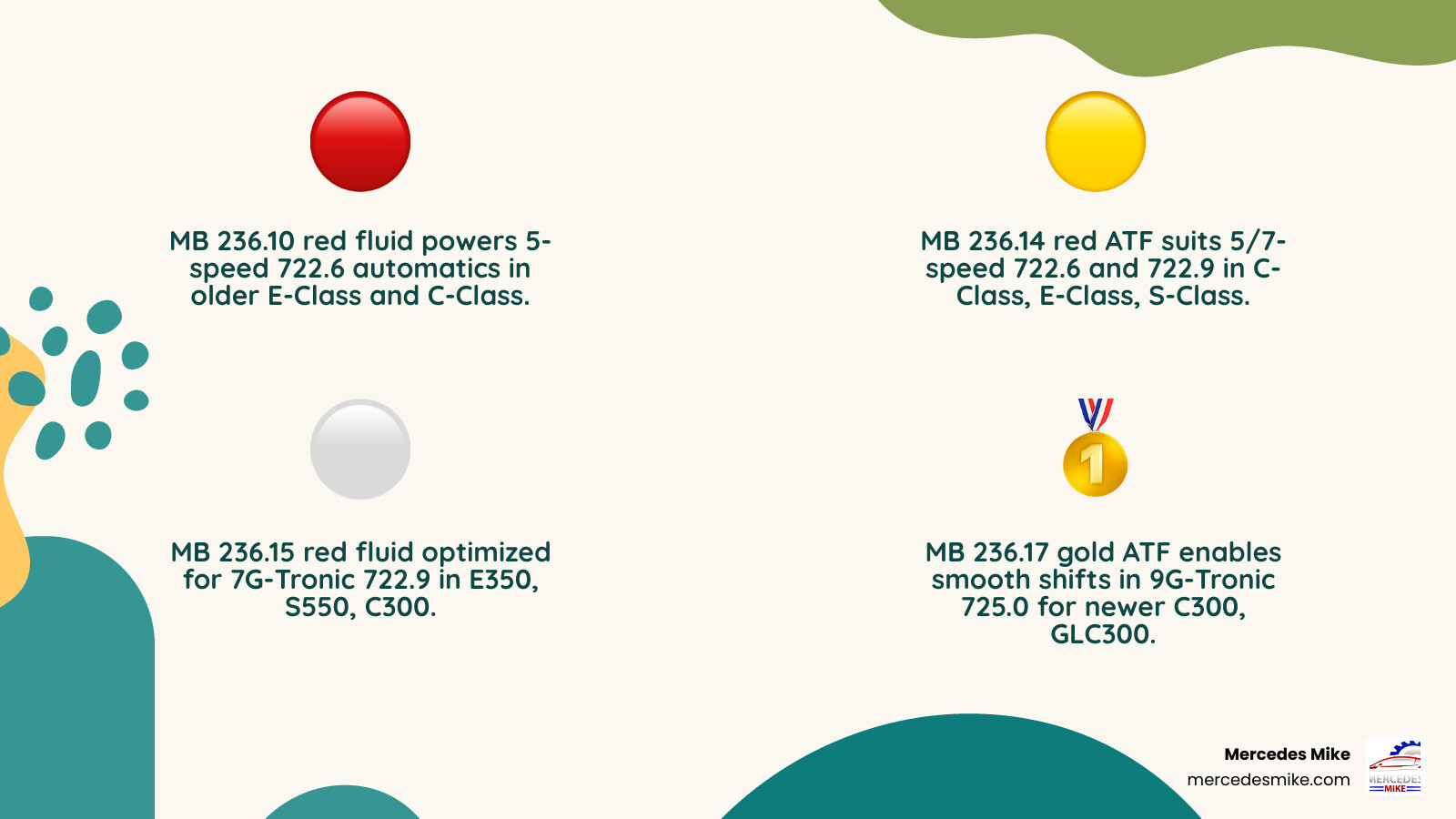
MB 236.10 is for older 5-speed automatic applications
MB 236.14 is used for many 5-speed and early 7-speed automatics
MB 236.15 is for later 7G-Tronic applications with lower-viscosity needs
MB 236.17 is for newer 9-speed applications and some later fuel-efficiency-focused designs
MB 236.21 is for dual-clutch transmissions, not conventional torque-converter automatics
These specs are not just labels. Each one controls:
Friction behavior during shifts
Shear stability at high temperature
Cold-flow performance
Seal compatibility
Wear protection for valve bodies, clutch packs, and internal gears
Some Mercedes fluids are fully synthetic and designed for very low internal drag to support smoother operation and better fuel economy. Older fluids can be less specialized. That does not mean "older is close enough." In transmission fluid language, close enough is often how expensive mistakes begin.
ATF spec comparison at a glance
MB Spec Typical Color Main Use Transmission Generation Notes MB 236.10 Red Automatic ATF Older 5-speed Legacy applications MB 236.14 Red Automatic ATF 722.6 and some 722.9 Widely used service fluid MB 236.15 Red Low-viscosity ATF Later 722.9 Improved efficiency MB 236.17 Gold Ultra-low viscosity ATF 725.0 and newer 9-speed use cases Not backward universal MB 236.21 Varies DCT fluid 7G-DCT For dual-clutch only
One extra detail that often confuses owners: transmission fluid color can help with identification, but color alone is not enough. Always confirm the MB approval number and transmission code.
The Evolution of Fluids for 7G and 9G-Tronic
As Mercedes transmissions became more complex, the fluids became more specialized.
The 722.9 7G-Tronic family used different fluid generations over time. Early versions commonly used ATF 134 style fluid associated with MB 236.14. Later low-friction versions moved to ATF 134FE and MB 236.15 to reduce internal drag and improve efficiency.
Then came the 9-speed family, including 725.0 applications, which moved to fluids such as ATF D97 or other products carrying MB 236.16 or MB 236.17 depending on exact application. Research sources also note that MB 236.17 fluids are especially low-viscosity and fuel-economy focused. Some aftermarket technical pages even state 236.17 can substitute for 236.16 in certain 9-speed uses, but not for earlier 236.10, 236.12, 236.14, or 236.15 applications.
The big takeaway:
7G-Tronic fluid is not automatically right for 9G-Tronic
Early 722.9 fluid is not automatically right for later 722.9
Newer low-viscosity fluid is not always backward compatible
If you are trying to avoid the kind of repair bill covered in our guide to Automatic Transmission Replacement Cost, using the exact approved fluid is cheap insurance.
Matching Your Transmission Type to the Correct Mercedes Gearbox Oil
The right fluid starts with identifying the transmission itself, not just the car model. Mercedes often used more than one transmission family in the same model line depending on year, engine, and drivetrain.
Common Mercedes transmission families include:
722.6 - 5-speed automatic
722.9 - 7-speed automatic
725.0 - 9G-Tronic 9-speed automatic
722.8 - CVT
7G-DCT - dual-clutch automatic
Manual gearboxes - separate manual transmission gear oils
That is why we always recommend checking by VIN, not guesswork.
Useful ways to identify the correct fluid:
Check the owner’s manual
Look up the VIN in factory parts data
Confirm the transmission code on the vehicle or service records
Verify the required MB approval on the official fluid list
Inspect prior service documentation if the vehicle has already been maintained correctly
The Oils_Mercedes reference and other technical catalogs show how specific these applications can be.
For example:
722.6 5-speed units typically use older approved ATFs such as MB 236.10 or 236.14 depending on application
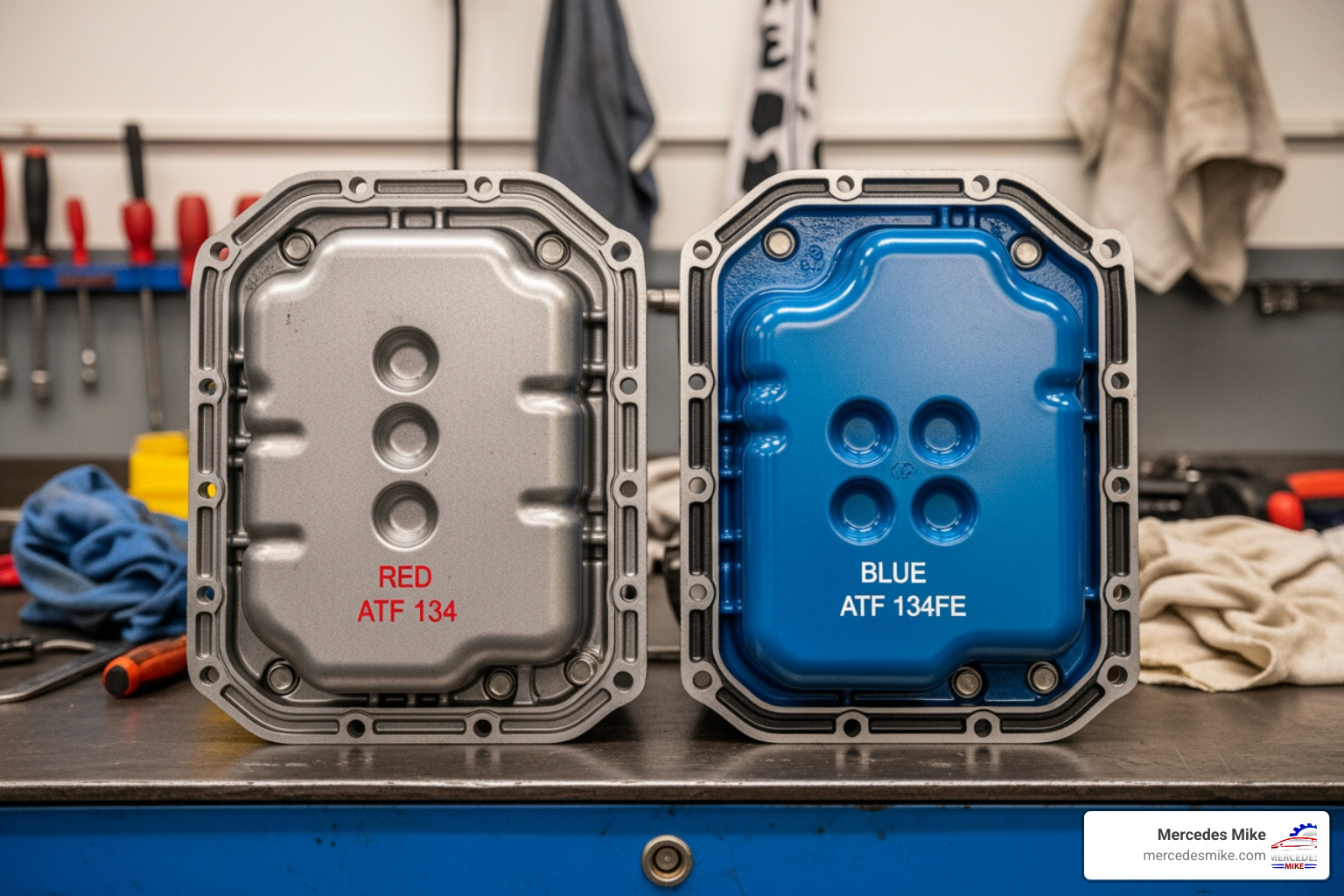
722.9 7-speed units may use either the earlier red ATF 134 type or later blue 134FE style fluid depending on version
725.0 9G-Tronic units need their own newer low-viscosity fluid family
722.8 CVT units use CVT-specific fluid, not standard automatic ATF
7G-DCT units require MB 236.21 dual-clutch fluid
A particularly useful field tip from technical product references: some 722.9 pans can be identified by dimples, where round versus oval pan details help distinguish red versus blue fluid applications. That is helpful as a clue, but we still would not use that clue alone as final proof. Mercedes did not design these transmissions for detective games.
Identifying the Right Mercedes Gearbox Oil for DCT and Manual Units
Dual-clutch and manual transmissions are their own world.
MB 236.21 is the Mercedes spec commonly associated with 7G-DCT units used in models like the CLA250, GLA250, and some A-Class applications. This is not the same thing as fluid for a standard automatic. A DCT uses wet clutches and mechatronic controls that need a very specific fluid profile.
Some AMG-related applications may also require model-specific details, and certain technical references mention anti-foam additives for specific later high-performance models. That is a reminder that performance Mercedes models can have extra service requirements beyond the basic fluid spec.
Manual transmissions are different again. They generally use manual transmission fluid or gear oil rather than ATF. Differentials use hypoid gear oil, commonly in grades like 85W-90 depending on the assembly and application. That is why people sometimes mix up "gearbox oil" and "transmission fluid" in conversation. In practice, you must match the fluid to the exact component:
Automatic transmission = approved ATF
Dual-clutch transmission = approved DCT fluid
Manual transmission = manual gearbox oil
Differential/final drive = hypoid gear oil
If you are unsure, this is exactly when it helps to work with a Certified Mercedes-Benz Mechanic rather than trusting a universal-fluid bottle that promises to fit half the automotive industry.
Service Intervals and Fluid Capacities for Mercedes Transmissions
Mercedes has changed its messaging over the years, and many vehicles were once described as having "lifetime" fluid. In the real world, especially here in South Florida heat, fluid does not live forever.
By 2026 standards, a practical service approach is:
Automatic transmissions: often around every 40,000 to 60,000 miles depending on transmission type and use
Severe driving conditions: service sooner
DCT and CVT units: follow model-specific intervals very carefully
Manual gearboxes and differentials: inspect and service by schedule or condition, especially on performance or high-mileage vehicles
Severe use includes:
Stop-and-go traffic
High ambient heat
Short trips
Heavy loads
Aggressive driving
Repeated city driving
Those conditions describe a lot of real-world driving in Pompano Beach and Deerfield Beach, which is why we do not recommend stretching fluid intervals just because the transmission still "feels okay."
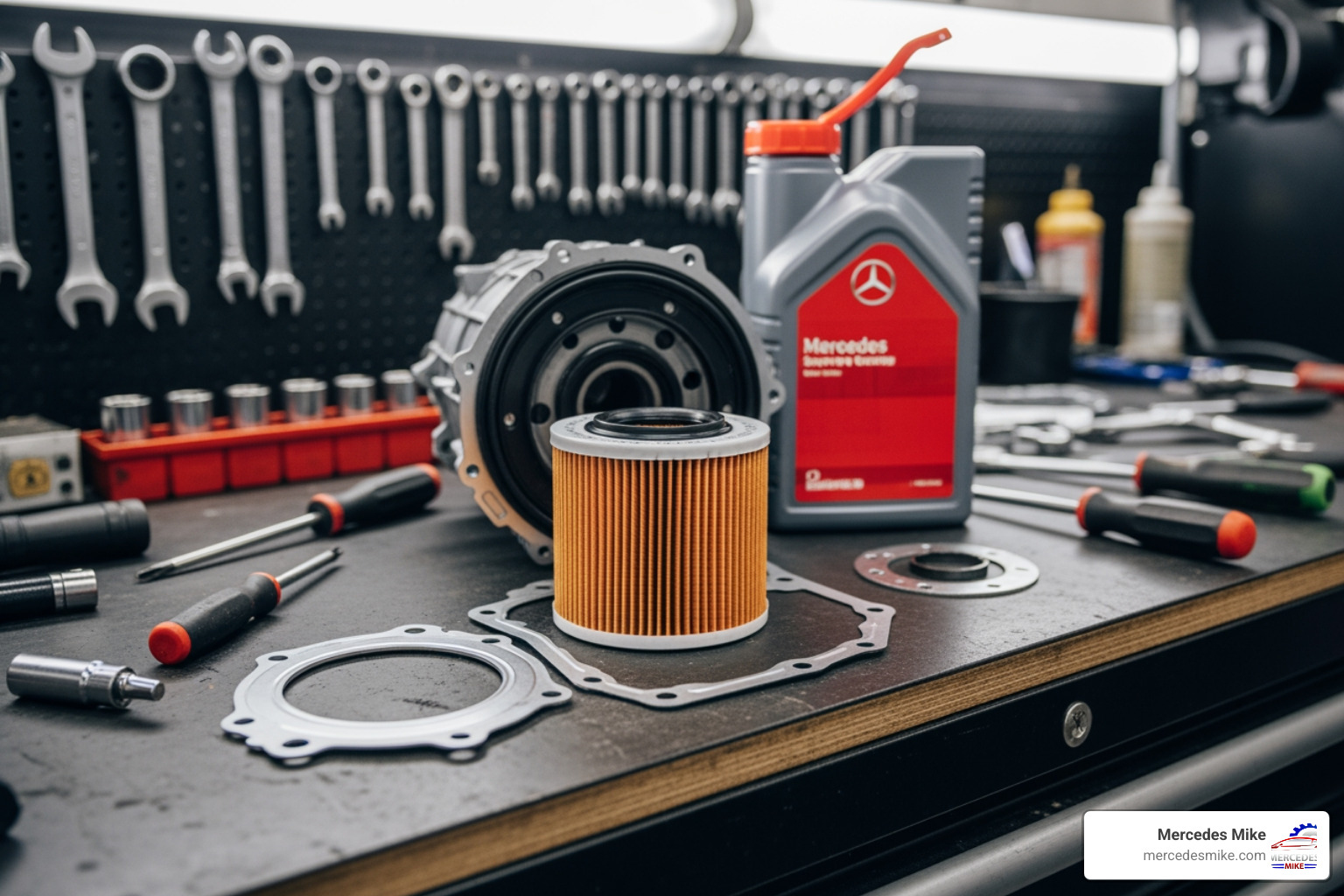
In most cases, transmission service means:
Draining the old fluid
Replacing the filter
Replacing the pan gasket if applicable
Refilling with the exact approved fluid
Setting the fluid level at the proper temperature
Resetting adaptations or service values when required
A simple drain-and-fill uses less fluid than a more complete service. Typical numbers vary by transmission, but here are practical examples from the research:
722.8 CVT drain/refill: about 5.7L
722.8 CVT dry fill: about 6.25L to 6.5L depending on cooler setup
For many conventional Mercedes automatics, a basic service often lands in the roughly 5L to 8L range, while a more complete exchange can require significantly more. Exact quantity depends on the transmission, pan style, torque converter draining method, and service procedure.
The important point is this: do not buy fluid based on internet guesses. Buy based on the actual service procedure for your VIN and transmission code.
If your vehicle is due, our transmission service process follows current best practices rather than old "sealed for life" myths. Timely service is usually much cheaper than waiting until shifts flare, bang, or slip.
OEM vs. Aftermarket: Who Makes Mercedes Gearbox Oil?
This is one of the most common questions we hear: who actually makes the fluid in the Mercedes bottle?
Based on enthusiast research and approved product lists, major companies such as Shell, Fuchs, Ravenol, Castrol, and others have been involved in approved Mercedes fluid supply depending on the spec and product category. Forum discussions from technical communities also point out that Shell has been a major supplier for several Mercedes ATF specs, while gear oils are often associated with Castrol in some applications.
That said, there are two very important rules:
Do not assume the same brand always supplies every Mercedes fluid
Do not assume a retail fluid from the same company is identical unless it carries the official MB approval
That second point matters a lot. There is a major difference between:
"MB-Approval 236.15"
"Recommended for MB 236.15" or "meets requirements"
If we are protecting a sophisticated Mercedes transmission, we want the official approval whenever possible.
Enthusiast discussions, including those on BobIsTheOilGuy, generally land in a sensible middle ground:
Genuine Mercedes fluid is the safest default
Approved aftermarket fluids from reputable brands can be excellent
Non-approved universal fluids are where risk rises sharply
For very specific modern transmissions, many experts prefer sticking with OEM or explicitly approved products only
For MB 236.17 specifically, the research notes that as of late 2021 there were only 8 approved fluids listed, including Mercedes Genuine, Fuchs, Ravenol, Shell variants, and Sinopec. That small list tells you how selective Mercedes is with newer transmissions.
Where to buy and what it costs
Pricing varies widely depending on bottle size, seller, and whether you buy genuine or approved aftermarket fluid.
Research from retailer and marketplace listings shows:
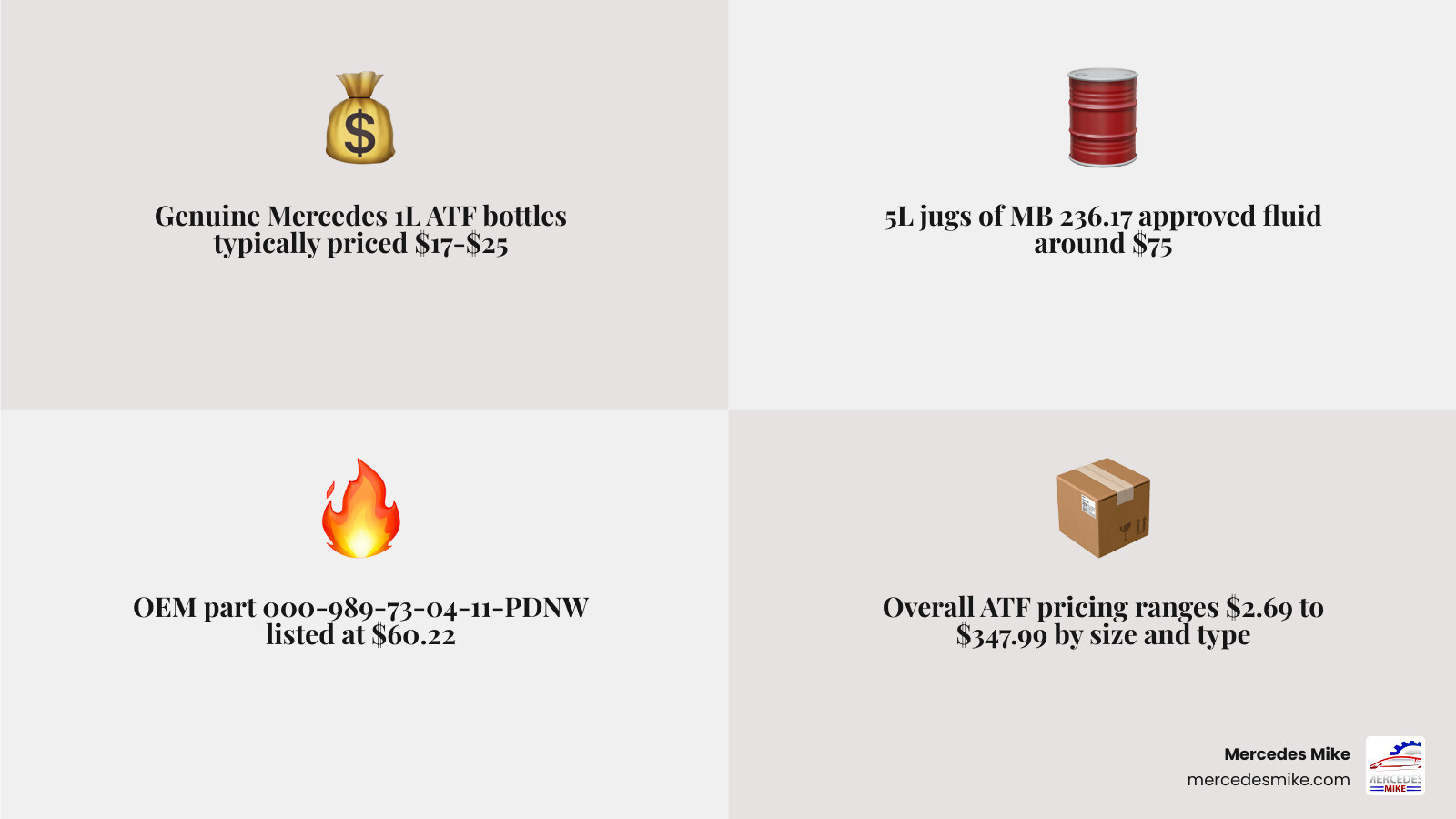
Average Mercedes transmission fluid pricing can range from about $2.69 to $347.99 across many part types
One catalog showed 24 different Mercedes transmission fluid part types
A Genuine Mercedes 5L ATF listing was around $109.99
eBay showed 58 fluid-related results in one search snapshot
Common OEM 1L bottle pricing often falls around $17 to $25
Some 5L jugs of MB 236.17 were around $75 in marketplace listings
A genuine transmission oil listing for Transmission Oil 000-989-73-04-11-PDNW | Mercedes-Benz Parts showed a sale price of $60.22
Another OEM listing tied to 000-989-88-03-09 - Transmission Oil For Mercedes-Benz Parts Store showed a sale price of $15.24
Those prices are useful for budgeting, but when shopping online, always verify:
Exact part number
Exact MB approval
Container size
Seller reputation
Whether the part has been superseded
A superseded part number is not automatically wrong, but it should be confirmed.
Common Maintenance Questions
Can I mix red and blue Mercedes gearbox oil?
In general, no. Do not mix them unless Mercedes service information for your exact transmission explicitly allows it.
Technical references for 722.6 and 722.9 applications warn that red and blue fluids can be incompatible. The fluid color often reflects different additive chemistry and viscosity characteristics, not just dye.
Mixing can lead to:
Shift quality problems
Friction instability
Foaming
Heat buildup
Premature wear
If the wrong fluid was added, the safest move is usually a proper corrective service rather than hoping the transmission will forgive you later. Transmissions are many things, but forgiving is rarely one of them.
What happens if I use the wrong ATF spec?
Using the wrong spec can cause both immediate and slow-developing problems.
Short-term symptoms may include:
Harsh shifting
Delayed engagement
Flare between gears
Torque converter shudder
Warning lights
Overheating
Long-term consequences can include:
Accelerated clutch wear
Valve body issues
Solenoid malfunction
Seal deterioration
Internal varnish or sludge
Full transmission failure
The scariest part is that some wrong fluids do not cause instant drama. They just slowly wear the transmission in the background until the repair becomes painful.
How much does Mercedes transmission fluid cost?
Usually, the fluid itself is not the expensive part of transmission ownership. The transmission is.
Typical shopping patterns look like this:
1L bottles are convenient for topping off or small corrections
5L containers are often the best value for a standard service
6-pack liter sets can work well for DIY service planning
OEM fluid usually costs more than approved aftermarket alternatives
The full job also includes a filter, gasket, drain plug or sealing parts, and labor
For many owners, the best value is not the cheapest bottle. It is the right fluid installed correctly at the right interval.
Conclusion
Mercedes transmissions are precise, expensive, and extremely sensitive to fluid choice. That is why Mercedes gearbox oil should never be treated like a generic maintenance item.
If you remember only a few things from this guide, make them these:
Match the fluid to the exact MB 236.x specification
Identify the transmission by VIN and transmission code
Do not mix fluid types or colors casually
Use officially approved fluids whenever possible
Service the transmission before problems start, not after
At Mercedes Mike, we help drivers in Pompano Beach, Deerfield Beach, and across South Florida keep their Mercedes vehicles shifting the way they were designed to shift. Our decades-experienced technicians use the latest tools and the correct service procedures for German cars, so your transmission gets more than a fluid change - it gets the right fluid change.
If your Mercedes is due for transmission service, or you want help identifying the correct gearbox oil for your vehicle, explore our Mercedes Mike Services. If you are already handling other maintenance items, you may also find our guides on Mercedes Air Conditioning Service, Mercedes-Benz Air Balance Refill, and Mercedes B-Class Fuel Filter Replacement helpful.