
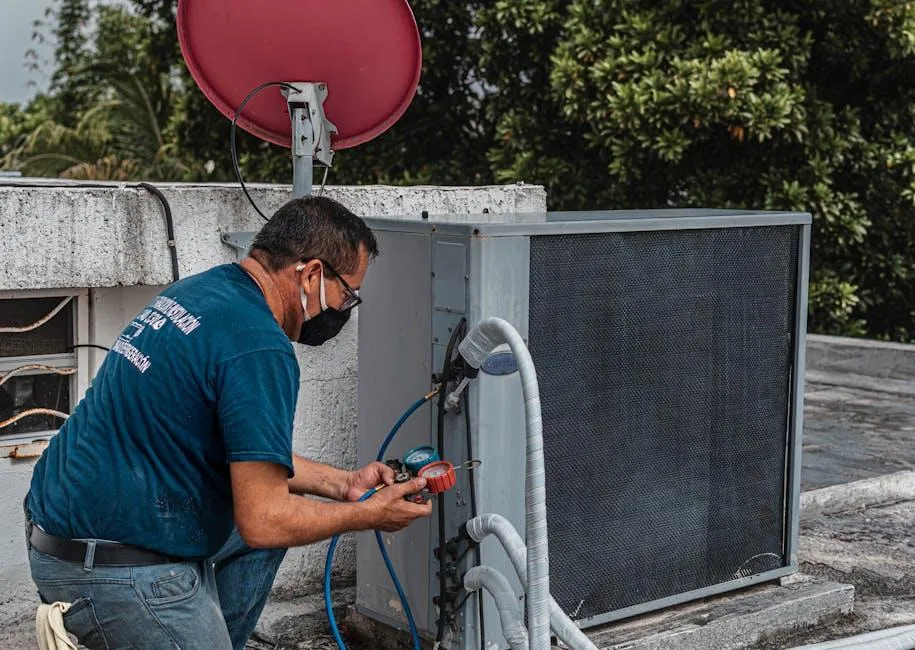
The Ultimate Guide to Refrigerant Leak Repair Costs
Why Refrigerant Leak Repair Can't Wait — And What It Will Cost You
Refrigerant leak repair is one of the most common — and most misunderstood — AC system services your car will ever need.
Quick answer: Here's what you need to know right now.
Question Short Answer What are the signs? Warm air from vents, hissing sounds, oily residue on lines, AC compressor not engaging Can you drive with a leak? Not recommended — compressor damage can follow quickly Who can legally fix it? Only EPA Section 609 certified technicians How much does it cost? Typically $300 to $2,500, averaging around $900 for most vehicles How long does repair take? 1–3 hours for minor leaks; longer if evaporator or condenser replacement is needed
If your Mercedes, BMW, or Audi is blowing warm air on a hot South Florida afternoon, a refrigerant leak is one of the first things to suspect.
The AC system in a German luxury vehicle is a closed loop — it should never lose refrigerant on its own. When refrigerant levels drop, it means something has failed. A seal, a hose, a fitting, or a coil is letting refrigerant escape.
And here's the part most people don't realize: running the system low on refrigerant stresses the compressor. What starts as a small, inexpensive leak can turn into a compressor replacement costing thousands — if you ignore it long enough.
This guide covers everything: how to spot a leak, what the repair process looks like, what it costs in 2026, and why this is one job you should never attempt yourself.
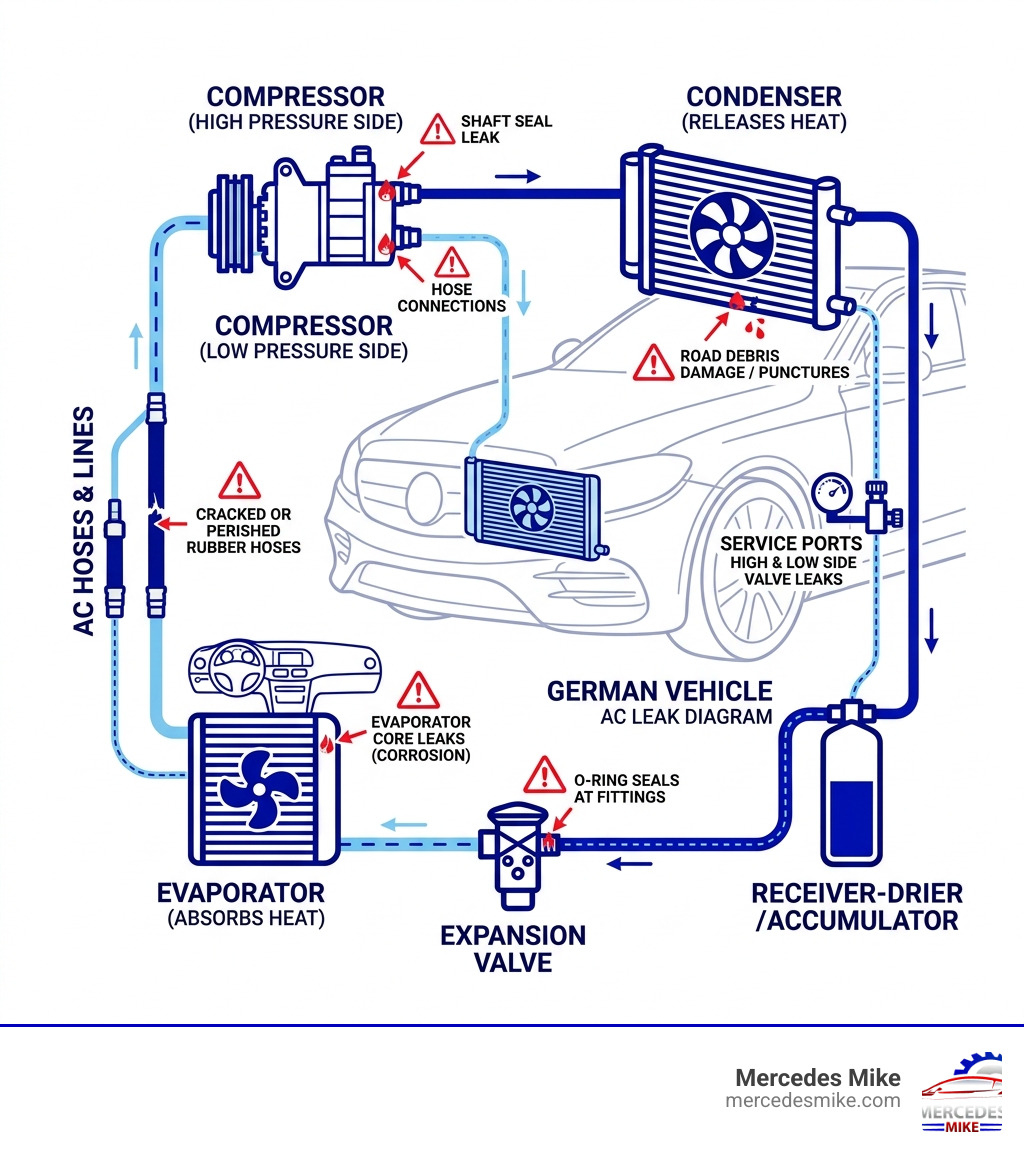
Identifying the Signs and Causes of an Automotive Refrigerant Leak
Detecting a leak early is the difference between a simple O-ring replacement and a massive repair bill. Because refrigerant (often referred to by the brand name Freon) is a gas at room temperature and pressure, you won't usually see a "puddle" under your car like you would with oil or coolant. Instead, you have to look for more subtle clues.
The most common symptom is, of course, warm air blowing from the vents. If your AC was ice-cold yesterday but feels like a lukewarm breeze today, the system has likely reached a low-pressure threshold where the compressor refuses to engage to protect itself.
Other signs we frequently see at our Pompano Beach shop include:
Hissing sounds under the dashboard: This often indicates a leak in the evaporator core located inside the cabin.
A faint chemical odor: Some describe it as a sweet, "ether-like" smell or even like nail polish remover.
Oily residue on AC lines: Refrigerant carries a specialized lubricating oil. When the gas escapes, it leaves behind a greasy film that attracts dust and dirt.
The AC compressor failing to engage: If you don't hear that familiar "click" when you turn on the air, the system is likely bone dry.
For a deeper dive into how these systems function, check out our guide on Mercedes Air Conditioning Service.
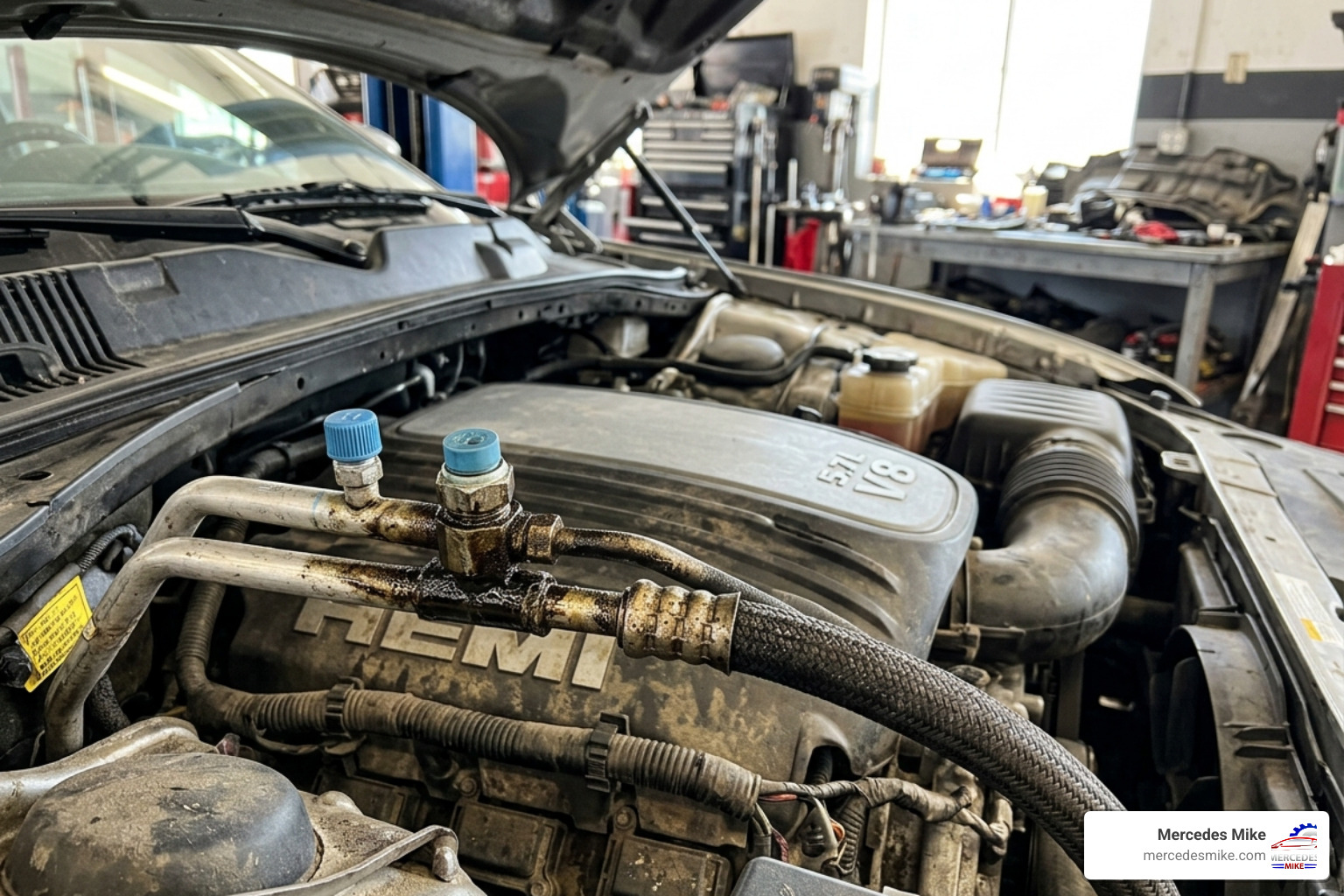
Common Causes of Vehicle System Leaks
Why do these leaks happen in the first place? In South Florida, our environment is particularly tough on AC components.
Corrosion of Aluminum Lines: Humidity and salt air can lead to "pitting" corrosion on the aluminum refrigerant lines.
Road Debris Damage: The condenser sits right at the front of your car, behind the grille. A single pebble at highway speeds can puncture it.
Vibration-Induced Cracks: German cars are engineered for performance, but constant vibration can eventually fatigue the metal lines or loosen fittings.
Seal and O-ring Degradation: Rubber seals eventually dry out and shrink, especially if the AC isn't used regularly (though that's rarely an issue in Deerfield Beach!).
Thermal Expansion and Contraction: The extreme heat of a South Florida summer followed by the (relative) cool of the evening causes components to expand and contract, eventually stressing the joints.
Professional Refrigerant Leak Repair: The Step-by-Step Process
When you bring your vehicle to us for refrigerant leak repair, we don't just "top it off" and send you on your way. That’s a temporary fix that wastes money and harms the environment. We follow a rigorous diagnostic and repair protocol.
Electronic Leak Detection: We use sensitive "sniffers" that can detect refrigerant concentrations as low as 0.1 ounces per year.
UV Dye Inspection: If the leak is slow, we inject a fluorescent dye into the system. After running the AC, we use a UV light to trace exactly where the glowing dye is escaping.
Nitrogen Pressure Testing: For stubborn leaks, we evacuate the system and fill it with dry nitrogen. Since nitrogen is under higher pressure and doesn't liquefy, it makes hissing leaks much easier to find.
Visual Inspection: We check every fitting, hose crimp, and service port for that tell-tale oily residue.
For those interested in the technical side of modern diagnostics, you can view this Diagnosis: Detecting Refrigerant Leaks procedure, which outlines high-level detection steps similar to those used in our luxury vehicle service.
Detection and Sealing Methods
Once the leak is found, the real work begins. In high-end German engineering, "patching" a line is rarely the answer.
Component Replacement: If a condenser or evaporator is leaking, it must be replaced.
Evaporator Core Access: This is often the most labor-intensive repair, as it frequently requires removing the entire dashboard.
Why "Stop-Leak" Cans are Dangerous: You’ve likely seen "AC in a can" at the local auto parts store. Do not use these in a Mercedes, BMW, or Audi. These sealants react with moisture to form a hard sludge. While they might plug a tiny hole, they also plug the expansion valve and the delicate veins of your evaporator, often turning a $400 repair into a $4,000 total system replacement.
Moisture Contamination: If a leak is open to the atmosphere, moisture enters the system. Moisture combines with refrigerant to create acid, which eats your system from the inside out.
Evacuation and System Recharge
After the physical repair is complete, we must "pull a vacuum." We use a high-powered vacuum pump to reach "micron levels" (specifically below 500 microns). This serves two purposes: it proves the system is now airtight, and the low pressure causes any remaining moisture to boil off and be sucked out.
Finally, we recharge the system using digital scales. Unlike older cars, modern European vehicles require a very specific weight of refrigerant (often measured in grams). Being off by just an ounce can lead to poor cooling or system "slugging."
Breakdown of Refrigerant Leak Repair Costs in 2026
As of April 2026, the costs for refrigerant leak repair have stabilized, though they remain higher for luxury imports due to the complexity of the systems and the price of the latest refrigerants.
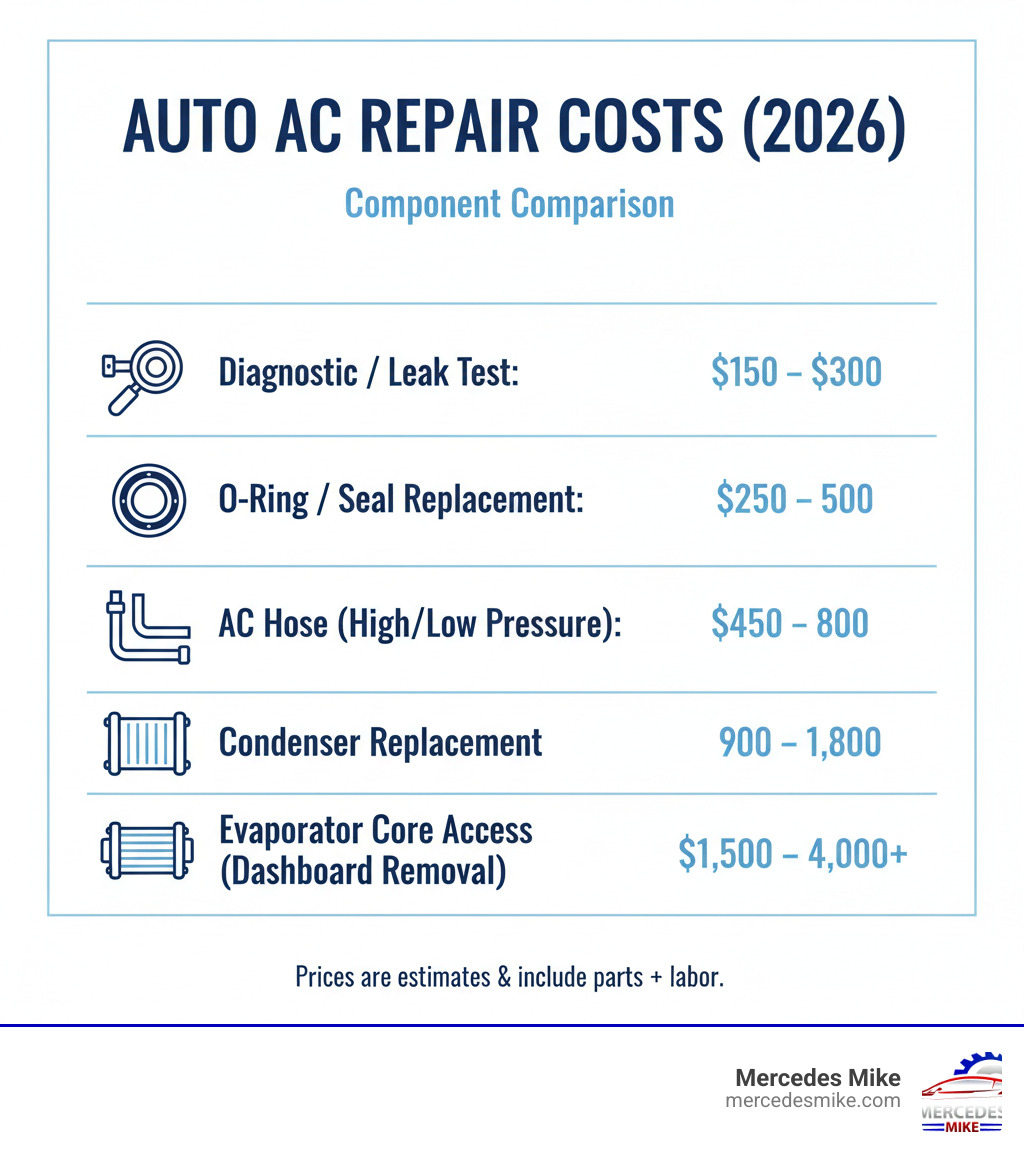
Service Component Estimated Cost Range (Parts & Labor) Diagnostic / Leak Test Fee $150 – $300 O-Ring / Seal Replacement $250 – $500 AC High/Low Pressure Hose $450 – $800 AC Condenser Replacement $700 – $1,400 AC Evaporator Core (Dash Removal) $1,500 – $3,500 AC Compressor Replacement $1,200 – $2,500
The Average Homeowner/Car Owner Experience: While residential AC repairs average around $800, automotive refrigerant leak repair for a German vehicle typically lands in the $900 to $1,200 range for mid-level repairs like a condenser or hose replacement.
Labor rates for luxury specialists in South Florida generally range from $150 to $250 per hour. While this may seem high, our decades-experienced technicians use specialized tools that ensure the job is done right the first time, backed by our parts and labor warranties.
How Refrigerant Type Impacts Repair Costs
The type of "juice" your car drinks matters immensely.
R134a: Used in most cars built between 1994 and 2014. It is becoming more expensive as it is phased out, currently costing roughly $40–$75 per lb.
R1234yf: The new eco-friendly standard found in almost all post-2017 German vehicles. This refrigerant is significantly more expensive and requires specialized, spark-proof recovery machines. Expect to pay $150–$300 just for the refrigerant during a recharge.
Repair vs. Replace: Making the Right Decision for Your Car's AC
When faced with a $2,000 bill for an evaporator core on a 15-year-old BMW, you have to ask: is it worth it?
We generally recommend the 50% Rule: If the cost of the refrigerant leak repair exceeds 50% of the vehicle's trade-in value, it might be time to consider a new car. However, for most Mercedes and Audi owners, the vehicle's longevity makes the repair a smart investment.
When to Choose Refrigerant Leak Repair Over Full Overhaul
Manufacturer Warranty: Always check if you are still under factory or extended warranty.
Minor O-ring Leaks: If the leak is at a service port or an accessible fitting, fix it immediately. It's cheap and saves the compressor.
Newer Luxury Models: If the car is less than 10 years old, it almost always makes sense to repair the leak with OEM parts to maintain the vehicle's resale value and comfort.
Long-term Reliability: Using OEM (Original Equipment Manufacturer) parts ensures that the new component won't just leak again in twelve months.
Legal Requirements and Safety: Why DIY is Not an Option
We often get asked, "Can't I just buy a kit and do this myself?" The short answer is: No.
Under the EPA Clean Air Act (Section 609), it is illegal for anyone other than a certified technician to service a motor vehicle air conditioning (MVAC) system for "compensation," but more importantly, it is illegal to intentionally vent refrigerant into the atmosphere.
Professional shops are required to use refrigerant recovery machines that capture the gas so it can be recycled. Venting R134a or R1234yf contributes significantly to global warming (high GWP).
Health and Environmental Risks
Refrigerant Poisoning: Inhaling concentrated refrigerant can cause dizziness, headaches, and in extreme cases, asphyxiation.
Frostbite: Refrigerant leaves the can at sub-zero temperatures. If it touches your skin or eyes, it causes instant cryogenic burns.
Environmental Fines: The EPA takes venting seriously. Fines for violating the Clean Air Act can reach tens of thousands of dollars.
System Damage: Without a vacuum pump and manifold gauges, a DIYer will almost certainly leave air and moisture in the system, guaranteeing a future compressor failure.
Frequently Asked Questions about Refrigerant Leaks
Can I drive my car with a known AC leak?
Technically, yes, the car will move. However, you should stop using the AC immediately. Most modern compressors run even when the AC is "off" (variable displacement compressors). If the refrigerant is gone, the oil is also gone. This leads to compressor seizure, which can snap the serpentine belt, leaving you stranded on the side of I-95 with no power steering or alternator.
How much does R1234yf refrigerant cost in 2026?
In 2026, R1234yf remains a premium product. While prices have come down from their initial launch highs, the specialized handling and equipment requirements mean a full recharge usually costs between $250 and $450 for the gas alone, depending on the system's capacity.
How can I prevent future refrigerant leaks in my Mercedes?
Annual AC Performance Checks: We can spot oily residue during a routine oil change before the system fails.
Cabin Filter Changes: A clogged filter strains the blower and can cause the evaporator to freeze, leading to cracks. Replace these every 15,000 miles.
Clean the Condenser: Gently spray out your front grille with a garden hose to remove salt, sand, and bugs that can cause corrosion.
Run the AC in Winter: Running the AC for 10 minutes once a week in the winter keeps the seals lubricated with oil.
Conclusion
A refrigerant leak repair isn't just about staying cool; it's about protecting one of the most expensive systems in your vehicle. At Mercedes Mike, we specialize in the intricate AC systems of BMW, Mercedes, Audi, and Porsche. Our Pompano Beach facility is equipped with the latest R134a and R1234yf diagnostic tools, and our technicians bring decades of experience to every service bay.
Don't let a small leak turn into a "Black Death" system failure (where the compressor explodes and sends metal shards through every hose). Whether you're in Deerfield Beach or anywhere in South Florida, we are here to provide expert, honest, and efficient climate control solutions.
Schedule your professional AC service today and get back to enjoying the drive!