Weistec W.3 vs W.4: Which AMG GTS Turbo Upgrade is Right for You?
The AMG GT Turbo Upgrade: What You Need to Know Before You Buy
If you're researching an amg gt turbo upgrade, here's the quick answer:
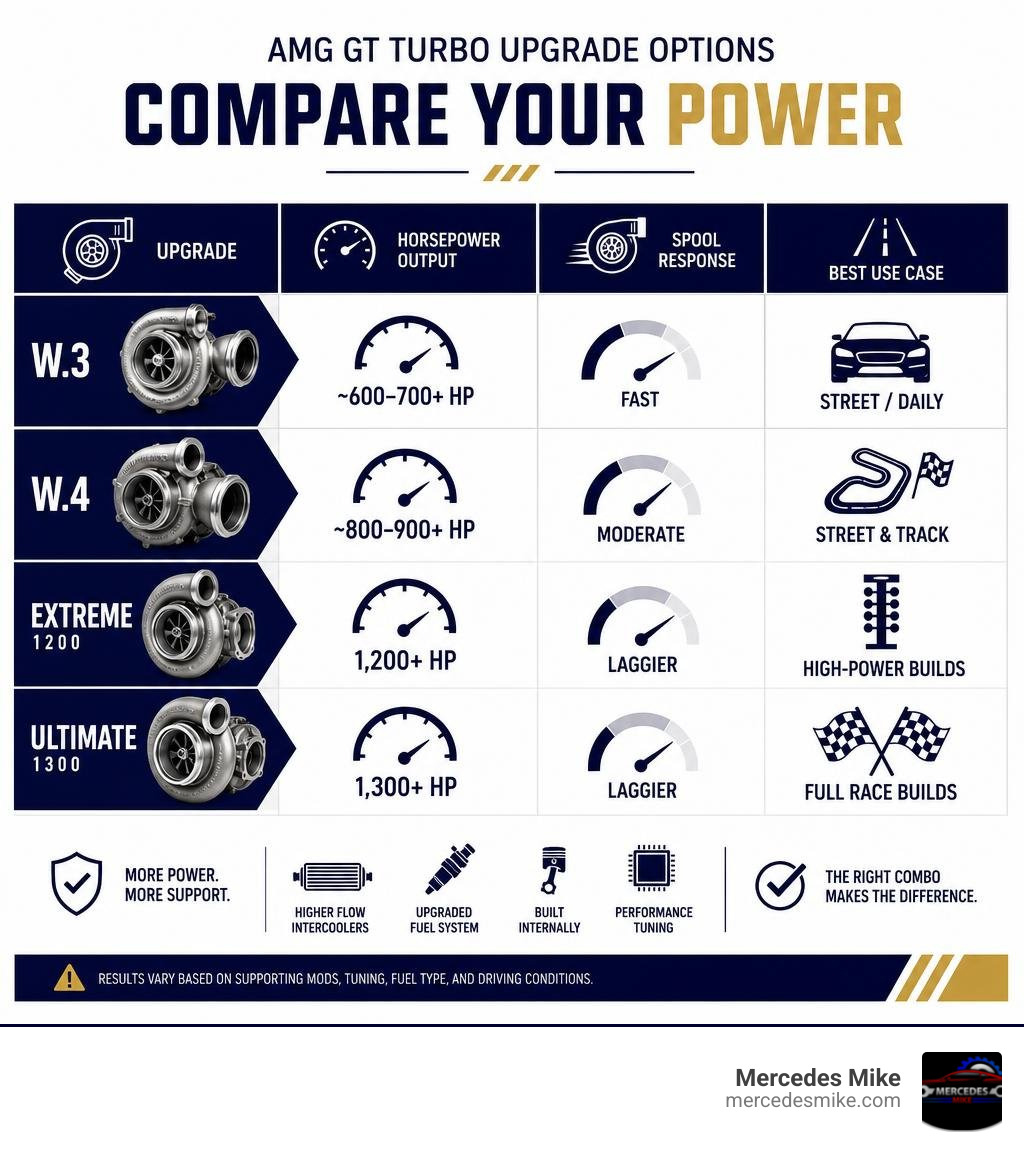
Top AMG GT Turbo Upgrade Options at a Glance
Upgrade Power Output Best For Price Range Weistec W.3 ~600-700+ HP Street/daily use ~$5,499 RENNtech Stage I Up to 714 HP Street performance Custom quote TTE760+ Up to 780 HP (98 RON) / 850+ HP Street & track Premium Spool IFX1200 1,200+ HP capable High-power builds ~$4,999 PTG X System 1,300+ HP capable Full race builds Premium
The Mercedes-AMG GT's 4.0L twin-turbo V8 — known as the M177 or M178 — is one of the strongest factory performance platforms you can buy. But even from the factory, it leaves a lot of power on the table.
That's where turbo upgrades come in.
Whether you're chasing faster lap times, more pull on the highway, or a full-on race build, upgrading the turbos is the single biggest lever you can pull on this engine. But not every upgrade is built for the same driver — or the same car.
This guide focuses specifically on the Weistec W.3 and W.4 upgrades, comparing them head-to-head so you can decide which one fits your goals. We'll also cover what supporting mods you'll need, what installation looks like, and how these options stack up against alternatives from RENNtech, TTE, and PTG.
Understanding the AMG GT Turbo Upgrade: Stock vs. Upgraded Performance
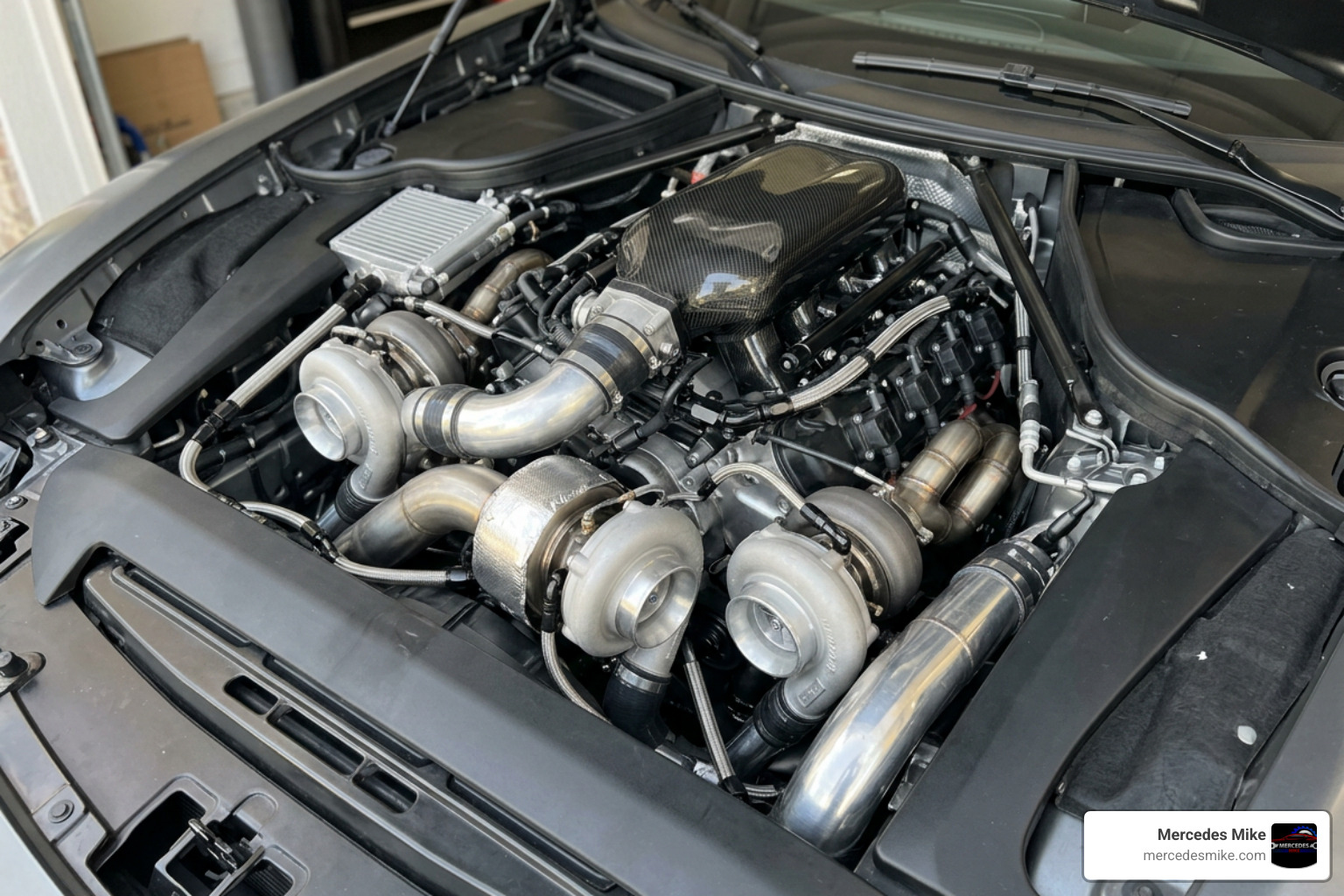
To appreciate what a turbo upgrade does for the M178 engine in your AMG GT, GTS, or GTR, you first have to understand how Mercedes designed this power plant. Unlike traditional V8 engines where the turbochargers sit on the outside of the engine block, AMG famously utilizes a "hot-inside-V" configuration.

In this layout, the twin turbochargers are nestled directly inside the valley of the cylinder banks. This design makes the engine incredibly compact and keeps the exhaust gas path from the cylinder heads to the turbines extremely short, virtually eliminating off-the-line turbo lag.
However, this tight packaging creates massive thermal management challenges. The "hot-V" acts like a furnace, trapping heat in a small, enclosed space. As you push the factory turbos past their comfort zone with basic ECU tuning, exhaust backpressure spikes dramatically. The stock compressor wheels and turbine housings quickly reach their flow limits, choking the engine at high RPMs and raising intake air temperatures to dangerous levels.
An aftermarket amg gt turbo upgrade replaces or heavily modifies these restrictive factory units. By installing larger, aerodynamically optimized compressor and turbine wheels, you drastically reduce exhaust backpressure and lower thermal stress. The engine breathes easier, runs cooler, and continues pulling hard all the way to the redline instead of falling flat on its face in the upper RPM range. If you want to dive deeper into how these engineering changes integrate with your vehicle's electronics, check out our comprehensive guide on Mercedes Tuning.
Why Invest in an AMG GT Turbo Upgrade?
While a simple Stage 1 ECU tune delivers a satisfying initial bump in mid-range torque, it doesn't change the physical flow limits of your stock hardware. If you want true supercar-killing performance, upgraded turbos are a necessity.
Here is what you actually get when you make the jump:
Sustained Top-End Power: Factory turbos are designed for quick low-end response, which means they run out of breath above 5,500 RPM. Upgraded turbos shift the power band upward, offering relentless acceleration that builds linearly all the way to a 7,000+ RPM redline.
A Flattened, Predictable Torque Curve: Instead of a sudden, violent spike in low-end torque that spins your rear tires and stresses your connecting rods, upgraded turbos deliver power progressively. This makes the car much easier to control on a race track or twisty backroad.
Lower Operating Temperatures: Larger, more efficient compressor wheels compress air without generating as much friction heat. Combined with lower backpressure, your engine runs safer at higher boost levels.
If you are planning out your vehicle's evolution, look at our breakdown of The Top 5 Performance Upgrades for Your German Car to see how turbos fit into the ultimate build sheet.
Alternative Market Options: RENNtech, TTE, and PTG
Before we dive deep into Weistec's offerings, it is helpful to look at how other heavy hitters in the AMG world approach the M178 platform. The aftermarket is filled with incredible engineering, ranging from subtle hybrid upgrades to wild, full-frame race kits.
RENNtech Stage I Turbo Upgrade
RENNtech takes a highly refined, OEM-plus approach. Their Stage I upgrade uses lightweight forged billet compressor wheels with a larger impeller and increased turbine trim, all fitted into the factory housings. The entire cartridge assembly is dynamically balanced to handle high speeds safely while retaining stock oil and coolant lines.
Performance: For the AMG GT S, this kit boosts output up to 714 HP and 604 LB-FT at the crank (an increase of +178 HP and +109 LB-FT over stock). The same 714 HP output is achieved on the GT C and GT R variants.
Learn More: Read the exact specifications on the RENNtech Stage I Turbo Upgrade page, or view the specific kit for the RENNtech Stage I Turbo Upgrade | C190 | AMG GT C | 714HP/604LB-FT | 4. model.
TheTurboEngineers TTE760+
Engineered and manufactured in Germany, the TTE760+ is a highly popular hybrid option. It features a custom 9-blade lightweight turbine designed to minimize rotational inertia and maximize spool response.
Performance: The TTE760+ is proven to deliver 780 HP on standard 98 RON pump fuel and has cracked over 850+ HP on race gas or ethanol blends. Real-world examples include an AMG GTS reaching 780 PS and 997 Nm of torque on pump fuel.
Learn More: Check out the technical details on the TTE760+ Turbocharger Upgrade page.
PTG X M178 Turbo System by Premier Tuning Group
If your goal is to build an absolute monster, the PTG X system moves away from modified stock housings entirely. This is a complete bolt-on replacement system featuring a dual ceramic ball-bearing center cartridge, a massive 62/84mm compressor wheel, and an investment-cast Inconel turbine housing.
Performance: Capable of supporting over 1,300 horsepower on built engines, this system requires no core exchange and reuses your factory wastegate actuators for seamless electronic control.
Learn More: Review the full kit contents at the PTG X M178 Turbo System by Premier Tuning Group – High-Performance Upgrade | TunerGenix page.
Weistec W.3 vs. W.4: Technical Breakdown and Comparison
When it comes to Weistec, AMG owners generally choose between two distinct paths: the W.3 and the W.4. While both will make your AMG GT incredibly fast, they are fundamentally different in how they are constructed, how they deliver power, and what they require from the rest of your vehicle.
Technical Feature Weistec W.3 Turbo Upgrade Weistec W.4 Turbo Upgrade Turbo Design Modified OEM Hybrid (Machined Housings) Full Frame Replacement Compressor Wheel 5-Axis CNC Machined Billet Wheel Large Custom Billet Wheel Bearing Type Upgraded Journal / Thrust Bearings Dual Ceramic Ball Bearings Manifolds Retains Factory Exhaust Manifolds Custom Cast High-Flow Manifolds Wastegate Control Factory Electronic Wastegates External Wastegates Core Exchange Required (Send-in or core charge) Not Required (Complete new units) Power Potential 700 - 800+ HP (Fuel dependent) 1,000 - 1,200+ HP (Engine build dependent) Drivability Near-stock spool, perfect daily manners Noticeable lag, explosive top-end power
Weistec W.3: The Ultimate Street AMG GT Turbo Upgrade
The Weistec W.3 is designed for the enthusiast who wants a massive performance upgrade without sacrificing the daily usability, reliability, or stealthy engine bay appearance of their AMG GT.
To build a W.3, Weistec takes original factory M178 turbochargers, completely disassembles them, and inspects all internal components. The compressor housings are then precision CNC-machined to accommodate a significantly larger, 5-axis CNC-machined billet impeller wheel. The internal thrust bearings are replaced with reinforced heavy-duty components to handle the increased thrust loads of high-boost environments.
Because the W.3 retains the factory external housings, it is a direct bolt-on installation. It connects perfectly to your OEM oil lines, coolant lines, and exhaust manifolds. On the street, the W.3 behaves beautifully. Thanks to the lightweight design of the custom impeller, turbo lag is virtually identical to stock, but the car continues to pull hard past 7,000 RPM. It is the perfect match for a stock-engine car running pump gas or water-methanol injection. If this sounds like the right balance for your car, you can explore the kit directly on the Weistec W.3 Turbo Upgrade page.
Weistec W.4: Maximum Power for Built Engines
If the W.3 is a surgical scalpel, the Weistec W.4 is a sledgehammer. The W.4 is not a modified stock turbo; it is a complete, ground-up redesign of the AMG GT's forced induction system.
The W.4 kit replaces the restrictive factory "hot-V" turbo layout with a pair of massive, full-frame ball-bearing turbochargers. To fit these large units inside the engine bay, Weistec includes custom-engineered, high-flow exhaust manifolds. Additionally, the W.4 moves away from the factory internal electronic wastegates in favor of heavy-duty external wastegates to manage high boost pressures without boost creep.
This kit is designed strictly for dedicated drag racing, half-mile roll racing, or extreme builds. To safely run the W.4, you cannot rely on a stock engine. You will need built internal components (forged pistons and connecting rods), a fully upgraded fuel system, and a reinforced transmission to handle the torque. The trade-off for this four-digit horsepower capability is a noticeable increase in turbo lag, as the larger turbines require more exhaust volume to spool. For those ready to build a record-breaking machine, check out the Weistec W.4 Turbo Upgrade product page.
Supporting Modifications and Installation Requirements
You cannot simply bolt a massive set of turbos onto your M178 engine, flash a basic tune, and hope for the best. To run an upgraded turbocharger safely and achieve the power figures advertised by manufacturers, you must upgrade the surrounding hardware.

Here are the essential supporting modifications required for a successful upgrade:
High-Flow Downpipes: The factory catalytic converters are a major bottleneck. Upgrading to high-flow or cast downpipes is mandatory to allow the increased exhaust volume from the larger turbines to escape quickly, keeping exhaust gas temperatures (EGTs) safe.
Upgraded ECU and TCU Tuning: A custom ECU calibration is required to scale the fuel delivery, ignition timing, and boost control for the new turbo flow characteristics. Additionally, a Transmission Control Unit (TCU) tune is highly recommended to increase clutch clamping pressure, preventing transmission slippage under massive torque.
Water-Methanol Injection (WMI): Because the M178 engine's intercoolers are compact, intake air temperatures can rise quickly during back-to-back pulls. A high-quality water-methanol injection system cools the intake charge and effectively raises the octane rating of your fuel, allowing you to run more boost safely.
High-Flow Air Filters: Upgraded turbos pull in a massive volume of air. Replacing the restrictive paper factory filters with high-flow oiled or dry panel filters ensures the compressor wheels are never starved for air.
Upgraded Spark Plugs: Running higher boost pressures can literally blow out the spark on factory plugs. Installing spark plugs that are "one step colder" and gapping them tightly ensures clean, consistent combustion.
Frequently Asked Questions About AMG GT Turbo Upgrades
How does a turbo upgrade affect turbo lag and daily drivability?
A common fear is that installing larger turbos will turn your responsive AMG GT into a laggy, undrivable mess. With modern hybrid upgrades like the Weistec W.3 or RENNtech Stage I, this is simply not the case. Because these kits utilize lightweight, forged billet compressor wheels, the rotational inertia is incredibly low. You might notice a minor shift in full boost threshold (perhaps 150 to 300 RPM later in the rev range), but the transition into boost remains smooth and highly progressive. Your car will still crawl through South Florida traffic comfortably without any jerky behavior.
What are the installation and core exchange requirements?
For hybrid turbo upgrades (like the Weistec W.3 or RENNtech Stage I), manufacturers require your original factory turbos to complete the build. You have two choices:
Send-In Service: You or your mechanic removes your factory turbos and ships them to the manufacturer. The manufacturer rebuilds your exact units and ships them back. This option keeps your costs lower but results in several weeks of vehicle downtime.
Core Exchange: You pay an upfront, refundable core deposit. The manufacturer ships you a pre-built set of upgraded turbos. Once installed, you ship your healthy factory turbos back to them within a specified window to receive your deposit refund.
Because of the complexity of the "hot-inside-V" layout, removing and installing these turbos requires disconnecting vital coolant lines, oil lines, and structural components. This is not a DIY job for a driveway mechanic. To ensure your engine is handled with the precision it deserves, we highly recommend booking an appointment with an Independent Mercedes Repair facility that has specialized experience with the AMG M177/M178 platform.
Are aftermarket turbo upgrades legal for street use?
It is important to note that most high-performance turbo upgrades, downpipes, and water-methanol systems are designed and sold strictly for track, off-road, or sanctioned competition use. In the United States, modifying emissions-control equipment (such as replacing factory catalytic converters with catless downpipes) is not legal for street-driven vehicles under EPA guidelines. Always check your local county and state emissions regulations before committing to these modifications.
Conclusion
Upgrading the turbos on your Mercedes-AMG GT, GTS, or GTR is the ultimate way to unlock the true supercar potential of the M178 engine. If you want a incredibly fast, highly responsive street car that retains its factory appearance and daily drivability, the Weistec W.3 (or a premium hybrid alternative like the RENNtech Stage I) is the perfect choice. If you are building an absolute track monster and have the budget for a built engine and custom fabrication, the Weistec W.4 will take you into the stratosphere of horsepower.
At Mercedes Mike, we specialize in the maintenance, repair, and performance servicing of elite German machinery right here in Pompano Beach, Florida. Serving South Florida communities from Deerfield Beach to Fort Lauderdale, our team of highly skilled technicians uses the absolute latest diagnostic tools and industry-best practices to keep your AMG running at its absolute peak.
Ready to take your AMG GT to the next level, or simply need expert routine maintenance? Visit our Mercedes Mike Services page to see how we can help, or schedule an appointment with a Certified Mercedes-Benz Mechanic at our Pompano Beach workshop today!