Everything You Need to Know About Mercedes Tuning
Why Mercedes Tuning Is Worth Understanding Before You Spend a Dollar
Mercedes tuning is one of the fastest ways to unlock serious performance from a car that's already built to impress — but it's also one of the easiest ways to waste money or damage an expensive engine if you go in blind.
Here's a quick overview of what Mercedes tuning involves:
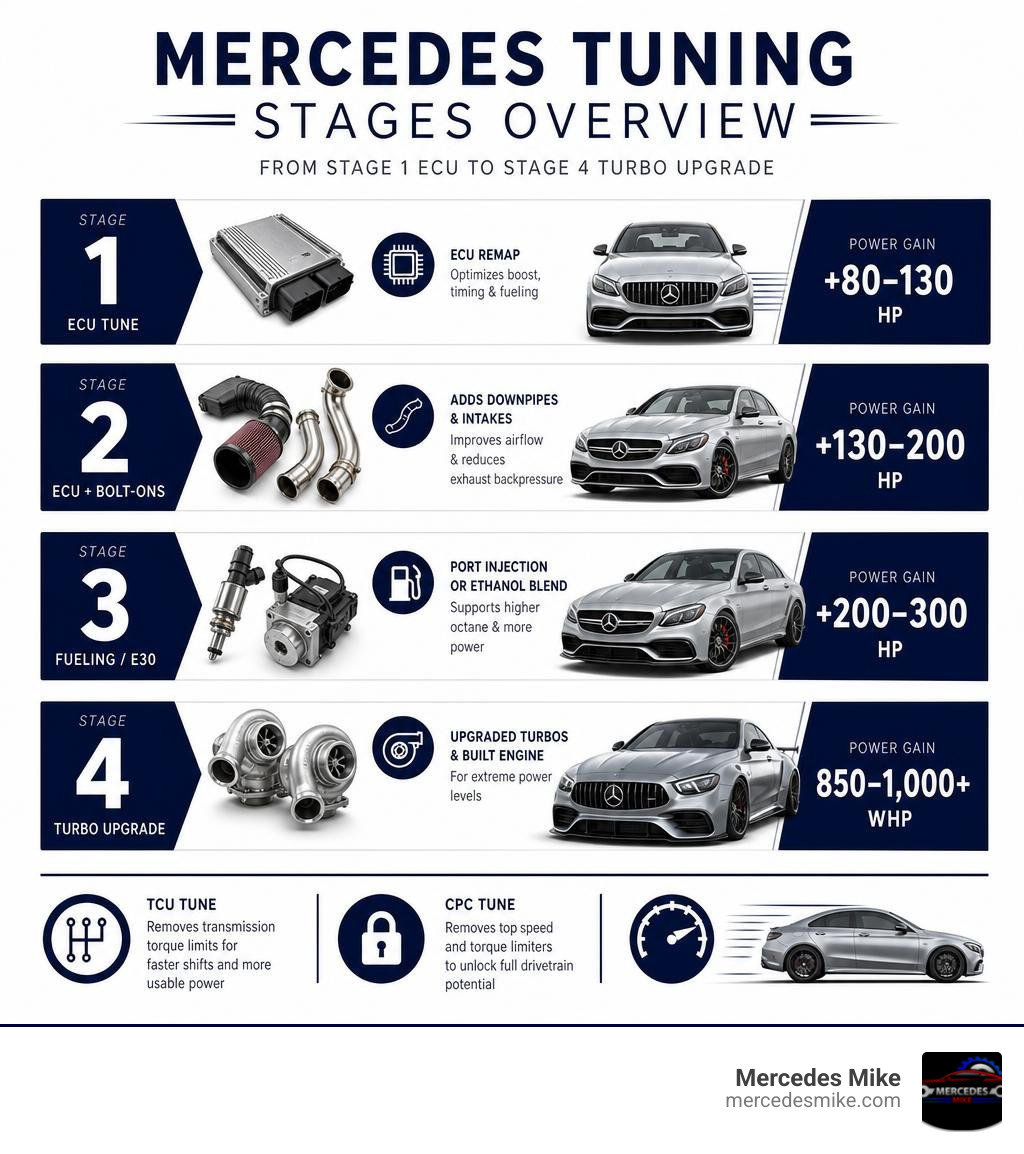
Tuning Type What It Does Power Gain (Typical) ECU Tune (Stage 1) Remaps boost, timing, fueling +80–130 HP ECU + Bolt-ons (Stage 2) Adds downpipes, intakes +130–200 HP Stage 3 (Fueling/E30) Port injection or ethanol blend +200–300 HP Stage 4 (Turbo Upgrade) Replaces turbos, built engine 850–1,000+ WHP TCU Tune Removes transmission torque limits Faster shifts, more usable power CPC Tune Removes top speed and torque limiters Unlocks full drivetrain potential
Mercedes-AMG engines — especially the 4.0L V8 biturbo variants — are widely considered some of the most tuning-friendly platforms ever built. A factory M177 or M178 making 469–577 HP from the showroom floor can realistically hit 600–700 HP on a simple ECU reflash without touching a single hardware component.
But the ECU is only part of the picture. The transmission control unit (TCU) and central powertrain controller (CPC) both impose their own torque limits. Tune just the engine and you're leaving real performance — and drivability — on the table.
This guide covers everything: the engines, the stages, the tuners, the fuel types, and the safety considerations you need to know before modifying your Mercedes.
What is Mercedes Tuning? ECU, TCU, and CPC Explained
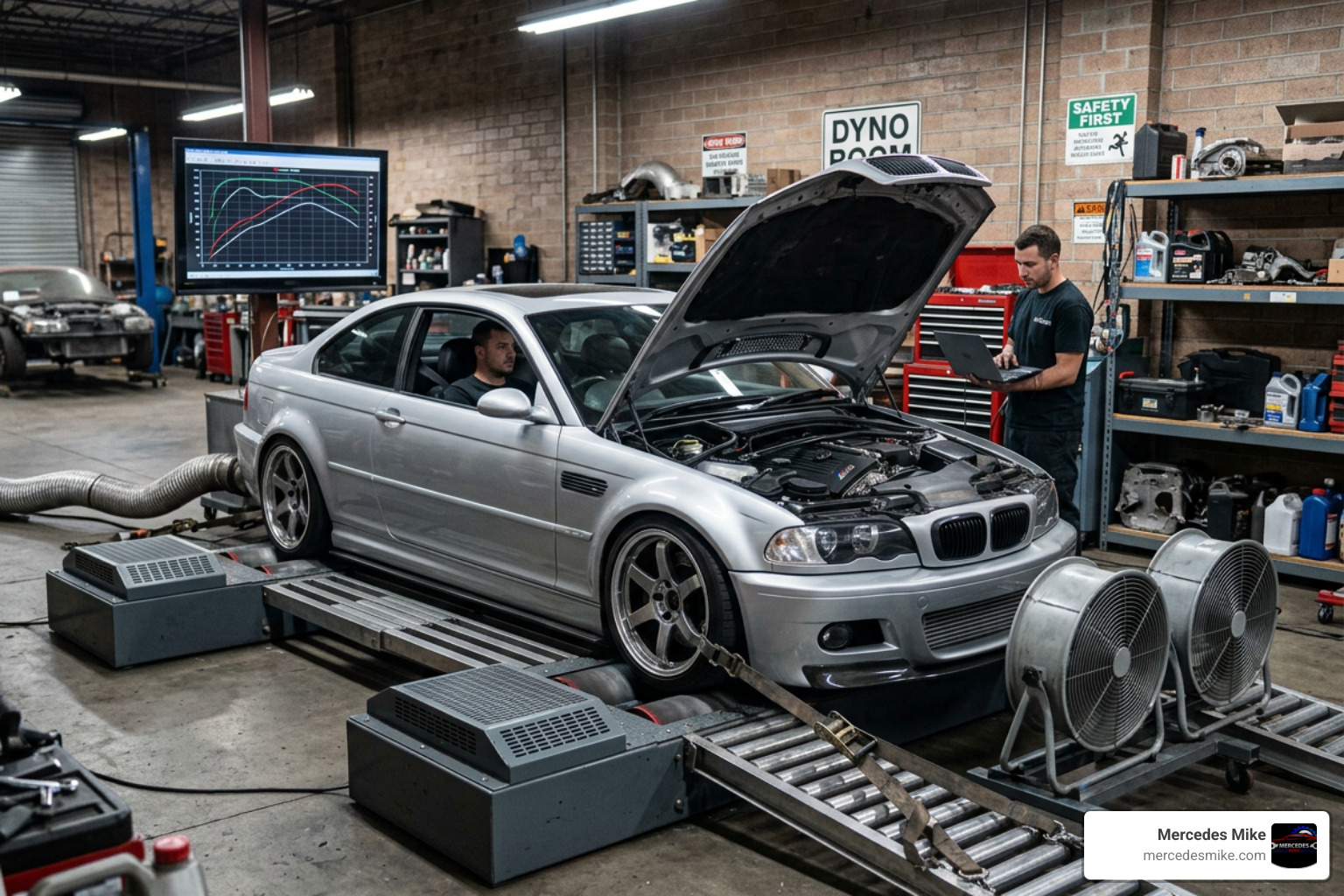
When people talk about mercedes tuning, they are usually referring to reprogramming the vehicle's onboard computers to extract more horsepower, torque, and responsiveness. In modern Mercedes-Benz and AMG vehicles, this is not a single-step job. To get the best results, you must address the three pillars of the Mercedes drivetrain: the Engine Control Unit (ECU), the Transmission Control Unit (TCU), and the Central Powertrain Controller (CPC).
Understanding how these modules communicate is key to planning The Top 5 Performance Upgrades for Your German Car. If you only modify the engine's software while ignoring the transmission and powertrain controllers, the vehicle's factory torque limiters and speed limiters will step in, cutting power to protect components that don't actually need protecting.
The Role of ECU Calibration in Mercedes Tuning
The ECU is the brain of your engine. Factory calibrations are engineered for a global market, meaning they are compromised to accommodate poor fuel quality, extreme weather, neglected maintenance, and strict emissions laws.
When we perform an ECU calibration, we modify specific programmed maps within the engine's computer. Key targets include:
Boost Targets: Safely increasing the pressure delivered by the turbochargers.
Ignition Timing: Optimizing when the spark plugs fire relative to the piston position to maximize the force of combustion.
Air-Fuel Ratio (Lambda): Ensuring the engine runs at the perfect chemical mixture of air and gasoline for both power and engine safety.
Throttle Mapping: Removing factory delays for instantaneous accelerator response.
Unlike cheap "piggyback" tuning boxes that trick factory sensors into demanding more boost, a true ECU tune rewrites the actual logic tables. This ensures the car knows exactly how much torque it is making, allowing factory safety systems to remain completely intact. If you are looking for local experts to help you read and write these files, searching for ECM Tuners Near Me is a great place to start.
Why TCU and CPC Upgrades Are Essential
Many Mercedes owners are disappointed when their newly tuned AMG feels sluggish off the line or hesitates during hard gear shifts. This happens because the TCU and CPC are still operating on factory limits.
The TCU regulates shift speeds, clutch pressure, and torque limits for your gearbox — whether it is the older AMG SPEEDSHIFT 7-speed DCT or the modern 9-speed MCT. When the engine produces torque beyond the TCU's factory-programmed threshold, the transmission tells the ECU to pull back timing and boost. A TCU upgrade increases clutch clamping pressure to prevent slipping and raises these internal torque limits.
The CPC is a secondary module introduced in newer Mercedes models (typically 2018 and later) that acts as a master gatekeeper. It enforces regional top-speed limits and acts as a final filter for torque delivery. Without a CPC tune, your car may physically block the extra power your newly flashed ECU is trying to deliver. Having a Certified Mercedes-Benz Mechanic evaluate your vehicle’s network of control modules ensures these upgrades work in perfect harmony.
The Four Stages of AMG Performance Upgrades
To make the tuning process easier to understand, the aftermarket performance industry categorizes upgrades into four distinct "Stages." Each stage represents a step up in power, hardware complexity, and budget.
Stage Required Hardware Fuel Requirements Focus Stage 1 None (100% Stock Hardware) 91 or 93 Octane Software-only optimization for daily driving Stage 2 High-flow downpipes, intake 93 Octane Maximizing factory turbos by reducing backpressure Stage 3 High-pressure fuel pumps, ethanol sensors E30 Blend / Methanol Overcoming factory fueling limits Stage 4 Upgraded hybrid turbos, built engine internals E85 / Race Fuel Unlocked maximum track performance (900+ WHP)
Whether you are looking for a mild street boost or a 1,000-horsepower highway monster, determining your budget and goals will dictate which stage is right for you. You can read more about how these stages fit into your long-term ownership plans in our guide on The Top 5 Performance Upgrades for Your German Car.
Stage 1 and Stage 2: Bolt-ons and Software
Stage 1 is the sweet spot for 90% of Mercedes owners. It requires absolutely no hardware modifications and is entirely reversible. By simply flashing a new software calibration to the ECU, you can wake up the engine's dormant potential.
Stage 2 is where things get louder and faster. The main goal here is to help the engine breathe. By installing high-flow downpipes (either catless or featuring 400-cell metallic sport catalysts) and performance air intakes, you drastically reduce exhaust backpressure and turbo lag. This allows the tuner to run slightly more aggressive boost targets. If you are ready to take this step, consult with professional ECM Tuners Near Me to ensure your software is properly matched to your new exhaust setup.
Stage 3 and Stage 4: Turbos and Fueling
Stage 3 is where we begin to run into the physical limits of the factory fuel system. To feed the engine enough fuel to match high boost levels, tuners introduce upgraded high-pressure fuel pumps (HPFP), water-methanol injection kits, or port fuel injection. This stage frequently utilizes ethanol blends like E30 to keep combustion temperatures low and prevent engine knock.
Stage 4 represents the absolute peak of mercedes tuning. At this level, the factory turbochargers are removed and replaced with larger, billet-wheel hybrid turbos. To prevent the engine from throwing a rod under immense cylinder pressure, Stage 4 builds often require built engine internals, including forged pistons, upgraded connecting rods, and sleeved engine blocks. For those running diesel performance platforms, similar multi-stage methodologies apply, as discussed in our deep-dive on the C350 CDI Remap.
Most Popular Mercedes-AMG Engines to Tune

Not all Mercedes engines are created equal. While almost any turbocharged engine from Stuttgart can be tuned, a few specific powerplants have earned legendary status in the aftermarket community for their durability and massive power reserves. If you are looking to modify your vehicle, finding experienced ECM Tuners Near Me who understand the unique structural differences of these engines is critical.
The V8 Biturbo Legends: M177, M178, and M157
The modern era of AMG performance is defined by the hot-inside-V biturbo V8 engines.
M177 & M178 (4.0L V8 Biturbo): Found in everything from the C63 and E63 to the AMG GT lineup. This engine is a masterpiece. The TunedMercedes M177.1 M178 Tune ECU Calibration safely achieves roughly 600 HP and 604 lb-ft of torque on a Stage 1 calibration, up from a factory baseline of 469–503 HP. The updated twin-scroll version, addressed by the TunedMercedes M177.2 Tune , pushes even further, hitting an incredible 690 HP and 737 lb-ft of torque on Stage 1 software. With Stage 4 hybrid turbos, these 4.0L engines routinely break the 1,000 HP barrier.
M157 (5.5L V8 Biturbo): The predecessor to the 4.0L, this massive engine powered the older E63, CLS63, and S63 models. It is a torque monster. A Stage 1 tune on this platform can easily yield 640 HP and 663 lb-ft of torque, turning these heavy luxury cruisers into absolute rocket ships.
To keep these high-output V8s running smoothly, always rely on a Certified Mercedes-Benz Mechanic for routine maintenance and pre-tuning health checks.
V6 and V12 Platforms: M276 and Beyond
While the V8s get the most attention, the twin-turbo V6 and V12 platforms have massive tuning potential of their own.
The M276 3.0L V6 Biturbo (found in the C43 and E43 AMG models) is highly responsive to software modifications. Because these cars rely heavily on integrated electronic systems, bundled packages like the PTG M276 ECU, TCU, CPC Tune Package | Premier Tuning Group are incredibly popular, offering a complete, calibrated drivetrain overhaul.
On the extreme end of the scale, tuners like RENNtech Inc. – Performance without compromise have built their reputations on insane, low-volume builds. A historic example is the legendary RENNtech Sledgehammer, which was limited to just 12 units worldwide and featured a massive 7.5-liter V12 M120 engine. For standard passenger cars looking for a similar proportional jump in daily drivability, a simple software remap can work wonders, as we explore in our article on the C350 CDI Remap.
Supporting Modifications and Hardware Upgrades
Tuning is about balance. If you increase the amount of air and fuel entering the engine, you must also upgrade the hardware responsible for moving that air and keeping the engine cool.
Crucial supporting modifications include:
Downpipes: Factory downpipes feature highly restrictive catalytic converters right next to the turbos. Upgrading to high-flow or catless downpipes reduces backpressure, allowing the turbos to spool faster and run cooler. For extreme track applications, specialized systems like the AMG GT Black Series ECU Tune are designed to work hand-in-hand with upgraded downpipes to shave over a second off 60–130 mph acceleration times.
Performance Intakes: Upgraded carbon fiber or high-flow intake systems allow the turbos to draw in larger volumes of cold air, adding an extra 20–40 HP on modern biturbo engines.
Upgraded Intercoolers: Compressing air creates heat. Upgraded air-to-water intercoolers and heat exchangers keep intake air temperatures (IATs) low, preventing the ECU from pulling timing due to heat soak.
Water-Methanol Injection: Spraying a fine mist of water and methanol into the intake tract cools the air charge and artificially raises fuel octane, preventing knock under heavy load.
For those chasing maximum power, high-end hardware systems like the PTG 1000 M177.1 Turbo System (priced around $6,499.99) or the PTG 1000 M178 Turbo System (priced around $7,499.99) replace the factory turbos with custom-engineered, high-volume units. To ensure these complex mechanical parts are installed correctly, always have a Certified Mercedes-Benz Mechanic perform the installation.
Choosing the Right Fuel for Mercedes Tuning
Your tune is only as good as the fuel in your gas tank. High boost levels require high-octane fuel to prevent pre-ignition (knock), which can quickly destroy an engine.
For Stage 1 and Stage 2 street tunes, 93 octane pump gas (98 RON in Europe) is the baseline standard. If you only have access to 91 octane, your tuner must scale back boost and timing to keep the engine safe.
If you want to unlock maximum power, ethanol blends like E30 (30% ethanol, 70% gasoline) provide incredible thermal stability. Ethanol burns cooler and has a much higher effective octane rating than pump gas. However, running full E85 requires highly specialized, high-volume high-pressure fuel pumps, as ethanol requires roughly 30% more fuel volume than gasoline to achieve the same energy output.
Frequently Asked Questions About Mercedes Tuning
Modifying an expensive luxury vehicle naturally raises a lot of questions. Because we specialize in German car maintenance and repair, we believe in helping owners understand the real-world trade-offs of performance modifications. Keeping an eye on your baseline maintenance is the best way to avoid unexpected expenses, which you can learn more about in our breakdown of the Mercedes GLS 450 Maintenance Cost.
Is tuning safe for my Mercedes-AMG engine?
Yes, provided the tune is written by a reputable calibrator and the vehicle is properly maintained. Professional tuners design their files to preserve all factory safety systems. If engine temperatures spike or oil pressure drops, the ECU will still trigger "limp mode" to protect the engine.
The biggest risk to a tuned engine isn't the software — it's deferred maintenance. A tuned engine places higher demands on spark plugs, ignition coils, and engine oil. We highly recommend changing your oil every 5,000 miles (instead of the factory 10,000-mile interval) and running "one-step-colder" spark plugs to handle the increased heat.
What is the difference between OBD flashing and bench tuning?
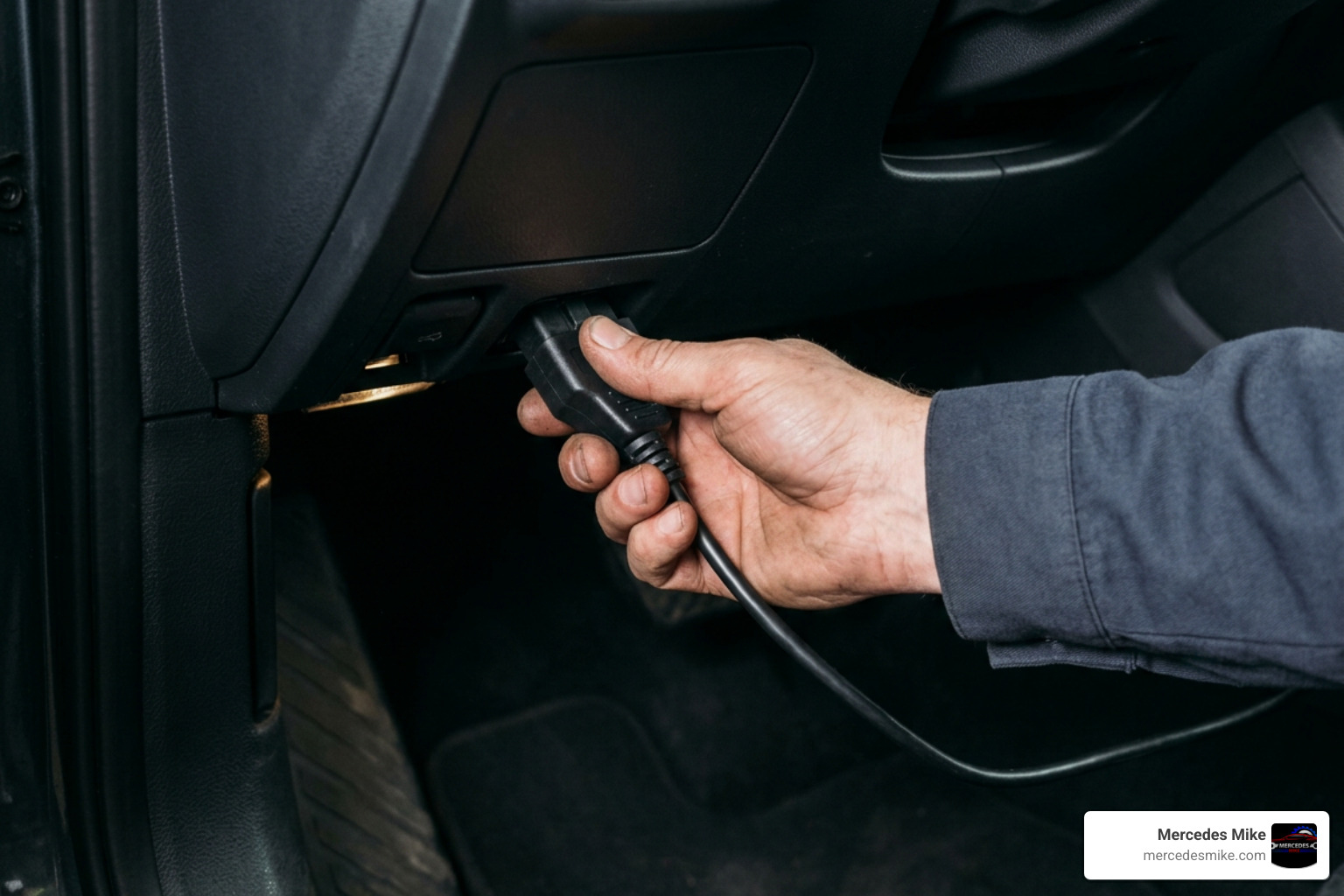
OBD Flashing: This is the modern, convenient standard. Using a laptop or a handheld device (such as the HP Tuners MPVI4 or proprietary software like Premier Tuning Group's Verstand), the tune is written directly through the car's OBDII port under the dashboard. It takes minutes and can be done in your own driveway.
Bench Tuning: Some newer Mercedes ECUs feature advanced factory write-protection. To bypass this, the ECU must be physically removed from the engine bay, opened on a technician's workbench, and flashed by directly pinning the internal circuit board.
To ensure a successful multi-stage build, it is best to work with experienced professionals who can coordinate the software and hardware upgrades seamlessly.
Will tuning my Mercedes void the factory warranty?
Legally, a dealership cannot void your entire warranty simply because a car is modified; they must prove that the aftermarket tune directly caused the specific failure. However, in the real world, if you blow an engine or damage a transmission with an active ECU tune, Mercedes-Benz will almost certainly deny the warranty claim.
Even if you flash your car back to "stock" before visiting the dealer, modern Mercedes ECUs feature internal flash counters and torque loggers. Dealership diagnostic tools can easily detect that the ECU has been modified. If maintaining your factory warranty is your top priority, you should leave the engine software stock.
Conclusion
Tuning your Mercedes-Benz or AMG is an incredibly rewarding experience that completely transforms the personality of your car. By combining a professional ECU calibration with supporting TCU and CPC upgrades, you can safely unlock supercar levels of performance while maintaining the daily drivability and luxury you bought the car for in the first place.
At Mercedes Mike, we specialize in keeping high-performance German cars running at their absolute best. Located in South Florida, our team of highly experienced technicians uses the latest diagnostic tools and OEM parts to handle all of your maintenance and repair needs. Whether you are located in Pompano Beach, Deerfield Beach, or the surrounding area, we are here to ensure your vehicle has a healthy mechanical foundation before you begin your tuning journey.
Ready to make sure your Mercedes is in perfect mechanical shape before uploading your new tune? Come visit us at 882 NE 41st Court (just off N Dixie Hwy) in Pompano Beach.