
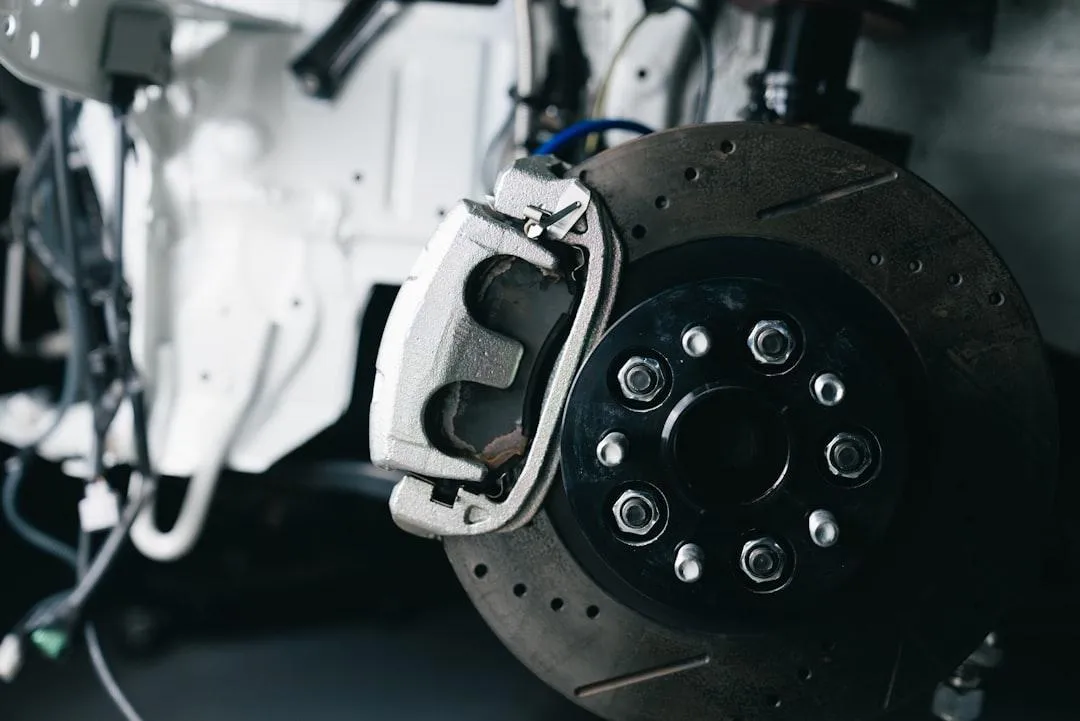
How to Replace Brake Discs Step by Step
Why Brake Disc Replacement Is One of the Most Important Services You Can Do for Your Car
Brake disc replacement is a safety-critical maintenance job — and on a German luxury vehicle like a Mercedes-Benz or BMW, getting it right matters even more than on a standard car.
Here's a quick overview of what you need to know:
How to replace brake discs (summary):
Park on a flat surface and secure the vehicle with wheel chocks and jack stands
Loosen lug nuts and remove the wheel
Remove the brake caliper and hang it safely — never let it hang by the brake hose
Remove the old rotor and clean the hub surface thoroughly
Install the new rotor and reassemble the caliper with new pads
Torque all bolts to manufacturer specs
Pump the brake pedal several times before driving
Bed in the new brakes gradually over the first 200 km
Key facts at a glance:
Topic Quick Answer Average cost per axle $300 to $800 (parts + labor) Rotor lifespan 50,000 to 70,000 miles typically Replace pads too? Yes — always replace pads and rotors together DIY or professional? Professional strongly recommended for German cars Bedding-in required? Yes — gradual braking over first 200 km
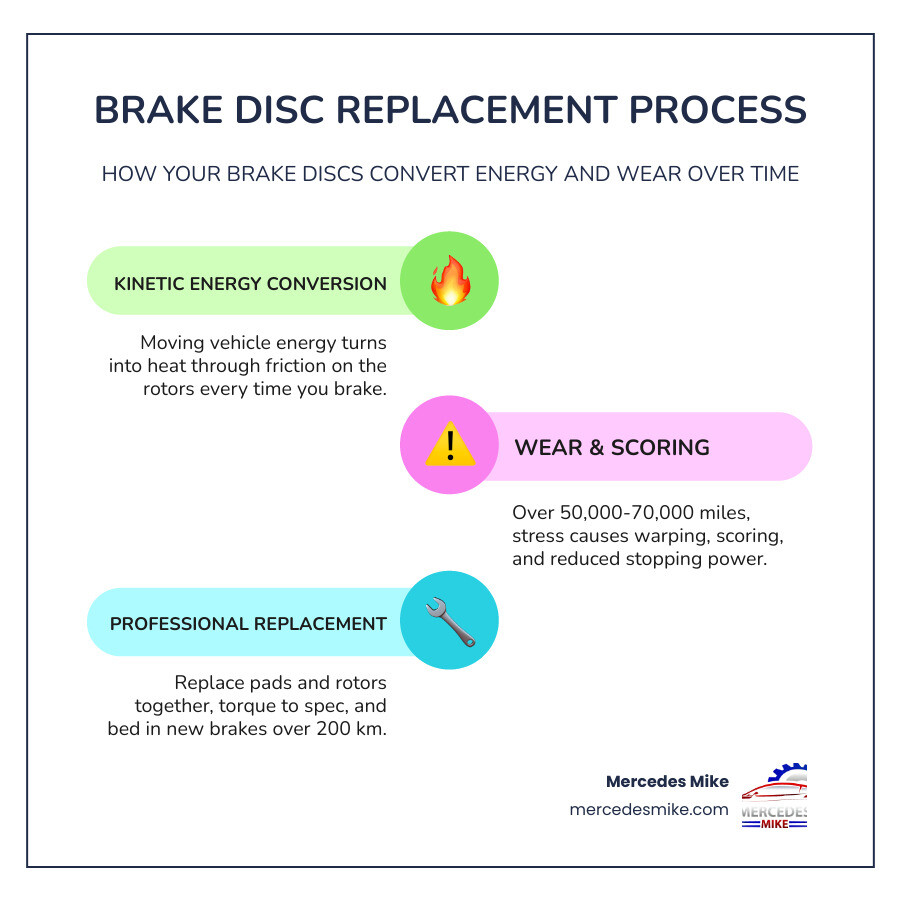
Brakes work by converting the kinetic energy of a moving car into heat through friction. Your brake discs take the full force of that process — every single stop. Over time, that stress causes wear, scoring, and warping that reduce stopping power and put you at risk.
80% of your braking force comes from your front brakes alone. That means front rotors wear faster and need attention more often.
For a busy professional driving a high-performance German car, a brake job isn't just routine maintenance — it's a precision task that directly affects your safety and the safety of everyone around you.
The full guide below walks you through every step of the process, what it costs, when to do it yourself, and when to hand it to a specialist.
Understanding Brake Disc Replacement Costs and Lifespan
When it comes to brake disc replacement, the question we hear most often in our Pompano Beach shop is: "How much is this going to cost?" In May 2026, the average cost for a standard brake job (replacing both pads and rotors on one axle) typically ranges between $300 and $800. If you are looking to service all four wheels, expect to pay anywhere from $600 to $1,200 or more.
However, if you drive a German masterpiece like a Porsche or a Mercedes-AMG, these numbers can shift significantly. Luxury and performance vehicles often utilize specialized materials. For instance, a Mercedes-AMG equipped with carbon-ceramic rotors is a marvel of engineering, but replacing those components can exceed $15,000. These high-performance parts are designed to withstand extreme heat without fading, but that technology comes at a premium.
Lifespan and Longevity
How long do these parts actually last? While brake pads usually need replacing every 30,000 to 40,000 miles, rotors are more durable, generally lasting between 50,000 and 70,000 miles. However, your driving habits in South Florida traffic play a massive role. Frequent "stop-and-go" driving on the N Dixie Hwy or aggressive braking can shorten that lifespan to as little as 25,000 miles. Conversely, conservative highway driving might let you see 80,000 miles or more.
Rotor Types and Cost Comparisons
Not all rotors are created equal. Depending on your vehicle's weight and performance needs, we might install one of three main types:
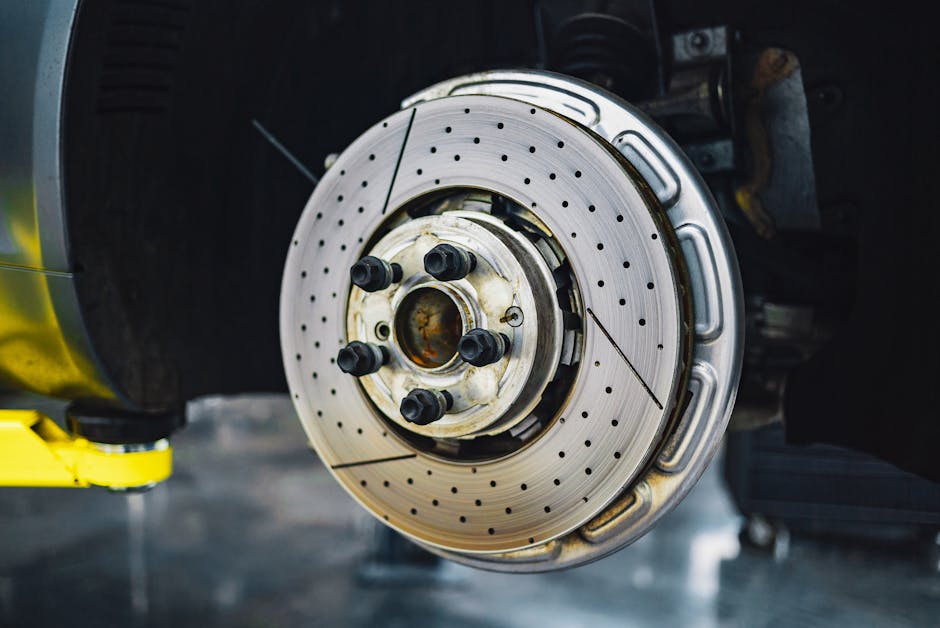
Rotor Type Best For Relative Cost Standard (Flat) Small, lightweight daily drivers $ (Budget-friendly) Vented High-load vehicles and most German sedans $$ (Mid-range) Drilled/Slotted Performance driving and superior heat dissipation $$$ (Premium)
Choosing the right material is vital. While aftermarket rotors can be found for $30 to $75 each, we always recommend Expert Brake Inspection and Service at Mercedes Mike to ensure you are getting OEM-quality parts that meet the specific weight and heat requirements of your German vehicle.
Signs You Need New Brake Discs and Pads
Your car is usually pretty good at telling you when it needs help. If you listen and feel for the signs early, you can often avoid a much larger repair bill.
The Squeal of the Wear Indicator: Most modern brake pads have a small metal tab called a wear indicator. When the pad gets too thin (usually below 3mm), this tab scrapes against the rotor, creating a high-pitched squeal.
Steering Wheel Vibration: If your steering wheel shakes when you apply the brakes, it’s a classic sign of warped rotors. This happens when the disc has "hot spots" or uneven thickness, causing the pads to bounce off the surface rather than grip it smoothly.
Pulsating Brake Pedal: Similar to the steering wheel shake, a pulsating pedal suggests the rotor surface is no longer flat.
Dashboard Warning Lights: Many German cars feature electronic sensors that trigger a light on your dash the moment the pads reach a critical level of wear.
Grinding Noises: This is the "danger zone." A grinding sound means you have reached metal-to-metal contact. The friction material is gone, and the metal backing plate of the pad is eating into the brake disc. At this point, brake disc replacement is no longer optional—it's an emergency.
If you notice any of these symptoms, it’s best to consult a professional. You can learn more about how the entire system connects in our Mercedes Mike Guide to Brake Warning Signs.
How to Perform a Brake Disc Replacement Step by Step
For the DIY enthusiast, replacing rotors is a rewarding but labor-intensive task. Because 80% of your braking power comes from the front, we will focus on the front axle for this guide.

Preparing Your Vehicle for Brake Disc Replacement
Safety is non-negotiable. You are working with a multi-ton machine; do not take shortcuts.
Park on a Flat Surface: Ensure the car won't roll.
Chock the Wheels: Place blocks behind the rear tires.
Loosen Lug Nuts: Do this while the car is still on the ground so the wheel doesn't spin.
Lift and Secure: Use a hydraulic jack to lift the car, but never work on a car supported only by a jack. Always use jack stands placed at the manufacturer's suggested points.
Check Fluid: Open the hood and check the brake master cylinder fluid level. You'll be compressing pistons later, which can cause the fluid to rise and potentially overflow.
Step-by-Step Removal
Once the wheel is off, you'll see the caliper and the rotor.
Remove the Caliper: Undo the mounting bolts. Use a piece of heavy wire or a zip tie to hang the caliper from the suspension. Warning: Never let the caliper hang by the rubber brake hose; the weight can cause internal damage to the line.
Remove the Caliper Bracket: To get the rotor off, you usually need to remove the larger bracket that holds the pads. These bolts are often very tight and may require a breaker bar.
Remove the Rotor: Some rotors have a small locating screw. Remove that first. If the rotor is stuck due to rust, a few taps with a rubber mallet should loosen it.
Clean the Hub: This is the most skipped step, but it's the most important. Use a wire brush to remove every speck of rust from the hub surface. Even rust as thin as a sheet of paper can cause the new rotor to sit unevenly, leading to pedal pulsation later.
Installing the New Components and Bedding-In
Install the New Rotor: Slide it onto the hub and replace the locating screw.
Compress the Piston: Use a caliper tool or a large C-clamp to slowly push the piston back into the caliper housing. This creates room for the new, thicker pads.
Lubricate: Apply a thin layer of high-temperature anti-squeal grease to the back of the new pads where they touch the caliper. Never get grease on the friction surface of the pad or the rotor.
Reassemble: Bolt the bracket and caliper back into place. For German cars, using a torque wrench is essential. Every bolt has a specific "Newton-meter" (Nm) rating that ensures it stays tight without snapping.
The Final Checks: Before putting the wheels back on, ensure everything is clean. Use brake cleaner to wipe any fingerprints or oil off the new rotors.
After the wheels are back on and the car is on the ground, pump the brake pedal three to five times. This seats the pads against the rotor. If you skip this and try to drive, you won't have any braking power on the first press!
The Bedding-In Process
New brakes need to be "mated" together. This process, called bedding-in, transfers a thin layer of pad material onto the rotor.
Drive to a quiet road.
Accelerate to about 50 mph, then brake firmly (but not hard enough to trigger ABS) down to 30 mph.
Drive for a minute to let them cool.
Repeat this 4-5 times.
Avoid "panic stops" for the first 200 km (about 125 miles) to ensure a perfect finish.
Professional vs. DIY: Why German Cars Require Special Care
While the steps above apply to most cars, German engineering often adds layers of complexity. Many modern Mercedes and BMW models use Electronic Parking Brakes (EPB). You cannot simply "push" these rear pistons back; they require a specialized diagnostic computer to retract the electronic motor. Attempting to force them manually can result in a repair bill worth thousands.
Furthermore, luxury vehicles often use multi-piston fixed calipers rather than the simple floating calipers found on domestic cars. These require precision alignment and specific hardware kits that must be replaced every time. At Mercedes Mike in Pompano Beach, our technicians have decades of experience and the latest tools to handle these nuances, ensuring your brake disc replacement is performed to factory standards.
Improper DIY installation on a high-performance system can lead to reduced braking efficiency, uneven wear, or even complete system failure. If your car has advanced driver-assistance systems (like Pre-Safe or adaptive cruise control), the braking system must be perfectly calibrated to work with these safety features.
Frequently Asked Questions about Brake Disc Replacement
Should I replace brake pads and rotors at the same time?
Yes, we almost always recommend it. While you can sometimes resurface (turn) old rotors if they are thick enough, the labor cost often makes it more efficient to simply install new ones. Putting new pads on old, grooved rotors will significantly reduce your stopping power and cause the new pads to wear out prematurely. For the best safety and performance, replace them as a set.
How long do brake discs typically last in 2026?
In 2026, with the advancement of hybrid regenerative braking and better metallurgy, many rotors can last up to 70,000 miles. However, the heavy weight of modern SUVs and the heat of South Florida summers mean many local drivers see a lifespan closer to 50,000 miles. Heavy-duty use, such as towing or spirited driving through the Everglades, will reduce this further.
Why are my new brakes squeaking after replacement?
A little noise during the first few miles is normal as the protective coating wears off the rotors. However, persistent squeaking usually means one of three things:
Improper Bedding: The pad material hasn't transferred evenly.
Lack of Lubrication: The technician didn't apply anti-squeal grease to the contact points on the back of the pads.
Moisture: If it only happens in the morning, it's likely just surface rust from humidity being scraped off during your first stop.
Conclusion
Your brakes are the most important safety feature on your vehicle. Whether you are cruising down Federal Highway or navigating the streets of Deerfield Beach, you need to know that your car will stop exactly when you need it to.
Brake disc replacement is more than just a mechanical task; it's an investment in your peace of mind. While DIY is an option for some, the complexity of modern German engineering—from electronic sensors to high-performance calipers—often makes professional service the smartest choice.
At Mercedes Mike, we specialize in the maintenance and repair of Mercedes, BMW, Audi, and Porsche. With decades of experience and a commitment to using the latest tools and OEM-quality parts, we ensure your German vehicle performs exactly as the engineers intended. Don't leave your safety to chance. Schedule your professional brake service at our Pompano Beach location today and experience the difference that expert care makes.