The Ultimate Guide to CLK 200 Kompressor Tuning and Performance
What You Need to Know About CLK 200 Kompressor Tuning
CLK 200 Kompressor tuning is one of the most searched topics among Mercedes enthusiasts — and for good reason. The stock 163 PS output leaves many owners wanting more, especially those who have driven more powerful cars before.
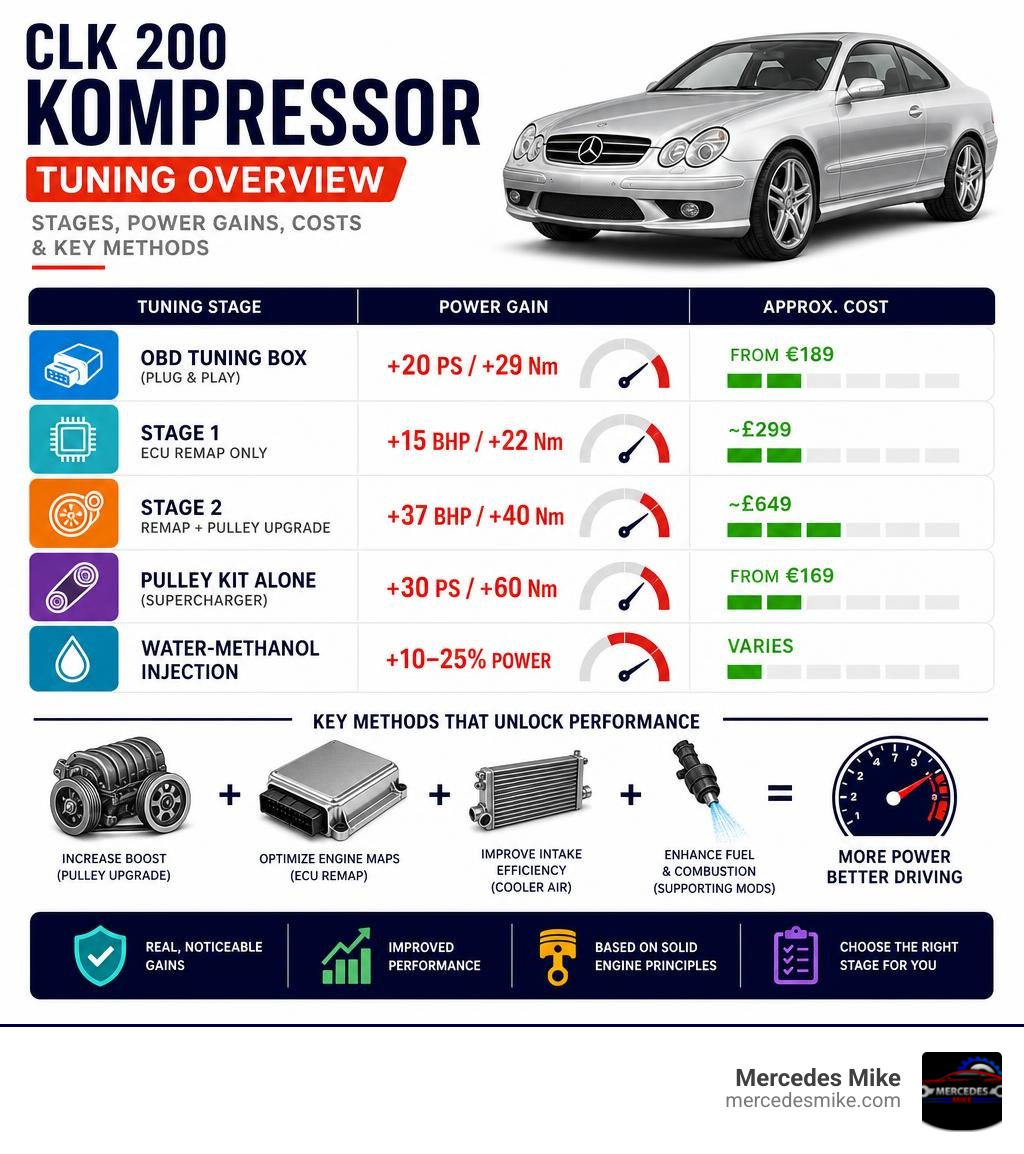
Here's a quick summary of what's actually possible:
Tuning Method Power Gain Approx. Cost OBD tuning box (e.g. GAN) +20 PS / +29 Nm From €189 Stage 1 ECU remap only +15 BHP / +22 Nm ~£299 Stage 2 remap + pulley upgrade +37 BHP / +40 Nm ~£649 Pulley kit alone (e.g. Speer) +30 PS / +60 Nm From €169 Water-methanol injection +10–25% power Varies
The bottom line: a pulley upgrade combined with an ECU remap is the most effective way to get real, noticeable gains from the M111 or M271 Kompressor engine. A remap alone delivers modest results that most drivers barely feel on the road.
But tuning this car isn't just about bolting on parts. There are real mechanical prerequisites, common failure points, and financial trade-offs that every CLK 200K owner should understand before spending a single euro.
One forum member summed it up perfectly after switching from a 225 BHP Audi TT to a CLK 200K: the power gap was immediately obvious. That frustration is exactly what drives owners to explore what this supercharged coupe is actually capable of.
This guide covers every tuning stage, supporting modifications, common problems, and whether tuning even makes financial sense compared to simply upgrading to a more powerful model.
The Core Methods of CLK 200 Kompressor Tuning
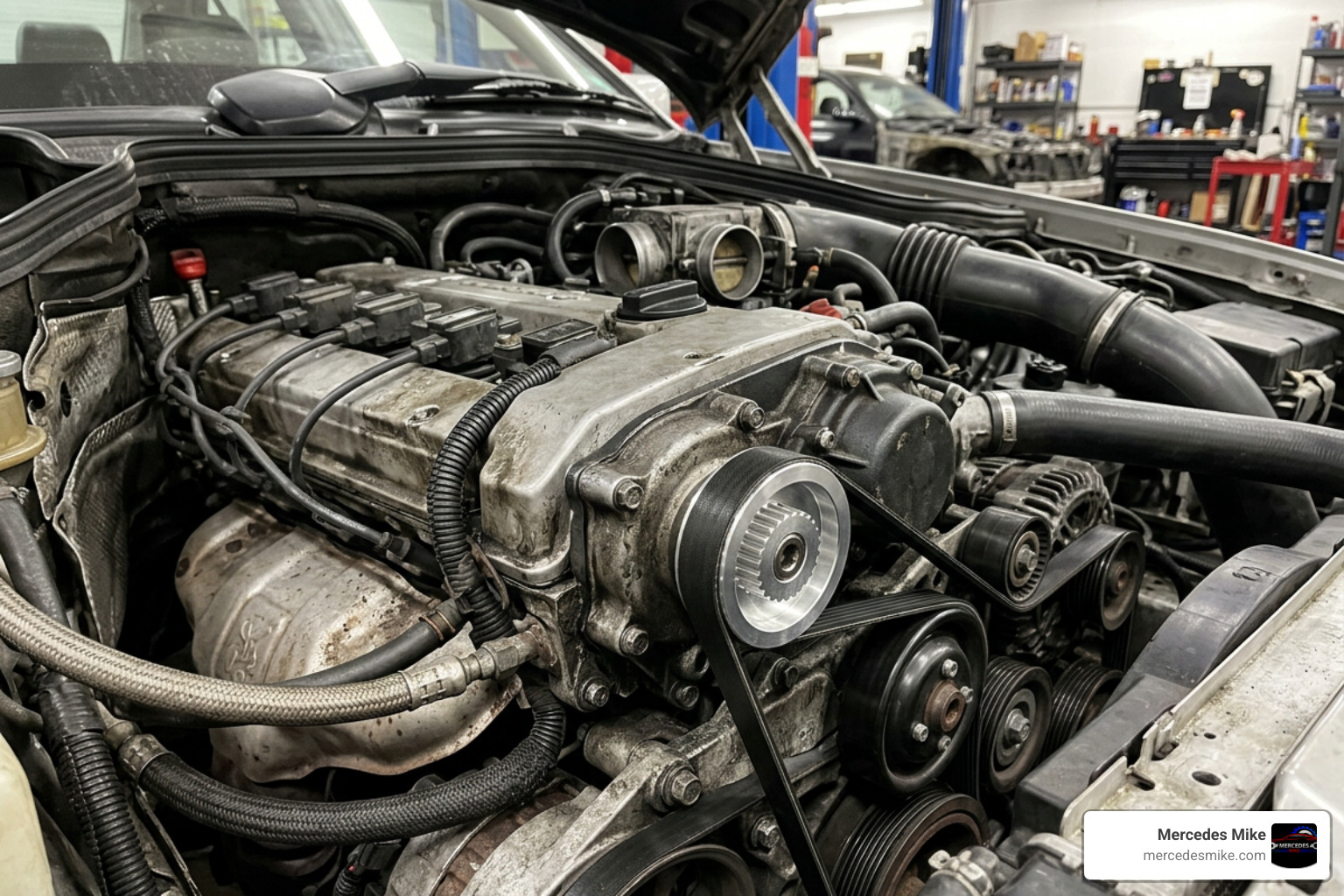
When it comes to extracting more power from the 2.0L M111 or the 1.8L M271 supercharged engines inside the W208 and W209 chassis, we must look at how these forced-induction powerplants breathe. Unlike a naturally aspirated engine, where you are heavily limited by atmospheric pressure, a Kompressor engine relies on a belt-driven Eaton supercharger to pack dense air into the cylinders.
To make more power, we need more boost, more fuel, and optimized ignition timing. This can be achieved through three primary avenues: mechanical hardware changes (pulley upgrades), direct electronic changes (ECU remapping), or external electronic interceptors (plug-and-play tuning boxes).
Before diving into the mechanical work, it is important to understand the overall landscape of upgrading these classic European platforms. For a broader look at upgrading these powerplants, you can read More info about Mercedes tuning.
Is a Standalone ECU Remap Enough for CLK 200 Kompressor Tuning?
Many owners ask if they can simply plug a laptop into the OBD-II port, flash a new map, and walk away with a fast car. The short answer is: yes, you can do it, but you will likely be underwhelmed by the results.
A standard Stage 1 ECU remap on a completely stock CLK 200 Kompressor typically yields a modest increase of about +15 BHP and +22 Nm of torque. While this software adjustment does sharpen throttle response and smooth out the mid-range torque curve, a 15-horsepower gain on a heavy luxury coupe is barely noticeable in daily driving.
The reason for this limitation is simple physics. The factory Eaton supercharger is mechanically locked to a specific spin rate by the physical sizes of the crankshaft pulley and the supercharger snout pulley. Without changing these physical diameters, the supercharger cannot physically pump more air volume into the engine. The ECU remap can only optimize the fuel mixture and advance the ignition timing within the tight limits of the stock boost pressure (which sits around a conservative 0.4 bar).
If you are looking for local experts to help you navigate software-based calibrations, you can find More info about ECM tuners.
Stage 2 Upgrades: The Sweet Spot of CLK 200 Kompressor Tuning
If you want a transformation that makes your CLK feel like an entirely different machine, Stage 2 is where you need to look. This is the sweet spot of clk 200 kompressor tuning.
Stage 2 combines a physical pulley upgrade with a matching ECU remap. By either reducing the size of the supercharger snout pulley or enlarging the crankshaft pulley, you change the drive ratio. This forces the Eaton supercharger to spin faster at any given engine RPM, raising boost pressure from the factory 0.4 bar to approximately 0.6 bar.
An enlarged crankshaft pulley (for instance, stepping up from a stock 200mm to a 220mm duraluminum pulley) increases boost pressure by about 0.09 bar on its own. When paired with a shorter, heavy-duty V-ribbed belt and a custom Stage 2 software calibration to adjust the fuel-to-air ratio, this setup reliably delivers an additional +37 BHP and +40 Nm of torque. This pushes your total output to a very respectable 200 BHP.
Enthusiasts regularly exchange real-world dyno results and installation tips on this exact setup. You can read through a highly detailed Discussion on Kompressor pulley and chiptuning to see how these modifications perform over time.
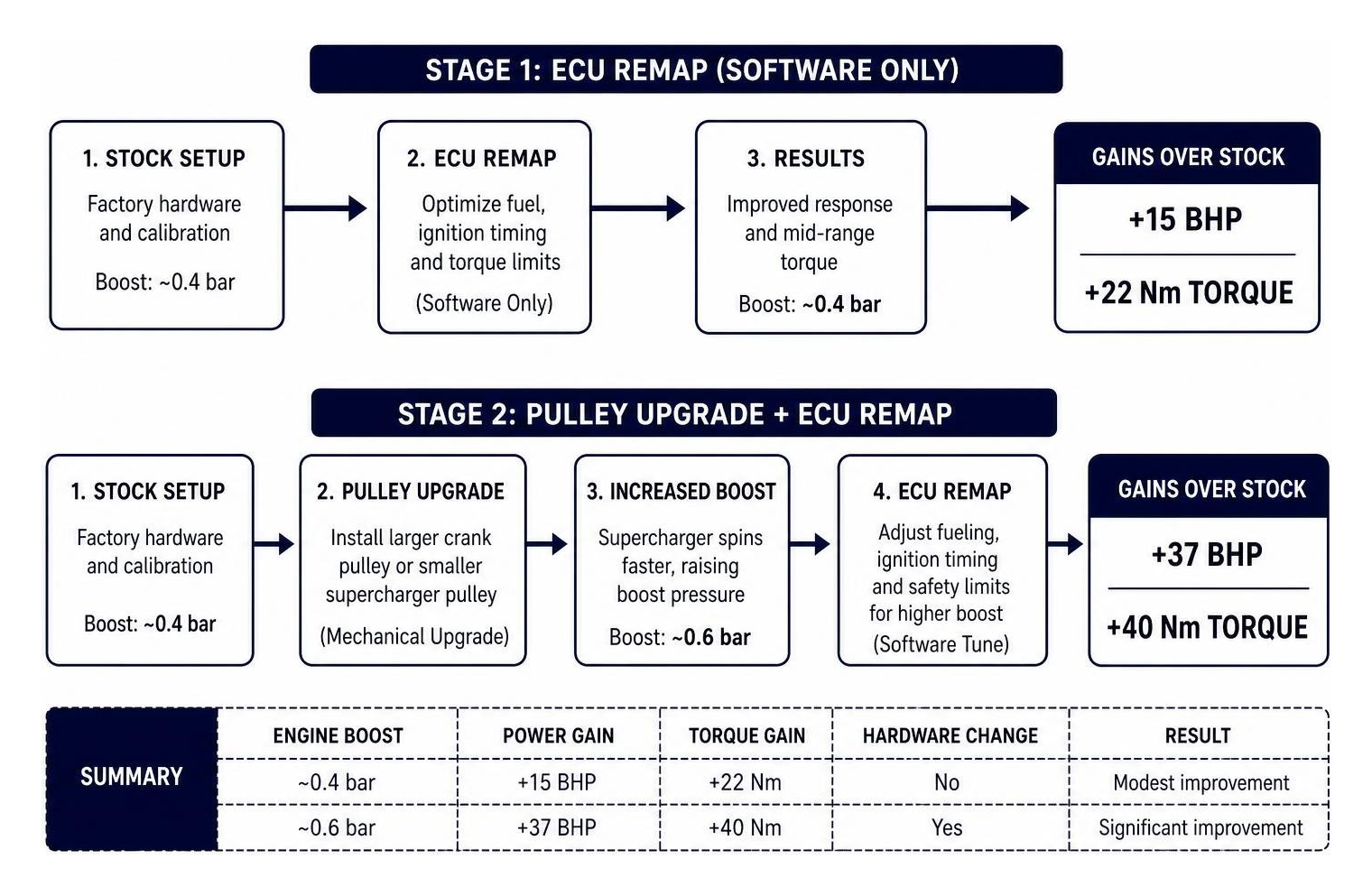
Here is a detailed comparison of the realistic gains you can expect when choosing between these paths:
Metric Stock Stage 1 (Software Only) Stage 2 (Pulley + Software) Engine Boost ~0.4 bar ~0.4 bar ~0.6 bar Peak Horsepower 163 BHP ~178 BHP ~200 BHP Peak Torque 240 Nm ~262 Nm ~280 Nm Seat-of-the-pants Feel Lazy off the line Slightly crisper throttle Strong mid-range pull
Supporting Modifications for Safe Power Delivery
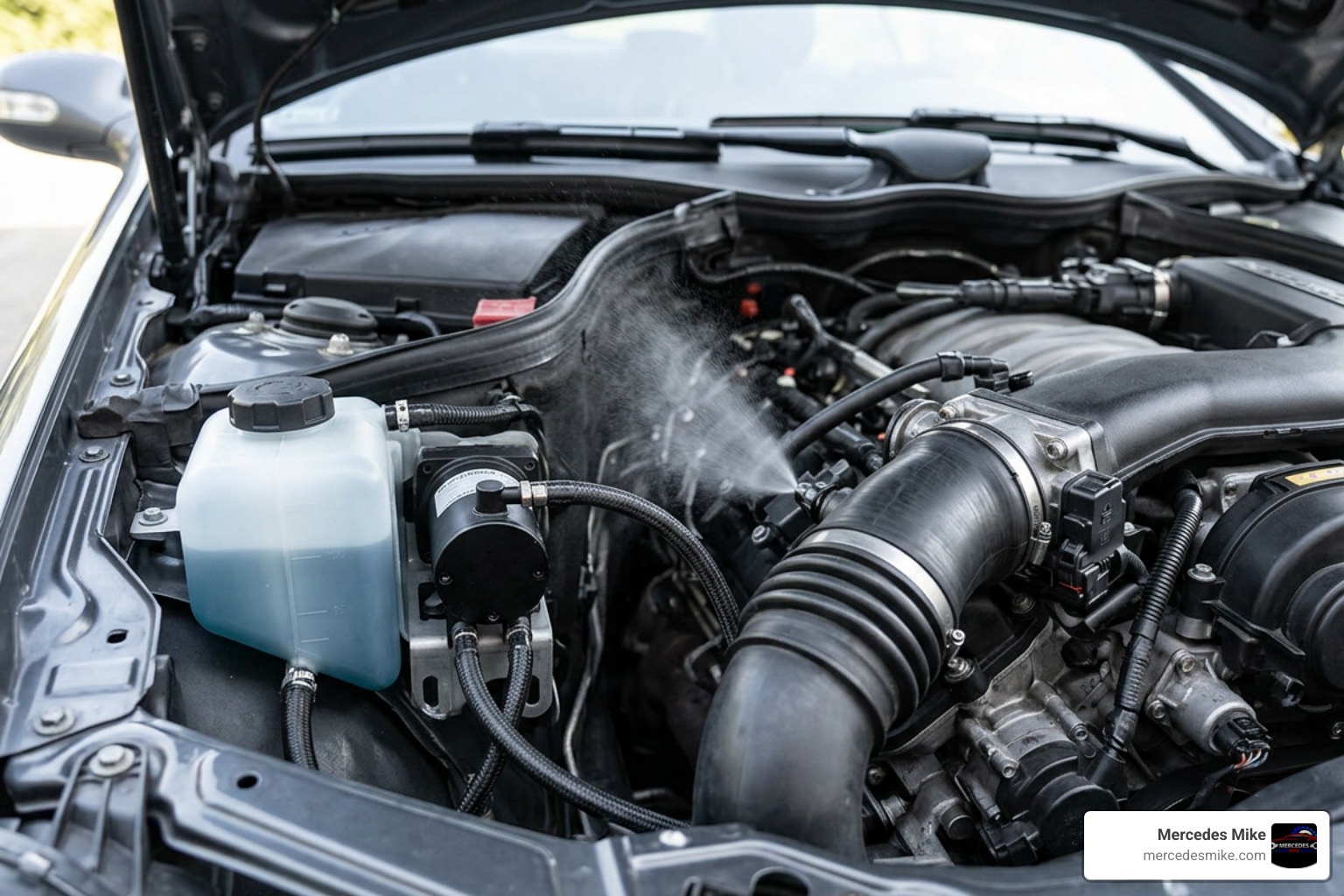
When you force a supercharger to spin faster, you run directly into the laws of thermodynamics. Compressing air generates heat. If your intake air temperatures (IATs) climb too high, the air becomes less dense, and the risk of destructive engine knock (pre-ignition) increases. To protect the engine, the factory ECU will automatically pull back ignition timing, which completely robs you of the extra power you just paid to unlock.
To keep your engine running safely and reliably under higher boost, you need to think about supporting modifications. For a broader look at how to build a reliable high-performance European car, check out More info about top performance upgrades.
Water-Methanol Injection and Cooling
One of the most elegant ways to combat rising intake air temperatures on a supercharged Mercedes is chemical intercooling via water-methanol injection. Systems like the Snow Performance Boost Cooler inject a finely atomized mist of water and methanol directly into the intake tract before the throttle body.
This mixture does two things simultaneously:
Extreme Thermal Reduction: The water droplets evaporate instantly upon entering the hot intake air, dropping intake charge temperatures by up to -60°C.
Octane Boosting: The vaporized methanol acts as an extremely high-octane fuel source, effectively raising the knock resistance of your pump gas and allowing the ECU to safely run advanced ignition timing.
By using water-methanol injection, you can safely extract an additional 10% to 25% more power from your tuned Kompressor engine without exposing the internal pistons and valves to thermal stress.
Exhaust Upgrades and Custom Piping
To get more air into the engine, you must also make it easier for exhaust gases to escape. High backpressure is the enemy of supercharged performance.
For the W209 CLK 200K, many owners want to install a dual-exit exhaust system to mimic the aggressive look of V8 AMG models. However, this is not a simple bolt-on affair. Because the factory exhaust on the CLK 200K only exits on the left side, a custom exhaust shop must carefully route the right-side piping around the spare wheel well tub.
Beyond aesthetics, upgrading to a high-flow downpipe and a sport catalytic converter is highly recommended. Reducing restriction directly behind the exhaust manifold lowers exhaust gas temperatures (EGTs) and allows the supercharger to scavenge the cylinders more efficiently, preventing power loss at high RPMs.
Common Issues and Troubleshooting When Tuning
Tuning an older vehicle will quickly expose any weak links in the mechanical chain. Before adding more boost, you must ensure your engine is in perfect running health. If your car is already suffering from minor sensor issues or vacuum leaks, tuning it will only amplify these problems.
If you are experiencing strange power loss or supercharger issues, you should read through a community-driven Troubleshooting supercharger disengagement guide to understand how the factory ECU manages boost protection.
Supercharger Disengagement and Limp Mode
A classic symptom of a problematic Kompressor engine is a supercharger that works perfectly when the car is cold, but suddenly disengages entirely once the engine warms up to its operating temperature of 80°C (typically when accelerating past 3,200 RPM). When this happens, the car feels incredibly slow, acting as a heavy, naturally aspirated 2.0L engine.
This is almost always caused by the ECU triggering a safety "limp mode." The W208 and W209 engines utilize an electromagnetic clutch on the supercharger snout. If the ECU detects a fault, it will cut power to this electromagnet, preventing the clutch from engaging. Common triggers for this safety mode include:
Faulty Mass Airflow (MAF) Sensor: If the MAF sensor sends incorrect or missing data, the ECU cannot safely calculate fueling under boost and disables the supercharger.
Oil Migration: A notorious issue on M111 and M271 engines is oil leaking from the camshaft adjuster sensor. This oil can physically migrate down inside the wiring harness, eventually reaching the ECU and shorting out critical sensor signals.
Blocked Catalytic Converters and Backpressure
Another frequent culprit behind sudden supercharger disengagement is a blocked or disintegrating factory catalytic converter. Over time, the internal ceramic honeycomb structure of the catalytic converter can break apart, creating a physical restriction in the exhaust pipe.
When you attempt to accelerate, this restriction creates massive exhaust backpressure. The ECU monitors engine load and exhaust parameters; when it detects this excessive backpressure, it immediately cuts power to the supercharger clutch to prevent the engine from melting a piston due to trapped heat.
A quick way to diagnose this at home is to temporarily loosen the exhaust flange coupling slightly before the catalytic converter to let exhaust gases escape. If the supercharger suddenly engages and stays active when warm, you have confirmed that a blocked catalytic converter is your issue. For a definitive diagnosis, a professional workshop should scan the vehicle using a dedicated Mercedes Star Diagnosis system.
Financial Feasibility: Tuning vs. Upgrading Your CLK
Before spending thousands of dollars modifying a CLK 200 Kompressor, you must step back and look at the financial reality. The W208 and W209 generation cars are highly affordable on the used market, meaning you must weigh the cost of modifications against the market value of the car.
If you are trying to decide whether to build or buy, you can read more about Evaluating W208 tuning feasibility.
Let's look at the numbers. A proper Stage 2 package (high-quality duraluminum pulley, matching belt, software calibration, and professional installation) will easily run you upwards of $800 to $1,200. If you add supporting mods like a high-flow exhaust or water-methanol injection, you can easily double that figure.
For that same total investment, you could often sell your CLK 200K and buy a factory-original CLK 230K, a silky-smooth V6 CLK 320, or even a V8-powered CLK 430/500. Upgrading to a more powerful factory model offers several distinct advantages:
OEM Reliability: A larger engine making the same power does so with less stress, lower operating temperatures, and better long-term reliability.
Insurance Simplicity: Highly modified vehicles can see massive spikes in insurance premiums. A factory CLK 320 is often cheaper to insure than a heavily modified CLK 200K making the same horsepower.
Resale Value: Modified cars are notoriously difficult to sell. Buyers generally prefer unmolested, factory-original cars over someone else's custom project.
However, if you live in a region with displacement-based road taxes, or if you simply love the unique character and supercharger whine of a highly tuned four-cylinder, modifying your CLK 200K can be an incredibly rewarding project.
Frequently Asked Questions About CLK 200K Tuning
Do I need to run higher octane fuel after installing a pulley kit?
Yes, absolutely. When you install a pulley kit to increase boost pressure, you are packing more air and fuel into the combustion chamber, which raises cylinder pressures and temperatures. Under these conditions, low-octane fuel is highly prone to pre-ignition (engine knocking).
To prevent catastrophic engine damage, you must run high-octane premium fuel (Super Plus 98 octane in Europe, or 93 AKI in South Florida). The ECU will use its knock sensors to adjust ignition timing, but running low-grade fuel on a pulley-tuned engine will cause the ECU to pull timing, completely defeating the purpose of the tune. You can dive deeper into the combustion physics in this Technical discussion on Kompressor tuning.
What are the safe RPM limits for the Eaton supercharger?
The factory Eaton supercharger (such as the M45 or M62 used on these engines) is a highly robust unit, but it does have physical speed limits. Under nominal daily driving conditions, you should keep the supercharger's rotational speed under 17,000 RPM at the engine's redline, with absolute brief peaks never exceeding 20,000 RPM.
When calculating your pulley ratios (crankshaft pulley size vs. supercharger snout pulley size), make sure you do not over-spin the supercharger. Over-spinning it past its design limits will not yield more boost; instead, the supercharger will simply act as a giant hair dryer, superheating the intake air and causing a massive drop in performance.
Will an aftermarket OBD tuning box void my vehicle warranty?
If you are using a modern plug-and-play OBD tuning module (like the GAN GA+), these units do not actually overwrite the factory ECU's internal flash memory. Instead, they plug into the OBD-II port and intercept sensor signals in real-time, correcting them to optimize power.
Because they do not write permanent changes to the ECU, they are completely reversible. You can simply unplug the device before taking your car in for service, and the vehicle will return to its 100% factory state without leaving a digital footprint. For more details on these plug-and-play software options, see the OBD chip tuning options.
Conclusion
Tuning your Mercedes-Benz CLK 200 Kompressor is a fantastic way to unlock the hidden potential of a classic German coupe. Whether you opt for a simple plug-and-play tuning box to sharpen up your daily commute, or go all-out with a custom Stage 2 pulley and software package, ensuring your engine's baseline health is the absolute key to success.
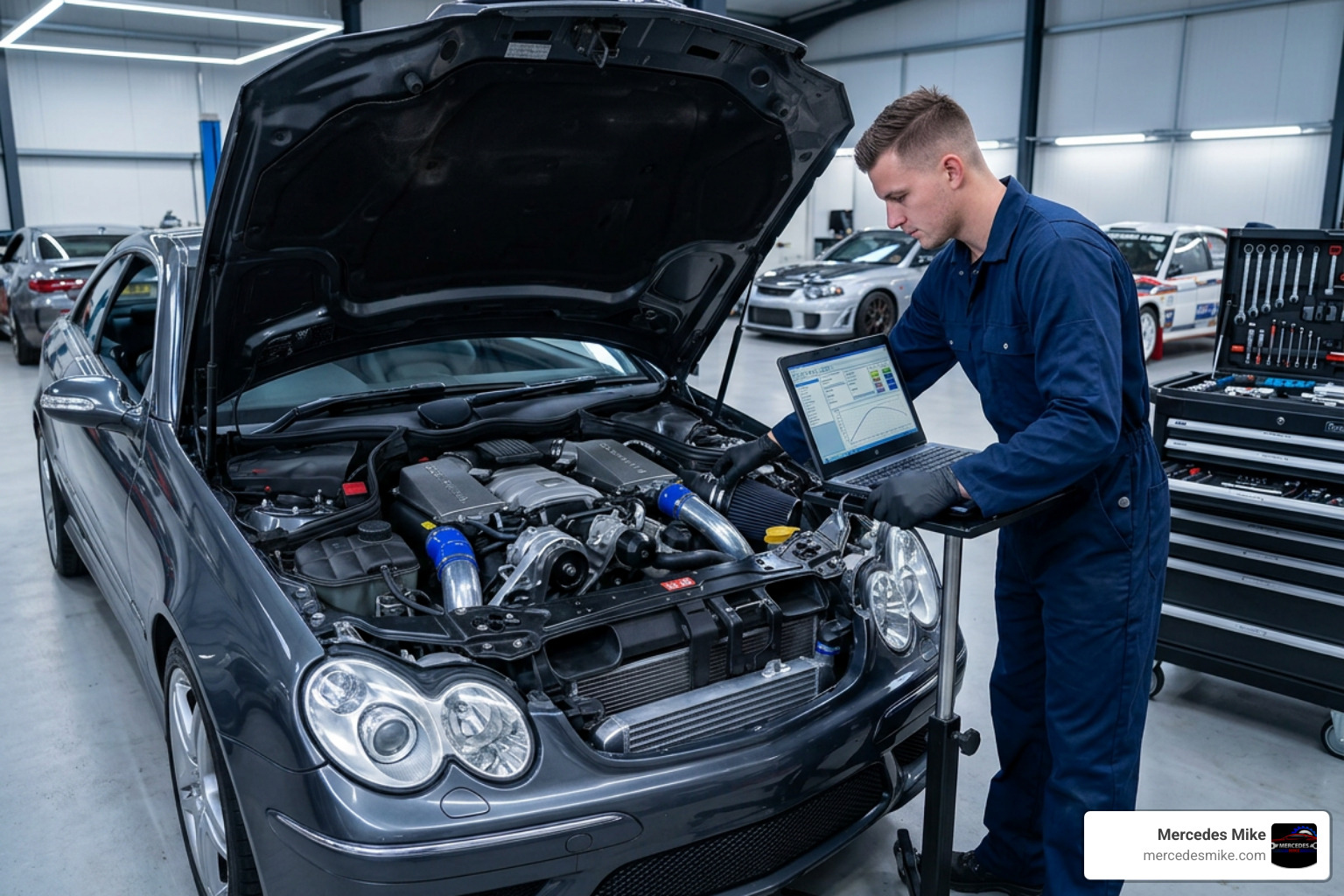
At Mercedes Mike, we specialize in high-quality maintenance, deep-level diagnostics, and performance consulting for German vehicles across South Florida, including Pompano Beach and Deerfield Beach. Our shop is located at 882 NE 41st Court, just off N Dixie Hwy in Pompano Beach. With decades of hands-on experience and the latest factory-grade diagnostic tools, our master technicians can help you diagnose supercharger issues, repair oil-damaged wiring harnesses, or prepare your vehicle for performance upgrades.
Ready to make sure your Kompressor is running at peak performance? Schedule a performance consultation with us today, and let our team keep your classic Mercedes driving beautifully.