
How to Find a Scheduled Maintenance Schedule
Why Scheduled Maintenance Is the Difference Between a Smooth Ride and a Costly Breakdown
Scheduled maintenance is any planned upkeep task performed on a set timetable — before problems occur — to keep equipment, vehicles, or systems running reliably.
Quick answer: What is scheduled maintenance?
What it is: Maintenance performed at regular intervals (by time, mileage, or usage), regardless of whether a problem is visible yet
Goal: Prevent failures before they happen, reduce downtime, and control costs
Examples: Oil changes every 10,000 km, quarterly HVAC filter replacements, annual brake inspections
Who it's for: Vehicle owners, facility managers, manufacturers — anyone who depends on equipment staying operational
Key benefit: Catching small issues early is almost always cheaper than emergency repairs
Despite how important this is, 37% of businesses still track maintenance using spreadsheets or manual methods. That makes it easy to miss tasks, fall behind on schedules, and end up paying far more for reactive repairs than proactive ones.
For owners of German luxury vehicles — like a Mercedes-Benz or BMW — this matters even more. These cars use sophisticated engineering that rewards consistent care. Skip a scheduled service, and a small issue can quietly become a transmission problem or an electrical fault that costs thousands.
This guide walks you through exactly how to find, understand, and follow a scheduled maintenance schedule for your vehicle.
Understanding Scheduled Maintenance and Its Core Benefits
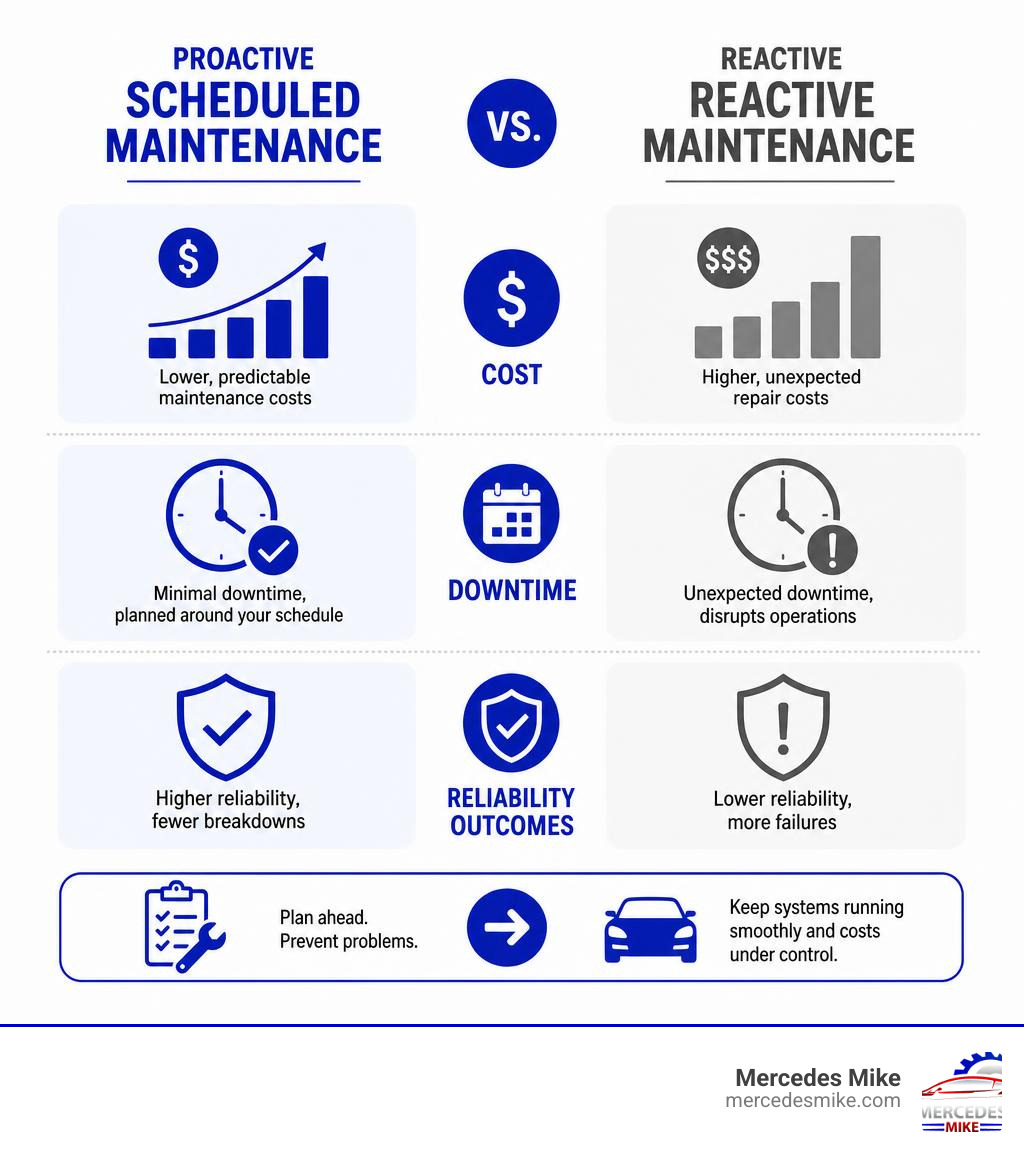
To truly appreciate why a scheduled maintenance program is so vital, we first need to look at how it differs from other upkeep strategies. In the maintenance world, there are three primary ways to handle equipment:
Reactive Maintenance (Run-to-Failure): You fix things only when they break. It’s the equivalent of driving your car until the engine stops running because it ran out of oil. It requires zero planning, but it is incredibly expensive, stressful, and disruptive.
Condition-Based Maintenance: Upkeep is performed based on real-time measurements of the equipment's physical condition (like monitoring tire tread depth or using vibration analysis on a factory motor).
Scheduled Maintenance: This is a proactive, time- or usage-based approach. Tasks are assigned to specific dates, mileage markers, or run-time hours. It happens regardless of whether the asset is currently showing signs of wear.
Maintenance Type Trigger Cost Operational Impact Best Used For Reactive Equipment breakdown Very high (emergency repairs) High (unplanned downtime) Non-critical, cheap assets Condition-Based Real-time wear indicators Moderate to high (requires sensors) Low (planned around wear) Highly critical, expensive machinery Scheduled Calendar time, mileage, or usage Low and highly predictable Very low (scheduled during off-peak) Vehicles, HVAC, and vital infrastructure
The Core Benefits of a Scheduled Approach
Implementing a rigorous schedule of upkeep tasks offers major advantages across any industry, whether you are managing a fleet of vehicles in South Florida or coordinating municipal infrastructure like the City of Pompano Beach Facilities Maintenance team.
Unmatched Cost Control: Unplanned emergency repairs can cost up to three to four times more than scheduled service. Proactive care allows you to budget your expenses predictably.
Superior Equipment Reliability: Regularly cleaning, lubricating, and inspecting components prevents the sudden failures that leave you stranded on the side of the road or shut down a production line.
Enhanced Safety: Worn-out brakes, clogged ventilation systems, and frayed belts are safety hazards. Regular checks catch these dangers before they put lives at risk.
Regulatory Compliance: For businesses and municipalities, keeping detailed records of scheduled upkeep is often a legal requirement. It ensures you easily pass safety and environmental audits.
Planned Maintenance vs. Scheduled Tasks: Key Differences
It is incredibly common to hear people use the terms "planned maintenance" and "scheduled maintenance" interchangeably. However, in professional operations, they represent two distinct stages of the upkeep process.
Planned maintenance is the what and the how. It is the analytical phase where you identify what materials, tools, safety procedures, and workflows are required to complete a task.
Scheduled maintenance is the when and the who. It is the scheduling phase where you take those planned tasks and assign them to a specific calendar date, time window, and technician.
Think of it like planning a road trip down to the Florida Keys. Planning the trip involves picking the route, deciding which bags to pack, and calculating how much fuel you'll need. Scheduling the trip is deciding that you will turn the key in the ignition at exactly 7:00 AM on Saturday morning.
Without planning, a scheduled task can quickly fall apart because the technician might show up only to realize they don't have the correct replacement part. Conversely, without scheduling, a well-planned task simply sits on a to-do list forever, never actually getting done.
This dual-stage approach is exactly how manufacturers maintain peak performance, and it is the foundation of factory-recommended care for luxury vehicles. Following a manufacturer's factory scheduled maintenance plan ensures that every single filter, fluid, and mechanical component is checked and replaced at the precise moment it needs to be, keeping your machine running like new.
This concept isn't limited to physical machinery, either. Software platforms use the exact same logic. For example, during the Namecheap scheduled software maintenance event in May 2026, engineers planned the necessary security updates weeks in advance, but scheduled the actual execution for a specific off-peak three-hour window to ensure zero downtime for active users.
How to Create and Optimize an Effective Maintenance Schedule
Building a successful schedule requires moving away from messy spreadsheets and adopting a structured, repeatable system.

Step-by-Step Guide to Building a Scheduled Maintenance Program
If you are looking to establish a reliable schedule for your business assets or your household vehicles, follow these five proven steps:
Inventory Your Assets: You cannot maintain what you do not know you have. Create a complete list of every piece of equipment, machine, or vehicle under your care.
Determine Maintenance Requirements: Consult manufacturer manuals, historical repair logs, and regulatory guidelines to outline exactly what services are needed and how often.
Prioritize Maintenance Tasks: Not all assets are created equal. Focus your immediate attention and resources on critical assets — those whose failure would stop your daily operations or compromise safety.
Create the Schedule: Map out the tasks onto a digital calendar or dedicated software. Assign specific dates and make sure to distribute the workload evenly so your technicians (or your own schedule) aren't overwhelmed all at once.
Implement and Adjust: Put the plan into action. As you collect data over time, review how well the schedule is working and adjust the intervals if you find you are over-maintaining or under-maintaining certain items.
Best Practices for Optimizing Your Scheduled Maintenance Workflows
To make your program as efficient as possible, keep these best practices in mind:
Leverage Technology: Ditch the whiteboard. Modern digital management tools send automatic alerts when a service window is approaching, ensuring nothing slips through the cracks.
Train Your Team thoroughly: Ensure that whoever is performing the work has the right training and specialized tools. This is especially true for complex systems.
Review and Optimize Regularly: Use historical data to find patterns. If a specific component consistently fails a week before its scheduled service, it's time to shorten that maintenance interval.
For owners of high-end imports, keeping up with these steps is the single best way of preventing common German car problems, such as oil leaks, cooling system failures, or complex electrical gremlins that often plague poorly maintained European vehicles.
Prioritizing Overdue Tasks with Critical Percent (SMCP)
We don't live in a perfect world. Even with the best software and the most dedicated team, maintenance tasks will occasionally fall behind. When you have a backlog of overdue tasks, how do you decide which one to tackle first?
This is where Scheduled Maintenance Critical Percent (SMCP) comes in. SMCP is a highly effective mathematical formula used by professional maintenance managers to prioritize overdue tasks based on how late they are relative to their overall cycle frequency.
The formula to calculate SMCP is:
$$SMCP = \frac{\text{Days Late} + \text{PM Cycle Days}}{\text{PM Cycle Days}} \times 100$$
Where PM Cycle Days is how often the task is supposed to occur (e.g., every 30 days, every 90 days).
Let’s look at a real-world example comparing two overdue tasks to see how SMCP helps you make the right decision:
Task A (Monthly Oil Check): This task has a 30-day cycle and is currently 3 days late.
Task B (Bi-Annual Transmission Flush): This task has a 180-day cycle and is currently 9 days late.
At first glance, you might assume Task B is the priority because it is 9 days late compared to Task A's 3 days. Let’s run the math:
Task A SMCP: $$\frac{3 + 30}{30} \times 100 = 110\%$$
Task B SMCP: $$\frac{9 + 180}{180} \times 100 = 105\%$$
Because Task A has a higher SMCP (110% vs 105%), it actually takes priority! This is because being 3 days late on a monthly task represents a larger relative delay in the asset’s lifecycle than being 9 days late on a service that only happens twice a year.

By using SMCP, you remove the guesswork from your maintenance backlog, ensuring that your team always focuses on the most critical overdue tasks first.
Frequently Asked Questions About Maintenance Schedules
What is an example of a scheduled service task?
A classic example of a scheduled service task is a vehicle oil and filter change. This task is scheduled strictly based on mileage (e.g., every 10,000 miles) or time (e.g., every 12 months), regardless of how well the car is running. Other common examples include replacing building HVAC filters every quarter or swapping out conveyor belt bearings in a factory every 30 days to prevent a costly production halt.
How does scheduling maintenance save time and money?
Scheduling maintenance prevents catastrophic, unexpected equipment failures by catching minor wear and tear early. This reduces expensive emergency towing fees, overnight parts shipping, and secondary damage (like a broken timing belt destroying an entire engine). In fact, studies show that consistent scheduled maintenance can improve vehicle uptime by up to 25%, translating to thousands of dollars in annual savings.
What is the difference between fixed and floating PMs?
Fixed Preventive Maintenance (PM): These tasks are scheduled on rigid, recurring calendar dates, regardless of when the last service was actually completed. For example, if a service is scheduled for the first of every month, it will always occur on that date.
Floating PM: These tasks reset their schedule based on when the previous task was completed. If a 30-day service scheduled for May 1st doesn't actually get completed until May 10th, a floating schedule will set the next due date for June 9th (30 days from the actual completion date), preventing you from performing maintenance too close together.
Conclusion
At the end of the day, a vehicle is only as reliable as the care it receives. If you drive a precision-engineered German automobile, staying on top of your scheduled maintenance isn't just a recommendation — it is the lifeblood of your car's performance, safety, and resale value.
At Mercedes Mike, located at 882 ne 41st Court in beautiful Pompano Beach, we specialize in providing top-tier maintenance and repair services for Mercedes-Benz, BMW, Audi, and Porsche. Serving Pompano Beach, Deerfield Beach FL, and the broader South Florida region, our decades-experienced master technicians utilize the absolute latest diagnostic tools and factory-approved techniques to keep your luxury vehicle performing exactly the way its engineers intended.
Don't wait for a warning light to ruin your day. More info about our services is just a click away. Reach out to us today to schedule your next service and experience the peace of mind that comes with expert German automotive care!