How to Find Affordable Steering Repair Costs
Why Steering Repair Costs More Than Most Drivers Expect
Steering repair is one of the most safety-critical services your vehicle will ever need — and for German luxury cars like Mercedes-Benz and BMW, the costs can catch even prepared owners off guard.
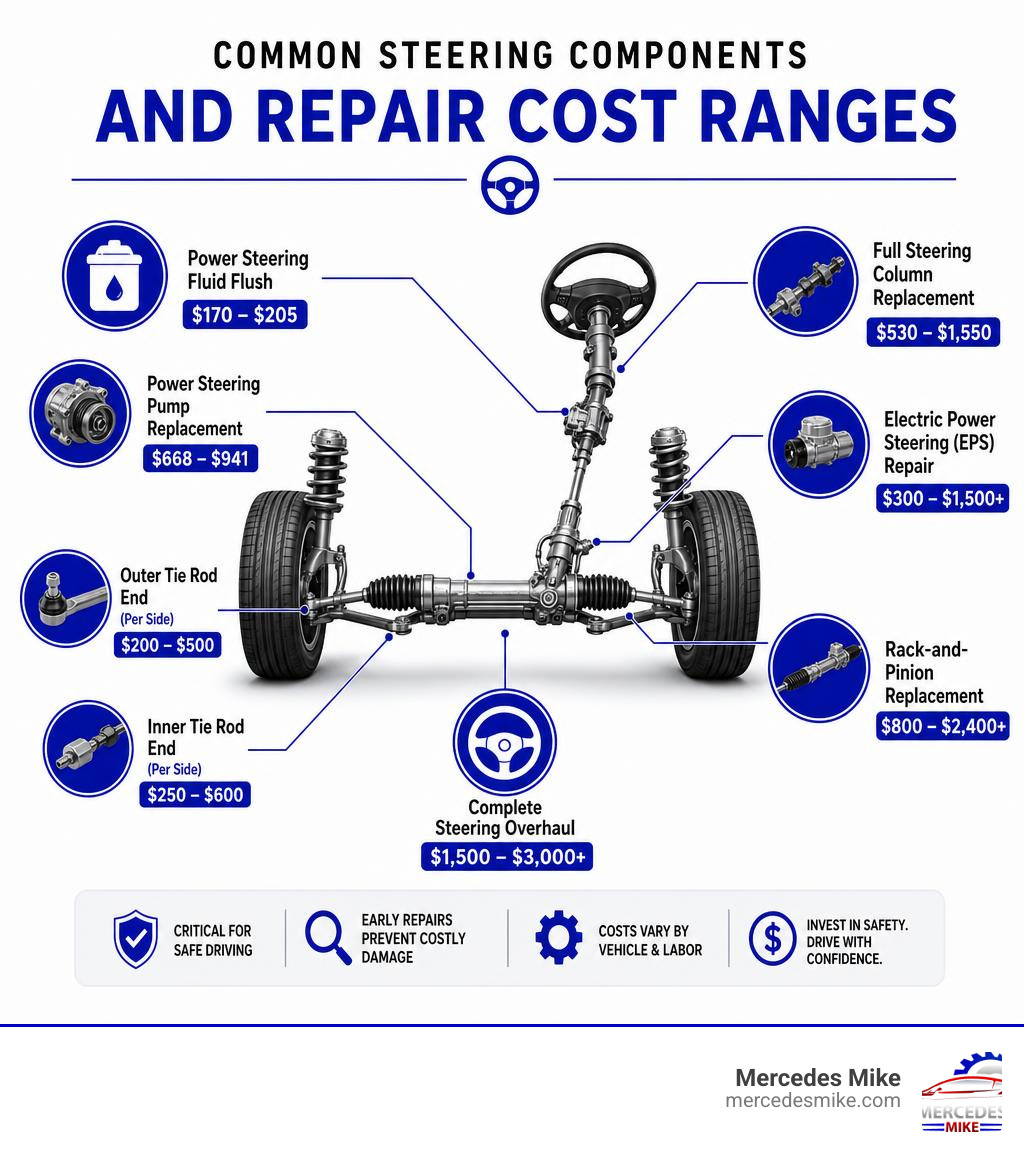
Here's a quick look at what you're likely to face:
Service Typical Cost Range Power steering fluid flush $170 – $205 Power steering pump replacement $668 – $941 Outer tie rod end (per side) $200 – $500 Inner tie rod end (per side) $250 – $600 Rack-and-pinion replacement $800 – $2,400+ Electric power steering (EPS) repair $300 – $1,500+ Full steering column replacement $530 – $1,550 Complete steering overhaul $1,500 – $3,000+
Your steering system is one of only three systems that directly control your vehicle — alongside brakes and tires. When something feels off — stiffness, a pulling sensation, a whine on turns — ignoring it isn't really an option.
The challenge? Most steering problems don't trigger a warning light. By the time you notice something is wrong, a minor fluid issue can have quietly turned into a failed pump or damaged rack.
This guide breaks down what steering repairs actually cost, what drives those prices up, and how to stay ahead of expensive failures — especially if you're driving a German luxury vehicle where parts and labor run higher than average.
Understanding the Cost of Steering Repair
When you take your car in for steering repair, the final estimate is rarely just a single number. It is a combination of advanced diagnostic time, precision parts, and specialized labor.

For owners of European performance vehicles in South Florida, these costs can vary significantly compared to standard domestic cars. German engineering relies on tight tolerances, complex multi-link suspension systems, and highly integrated electronics. This means a simple mechanical issue often requires specialized diagnostic software and teardown processes just to access the failing component.
To help you understand where your money goes during a service visit, we have broken down the average cost expectations by component:
Component / Service Estimated Parts Cost Estimated Labor Cost Total Average Cost Power Steering Fluid Flush $15 – $45 $150 – $160 $170 – $205 Tie Rod End (Outer) $50 – $150 $150 – $350 $200 – $500 Tie Rod End (Inner) $70 – $200 $180 – $400 $250 – $600 Power Steering Pump $460 – $595 $207 – $304 $668 – $941 Steering Rack & Pinion $500 – $1,400+ $300 – $1,000+ $800 – $2,400+ EPS Motor / Module $200 – $600 $100 – $200 $300 – $800 Full Steering Column $350 – $1,000 $180 – $550 $530 – $1,550
Because modern luxury vehicles integrate steering with Advanced Driver Assistance Systems (ADAS) like lane-keep assist and active parking, mechanics must refer to official diagnostic guidelines for steering systems to ensure all electronic sensors are calibrated correctly after a physical repair.
Average Costs for Common Steering Repair Services
If you are trying to budget for an upcoming repair in the Pompano Beach or Deerfield Beach FL areas, here is what you need to know about the most common services:
Power Steering Fluid Flush ($100 – $200): This is the most affordable preventative measure. Over time, hydraulic fluid degrades due to extreme engine heat and moisture absorption. A professional flush removes old, contaminated fluid and cleans out micro-debris before it can scar the internal seals of your steering rack.
Power Steering Pump Replacement ($668 – $941): The pump is the heart of a hydraulic system. If it runs dry or wears out internally, you will hear a loud whining noise when turning. Replacing it requires draining the system, removing the drive belts, installing the new unit, and performing a full system bleed.
Tie Rod End Replacement ($200 – $600 per side): Tie rods connect your steering rack to the steering knuckles on your wheels. Because they feature ball joints exposed to road debris, water, and South Florida potholes, they eventually develop play. Outer tie rods are generally easier and cheaper to replace than inner tie rods.
Rack-and-Pinion Replacement ($800 – $2,400+): This is the most extensive mechanical repair in hydraulic and early electric systems. If the internal seals blow or the gear teeth wear down, the entire assembly must be unbolted from the subframe. This is a labor-intensive job that often requires dropping parts of the front suspension.
Factors That Influence Your Steering Repair Estimate
Why does a repair on a Mercedes-Benz E-Class cost more than the same repair on a domestic sedan? Several factors influence your final invoice:
Vehicle Make and Model: German luxury brands (Mercedes, BMW, Audi, Porsche) feature sophisticated steering geometry designed for high-speed stability. The parts are engineered to higher specifications, and accessing them often requires removing protective belly pans and structural reinforcement brackets.
OEM vs. Aftermarket Parts: Original Equipment Manufacturer (OEM) parts are built to the exact specifications of your vehicle and offer unmatched durability. While aftermarket parts can save you money upfront, they may lack the precise fitment or sensor compatibility required by European electronic modules, leading to premature failure.
Diagnostic Complexity: Modern electric power steering (EPS) systems rely on torque sensors, steering angle sensors, and dedicated control modules. Finding the root cause of a steering fault requires advanced, manufacturer-specific scan tools rather than a simple visual inspection.
Labor Rates and Hours: The physical location of the steering gear in premium vehicles often means a technician must spend several hours just to remove and reinstall the assembly. High-end shops employ factory-trained technicians who understand these complex layouts, which is reflected in the labor rate.
Hydraulic vs. Electric Power Steering Systems
The automotive industry has undergone a massive shift in how steering assist is delivered. If your vehicle was built before 2010, it likely utilizes a hydraulic system. If it was built after 2010, it almost certainly features Electric Power Steering (EPS).
[Hydraulic Steering] ---> Driven by Engine Belt ---> Uses Fluid & Pump ---> Requires Regular Flushes
[Electric Steering] ---> Driven by Electric Motor -> Uses Sensors & ECU ---> Maintenance-Free (No Fluid)
Hydraulic Power Steering
Hydraulic systems rely on an engine-driven pump to pressurize hydraulic fluid, which is then routed through high-pressure hoses to the steering gear. When you turn the wheel, a rotary valve directs this pressurized fluid to one side of a piston inside the steering rack, reducing the effort required to turn.
Maintenance Needs: High. Requires regular fluid level checks, periodic flushes, and inspection of hoses for cracking or seepage.
Common Failure Points: Leaking high-pressure hoses, failing pump bearings, and blown steering rack end-seals.
Electric Power Steering (EPS)
EPS completely eliminates the hydraulic pump, hoses, and fluid. Instead, an electric motor (either mounted on the steering column or directly on the steering rack) provides the steering assist. A computer monitors a torque sensor on the steering shaft and instantly calculates how much motor assistance to apply.
Maintenance Needs: Low. There is no fluid to leak or degrade.
Fuel Efficiency: Because the electric motor only draws power when you are actively turning the wheel (unlike a hydraulic pump that runs constantly via the engine belt), EPS systems improve overall fuel economy by 2% to 3%.
Common Failure Points: Electronic control module glitches, torque sensor calibration issues, or water intrusion into the electric motor housing.
For a bit of historical perspective, classic sports cars like the 1970s Datsun 240Z utilized direct-acting manual rack-and-pinion setups with a quick 17.8:1 gear ratio. These vintage systems required zero hydraulic fluid or electric motors; instead, all working parts were fully immersed in specialized lithium-base multipurpose grease. While they offered incredible road feel, they required significant physical effort at low speeds — a far cry from the effortless, speed-sensitive electronic steering assist we enjoy in modern German luxury cars today!
Warning Signs Your Vehicle Needs Steering Service
Because your steering system degrades gradually, it is easy to normalize small changes in how your car handles. However, catching these warning signs early can save you from a complete system failure on the highway.

Keep an eye (and ear) out for these common warning signs:
Steering Resistance (Stiffness): If turning the wheel feels like an unexpected upper-body workout, your steering assist is failing. In hydraulic systems, this is usually caused by low fluid, a slipping belt, or a failing pump. In EPS systems, it typically points to a blown fuse, a failing electric motor, or a system-disabled fault code.
Whining or Groaning Noises: A loud, high-pitched whine that gets louder as you turn the steering wheel is the classic signature of a hydraulic pump starved of fluid. If you hear squeaking or clunking sounds instead, you may have worn ball joints or dry tie rod ends.
Loose Steering Wheel (Excessive Play): If you can wiggle your steering wheel back and forth by an inch or more without the front wheels actually moving, your steering linkage has worn out. If you are experiencing this issue, you can read our detailed guide on fixing play in your steering wheel to understand which mechanical joints are likely to blame.
Fluid Leaks Under the Car: Hydraulic power steering fluid is typically red, pink, or clear (though it turns dark brown when old and contaminated). If you spot oily puddles under the front of your car, check your power steering reservoir immediately. A dry pump will destroy itself within minutes of running without lubrication.
Why You Need a Wheel Alignment After Steering Repairs
One of the most common questions drivers ask is: "Why do I have to pay for a wheel alignment after getting my tie rods replaced?"
The answer lies in how your steering system controls your tires. Tie rods directly dictate your vehicle's toe angle — which is the angle at which your front tires point inward or outward when viewed from above.
When a mechanic replaces an inner or outer tie rod, even if they carefully measure and count the threads during installation, the microscopic alignment of the wheel is altered. Driving even a few miles with an incorrect toe angle will cause:
Rapid, uneven tire wear (often destroying a brand-new set of front tires in a matter of weeks).
A persistent pull to one side of the road.
An off-center steering wheel when driving straight.
Reduced handling stability, especially at highway speeds.
To protect your tire investment and restore factory handling, we always include a precision four-wheel alignment as a mandatory final step for our professional steering and alignment services.
Frequently Asked Questions About Steering Maintenance
How often should power steering fluid be changed?
While some vehicle manufacturers claim their power steering fluid is a "lifetime" fluid, real-world driving conditions in South Florida's heat tell a different story.
We recommend having your power steering fluid inspected during every oil change and fully serviced every 30,000 to 50,000 miles (or every 3 to 5 years). Over time, heat cycles cause the fluid to lose its lubricating properties, leading to accelerated wear on your pump's internal bearings and the rubber seals inside your steering rack. If your fluid looks dark, cloudy, or smells burnt, it is time for a flush.
Is it safe to drive with steering issues?
No, it is not safe. Because steering is a safety-critical system, any compromise in your ability to control the vehicle increases your accident risk exponentially.
If your steering wheel becomes incredibly stiff, you may not be able to swerve quickly enough to avoid an obstacle or negotiate a sharp turn. Furthermore, a worn-out tie rod end can snap completely under load, causing the affected wheel to flop sideways independently of your steering wheel. If you experience sudden steering stiffness, loud grinding, or erratic handling, pull over safely and have your vehicle towed to a professional repair facility immediately.
How do mechanics diagnose steering problems?
Professional technicians use a structured, multi-step process to pinpoint steering faults accurately:
Visual and Physical Inspection: The technician will raise the vehicle on a lift to inspect the steering rack boots, hydraulic lines, and pump for active leaks. They will also physically shake down the front wheels to check for play in the inner/outer tie rods and wheel bearings.
Diagnostic Scan Tools: For modern EPS systems, we connect factory-level diagnostic computers to retrieve fault codes from the electronic steering module and read live sensor data (such as steering wheel angle and motor torque output).
Road Test Evaluation: Driving the vehicle allows the technician to experience the symptoms — listening for noises on turns, checking for steering wheel return-ability, and feeling for vibrations or pulling.
Reference to OEM Specifications: Mechanics cross-reference their findings with official OEM steering gear replacement procedures to determine if a component can be serviced or if a full assembly replacement is required.
Conclusion
Your steering system is your direct connection to the road. When it is working perfectly, your car feels responsive, stable, and effortless to drive. When it begins to fail, it compromises your safety and the safety of everyone else on the road.
At Mercedes Mike, we specialize in the precise maintenance and repair of German luxury vehicles — including Mercedes-Benz, BMW, Audi, and Porsche. Serving Pompano Beach, Deerfield Beach, and the broader South Florida area, our shop features decades-experienced technicians equipped with the latest diagnostic tools and factory-level software.
Whether you need a simple hydraulic fluid service, a tie rod replacement, or a complex electric power steering system diagnosis, we deliver dealership-quality work without the dealership price tag. Don't wait for a minor noise to turn into a dangerous steering failure. Contact us today or schedule professional steering services to keep your German machine driving exactly the way it was engineered to.