The Complete Guide to Comparing Performance Upgrade Options
Most Effective Performance Upgrades for Daily Drivers
Upgrading a daily driver requires a careful balance between elevated power output, mechanical reliability, and daily usability. When selecting performance upgrades, the overarching goal is to eliminate factory bottlenecks without making the car noisy, harsh, or uncomfortable to drive on South Florida roads. Factory engines are often intentionally detuned from the assembly line to account for varying global fuel quality, conservative emissions targets, or lax owner maintenance habits. By optimizing internal airflow and recalibrating engine software, you can safely unlock hidden power, sharper throttle response, and improved thermal efficiency.
For German luxury vehicles, entry-level upgrades offer remarkable performance gains across the entire power band. You can explore The Top 5 Performance Upgrades for Your German Car to see how simple bolt-ons transform your overall driving experience.
Affordable Performance Upgrades for Daily Driven Vehicles
You do not need to invest thousands of dollars to feel a noticeable difference in vehicle dynamics and throttle response. Here are the most effective, entry-level modifications for daily drivers:
Cold-Air Intakes ($100–$300): Replaces restrictive factory air boxes and corrugated intake tubes with smooth-bore piping and high-flow filters. Drawing cooler, denser air into the engine drops intake air temperatures, directly improving throttle response and acceleration.
Strut Tower Braces ($100–$300): Connects the tops of opposing strut towers across the engine bay to minimize chassis flex and strengthen lateral stiffness during hard cornering.
Spark Plug Replacement: Fresh, correctly gapped high-performance spark plugs (or colder heat-range plugs for tuned engines) ensure complete fuel ignition, eliminating misfires under heavy boost or high load.
Fuel Filter Maintenance: Replacing a tired fuel filter every 15,000 miles prevents fuel pump strain, eliminates starvation at full throttle, and maintains steady fuel pressure.
Engine Tuning vs Hardware Mods: Balancing Horsepower and Fuel Economy
A common myth among car owners is that increasing horsepower automatically destroys fuel economy. In reality, optimizing combustion efficiency often improves both output and fuel mileage simultaneously. Upgrades like cold-air intakes and high-flow exhausts reduce engine pumping losses—the energy wasted by the pistons pulling air in through tight restrictions and pushing exhaust out. When paired with precise computer tunes, the engine uses every drop of fuel far more effectively.
Combining intake and exhaust upgrades with proper tuning can yield up to a 5% improvement in overall fuel economy during highway cruising, while smoothing out power delivery and torque availability across the entire RPM range.
Exhaust Systems, Suspension, and Handling Modifications
Power means little if your car cannot apply it cleanly to the road or navigate tight corners with confidence. Upgrading exhaust, suspension, and tire components enhances mechanical grip, lateral chassis stiffness, and overall driving acoustics.
If you drive a performance sedan, upgrading to a specialized exhaust system like the BMW 340i M Performance Exhaust improves exhaust scavenging while producing an aggressive, refined exhaust tone without irritating interior drone during long highway cruises.

Cat-Back vs Axle-Back Performance Upgrades
When choosing an exhaust modification, you will typically compare cat-back and axle-back configurations. The right choice depends on whether you want genuine flow and horsepower improvements or just sound enhancement.
Exhaust Type Components Replaced Power Gain Acoustic Change Axle-Back Exhaust Rear mufflers and exhaust tips Minimal to none Moderate tone change Cat-Back Exhaust Tubing behind catalytic converter, mufflers, resonators Moderate (reduces backpressure) Significant tone and volume enhancement
Because cat-back systems leave original catalytic converters in place, they retain full emissions compliance while lowering exhaust backpressure for modest power gains and sharper engine response.
Selecting the Best Performance Tires for Your Driving Environment
Tires are the single most critical contact point between your vehicle and the pavement. High-performance summer tires cost between $500 and $900 for a set and provide massive upgrades in cornering grip, lateral acceleration, and stopping distance. Modern sticky tread compounds with optimized tread wear ratings maintain low rolling resistance to protect fuel economy while maximizing wet traction control during intense South Florida rainstorms.
To sharpen vehicle response further, replacing soft factory rubber suspension bushings with firm polyurethane bushings significantly reduces suspension deflection. This improves cornering stability and steering feel without destroying daily ride quality.
ECU Tuning: Self-Service Tuners vs Professional Dyno Calibrations
The Engine Control Module (ECM or ECU) manages fuel delivery schedules, ignition timing curves, target air-fuel ratios, and boost levels on turbocharged platforms. Modern vehicle manufacturers leave substantial margin on the table to protect engines against worst-case operational scenarios. Adjusting these parameters through ECU software tuning delivers the highest wheel horsepower gain per dollar spent of any performance upgrade.
If you are looking for local calibration experts, searching for ECM Tuners Near Me can connect you with specialists who understand how to tune safely for regional heat and humidity.

Self-Service vs Dyno-Tuned Computer Performance Upgrades
Choosing between an off-the-shelf software flash and a custom dyno tune depends on your hardware configuration and performance goals:
Handheld Tuners ($400–$700): Handheld devices flash pre-packaged calibration files directly through the OBD-II port in under five minutes. They work exceptionally well for stock vehicles or standard bolt-on parts like cold-air intakes.
Custom Dyno Calibrations: A master technician runs your car on a chassis dynamometer to log real-time engine telemetry, knock sensors, mass airflow readings, and target air-fuel ratios across the entire RPM band. Custom tuning tailors parameters directly to your exact engine condition, fuel octane, and regional climate.
For step-by-step guidance on hardware optimization and system configuration, reviewing technical resources like Improving performance - ArchWiki can help structure your overall mechanical approach.
Diesel Engine vs Gasoline Engine Upgrades
Diesel engine upgrades focus heavily on low-end heavy-duty towing torque delivery and load handling rather than high-RPM peak power. Performance packages for diesels typically combine high-flow fuel injectors, enlarged turbocharger intercoolers, and software adjustments designed to manage thermal loads and lower exhaust gas temperatures (EGTs) while avoiding excessive structural engine strain.
If you own a diesel European vehicle, applying a specialized calibration like the C350 CDI Remap dramatically increases passing torque while maintaining low-RPM fuel efficiency.
Planning a Multi-Stage Build and Maintaining Your Warranty
Building a reliable high-performance vehicle requires a clear, methodical strategy. Rushing straight into massive turbo upgrades without the necessary supporting cooling and fueling modifications risks severe thermal strain, knock, and unexpected mechanical failure.
For high-output vehicles, exploring advanced hardware routes like an AMG GT Turbo Upgrade illustrates how airflow dynamics, intercooling capacity, and high-pressure fueling systems must work in complete unison to handle elevated thermal management demands safely.
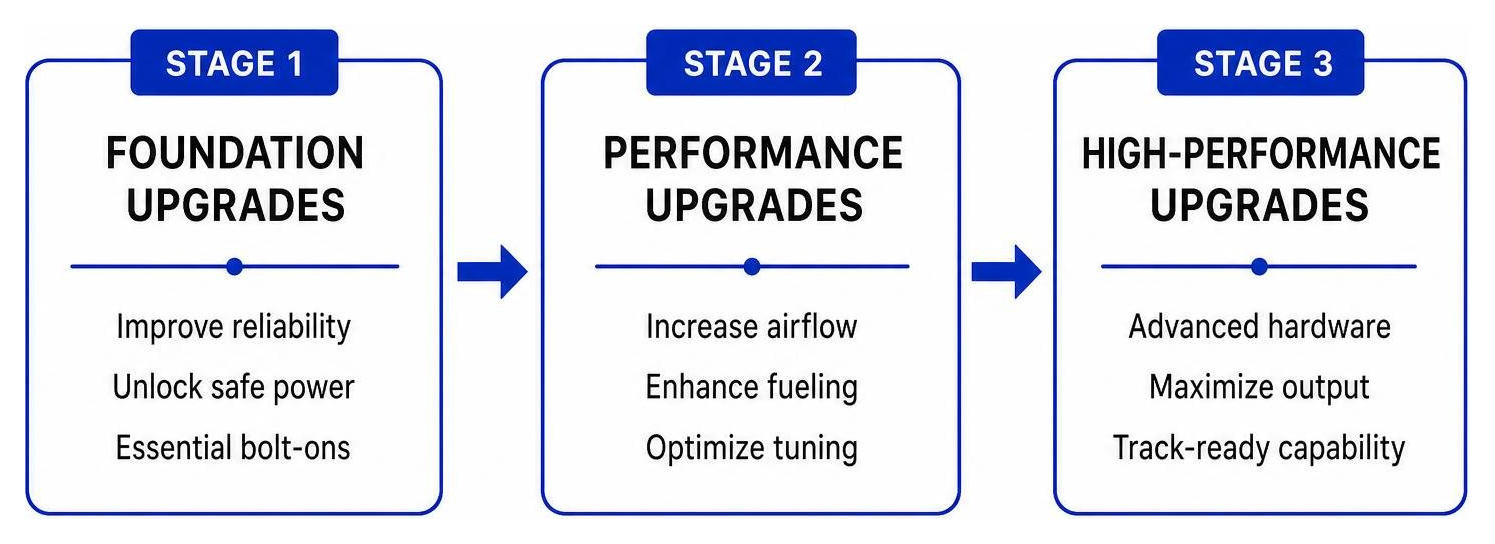
Staging Strategy for Multi-Stage Performance Upgrades
Stage 1: Optimized software flash paired with a high-flow cold-air intake. Requires no internal engine hardware changes and works with stock exhaust components.
Stage 2: High-flow cat-back exhaust system, upgraded charge-pipe or intercooler, and matching stage software adjustments to unlock increased midrange boost and horsepower gains.
Stage 3: Upgraded turbochargers or superchargers, enlarged high-pressure fuel pumps, upgraded fuel injectors, and custom dyno calibrations to safely handle elevated power levels and thermal loads.
Protecting Warranty Coverage and Professional Installation Standards
Under federal law, specifically the Magnuson-Moss Warranty Act, vehicle manufacturers cannot automatically void your entire factory warranty simply because an aftermarket part is installed. The manufacturer carries the burden of proof to demonstrate that the specific aftermarket part or installation directly caused the mechanical failure before denying warranty coverage.
To safeguard your vehicle, retain factory warranty protections, and protect your investment:
Maintain complete, detailed factory service documentation and maintenance logs.
Work exclusively with certified technicians who adhere to SEMA-standard installation processes.
Address baseline preventive maintenance (spark plugs, ignition coils, fluids, filters) before adding extra horsepower.
Frequently Asked Questions About Vehicle Upgrades
Can performance parts void my vehicle's factory warranty?
No. Under the Magnuson-Moss Warranty Act, a vehicle manufacturer cannot deny warranty coverage unless they can demonstrate that the installed aftermarket part directly caused the specific component failure. Documented maintenance logs and professional technician installation further protect your warranty coverage rights.
What is the difference between a handheld tuner and a custom dyno tune?
A handheld tuner uploads a pre-packaged flash file to the engine control module with pre-set calibration templates designed for common bolt-on configurations. A custom dyno tune uses a chassis dynamometer to record real-time vehicle telemetry, allowing an expert technician to make precise adjustments to target air-fuel ratios, ignition timing curves, and boost pressure specifically for your exact vehicle setup.
How do aftermarket intake and exhaust systems increase fuel economy?
By reducing intake air restriction and minimizing exhaust backpressure, high-flow intakes and exhaust systems lower engine pumping losses. Improved volumetric efficiency means the engine uses less mechanical energy to draw in intake air and push out exhaust gases, optimizing air-fuel ratio combustion during steady highway cruising.
Conclusion
Upgrading your German luxury vehicle should be an exciting, reliable, and rewarding journey. By taking a structured, multi-stage build strategy—starting with entry-level cold-air intakes, computer tunes, and high-performance tires before moving to advanced hardware—you unlock dynamic power delivery without sacrificing long-term reliability or daily fuel efficiency.
At Mercedes Mike in Pompano Beach, our decades-experienced technicians use state-of-the-art diagnostic tools and state-of-the-art chassis calibration equipment to perform professional installations, custom ECU software tunes, and baseline preventive maintenance. Whether you are aiming for subtle daily driver responsiveness or a full stage build, we ensure your vehicle operates at peak efficiency. Ready to elevate your driving experience? Explore The Top 5 Performance Upgrades for Your German Car today and plan your ideal performance setup!