
The Ultimate Guide to Power Steering Box Repair
When Your Steering Feels Wrong: What You Need to Know About Power Steering Box Repair
Power steering box repair is one of those jobs that can range from a simple seal replacement to a full internal rebuild — and knowing which one you need can save you hundreds of dollars.
Here's a quick answer if you're trying to figure out what to do:
Common signs your power steering box needs repair:
Loose or wandering steering (excessive play in the wheel)
Fluid leaks near the pitman arm or input shaft
Groaning or whining noises when turning
Stiff steering, especially at low speeds
Steering that pulls to one side
Your main repair options:
Seal-only repair — fixes leaks, costs ~$100–$200 in parts, works if internal components are not worn
Full rebuild — replaces seals, bearings, and recirculating balls, costs ~$300–$800 total
Remanufactured replacement unit — new internals, highest cost but longest lifespan
Over 60% of power steering box problems trace back to fluid leaks or contaminated fluid. Catch it early and a seal job may be all you need. Wait too long and you're looking at a full rebuild — or worse.
For owners of German vehicles like Mercedes-Benz, this matters even more. The steering feel on these cars is precise by design, and a worn or improperly rebuilt gearbox will feel immediately wrong.
This guide walks you through everything: how to diagnose the problem, what a proper rebuild involves, how to adjust the box correctly after reassembly, and when it makes sense to hand the job to a professional.
Diagnosing Steering Issues: Is the Gearbox the Culprit?
Before you grab your wrenches and pull the steering box out of your engine bay, you need to make sure the gearbox is actually the source of your issues. A car's steering system is a complex web of interconnected parts. What feels like a bad gearbox could easily be a failing power steering pump, worn-out tie rods, or bad ball joints.
Power steering system failures account for approximately 10-15% of all steering-related vehicle repairs in the U.S. If you are experiencing a loose, unresponsive steering wheel, the first step is to isolate the problem.

To determine whether the issue is inside the steering box or elsewhere, we recommend a simple diagnostic process:
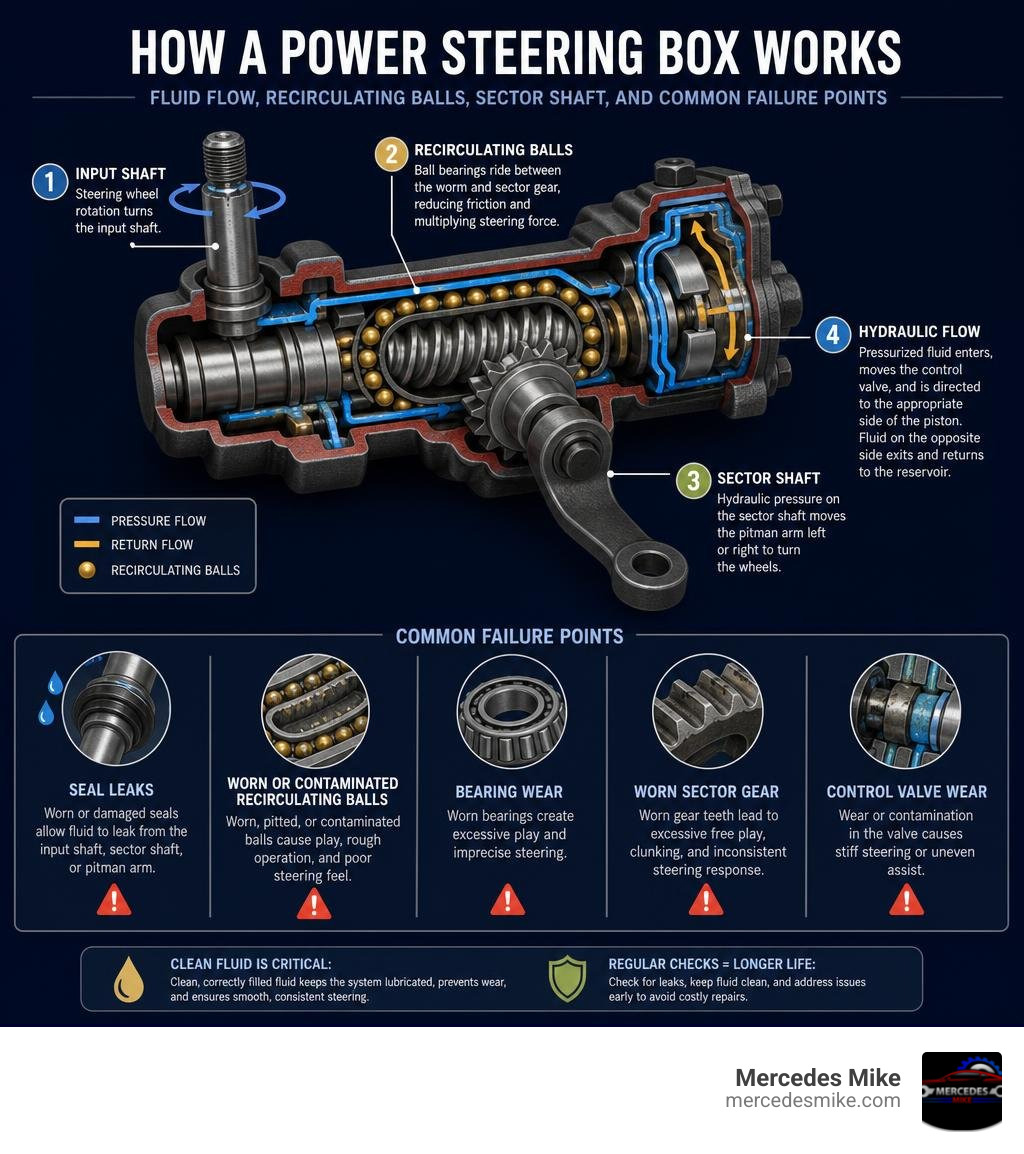
The Parking Lot Test: With the vehicle parked on flat ground and the engine running, have a friend turn the steering wheel back and forth. Look closely at the input shaft (where the steering column enters the box) and the pitman arm (where the steering box connects to the steering linkage). If the input shaft rotates but the pitman arm doesn't move immediately, you have excessive play inside the gearbox.
Inspect for Fluid Leaks: Power steering box leaks usually occur at two main points: the input shaft seal at the top of the box, or the sector shaft seal at the bottom (near the pitman arm). If you see red or clear hydraulic fluid dripping from these areas, your seals have failed.
Listen for Groaning Noises: If you hear a loud whining or groaning noise when you turn the wheel, check the power steering pump fluid level first. A low fluid level causes air to enter the system, which starves the pump and damages the seals inside the steering box.
Isolate the Steering Linkage: To completely rule out other steering components, lift the front of the vehicle and disconnect the pitman arm from the steering linkage. Manually turn the front wheels side-to-side to check for binding in the ball joints or tie rods. At the same time, rotate the input shaft of the steering box by hand. If the steering box binds or feels rough even when disconnected from the wheels, the internal gears or bearings are damaged.
If you find that the play is coming from the steering wheel itself rather than the steering box, you can learn more about how to Fix Play in Steering Wheel to resolve the issue before tearing down your hydraulic system.
Rebuild vs. Replacement: Costs, Longevity, and Options
When your steering box is confirmed to be failing, you have three primary paths forward: a seal-only repair, a full rebuild, or a complete replacement with a remanufactured unit. Choosing the right option depends on your budget, your mechanical confidence, and the physical condition of your steering box's internal gears.
Repair Option Average Cost Expected Longevity Best Suited For Seal-Only Repair $80 - $200 (DIY) 1 to 3 Years Gearboxes that leak but have zero steering play or internal wear. Full Rebuild $300 - $800 5 to 10+ Years (60k-100k miles) Gearboxes with minor play, worn bearings, or high mileage. Remanufactured Unit $400 - $900+ 5 to 10+ Years Severe internal damage, deep rust, or cracked housings.
Over 60% of power steering box issues are caused by fluid leaks or contaminated fluid, which leads to premature wear of the internal bearings and teeth. If you catch a leak early, a simple seal-only job can stop the fluid loss and protect the gears. However, if you have been driving with low or contaminated fluid, the recirculating balls and sector shaft teeth have likely worn down. In this case, a seal-only repair is a temporary band-aid; the play in the steering will remain, and the new seals will quickly fail due to shaft runout.
A professional rebuild is often the best choice for classic cars and high-end German vehicles. Many off-the-shelf, parts-store remanufactured boxes are simply cleaned with an aerosol solvent, fitted with cheap seals, and painted black. These quick-fix units often feel sloppier than the original unit you took off.
A high-quality, professional rebuild restores the steering box to factory specifications, replacing all worn bearings, measuring and matching the recirculating balls, and adjusting the internal valves. Vehicles with rebuilt steering boxes experience a 25-40% reduction in steering effort compared to worn units, restoring that tight, precise steering feel your vehicle had when it left the showroom.
For a deeper dive into how steering gearboxes are professionally rebuilt and calibrated to eliminate slop, read about this Sloppy Steering Fix With A New Turn One Steering Box Rebuild. If you decide to go with a full replacement or need professional assistance, you can explore our comprehensive Steering Repair services.
How to Rebuild a Steering Gearbox
Rebuilding a power steering gearbox is a highly rewarding project, but it requires patience, extreme cleanliness, and attention to detail. Most traditional power steering boxes use a recirculating ball system. In this design, steel ball bearings roll inside the grooves of a worm shaft, moving a power piston back and forth to turn the sector shaft.
Before starting, it is highly recommended to study a successful real-world teardown, such as this detailed Bronco Power Steering Box Rebuild, which highlights how to handle delicate internal parts without causing damage.
Tools, Parts, and Safety Precautions
A successful rebuild requires a clean workspace and several specialized tools. Do not attempt this job on a dirty workbench; even a tiny speck of dirt or lint can clog the internal hydraulic valves and destroy your new seals.
Required Safety Gear: Safety glasses (hydraulic fluid under pressure is dangerous) and chemical-resistant gloves.
Specialized Tools:
Pitman arm puller (or a heavy-duty press)
Snap ring pliers
Dial-indicator torque wrench (measuring in inch-pounds)
Seal driver set (or deep-well sockets of matching diameters)
Spanner wrench or channel-lock pliers
Dental picks (for removing old O-rings and Teflon seals)
Parts Needed: A high-quality vehicle-specific steering box rebuild kit (including all O-rings, Teflon rings, shaft seals, and new snap rings).
Lubricants: Fresh power steering fluid (or ATF, depending on your vehicle's specifications) and clean petroleum jelly (Vaseline) or high-quality assembly grease.
Step-by-Step Power Steering Box Repair and Rebuild
Once you have gathered your tools and cleaned your workspace, you are ready to begin the power steering box repair process.
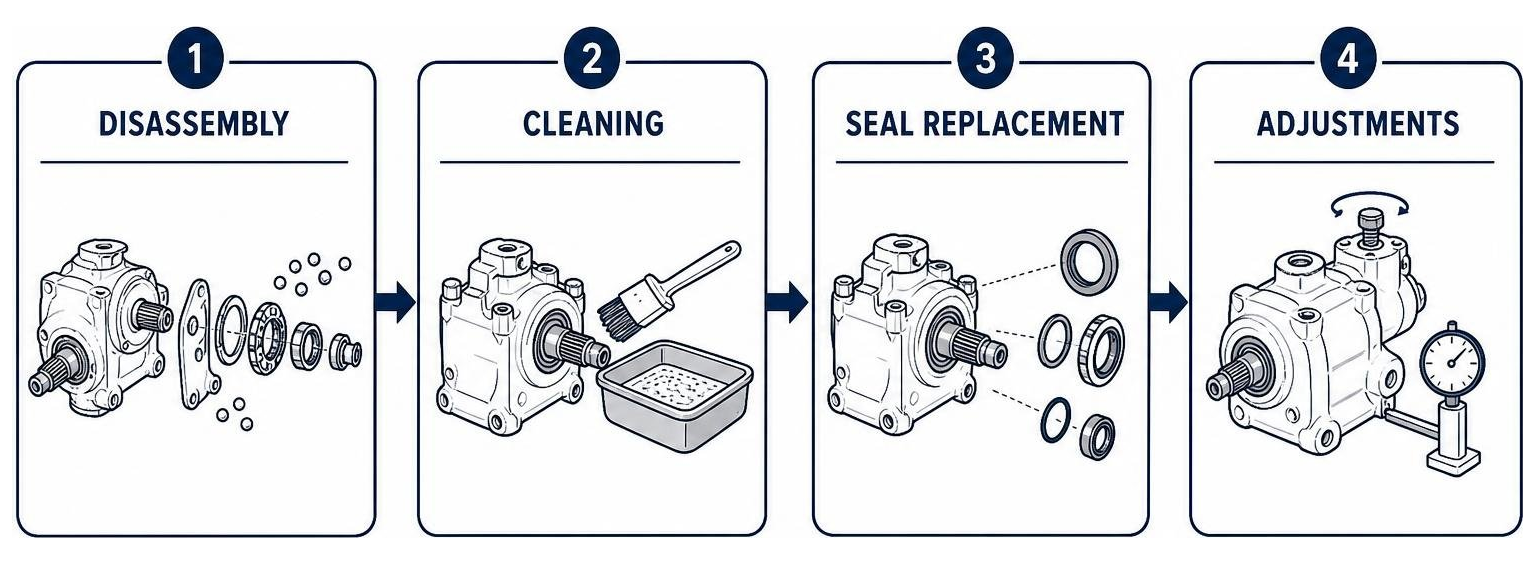
Step 1: Removal and External Cleaning
Disconnect the battery, drain the power steering fluid from the system, and remove the steering box from the vehicle. Use a pitman arm puller to remove the pitman arm from the sector shaft. Clean the outside of the steering box housing thoroughly with brake cleaner and a wire brush to prevent dirt from entering the housing during disassembly.
Step 2: Disassembling the Sector Shaft
Mark the relationship between the sector shaft cover and the main housing. Loosen the locknut on the sector shaft adjusting screw. Remove the four bolts holding the side cover to the housing. Gently turn the input shaft to center the steering box, which aligns the teeth of the sector shaft with the piston. Slide the sector shaft and its cover out of the housing as a single unit.
Step 3: Removing the Input Shaft and Valve Body
Remove the adjuster plug locknut and back out the adjuster plug using a spanner wrench. Carefully slide the input shaft, worm gear, and valve body assembly out of the main housing. Be extremely careful: the piston contains dozens of loose steel recirculating ball bearings. If you slide the piston off the worm shaft, these balls will spill out. Keep the assembly upright to prevent them from escaping.
Step 4: Seal and Teflon Ring Replacement
Using your dental picks, remove all old rubber O-rings and white Teflon seals.
The Boiling Water Trick: Teflon rings are stiff and easily damaged if stretched cold. To make them elastic, soak the new Teflon rings in boiling water for about 5 minutes. Once warm, carefully stretch them over the piston using a smooth tool (like a plastic pen cap) to avoid nicks. Once in place, wrap a piece of smooth plastic tape around the ring for a few minutes to help it shrink back to its original size.
Lubrication: Lubricate every new O-ring and seal with fresh power steering fluid or petroleum jelly before installation. Never install a seal dry.
For a detailed look at how to safely extract stubborn retaining rings and handle these delicate seals during a classic truck restoration, check out the Saginaw Steering Box Rebuild…. - 72 Chevy K20 Rebuild.
Adjusting Sector Shaft Preload and Input Shaft
Properly adjusting the steering box after reassembly is the difference between a steering wheel that glides smoothly and one that binds, wanders, or locks up completely while driving. There are two critical adjustments you must make.
1. Input Shaft / Worm Gear Preload
Before installing the sector shaft, you must set the preload on the input shaft bearings. Thread the adjuster plug into the housing until it bottoms out against the bearings, then tighten it to the manufacturer's specified torque (usually measured in inch-pounds).
Using an inch-pound torque wrench on the input shaft, measure the force required to keep the shaft rotating. It should rotate smoothly with a very light resistance (typically 4 to 8 in-lbs). Once set, tighten the locknut securely while holding the adjuster plug in place.
2. Sector Shaft Preload (Over-Center Adjustment)
Slide the sector shaft back into the housing, ensuring the gear teeth mesh perfectly with the power piston. Bolt the side cover down.
The sector shaft adjusting screw on top of the cover controls the depth of the gear teeth engagement. Turn the input shaft to its exact center point (where the gears are designed to have the tightest clearance).
Slowly tighten the adjusting screw until you feel a slight resistance when rotating the input shaft through its center point. Using your inch-pound torque wrench, measure the peak rotational force as the input shaft passes through the center. It should be approximately 4 to 5 in-lbs higher than the input shaft preload you measured earlier (for a total of about 8 to 14 in-lbs).
If you over-tighten this screw, the steering will bind, fail to return to center after a turn, and wear out the gears rapidly. If you leave it too loose, you will have sloppy steering. For step-by-step guidance on setting these delicate torque values on popular steering gears, see this guide on Fixing Your Ford F-150 Power Steering Box.
DIY vs. Professional Power Steering Box Repair
Deciding whether to tackle a power steering box repair yourself or hire a professional comes down to your mechanical experience and the tools you have available. DIY power steering box rebuilds can save 50-70% compared to professional shop labor rates, making it an appealing project for home mechanics.

On a difficulty scale of 1 to 10, a basic seal replacement is about a 4/10, while a complete internal rebuild with bearing replacement and valve adjustment is a solid 7/10. Because of the precision required to handle the recirculating ball bearings and set the preloads, a mistake can lead to a complete loss of steering control.
If you own a modern or classic German vehicle, the complexity increases. German steering systems are highly engineered, and working on them requires specialized knowledge. To understand why these systems require extra care, you can read about The Most Common Problems with German Cars and How to Prevent Them.
When to Choose Professional Power Steering Box Repair
While a DIY approach is great for learning, there are several situations where professional service is highly recommended:
Lack of Precision Tools: If you do not own a high-quality dial-indicator torque wrench that reads in inch-pounds, you cannot accurately set the preloads. Doing it "by feel" is highly risky.
Severe Internal Wear: If your teardown reveals pitting on the piston, chipped gear teeth, or deep grooves in the shaft, a standard DIY seal kit will not fix the problem. A professional shop can source oversized ball bearings or machine the shafts to restore factory tolerances.
Warranty Protection: A professional rebuild or replacement comes with a warranty, giving you peace of mind that your steering system is safe and reliable.
Time Constraints: A first-time DIY rebuild can easily take an entire weekend, especially if you lose a ball bearing or damage a seal. A professional shop can complete the repair efficiently, minimizing your vehicle's downtime.
If you are in South Florida and want to ensure your vehicle's steering is restored to absolute perfection, seeking out an Independent Mercedes Repair specialist is your best path forward.
Frequently Asked Questions about Steering Box Maintenance
How often should power steering fluid and filters be serviced?
To extend the life of your rebuilt steering box, we recommend flushing the power steering fluid and replacing the filter every 30,000 to 50,000 miles (or every 3 to 4 years).
Over time, power steering fluid breaks down due to heat and pressure, losing its lubricating properties. It also accumulates microscopic metal shavings from the pump and gear teeth. This contaminated fluid acts like liquid sandpaper, rapidly wearing out your new seals and bearings.
What are the risks of missing recirculating ball bearings during a rebuild?
The steel recirculating balls are critical for transferring force from the steering wheel to the tires. A typical steering box uses between 24 and 33 balls, depending on the model.
If you lose even one ball bearing during reassembly, the remaining balls will have too much room to move. This causes the balls to bunch up, leading to steering binding, catching, or a sudden lock-up of the steering wheel.
If you are attempting a rebuild for the first time, read this cautionary tale on the Power steering box rebuild- first time, lets see what happens | Jeep Enthusiast Forums to see how easily these bearings can escape and how to find replacements.
Can you adjust out all steering play using the sector shaft screw?
No! This is one of the most common and dangerous mistakes car owners make. The adjusting screw on top of the steering box is only meant to compensate for minor manufacturing tolerances and very light wear.
If your steering box has significant play due to worn-out internal gears or bearings, tightening the adjusting screw will not fix the problem. Instead, it will jam the gear teeth together tightly when you turn the wheel away from the center position, causing severe binding and potentially locking your steering.
If your steering box is worn out, it must be rebuilt or replaced. For modern vehicles with electronic steering systems, the diagnostic and repair process is entirely different; you can read about the Cost to Fix Electric Power Steering to compare these systems.
Conclusion
A properly functioning power steering box is essential for keeping your vehicle safe, responsive, and enjoyable to drive. Whether you choose to take on the challenge of a DIY rebuild or trust the job to a professional, maintaining clean fluid and addressing leaks early is the key to steering longevity.
At Mercedes Mike, we specialize in the maintenance, repair, and calibration of steering systems for German luxury vehicles, including Mercedes-Benz, BMW, Audi, and Porsche. Located at 882 NE 41st Court in Pompano Beach, Florida (just off N Dixie Hwy), our shop serves drivers across Deerfield Beach and the greater South Florida area.
Our team of decades-experienced technicians utilizes the latest diagnostic equipment and specialized tools to restore your vehicle's steering to original factory precision. Don't compromise on your safety or driving comfort. Schedule your steering service today with the experts at Mercedes Mike.