
Stop Confusing Scheduled and Preventive Maintenance
Why Most Car Owners Confuse Scheduled and Preventive Maintenance
When it comes to scheduled maintenance vs preventive maintenance, these two terms are often used interchangeably — but they are not the same thing.
Here is the quick answer:
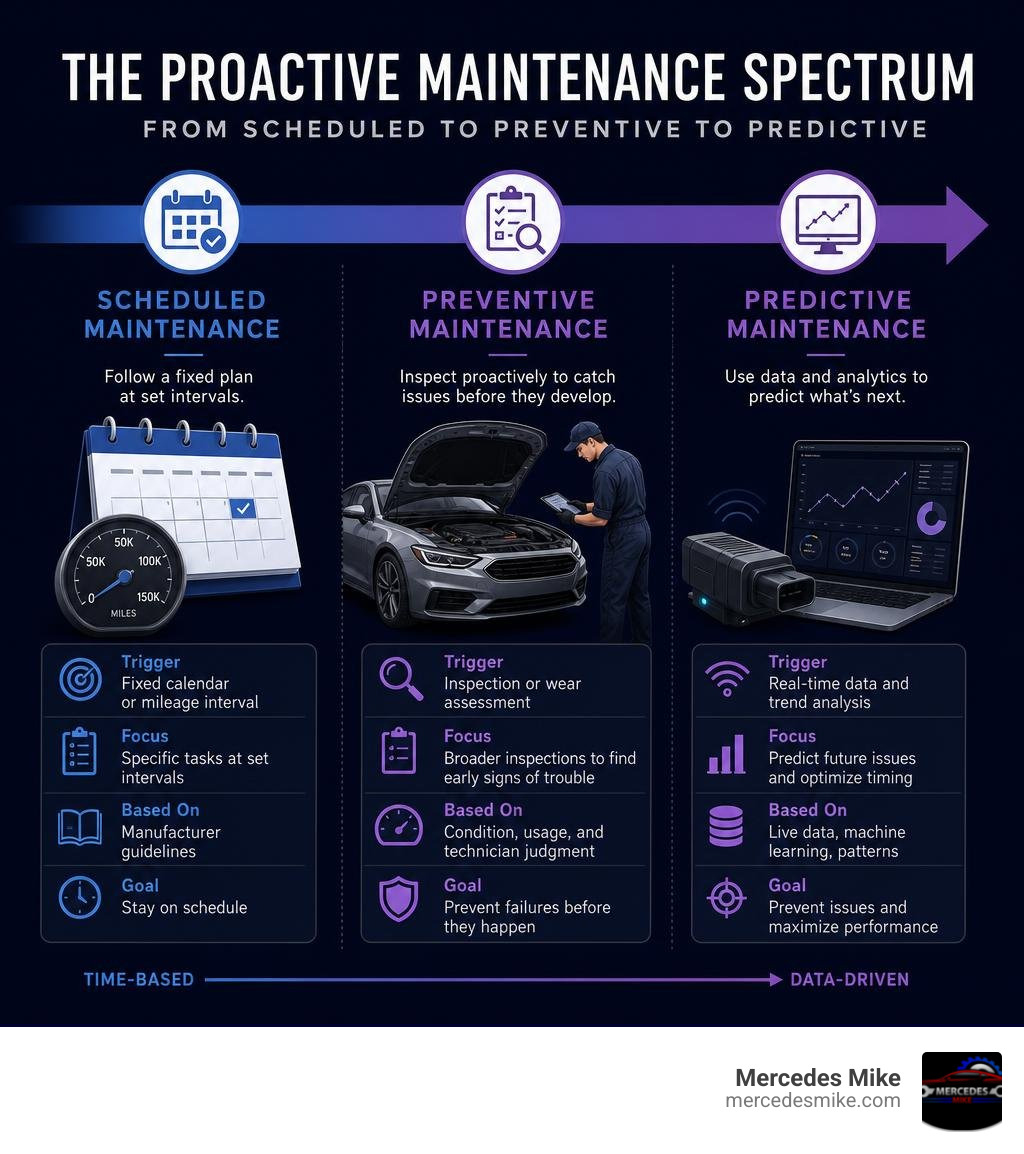
Scheduled Maintenance Preventive Maintenance Trigger Fixed calendar or mileage interval Proactive inspection or wear assessment Scope Specific tasks at set intervals (e.g. oil change every 10,000 miles) Broader inspections to catch issues before they develop Based on OEM manufacturer guidelines Equipment condition, usage, and technician judgment Goal Follow a predetermined service plan Prevent failures before they happen Example Mercedes Service A at 10,000 miles Checking brake pad thickness, hoses, and belts during a visit
Scheduled maintenance is a type of preventive maintenance. But preventive maintenance is the larger strategy — scheduled maintenance is one tool within it.
Think of it this way: scheduled maintenance tells you when to act. Preventive maintenance tells you what to look for while you're at it.
For owners of German luxury vehicles like Mercedes-Benz or BMW, mixing these two concepts up can be expensive. Missing a scheduled interval is costly. But skipping broader preventive inspections is often more costly — because the issues that cause transmission failures and electrical faults rarely announce themselves in the owner's manual.
In fact, reactive maintenance costs 3 to 5 times more than proactive approaches. And yet nearly half of all maintenance activity globally is still reactive — meaning problems get fixed after they break, not before.
This guide breaks down both strategies clearly, so you know exactly what your car needs and when.
Understanding Scheduled Maintenance vs Preventive Maintenance
To understand the core difference in scheduled maintenance vs preventive maintenance, we have to look at the philosophy behind how we care for high-performance machines.
When you purchase a precision-engineered German automobile, it doesn't come with a "wait until it breaks" philosophy. If you wait for the check engine light to blink or for smoke to billow from under the hood, you are already playing a very expensive game of catch-up. Proactive care is the only way to protect your investment, and both scheduled and preventive approaches form the foundation of this care.
At its simplest, scheduled maintenance is time-based or usage-based. It is calendar-driven and highly predictable. You can open your glove box, pull out your manual, and see exactly what needs to be done at 30,000 miles or 3 years. It is a rigid, systematic approach.
Preventive maintenance, on the other hand, is condition-based and predictive. It is a broader umbrella strategy focused on preventing failures before they happen, regardless of what the odometer says. While scheduled maintenance is a subset of this strategy, true preventive maintenance involves deep inspections, diagnostic scans, and the trained eyes of an expert technician looking for early signs of wear, fluid degradation, or micro-cracks in rubber components.
To keep your vehicle running like new, you need to understand how these two concepts interact. For a comprehensive overview of general car upkeep, you can check out the Car Maintenance Guide | Carfax. For a closer look at what this means for luxury vehicles in 2026, take a look at our Scheduled Maintenance Guide 2026.
What is Scheduled Maintenance?
Scheduled maintenance is the operational heartbeat of your vehicle’s upkeep. It is strictly dictated by calendar intervals, odometer readings, and Original Equipment Manufacturer (OEM) recommendations.
Think of scheduled maintenance as the routine appointments you cannot afford to miss. For a Mercedes-Benz, this looks like the alternating Service A and Service B cycles. For a BMW, it is the CBS (Condition Based Service) alerts that pop up on your dashboard. These tasks are set in stone by the engineers who designed the vehicle. They know exactly how long a specific oil formula will last under normal driving conditions, or when a cabin air filter will become too choked with South Florida pollen to function.
Common examples of scheduled maintenance include:
Changing the engine oil and filter every 10,000 miles or 12 months.
Flushing the brake fluid every 2 years.
Replacing spark plugs at 60,000 miles.
Swapping out transmission fluid and filters at designated mileage markers.
Because these tasks are predetermined, they are incredibly easy to budget for and track. They keep your factory warranty intact and ensure your car meets basic operating standards. To learn more about how these factory-recommended intervals protect your vehicle, read our deep dive on Factory Scheduled Maintenance.
What is Preventive Maintenance?
If scheduled maintenance is a checklist, preventive maintenance is an active investigation. Preventive maintenance focuses on proactive inspections, failure prevention, and the physical assessment of wear items before they reach their breaking point.
When a technician performs preventive maintenance, they are not just changing parts because a calendar says so. They are analyzing the actual health of the vehicle. They are checking the tension and condition of the serpentine belt, measuring the thickness of the brake rotors, testing the battery's cold cranking amps, and inspecting the suspension bushings for hairline cracks.
This is especially critical for German cars, which are built with highly complex, tight-tolerance systems. A small oil leak from a valve cover gasket might not trigger a dashboard warning light today, but if left unaddressed, that oil can drip onto hot exhaust components or degrade sensitive electrical wiring harnesses underneath. Catching that leak early is preventive maintenance in action.
By focusing on the physical condition of the vehicle rather than just its mileage, preventive maintenance eliminates the "surprises" that lead to tow trucks and ruined weekends. To understand what specific vulnerabilities you should be looking out for, explore The Most Common Problems with German Cars and How to Prevent Them.
Comparing the Two Proactive Strategies Side-by-Side
To truly master your vehicle's upkeep, it helps to see how these two strategies compare across different operational dimensions. While they work together to keep you on the road, they require different inputs, skill levels, and planning methods.
Feature / Dimension Scheduled Maintenance Preventive Maintenance Primary Trigger Time elapsed or mileage reached Physical condition, wear indicators, or technician inspection Scope of Work Rigid, standardized checklist of tasks Fluid, dynamic, and customized to the vehicle's current health Skill Required Standard technical execution (following a manual) Advanced diagnostic skills and forensic visual inspections Predictability High (you know the service schedule years in advance) Moderate (depends on driving habits, climate, and road conditions) Tooling Needed Standard service tools and reset equipment Advanced diagnostic scanners, pressure testers, and specialized tools Primary Benefit Keeps warranty valid; maintains baseline performance Prevents catastrophic, expensive system failures
Understanding these differences is crucial for any vehicle owner or fleet manager. For a deeper look at how planning and scheduling work together in broader industrial and fleet settings, you can read What's the Difference between Planned and Scheduled Maintenance?.
The Operational Scope of Scheduled Maintenance vs Preventive Maintenance
The operational scope of these two strategies differs dramatically when it comes to task complexity, component focus, and system-wide checks.
Scheduled maintenance has a narrow, highly targeted scope. When you bring your car in for a scheduled spark plug replacement, the technician's primary job is to remove the old plugs, gap the new ones to OEM specifications, install them, and torque them down. The scope is limited to that specific component and its immediate system.
Preventive maintenance, however, takes a holistic, system-wide approach. During a preventive inspection, a technician won't just look at the spark plugs; they will look at the ignition coils, check the valve cover gaskets for oil seepage into the spark plug wells, scan the engine control module (ECM) for silent pending codes, and evaluate the overall health of the ignition system.
This difference in scope is why scheduled maintenance alone is not enough to guarantee long-term reliability. A car can have its oil changed perfectly on schedule every 10,000 miles, but if no one is performing preventive inspections on the cooling system, a plastic coolant pipe could crack and cause a sudden, catastrophic engine overheat. For a detailed guide on managing different types of service orders, read the Corrective vs Preventive Work Orders: 2026 Comparison Guide.
Cost and Resource Allocation: Scheduled Maintenance vs Preventive Maintenance
Let's talk about the bottom line. The cost implications of scheduled maintenance vs preventive maintenance are eye-opening, especially when compared to the financial nightmare of reactive, run-to-failure repairs.
Globally, reactive maintenance is incredibly expensive — running 3 to 5 times more than planned, proactive maintenance. When a critical component fails while you are driving down I-95 in South Florida, you aren't just paying for the part. You are paying for:
Emergency towing services.
Collateral damage (e.g., a snapped serpentine belt wrapping around the fan and damaging the radiator).
Last-minute, premium parts shipping.
The sheer inconvenience of unplanned downtime.
Scheduled maintenance offers incredible budget predictability. You know exactly what your 40,000-mile service will cost, allowing you to plan your automotive expenses well in advance.
Preventive maintenance, while occasionally requiring an unexpected repair budget when an issue is discovered, delivers an astronomical Return on Investment (ROI). According to industry data from JLL, structured preventive maintenance programs deliver an average 545% ROI. Spending $400 to replace a worn water pump during a preventive inspection saves you from a $4,000 engine rebuild later.
Furthermore, best-in-class operations that prioritize proactive maintenance spend only 1.5% to 2.5% of their total asset value on maintenance annually, compared to 4% to 6% for reactive operations. For a complete financial and operational breakdown of these strategies, consult the Preventive vs Predictive vs Reactive Maintenance (Full Guide).
Impact on Equipment Reliability and Downtime
The ultimate goal of any proactive maintenance strategy is simple: keep the machine running and out of the shop. Whether you manage a fleet of delivery vehicles or drive a single, high-performance German sports car, downtime is frustrating, disruptive, and costly.
By combining scheduled and preventive strategies, you can reduce unplanned downtime by 30% to 50% and extend the overall lifespan of your vehicle by 20% to 40%.
In the maintenance world, we track a metric called Mean Time Between Failures (MTBF). By sticking to a strict proactive regimen, you dramatically increase your MTBF, meaning your car runs longer, smoother, and with fewer hiccups between services. To see how these proactive concepts compare to advanced predictive technologies, read Preventive Maintenance vs. Predictive Maintenance | IBM.
How Scheduled Tasks Prevent Catastrophic Failures
Scheduled maintenance tasks are designed to combat the predictable, unavoidable laws of physics and chemistry. Over time, fluids degrade, rubber loses its elasticity, and metal-on-metal friction creates microscopic wear patterns.
Take engine oil, for example. Its job is to lubricate moving parts, draw heat away from the combustion chamber, and suspend microscopic dirt and carbon particles. Over thousands of miles, the chemical additives in the oil break down, reducing its viscosity and its ability to protect your engine. If you ignore the scheduled oil change interval, that oil turns into a thick, tar-like sludge that clogs oil passages, starves the camshafts, and eventually seizes the engine.
Similarly, components like timing belts or timing chains have highly predictable lifespans. If a timing belt snaps while the engine is running, the pistons will slam into the open valves, destroying the cylinder head in a fraction of a second. Following the scheduled replacement interval completely eliminates this risk.
For luxury car owners, utilizing factory-backed plans is one of the easiest ways to stay on top of these critical milestones. Learn more about how to simplify this process with our guide on Mercedes Prepaid Maintenance.
How Preventive Inspections Catch Hidden Issues
While scheduled tasks handle the predictable wear, preventive inspections are your shield against the unpredictable. Not every part of a car wears out on a neat, linear timeline. Driving habits, climate, road conditions, and minor manufacturing variances all introduce randomness into how components fail.
This is where advanced diagnostic tools and technician expertise become invaluable. During a preventive inspection, a specialist technician uses their eyes, ears, and specialized computer diagnostics to catch problems in their infancy.
For example, a technician might notice:
A tiny drop of coolant pooling on the lower oil pan, indicating a water pump seal is starting to weep.
A slight cracking on the inner rib of a drive belt, long before it actually squeaks or breaks.
A soft brake pedal or a microscopic tear in a brake line boot that could lead to sudden braking loss under hard pressure.
A battery that is starting to hold less charge, allowing you to replace it before it leaves you stranded in a hot Pompano Beach parking lot.
In South Florida's intense heat and high humidity, rubber hoses, plastic connectors, and electrical systems degrade much faster than they would in cooler climates. Preventive inspections are the only reliable way to catch these environmental wear patterns before they turn into major breakdowns.
How to Choose the Right Strategy for Your Assets
Now that you understand the difference, how do you decide which approach to prioritize for different parts of your vehicle or fleet?

The answer is not choosing one over the other; it is building a hybrid strategy based on asset criticality, manufacturer guidelines, and actual operating conditions. For a deeper look at how to map out this decision-making process, read Predictive vs Preventive Maintenance: What’s Best for You?.
When to Rely on Scheduled Intervals
Scheduled intervals are the perfect choice for systems and components that exhibit predictable, wear-and-tear patterns. You should rely heavily on scheduled intervals for:
Fluids and Filters: Engine oil, transmission fluid, coolant, brake fluid, engine air filters, and cabin filters all degrade based on time and mileage.
Consumables: Spark plugs, wiper blades, and key fob batteries have highly predictable lifespans.
Warranty Compliance: If your vehicle is still under a factory or aftermarket warranty, you must document that all scheduled services were performed exactly when the manufacturer required them.
Fleet Management: For businesses managing multiple vehicles, scheduled intervals provide the logistical structure needed to schedule service downtime without disrupting daily operations. To learn more about managing fleet assets, check out The Importance of Preventive Maintenance for Fleet Vehicles | Geotab.
When to Prioritize Preventive Inspections
You should prioritize condition-based, preventive inspections for highly complex systems, high-use components, and vehicles operating in harsh environments. This includes:
Braking Systems: Brake pad and rotor wear depends entirely on your driving style. A driver who spends their time in stop-and-go South Florida traffic will wear out brakes twice as fast as a highway commuter. Inspections are the only safe way to track brake life.
Suspension and Steering: Bushings, ball joints, control arms, and shock absorbers are subject to sudden damage from potholes or rough roads. They must be physically inspected for leaks and play.
Cooling Systems: Plastic coolant expansion tanks, radiator hoses, and fittings become brittle over time due to constant heating and cooling cycles. Physical and pressure testing is required to verify their integrity.
Turbochargers and Superchargers: High-performance forced induction systems operate under extreme heat and pressure. Regular preventive checks for shaft play and oil seals can save you from a multi-thousand-dollar replacement bill.
Frequently Asked Questions about Proactive Maintenance
Can scheduled maintenance and preventive maintenance be used together?
Absolutely. In fact, they must be used together for optimal vehicle health. A world-class maintenance program uses a hybrid approach.
When you bring your vehicle to a professional shop for a scheduled oil change, the technician should always perform a comprehensive preventive inspection at the same time. The scheduled task gets you through the door, and the preventive inspection ensures no hidden issues are developing under the surface. This combined approach maximizes your time in the shop and keeps your vehicle in peak operating condition.
Does preventive maintenance actually save money compared to reactive repairs?
Yes, the savings are massive. Statistically, preventive maintenance delivers an average 545% ROI.
By catching a failing component early during a routine inspection, you avoid the high costs of emergency towing, collateral damage to surrounding parts, and premium labor rates. Furthermore, vehicles with a documented history of preventive care retain a significantly higher resale value and suffer far fewer breakdown-related disruptions.
How often should I perform scheduled maintenance on a high-performance vehicle?
For high-performance German vehicles, you should always follow the OEM manufacturer guidelines as a baseline, but you may need to adjust those intervals based on your driving habits and environment.
While many modern luxury cars allow for 10,000-mile oil change intervals, vehicles driven in extreme heat, stop-and-go traffic, or driven enthusiastically often benefit from shorter intervals (e.g., 5,000 to 7,500 miles). Always consult with a specialized technician who understands the specific needs of your engine and driving profile.
Conclusion
Understanding the difference between scheduled maintenance vs preventive maintenance is the first step toward protecting your vehicle's performance, safety, and longevity. Scheduled maintenance provides the essential roadmap, while preventive maintenance provides the watchful eye that catches unexpected issues before they disrupt your life.
At Mercedes Mike, we specialize in providing this exact level of precision, proactive care for German luxury cars. Located in Pompano Beach, South Florida, our team of decades-experienced technicians uses the latest diagnostic tools and OEM parts to service Mercedes-Benz, BMW, Audi, and Porsche vehicles. Whether you are due for a factory scheduled service or want a comprehensive preventive inspection to prepare for the South Florida summer, we are here to help.
Don't wait for a warning light to tell you something is wrong. Give your vehicle the expert care it deserves. Schedule professional maintenance services with us today at our convenient Pompano Beach location on N Dixie Hwy.