

Chill Out and Recharge Your BMW Air Conditioning Like a Pro
Is Your BMW Blowing Warm Air? Here's What You Need to Know
BMW air conditioning recharge is the process of restoring refrigerant to your BMW's AC system so it cools properly again. Here's a quick overview:
Signs you need a recharge: weak cooling, warm air from vents, hissing sounds, or a musty smell
Refrigerant type: R-134a (older BMWs) or R-1234yf (newer models) — check your engine bay sticker
DIY cost: roughly $80–$100 using a recharge kit
Professional cost: $200–$250 at a dealership or certified shop
When to go pro: if the compressor won't engage, if there's a known leak, or if you drive a newer BMW sensitive to overfilling
A BMW is built for comfort as much as performance. But when summer heat hits and your climate control starts pushing lukewarm air, that comfort disappears fast.
The good news? A refrigerant recharge is often all it takes to fix it. The tricky part is doing it correctly.
BMWs — from the 3 Series to the 8 Series — all come with climate control as standard. But over time, refrigerant levels drop. Even a sealed system loses small amounts gradually through seals and o-rings. One BMW M6 owner, for example, had only 0.26 lbs of refrigerant left in their system when the correct level was 1.60 lbs — and no leak was ever found.
This guide walks you through everything: how to spot the warning signs, which refrigerant your BMW actually needs, how to recharge it yourself, and when it's smarter to hand it off to a professional.
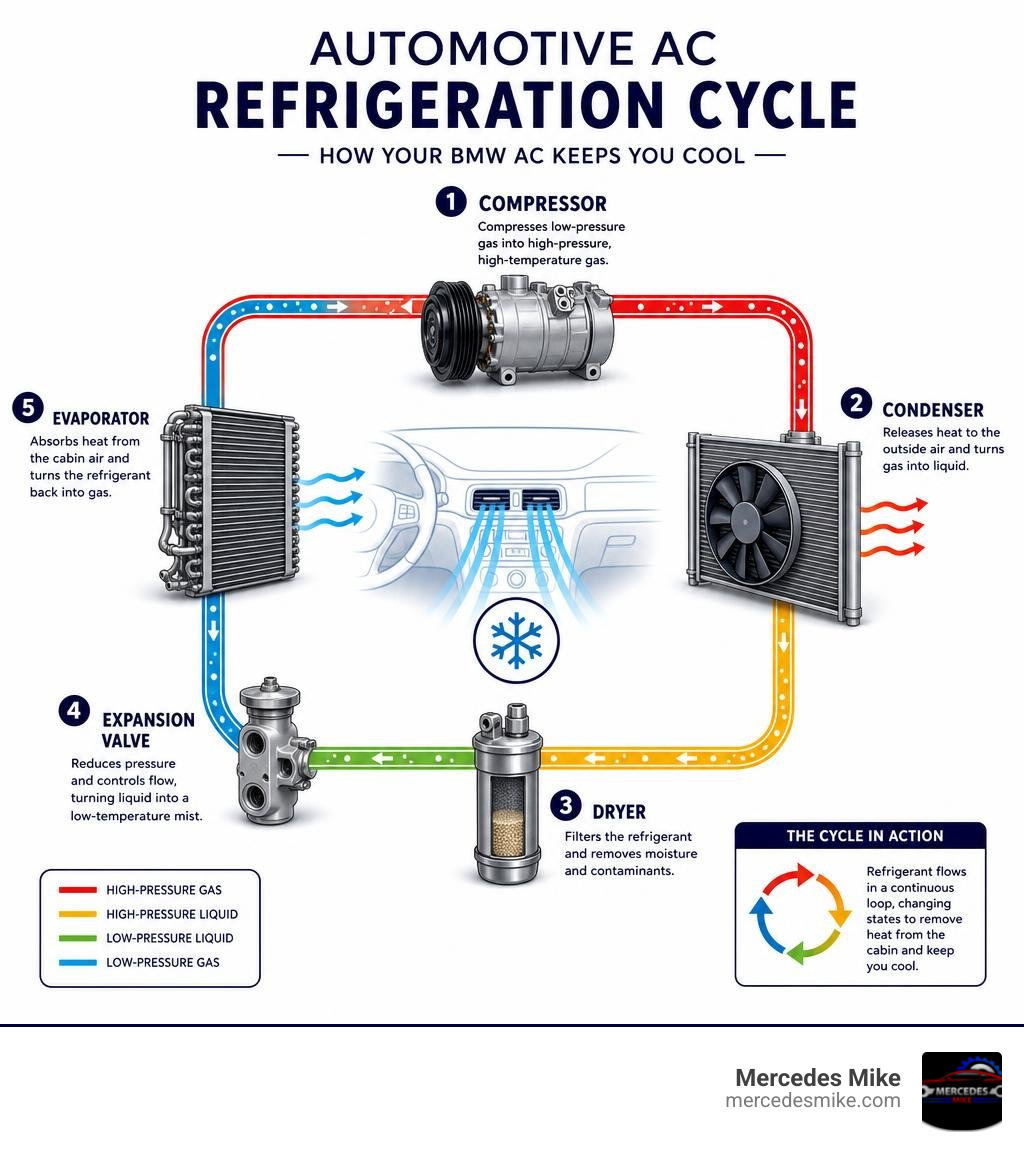
When to Get a BMW Air Conditioning Recharge
Many drivers assume that an automotive air conditioning system creates cold air from scratch. In reality, your BMW's climate control system works by extracting heat from inside the cabin and releasing it outside. This heat-exchange process relies entirely on a chemical refrigerant cycling through gaseous and liquid states.
When your refrigerant levels drop, your climate control's overall cooling efficiency takes a massive hit. You might notice that even on the absolute coldest setting with the fan on high, the cabin remains uncomfortably warm.
Another clear indicator is weak airflow or air that is barely cooler than the outside temperature. This occurs because there isn't enough refrigerant to absorb the heat passing over the evaporator core. In some cases, you may even hear a distinct hissing noise coming from the dashboard vents. This sound is often the physical refrigerant rushing through the thermal expansion valve under insufficient pressure.
Crucially, you should also check your AC compressor clutch. With the engine running and the AC turned on, the clutch (located on the front of the compressor pulley in the engine bay) should engage and spin. If the refrigerant level is too low, a safety pressure switch will prevent the compressor clutch from engaging to protect the system from running dry and seizing. If your compressor isn't clicking on, a simple top-off won't do the trick; you will need a professional AC Repair to safely diagnose and resolve the issue.
Warning Signs You Need a BMW Air Conditioning Recharge
Before you sweat through another drive in South Florida, keep an eye out for these classic warning signs:
Blowing Warm Air: This is the most obvious sign. If the vents are pumping out warm air on a hot afternoon, your refrigerant level is likely bottomed out.
Musty or Stale Odors: Sometimes, low refrigerant levels cause the evaporator to freeze and thaw repeatedly, creating a damp environment where mold can thrive. If you notice a musty smell, your cabin micro-filter might need replacement alongside a system recharge.
The "Warm Passenger, Cold Driver" Phenomenon: Modern BMWs are highly sensitive to low refrigerant. Often, a low charge will cause the passenger-side vents to blow warm air while the driver-side vents remain slightly cool.
Misconfigured Controls: Before assuming the worst, check your BMW’s stratified air dial (the physical thumbwheel between the center vents on many models, or the digital setting in iDrive). If this dial is set to the red (warm) zone, it will override your digital climate settings and blow warm air even if your AC is perfectly fine.
If you have verified your settings and are still getting warm air, you likely have a leak. A professional Refrigerant Leak Repair is necessary to keep your freshly added refrigerant from escaping right back into the atmosphere.
How Often Should You Service Your BMW Climate Control?
Unlike engine oil or brake fluid, there is no fixed schedule for a BMW air conditioning recharge. A perfectly sealed AC system can theoretically run for a decade or more without needing a top-off. Real-world conditions, however, are rarely perfect. Road vibrations, extreme temperature changes, and aging rubber hoses mean that tiny amounts of refrigerant will naturally escape over time.
At our Pompano Beach facility, we recommend having an annual inspection of your climate control system. This pre-summer check-up ensures that your system pressure is within spec before the intense Florida heat arrives.
One of the best preventative habits you can build is running your AC for at least 10 to 15 minutes once a month during the winter. This keeps the internal oil circulating, which provides critical o-ring lubrication. Keeping these rubber seals lubricated prevents them from drying out, cracking, and causing slow, frustrating leaks.
BMW Refrigerant Types: R-134a vs. R-1234yf
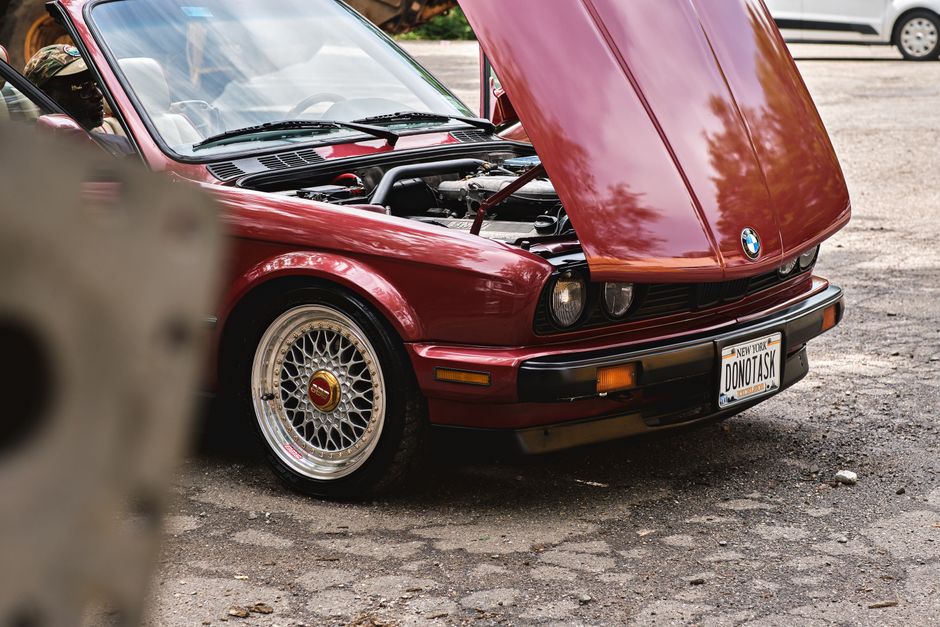
Using the wrong chemical in your BMW’s climate control system can destroy the compressor and cause thousands of dollars in damage. Modern vehicles use one of two primary types of refrigerant:
R-134a: The industry standard for decades. It is highly effective but has a high global warming potential (GWP).
R-1234yf: A newer, environmentally friendly refrigerant with a very low GWP. It has been phased into almost all passenger vehicles built after 2016-2017.
Because these chemicals operate under different pressures and require different compressor lubricants, they cannot be mixed. To prevent accidental cross-contamination, manufacturers designed the systems with physical port incompatibility. The service couplers for an R-134a system will not physically fit onto the ports of an R-1234yf system.
Choosing the Correct Refrigerant for a BMW Air Conditioning Recharge
To determine exactly which refrigerant your vehicle requires, look for the factory-installed engine bay sticker. This label is typically located on the underside of the hood or on the radiator core support. It will clearly display the refrigerant type (e.g., "R-134a" or "R-1234yf") along with the exact system capacity in grams or ounces.
Model-year differences play a massive role here. For example:
If you are driving an older classic, you can learn How to Add Refrigerant to a 2018 BMW M550i xDrive 4.4L V8 Turbo which may use R-134a or R-1234yf depending on its production date.
Newer plug-in hybrids require specialized care. You can see the differences in How to Add Refrigerant to a 2023 BMW 330e xDrive 2.0L 4 Cyl. Turbo PHEV, which strictly utilizes the newer R-1234yf chemical.
Step-by-Step Guide to a DIY AC Recharge
If you have confirmed your refrigerant type and want to attempt a DIY recharge, follow this step-by-step process carefully.
What You Will Need:
Safety goggles and heavy-duty work gloves (refrigerant can cause instant frostbite on bare skin)
A vehicle-specific AC recharge kit (complete with a pressure gauge and hose)
A digital thermometer
Step 1: Prepare Your Vehicle and Safety Gear
Put on your safety goggles and gloves. Park your BMW on a level surface, engage the parking brake, and start the engine. Turn your climate control system to its maximum cooling setting, set the fan speed to high, and ensure the recirculation mode is turned on.
Step 2: Locate the Low-Pressure Port
Open the hood and locate the low-pressure service port. It is situated on the larger-diameter aluminum AC line, often near the passenger side of the engine bay or close to the firewall. Do not touch the high-pressure port, which is located on the smaller-diameter line and has a physically different size. Unscrew the plastic dust cap (typically labeled "L").
Step 3: Check the Compressor and Initial Pressure
Attach the quick-connect fitting of your recharge kit's hose to the low-pressure port. Push down firmly until you hear it click into place. Look at the integrated pressure gauge.
If the gauge reads zero: You have a major leak. Stop immediately and seek professional help.
If the compressor clutch is not spinning: The system may be too low to trigger the switch, or the compressor itself has failed.
Step 4: Add the Refrigerant Slowly
Hold the refrigerant can completely upright. Squeeze the trigger in short, controlled bursts (about 5 to 10 seconds at a time), shaking the can gently between bursts. This allows the liquid refrigerant to vaporize before entering your compressor. Monitor the pressure gauge constantly. Your target pressure is typically around 40 psi, but consult your kit's ambient temperature chart for the exact target.
Step 5: Test the Output
Insert your digital thermometer into the center cabin vent. Once the pressure gauge reaches the correct zone, check the vent temperature. It should drop significantly, ideally registering between 40°F and 45°F. Once complete, disconnect the hose, reinstall the plastic dust cap, and close the hood.
The Risks of DIY AC Recharging
While a DIY recharge seems straightforward, modern BMWs are incredibly complex and sensitive. Attempting a quick fix with an over-the-counter can of freon carries significant risks:
Extreme Overfilling Sensitivity: Modern BMW climate control systems are engineered with incredibly tight tolerances. Overfilling by even a few ounces can cause high system pressures, leading to poor cooling performance, system shutdowns, or catastrophic compressor damage.
Moisture Introduction: DIY cans do not remove air or moisture from the lines. If moisture enters the system, it combines with the refrigerant to create highly corrosive acids that destroy internal components from the inside out.
Lack of Lubrication: When a system leaks refrigerant, it also loses compressor oil. Professional service includes adding the precise amount of PAO lubricant to prevent compressor seizure. DIY kits rarely address this balance accurately.
Incompatible Parts: As discussed in online enthusiast communities like the A/C Recharge F30 forum threads, owners often run into issues where standard retail store adapters do not fit BMW's specialized service ports, leading to damaged valves and leaked chemicals.
Professional Diagnostics vs. DIY Costs
When you take your vehicle to a professional shop, technicians do not just hook up a retail can and hope for the best. They utilize a comprehensive diagnostic approach to protect your vehicle's delicate climate control system.
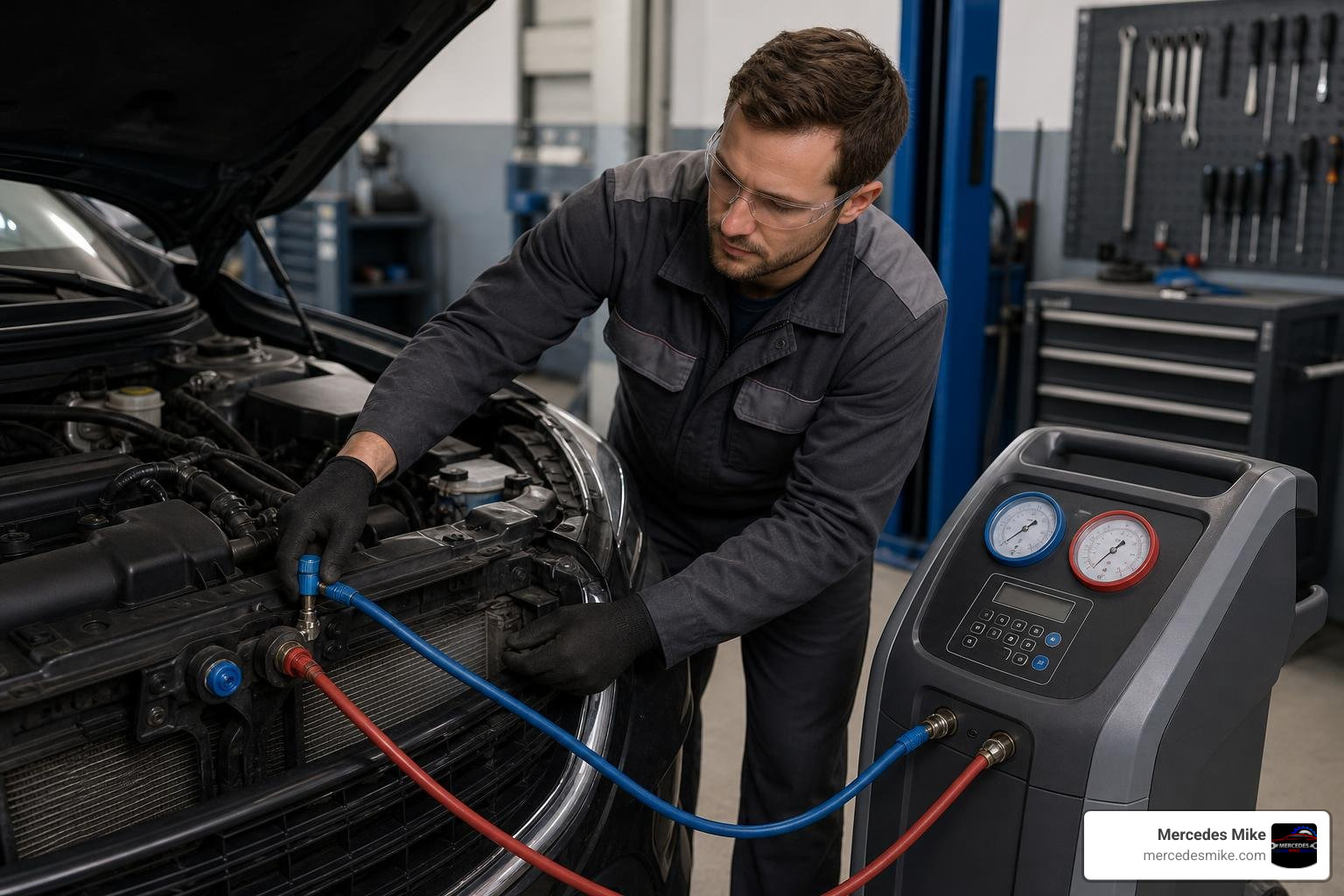
Essential Tools Used by Certified Technicians:
Professional Manifold Gauges: These measure pressures on both the high-pressure and low-pressure sides simultaneously, providing a complete picture of compressor health.
Electronic Leak Detectors (Sniffers): These highly sensitive hand-held devices can detect the presence of halogenated refrigerant molecules down to a fraction of an ounce per year.
UV Dye Kits: Technicians inject a fluorescent dye into the system, run the AC, and use an ultraviolet light to trace the exact physical location of even the smallest leaks.
Heavy-Duty Vacuum Pumps: Before refilling, professional machines pull a deep vacuum on the system for 30+ minutes to boil off any hidden moisture and verify that the system can hold a vacuum without leaking.
Cost Breakdown and Factors
How do the economics of a BMW air conditioning recharge stack up? Let’s look at the real-world numbers:
Service Type Average Cost What's Included Pros & Cons DIY Recharge Kit $80 – $100 1 can of refrigerant, basic hose, plastic gauge Cheap, fast; high risk of overfilling, does not fix underlying leaks. Professional Service $200 – $250 Complete evac & recharge, system vacuum, leak test, exact weight refill Extremely safe, includes warranty, accurate; higher upfront cost.
While a DIY kit costs under $100, it is only a temporary band-aid if your system has an active leak. If you have a newer BMW that uses the environmentally friendly R-1234yf refrigerant, the raw chemical cost is significantly higher than older R-134a, which drives up both DIY and professional prices.
Furthermore, if a slow leak is left ignored, it can eventually ruin major components. An evaporator replacement on a modern BMW, for example, is an incredibly labor-intensive job that can easily cost $3,000 to $4,000 at a dealership. Spending a little more on a professional Air Conditioning Recharge and leak test early on can save you thousands down the road.
Frequently Asked Questions About BMW AC Systems
Why is my BMW AC blowing warm air on one side?
This is a very common issue in dual-zone BMW climate control systems. It is usually caused by one of two things:
Low Refrigerant Charge: When the system is partially low, the refrigerant boils off completely in the first half of the evaporator core, leaving no cooling capacity for the passenger-side vents.
Failing Blend Door Actuators: These small electric motors control the flaps that mix hot and cold air. If an actuator fails, one side of the cabin may get stuck blowing hot heater air while the other side gets cool air.
Can I use a standard R-134a kit on a newer BMW?
No. Newer BMWs (typically model years 2017 and newer) utilize R-1234yf refrigerant. The service ports are physically different to prevent cross-contamination. Attempting to bypass this using cheap adapters will damage your service valves, contaminate your system, and potentially destroy your AC compressor.
How do technicians find slow refrigerant leaks?
Technicians use a multi-step process to find slow leaks. First, they inject a specialized fluorescent UV dye into the system and run the AC. They then inspect all lines, connections, the condenser, and the compressor using a UV light. For hidden areas like the evaporator core inside the dashboard, they use electronic "sniffers" that can detect trace amounts of chemical vapor escaping from the vents.
Conclusion
A properly functioning climate control system is essential for enjoying your BMW, especially during hot South Florida summers. While a DIY recharge might seem like an easy way to save a few dollars, the complexity and sensitivity of modern BMW systems make professional service the safest and most reliable choice.
At Mercedes Mike in Pompano Beach, our decades-experienced technicians use the absolute latest diagnostic tools and recovery machines to service your BMW. Whether you need a simple system test, a precise factory-weight recharge, or a complex leak repair, we serve drivers across Pompano Beach, Deerfield Beach FL, and the surrounding South Florida area with dealership-level expertise without the dealership price tag.
Don’t sweat through another drive. Schedule Professional BMW AC Service with the team at Mercedes Mike today and keep your cool all year long!