
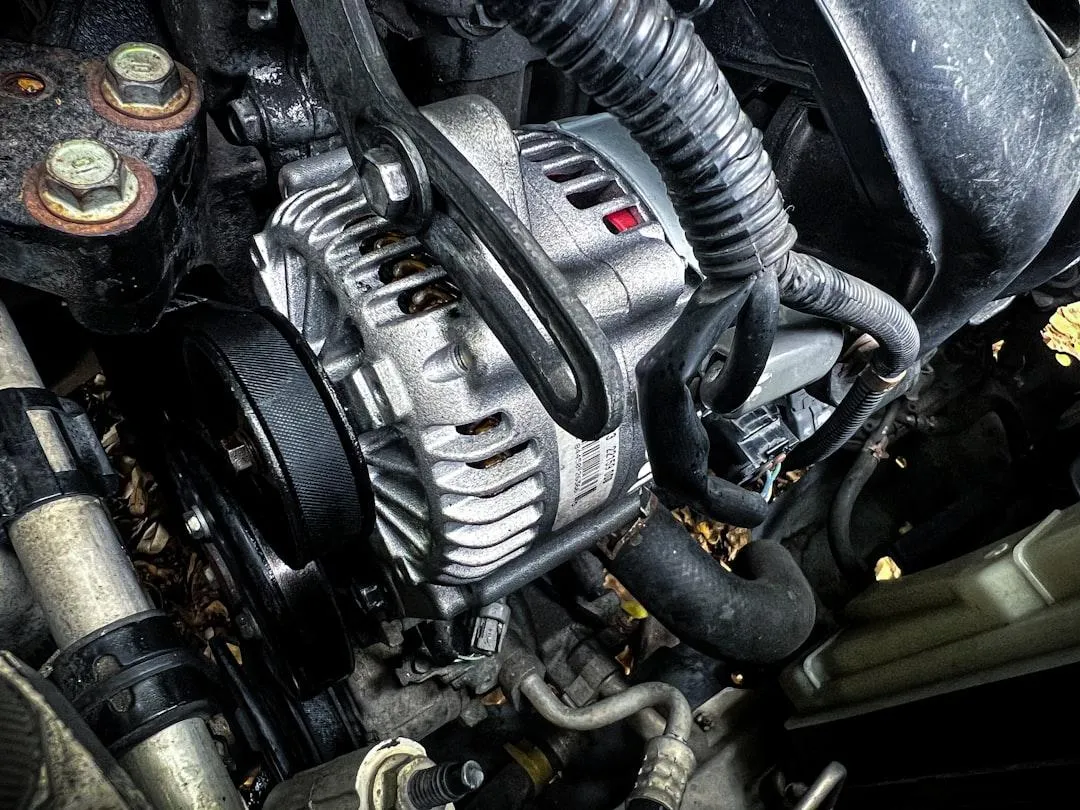
A Practical Guide to Comparing Engine Replacement Costs
When an Engine Fails: What You're Really Deciding
Engine replacement is one of the most expensive repair decisions a car owner will face — but it doesn't have to be a confusing one.
Here's a quick answer to the most common questions:
Question Quick Answer What does engine replacement cost? $4,500 – $11,500 out-the-door for most vehicles in 2026 New vs. remanufactured vs. used? Remanufactured offers the best balance of cost and warranty Rebuild or replace? Replace if damage is severe; rebuild if the block is still sound Is it worth it? Usually yes — if the swap costs less than 60% of the car's market value How long will it last? A quality remanufactured engine can last 100,000+ miles
When an engine fails, most owners face the same gut-punch moment: is this car worth saving, or do I walk away?
The answer depends on more than just the repair bill. It depends on the type of engine, the source of the replacement unit, your labor costs, and — critically — what the car is worth once it's back on the road.
For owners of German luxury vehicles like Mercedes-Benz or BMW, the stakes are even higher. These engines are precision-built, often hand-assembled, and require specialized tooling and certified technicians to replace correctly. A generic quote from a general repair shop may not reflect the full picture.
This guide breaks down every cost factor, every sourcing option, and every decision point — so you can make a confident, informed choice.
Rebuild vs. Swap: Understanding Your Engine Replacement Options
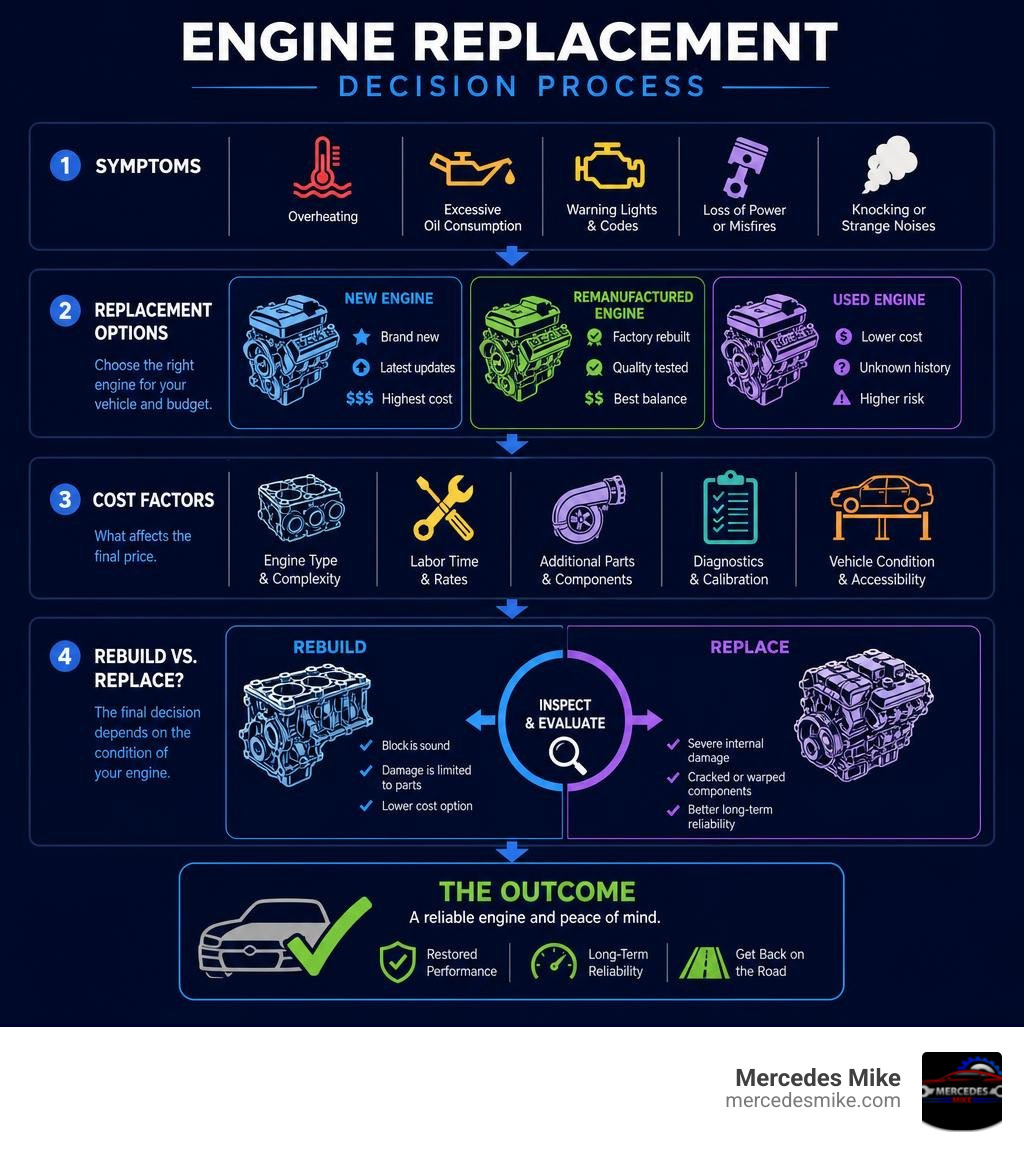
When your vehicle experiences a catastrophic powertrain failure, you are generally faced with two primary technical pathways: rebuilding your existing motor or performing a complete engine replacement. Deciding between these two requires understanding exactly what happens to your cylinder block, cylinder heads, and moving internals under each scenario.
Rebuilding Your Existing Block
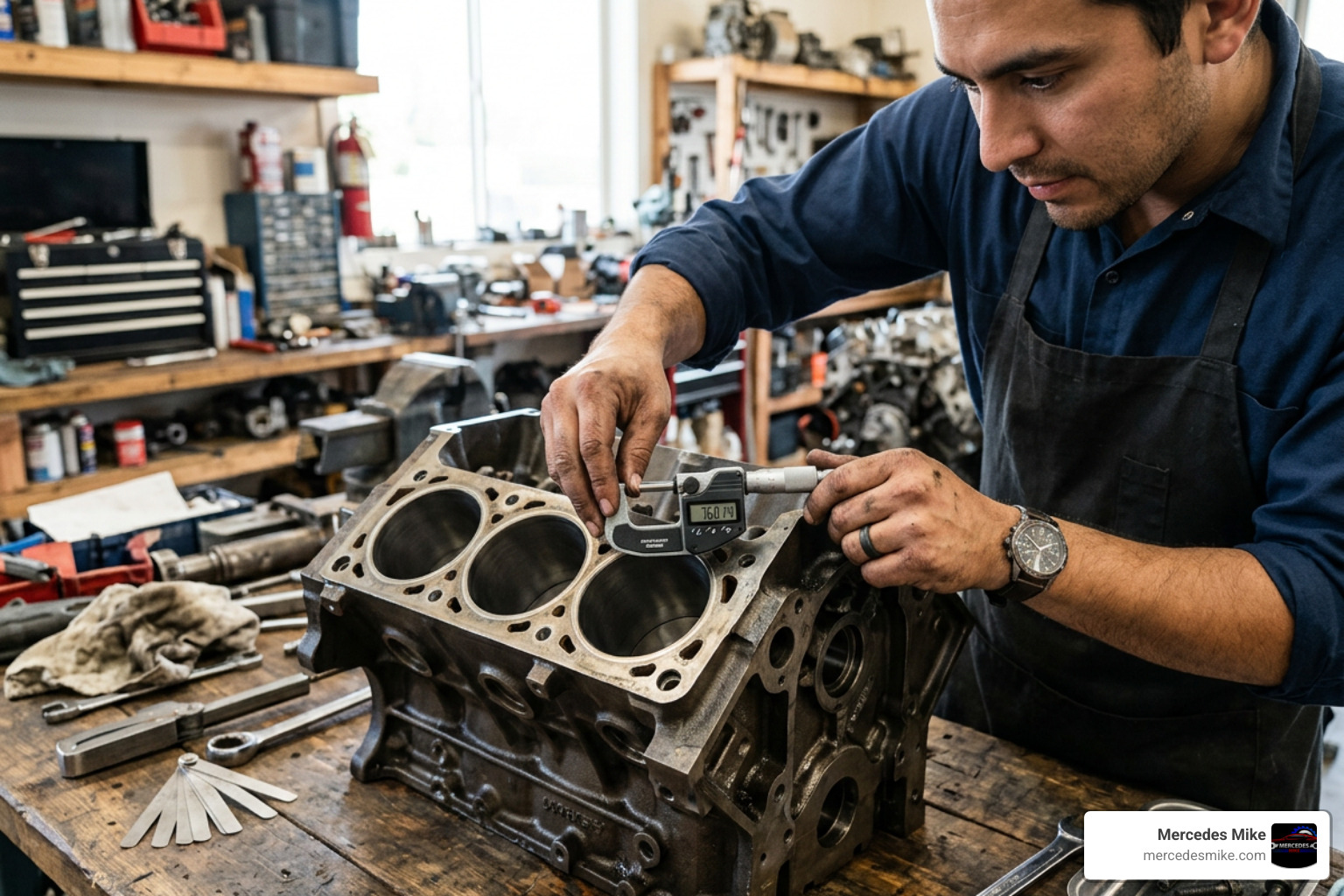
An engine rebuild is essentially a highly detailed reconditioning process. A technician completely disassembles your motor, cleans every component down to the bare metal, inspects the parts for micro-fractures, and measures tolerances against original factory specifications.
During an overhaul, the block is sent to specialized motor rebuild shops for machining services. This includes boring and honing the cylinders to remove scoring, resurfacing the cylinder deck to ensure flatness, and grinding the crankshaft. The mechanic then reassembles the engine using brand-new pistons, rings, bearings, gaskets, and seals, while reusing the main structural components like the engine block, crankshaft, and connecting rods if they are still sound.
A professional engine rebuild in the US typically costs between $2,500 and $4,000 for standard domestic or import utility blocks. However, depending on the complexity of the overhead cams, variable valve timing systems, and local labor rates, a comprehensive rebuild can range between $3,500 and $6,000. Professional facilities in South Florida manage machining and reconditioning to ensure factory-grade tolerances.
To understand how the parts and labor break down for this specific path, you can read our detailed guide on the cost to rebuild engine.
Choosing a Complete Engine Replacement
When the internal damage to your block is too severe—such as a thrown connecting rod that has punched a hole through the crankcase, or a severely cracked engine block from thermal shock—rebuilding is no longer a viable option. In these situations, a complete swap is necessary.
When choosing a replacement, you will encounter three main configurations:
Short Block: This includes only the lower portion of the engine—the engine block itself, the crankshaft, pistons, and connecting rods. You must transfer your existing cylinder heads, camshafts, oil pan, and manifolds to the new block.
Long Block: This is a more complete assembly. It includes the block, pistons, crankshaft, cylinder heads, camshafts, and valve train. It is pre-assembled and timed, which significantly reduces shop labor hours during installation.
Crate Engine: A fully completed, drop-in engine assembly that includes everything in a long block plus the intake manifold, fuel system, ignition system, water pump, and sometimes the oil pan and pulleys.
The choice between a rebuild and a swap often boils down to time, severity of damage, and the level of warranty you require.
Additionally, if you are a hands-on enthusiast or want to see the strict manufacturer specifications and torque sequences required to assemble classic blocks, you can reference the 5.0L & 5.7L Service Manual to appreciate the sheer complexity of correct fastener tensioning.
Cost Breakdown: What Does a Full Swap Cost in 2026?
Sourcing your replacement motor is the single largest variable in your overall invoice. The table below outlines the realistic out-the-door pricing expectations for mainstream passenger vehicles in 2026.
Engine Source Average Unit Cost Average Installation Labor Total Out-the-Door Cost Warranty Coverage Used / Salvage $1,500 – $4,500 $1,800 – $3,500 $3,700 – $7,900 30 – 90 Days (Parts Only) Remanufactured $2,500 – $7,500 $1,800 – $4,000 $4,700 – $10,400 3 – 5 Years (Parts & Labor) New OEM / Crate $6,000 – $10,000 $2,000 – $5,000 $8,000 – $14,000+ 2 – 3 Years (Factory Backed)
Sourcing Your Block: New, Remanufactured, or Used
Choosing where your replacement engine comes from has a major impact on both your wallet and your peace of mind.
New OEM / Crate Engines
These are brand-new engines straight from the vehicle manufacturer's assembly line, built with 100% original OEM parts. They represent the highest tier of reliability but carry a premium price tag. For luxury German engineering, a brand-new factory block can easily exceed $12,000 to $16,000 before labor is even calculated.
Remanufactured Engines
A remanufactured engine is the sweet spot for vehicles that are five to fifteen years old. These units are completely stripped down in a specialized factory setting. All wear components are replaced with brand-new parts, and the core structural castings are machined back to original tolerances.
Importantly, reputable remanufacturers often apply engineering updates to correct known factory design flaws that existed in the original engine. For a comprehensive look at how these averages play out across different platforms, see the Full Car Engine Swap Cost with OEM Parts (2026 Data & Averages) | UseCalcPro .
One important element of buying a remanufactured engine is the core charge. This is a refundable deposit (typically ranging from $400 to $1,200) charged by the supplier. Once your mechanic removes your old, broken engine and ships it back to the remanufacturer, the deposit is refunded.
Used Engines
Sourced from salvage yards and donor vehicles, used engines are the most budget-friendly upfront option. However, they carry the highest risk because their maintenance history is often unknown.
If you are considering a used unit, we strongly advise paying for a compression and leak-down test before the engine is bolted into your chassis. For comparison, you can read about how budget sourcing impacts overall costs in the guide on What is the Average Cost of a Nissan Engine Replacement in 2026? .
Labor Rates and Hidden Fees
The second half of your engine swap invoice is the professional shop time required to perform the physical extraction and installation.
An engine swap typically takes between 12 to 25 hours of labor for mainstream front-wheel-drive or rear-wheel-drive vehicles. However, highly complex German luxury cars or vehicles with tight, transverse engine bays can easily require 26 to 35+ hours of specialized shop time.
Labor rates vary significantly by the type of facility and region:
Independent Repair Shops: Typically charge between $110 and $160 per hour.
Dealership Service Centers: Often charge between $150 and $220+ per hour (a 30% to 60% premium over independent specialists).
If you are located in South Florida, labor dynamics are highly influenced by local market factors. The core reality remains the same: choosing a specialized independent mechanic with documented brand experience is almost always the most cost-effective path compared to high-overhead dealerships.
Beyond basic parts and labor, keep an eye out for these potential hidden fees:
Freight Charges: Shipping a heavy cast-iron or aluminum engine block across the country typically adds $250 to $450 in freight.
Diagnostic Time: Expect to pay $100 to $200 for the initial tear-down and diagnostic scans to confirm the engine failure.
Fluids and Shop Supplies: Brand-new synthetic oil, coolant, refrigerant recharge, and specialized filters can add $150 to $300 to your final bill.
Making the Decision: Keep Your Car or Sell It?
When faced with a massive repair quote, you have to run the numbers to see if keeping the vehicle makes financial sense.
Signs Your Motor is Failing
Before committing to a complete engine swap, you must ensure that your motor actually requires replacement rather than a minor, targeted repair. There are several critical red flags that point to internal engine failure:
Loud Knocking or Grinding: A deep metallic tapping noise that increases in speed with engine RPM usually indicates a spun rod bearing or severe crankshaft wear.
Metal Shavings in the Oil: Finding shiny, metallic flakes on your oil dipstick or inside the oil pan during a service means internal components are actively grinding themselves down.
Persistent White or Blue Exhaust Smoke: Thick white smoke points to coolant leaking into the combustion chambers (often due to a cracked block or blown head gasket), while blue-grey smoke indicates the engine is burning oil due to worn piston rings or valve stem seals.
Loss of Power and Severe Misfires: Continuous rough idling, loss of compression across multiple cylinders, and a flashing check engine light that cannot be resolved with basic ignition service.
If you drive a high-performance European vehicle, it is helpful to familiarize yourself with the most common problems with german cars and how to prevent them to distinguish between a simple sensor issue and a catastrophic mechanical failure.
Calculating the Value of an Engine Replacement
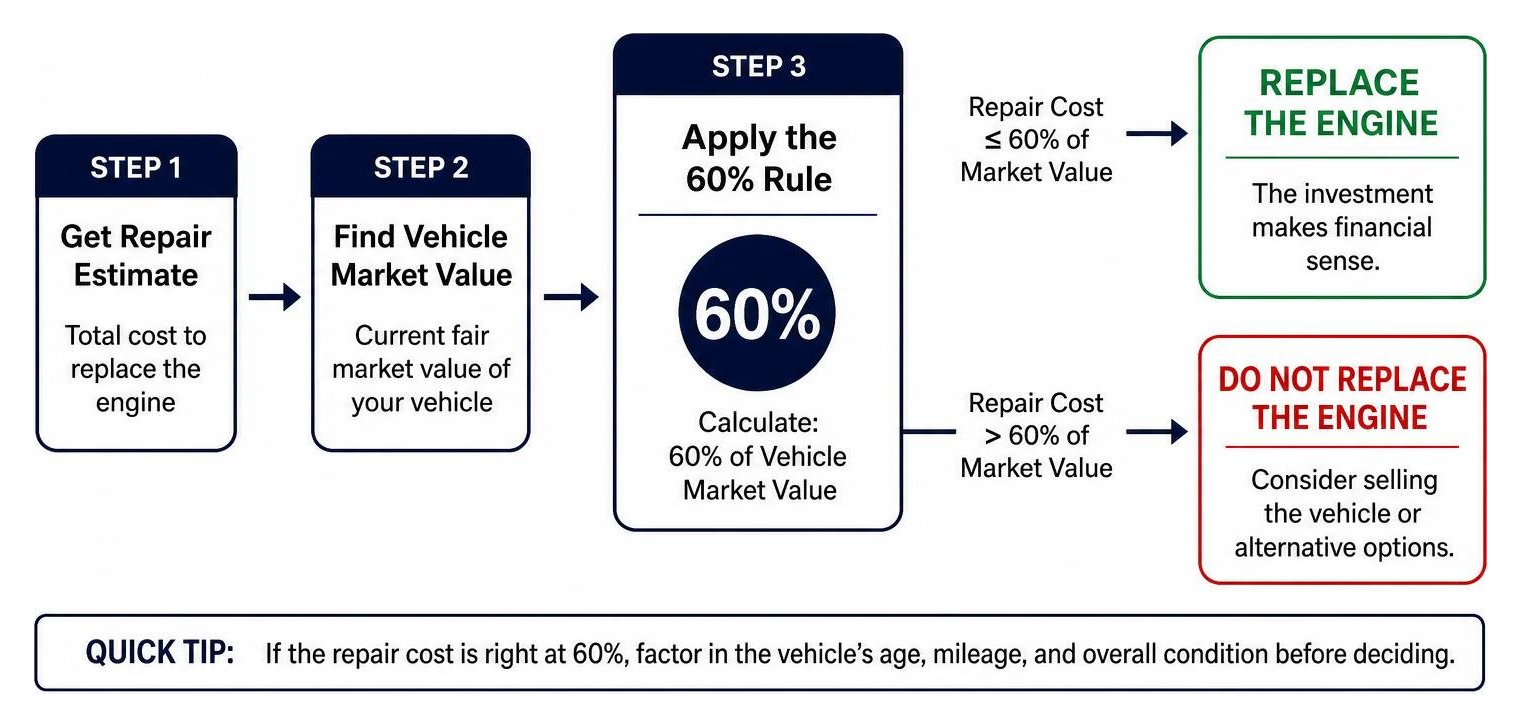
To decide whether to swap the engine or replace the car, we recommend using the 60% Rule.
If the total out-the-door cost of the engine replacement is less than 60% of the vehicle's actual market value (with a working engine), investing in the swap is generally the smarter financial move. This is especially true if the vehicle's body, suspension, interior, and transmission are in good condition.
For example, if your European sedan is worth $15,000 on the used market, and a professional engine swap costs $7,500 (50% of the car's value), you are successfully protecting your investment. For only $7,500, you restore a $15,000 asset. Buying a comparable replacement car would likely cost you far more in immediate depreciation, sales tax, and registration fees.
However, if your car is older and has high mileage across all major systems, you might want to consider if those funds would be better spent elsewhere. Alternatively, if your engine is still healthy but you are looking to extract more power and efficiency from your machine, you can check out the top 5 performance upgrades for your german car.
Frequently Asked Questions About Engine Swaps
How long does a remanufactured engine last?
A properly remanufactured engine that has been built to meet or exceed original OEM specifications can easily last 100,000 miles or more. Because all critical wear components—including pistons, rings, bearings, and valve guides—are replaced with brand-new parts, the physical lifespan of the block is essentially reset to zero.
To ensure this longevity, you must strictly follow the manufacturer's recommended break-in procedure (which often involves varying your engine speed and performing an early oil change within the first 500 to 1,000 miles) and stick to a rigorous maintenance schedule. You can refer to our scheduled maintenance guide 2026 and our guide on 100,000 mile maintenance to keep your newly installed engine running smoothly for years to come.
What warranty coverage comes with a remanufactured engine?
One of the greatest advantages of choosing a remanufactured engine over a used salvage unit is the warranty protection. High-quality remanufacturers typically back their products with a 3-year, 100,000-mile transferable nationwide warranty.
Crucially, you should verify if your chosen repair shop is installing an engine with a warranty that covers both parts and labor. A parts-only warranty will leave you responsible for thousands of dollars in shop labor if the replacement unit suffers a manufacturer defect. A transferable warranty also adds significant resale value to your vehicle if you decide to sell it down the road.
What additional parts should be replaced during an engine swap?
Skipping the replacement of routine wear parts during an engine swap to save a few hundred dollars is a very common mistake. When the engine is completely removed from the bay, the labor cost to replace supporting parts is virtually free.
We highly recommend replacing the following parts "while you're in there":
Water Pump and Thermostat: Especially on engines where the water pump is buried behind the timing chain assembly, making post-swap replacement extremely labor-intensive.
Timing Belt/Chain and Tensioners: Ensuring your new motor starts with a perfectly fresh timing set.
Engine and Transmission Mounts: Worn rubber mounts cause vibration and put unnecessary stress on your new drivetrain.
Spark Plugs, Belts, and Hoses: Cheap preventative insurance against future breakdowns.
Clutch Kit: On manual-transmission cars, always install a new clutch, pressure plate, and throw-out bearing while the transmission is detached.
For a great step-by-step visual of how these supporting components are addressed during an actual engine pull, you can watch the classic breakdown in Toyota 3.4 Liter 5VZ-FE Engine Replacement (Part 1 - Engine Removal) - Timmy the Toolman .
Additionally, because the engine and transmission must be separated during this process, it is also the perfect time to evaluate your gearbox. Check out our transmission replacement guide 2026 to see if your transmission requires attention while the powertrain is out of the vehicle.
Conclusion
An engine replacement is a major mechanical undertaking, but with the right team of experts, it can successfully extend the lifespan of your vehicle for another decade.
At Mercedes Mike, we specialize in providing elite maintenance, diagnostics, and engine replacement services for premium German brands, including Mercedes-Benz, BMW, Audi, and Porsche. Our decades-experienced technicians use the latest factory-diagnostic tools and specialized equipment at our state-of-the-art facility located at 882 NE 41st Court in Pompano Beach, just off N Dixie Hwy.
Whether you need a certified mercedes benz mechanic, specialized german auto repair pompano beach, or a trusted local auto service shop pompano beach, we serve drivers across Pompano Beach, Deerfield Beach, and the broader South Florida region with transparency, precision, and care.
Do not let engine trouble leave you stranded. Schedule your professional engine consultation today and let our team restore your vehicle's performance to factory standards.