

Don't Stall Your Business: The Complete Sprinter Service Schedule
Why the Mercedes-Benz Sprinter Maintenance Schedule Determines Your Van's Lifespan
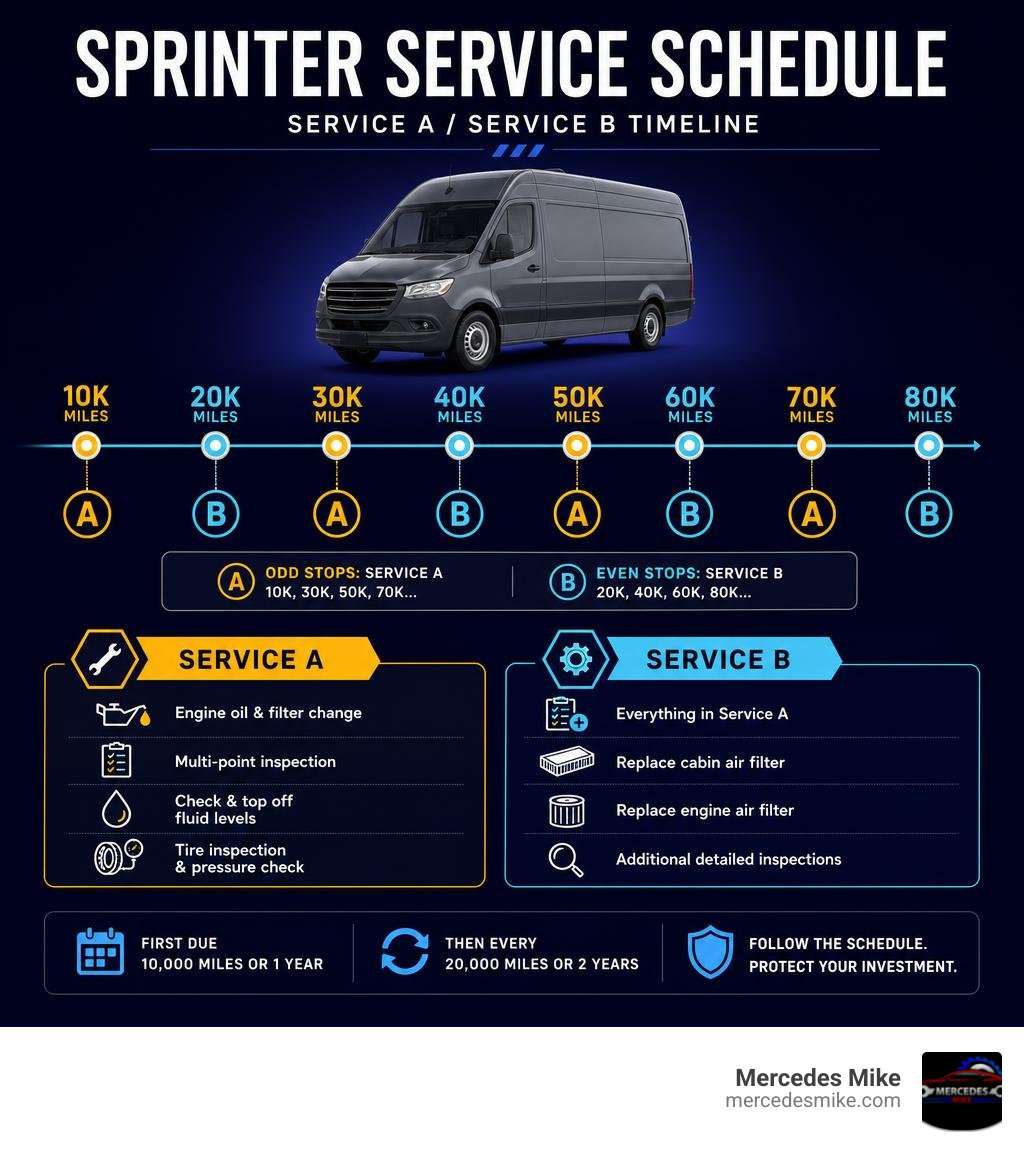
The Mercedes-Benz Sprinter maintenance schedule follows an alternating Service A / Service B pattern, starting at 10,000 miles or 1 year, then every 20,000 miles or 2 years after that.
Quick answer — Sprinter service intervals at a glance:
Service First Due Then Every Service A 10,000 miles or 1 year 20,000 miles or 2 years Service B 20,000 miles or 2 years 20,000 miles or 2 years
So the pattern looks like this: 10K → 20K → 30K → 40K → 50K → 60K...
Odd stops (10K, 30K, 50K, 70K): Service A
Even stops (20K, 40K, 60K, 80K): Service B
Your Sprinter works hard every day. Whether it's hauling cargo, running deliveries, or keeping a mobile business moving, missed maintenance doesn't just cost you a repair — it can cost you a whole workday, or worse, your warranty.
The good news? Mercedes-Benz built a clear, predictable service system for the Sprinter. Follow it, and the van will reliably clock hundreds of thousands of miles. Skip it, and you risk unexpected breakdowns, a voided powertrain warranty, and a lower resale price when it's time to move on.
This guide covers everything: Service A and B tasks, diesel vs. gas vs. eSprinter differences, emissions system care, milestone services, and how the onboard ASSYST PLUS system keeps you on track.
Decoding the Mercedes Benz Sprinter Maintenance Schedule: Service A vs. Service B
To keep your van in top operational shape, Mercedes-Benz utilizes the Flexible Service System (FSS). Instead of forcing you to guess what your van needs, the system alternates between two primary packages: Service A and Service B.
These packages are systematically spaced to ensure that wear-and-tear items are addressed before they cause a breakdown. Below is a direct comparison of what each service package includes:
Maintenance Task Service A (Odd intervals: 10K, 30K, 50K...) Service B (Even intervals: 20K, 40K, 60K...) Synthetic Engine Oil & Fleece Filter Yes Yes Fluid Level Checks & Corrections Yes Yes Tire Inflation Check & Correction Yes Yes Brake Component Inspection Yes Yes Maintenance Counter Reset Yes Yes Cabin Dust/Combination Filter No Yes Brake Fluid Exchange No Yes Diesel Exhaust Fluid (DEF) Refill Yes Yes
Service A: The 10,000-Mile Foundation
Service A is the critical baseline for your van's longevity. First performed at 10,000 miles (or 1 year), and then every 20,000 miles thereafter, this service prevents engine wear and catches minor issues before they snowball.
During Service A, we replace your engine's oil with high-grade synthetic motor oil matching Mercedes-Benz specification 229.52, paired with a specialized fleece oil filter designed to last the full service interval. We also check and correct all vital fluid levels, inspect the tire tread and adjust tire pressure, perform a comprehensive brake inspection, and reset your instrument cluster's maintenance counter. Keeping up with this foundation ensures your engine remains highly efficient and protected under warranty. For a detailed breakdown of how these initial stops protect your vehicle over its lifetime, you can read our Scheduled Maintenance Guide 2026.
Service B: The 20,000-Mile Comprehensive Check
Service B is your Sprinter's deep-dive checkup. It is first performed at the 20,000-mile mark (or 2 years) and continues on alternating 20,000-mile intervals. Because your van has worked twice as hard by the time it reaches Service B, this package includes everything found in Service A plus several deeper maintenance requirements.
The most notable additions in Service B are the replacement of the cabin dust/combination filter—which keeps the air inside your mobile workspace clean and free of allergens—and a complete brake fluid exchange. Over time, brake fluid naturally absorbs moisture from the air, which can lower its boiling point and cause a spongy brake pedal, especially when driving down steep grades or carrying heavy cargo. Swapping this fluid every two years is vital for your safety. To better understand why these factory-specified intervals are structured this way, check out our guide on Factory Scheduled Maintenance.
Diesel, Gas, and eSprinter Maintenance Requirements
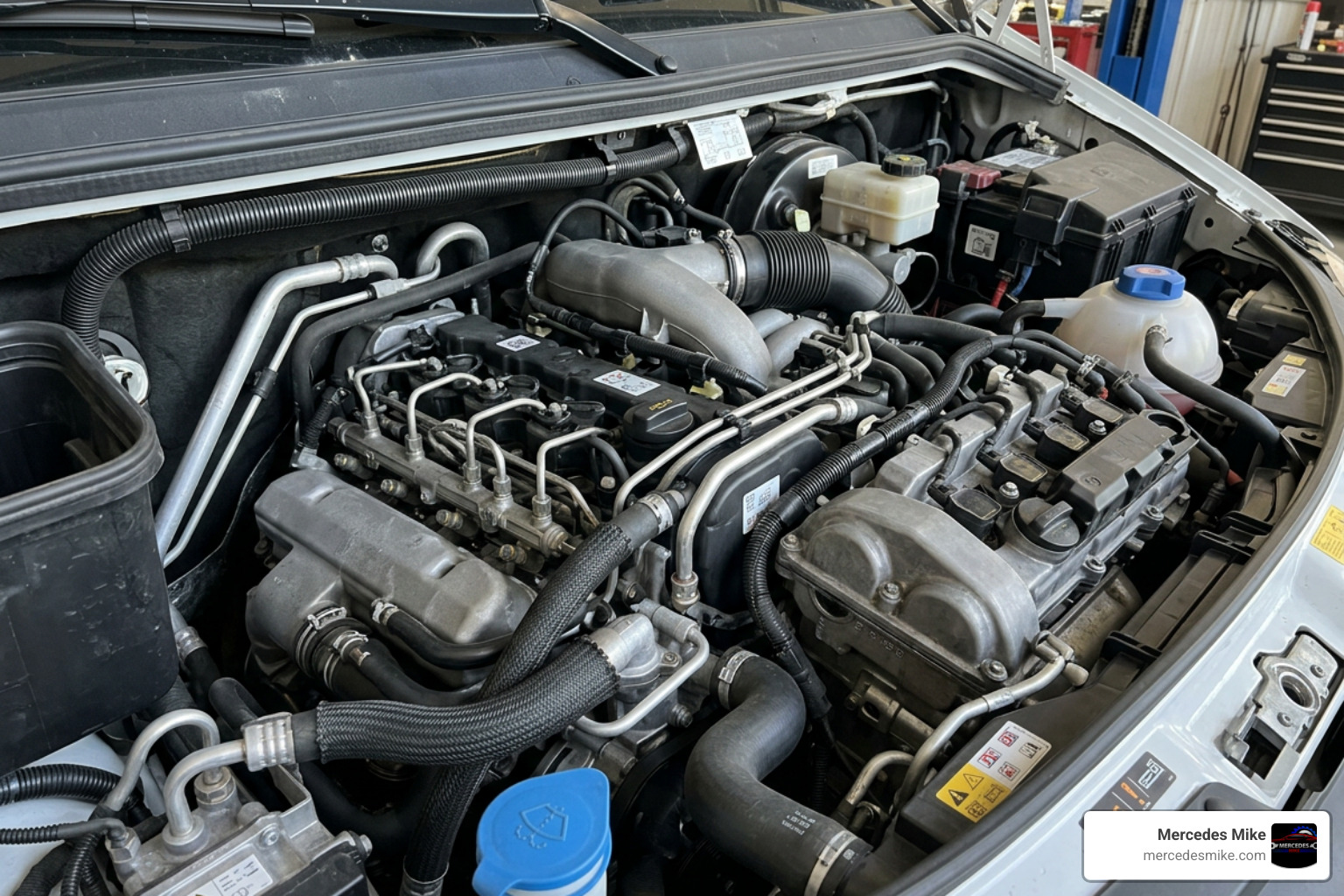
Not all Sprinters are built the same. Depending on what is under the hood of your van, your mercedes benz sprinter maintenance schedule will feature highly distinct service requirements.
Diesel-Specific Mercedes Benz Sprinter Maintenance Schedule Tasks
Diesel engines are legendary for their durability, but they require highly specific maintenance to stay healthy. If you operate a diesel Sprinter, you must pay close attention to your fuel filter and motor oil.
The diesel fuel filter must be replaced every 20,000 miles or 1 year to prevent water and debris from damaging your high-pressure fuel injectors. Additionally, diesel engines require low-ash synthetic oil meeting MB spec 229.52 (such as 0W-30 or 5W-30) to protect the exhaust aftertreatment systems.
Fuel quality also plays a massive role in your maintenance frequency. Mercedes-Benz strongly recommends using ultra-low sulfur diesel (ULSD) with a cetane rating of 45 or higher. While B5 biodiesel is perfectly fine, using higher biodiesel blends like B20 changes the game entirely. Biodiesel is prone to causing oil dilution and fuel filter clogging. If you regularly run B20 biodiesel, you must cut your service intervals in half—changing your engine oil and fuel filter every 10,000 miles or 1 year. For the official manufacturer guidelines on handling alternative fuels and diesel-specific fluids, refer to the 2024 Sprinter Fleet and RV Maintenance Brochure.
Gas and eSprinter Maintenance Differences
If you drive a gasoline-powered Sprinter, your maintenance tasks shift away from diesel filters and DEF toward spark plugs and ignition systems. Gasoline models require spark plug replacements every 30,000 miles or 3 years to prevent engine misfires and maintain fuel economy.
The electric eSprinter represents a massive shift in maintenance complexity. With no engine oil, spark plugs, fuel filters, or emissions aftertreatment systems, the eSprinter's maintenance schedule is significantly streamlined. However, it is not maintenance-free. eSprinter service focuses heavily on:
Inspecting high-voltage battery health and cooling systems
Checking electric motor drive components
Replacing cabin air filters to protect passengers
Performing regular brake fluid flushes (even though regenerative braking reduces brake pad wear, the fluid still absorbs moisture over time)
Inspecting suspension, steering, and wiper blades
Understanding the difference between these powerplants helps you budget for operating costs. For a deeper look at how to balance basic fluid swaps with long-term wear prevention, read our article on Scheduled Maintenance vs Preventive Maintenance.
Additional Milestone Services and Emissions Control
Beyond the standard Service A and Service B rotations, your Sprinter relies on several long-term milestone services to protect heavy-duty mechanical components and keep emissions compliant.
Critical Fluid and Filter Milestones
To keep your drivetrain operating smoothly under heavy South Florida loads, several fluids and filters require scheduled replacement:
Transmission Fluid & Filter: Your transmission works incredibly hard. For diesel models, the transmission oil and filter should be replaced at 40,000 miles, and then every 60,000 miles or 3 years thereafter. Newer 9-speed transmissions (NAG3) use a specialized golden fluid, while older 7-speed transmissions (NAG2) utilize a blue fluid. Mixing these up can cause severe transmission damage!
Engine Air Filter: To keep your engine breathing clean air, the engine air filter must be replaced every 60,000 miles or 3 years for diesels (more frequently if you drive on dusty construction sites).
Rear Axle Gear Oil: The rear differential fluid keeps your drive gears lubricated. It should be replaced every 180,000 miles or 10 years.
Poly-V Belt: The accessory drive belt is subject to dry rot and cracking. Inspect it regularly and replace it every 80,000 miles or 4 years.
Coolant: Your engine's cooling system relies on fresh anti-corrosive fluid. Replace your coolant every 220,000 miles or 15 years, and every 3 years after that.
For a comprehensive checklist of these long-term milestones directly from the manufacturer's documentation, refer to this official Service information.
Emissions Control: DEF and DPF Maintenance
Modern diesel Sprinters feature advanced emissions control systems designed to meet strict federal guidelines. Maintaining these systems is non-negotiable if you want to avoid costly repairs and performance limits.
The BlueTEC system relies on Diesel Exhaust Fluid (DEF/AdBlue), which is injected into the exhaust stream to reduce harmful nitrogen oxide emissions. Your DEF tank should be topped off at every oil service. Be aware that the onboard level gauge requires a minimum of 1.5 gallons of fresh DEF to register a refill. If you let your DEF run dry, your Sprinter will trigger a warning sequence: first displaying a warning message, then counting down 16 vehicle starts, and eventually entering a "derate mode" that limits your speed to 5 mph until the fluid is replenished.
Additionally, the Diesel Particulate Filter (DPF) captures soot from the exhaust. To burn off this soot, the vehicle must periodically run a "regeneration" cycle. This cycle requires driving the van at highway speeds for approximately 30 minutes. Frequent short trips or excessive idling in South Florida traffic prevents the DPF from reaching the temperatures needed to self-clean, leading to soot accumulation, dashboard warning lights, and eventual filter failure. To help manage these specialized services affordably, you can learn about structured service packages in our guide to Mercedes Prepaid Maintenance.
Tracking Your Service with ASSYST PLUS and Best Practices
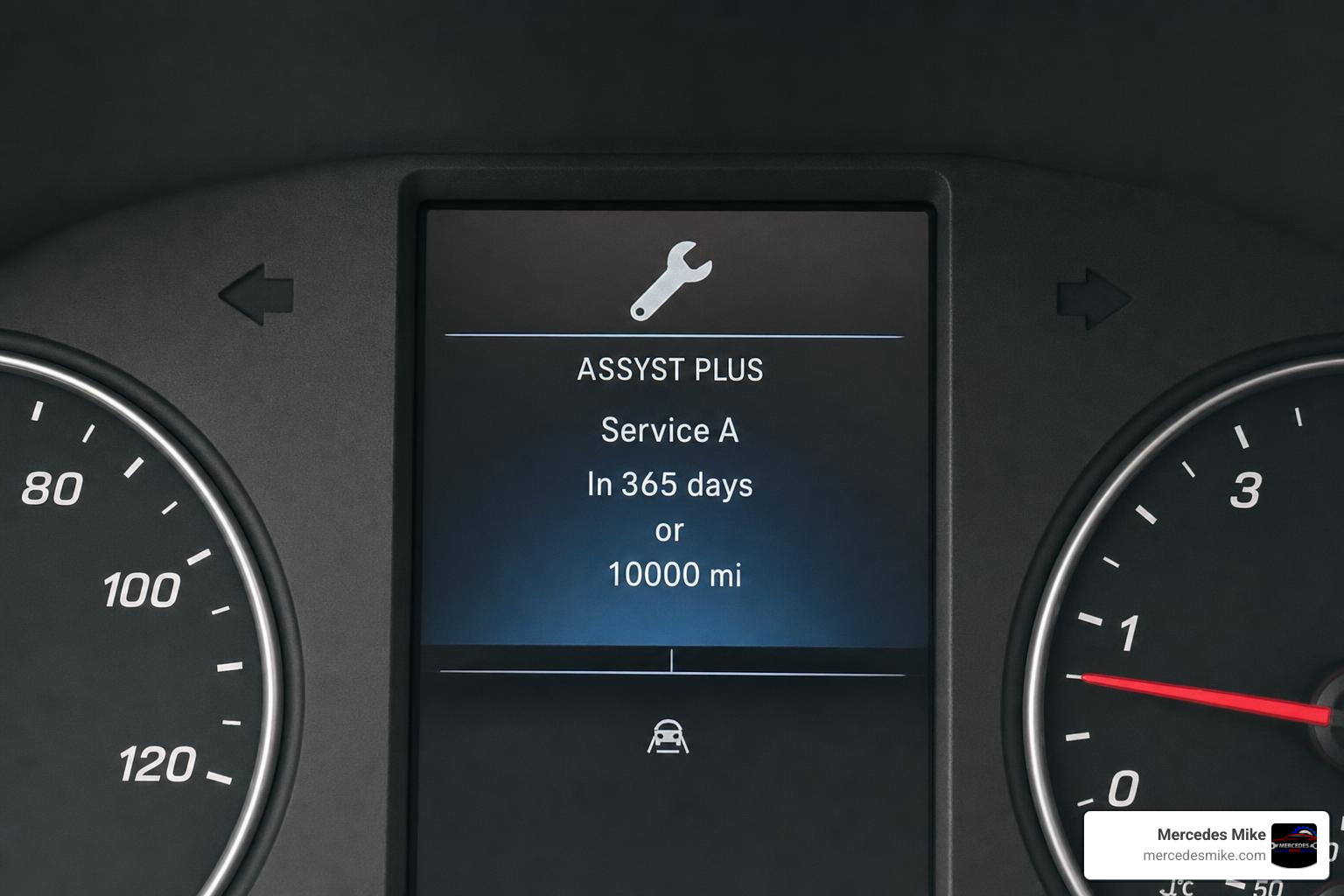
Keeping track of your maintenance schedule doesn't require a paper calendar or guesswork. Mercedes-Benz equips modern Sprinters with intelligent tracking tools to make fleet management simple.
How the ASSYST PLUS System Works
The ASSYST PLUS (Active Service System) is your onboard maintenance assistant. It actively monitors your driving habits, engine loads, operating temperatures, and elapsed time to calculate exactly when your next service is due.
Approximately one month before your service is due, the system will display a notification on your instrument cluster showing a wrench symbol and the remaining miles or days.
Because newer Sprinter engines (such as the OM642 V6 and OM654 Inline-4) do not feature a traditional mechanical dipstick, the ASSYST PLUS system also performs electronic engine oil level checks. This electronic sensor accounts for oil temperature and vehicle level to give you an accurate reading directly on your dashboard menu. Once a service is completed, the technician resets the system, and your service history is uploaded to the central Digital Service Booklet (DSB) for lifetime tracking. For more technical details on how the onboard diagnostic system calculates these intervals, you can check this official Service information guide.
Operating Conditions and the Mercedes Benz Sprinter Maintenance Schedule
While the standard schedule is a great baseline, real-world driving conditions in South Florida often dictate more frequent care. Your service intervals should be adjusted based on how your van is utilized:
Heavy Loads & Towing: If your Sprinter is fully loaded with tools, equipment, or a heavy camper conversion, your engine and brakes work significantly harder. This extra stress degrades engine oil and brake pads much faster.
Excessive Idling: If your van sits idling on construction sites or during deliveries to keep the air conditioning running, your engine is still accumulating wear that odometer mileage doesn't show. Idling also accelerates soot buildup in your DPF.
Stop-and-Go City Driving: Navigating local traffic in Pompano Beach or Deerfield Beach means frequent braking and shifting, which accelerates wear on your transmission fluid and brake pads.
Tire Rotations: To prevent uneven tread wear and extend tire life, tires should be rotated at least every 10,000 miles. Single rear wheel models follow a standard front-to-back rotation, while dually (twin rear wheel) models require a specialized cross-rotation pattern.
For those using their vans for recreation or off-grid travel, adapting your service schedule to handle dirt roads and heavy build-outs is essential. To read more about tailoring your schedule for heavy-duty use, take a look at the Sprinter Station Schedule & Service Intervals Guide - The Vansmith.
Frequently Asked Questions About Sprinter Maintenance
What happens if I miss a scheduled Sprinter service?
Delaying or skipping your scheduled service is a recipe for trouble. Mechanically, it leads to accelerated engine wear, clogged filters, and reduced fuel economy. From a financial perspective, neglecting your maintenance schedule can void your 3-year/36,000-mile New Vehicle Limited Warranty or your 5-year/100,000-mile Powertrain Warranty. It also severely hurts your van's resale value, as buyers look for a documented service history.
How does biodiesel use affect my Sprinter's maintenance intervals?
If you use B20 biodiesel, you must cut your engine oil and fuel filter replacement intervals in half (down to 10,000 miles or 1 year). Biodiesel has a higher boiling point than standard diesel fuel, which can lead to fuel entering the oil pan (oil dilution) during DPF regeneration cycles. It also attracts more moisture, increasing the risk of fuel filter clogging and fuel system corrosion.
How do I check my Sprinter's engine oil level without a dipstick?
For newer Sprinters with OM642 or OM654 engines, you check the oil electronically. Park the vehicle on level ground, switch on the ignition without starting the engine, navigate to the "Service" menu on your instrument cluster using the steering wheel controls, and select "Engine Oil Level." The system will display whether your oil level is correct or if you need to add fluid.
Conclusion
At Mercedes Mike, we specialize in high-quality maintenance and repair services for German vehicles in Pompano Beach, Deerfield Beach, and throughout South Florida. Located at 882 NE 41st Court, just off N Dixie Hwy, our shop features decades-experienced technicians equipped with the latest diagnostic tools to handle everything your Sprinter needs.
Whether your ASSYST PLUS system is alerting you that Service A is due, or you need a complex transmission or emissions system service, we provide dealer-level expertise with independent care. Don't let a missed service stall your business—Schedule your Sprinter service today and keep your van running at its absolute best.