
How to Replace Your Mercedes-Benz Fuel Filter Step by Step
Why Mercedes Fuel Filter Replacement Matters for Your Engine
Mercedes fuel filter replacement is one of the most important — and most overlooked — maintenance tasks on your vehicle. Here's what you need to know at a glance:
Quick Answer: Mercedes-Benz Fuel Filter Replacement
Topic Key Info Replacement interval Every 5 years or 50,000 miles (some models: 60,000 miles) DIY cost $100 – $190 (parts + basic tools) Professional cost $90 – $385 depending on model and labor Location Inside fuel tank (most modern models) or undercarriage fuel line Common symptoms Hard starts, stalling, misfires, rough idle, Check Engine light DIY difficulty Intermediate — requires fuel system safety precautions
The fuel your Mercedes runs on isn't perfectly clean. Contaminants left over from the refining and distribution process can build up in your fuel system over time. Your fuel filter is the only thing standing between those particles and your injectors, fuel pump, and engine.
When the filter gets clogged, your engine starts to starve for fuel. You might notice it first as a rough idle or sluggish acceleration. Left long enough, it can lead to stalling — or a car that simply won't start.
What makes Mercedes-Benz fuel systems different from most other vehicles is that many models use two filters: a strainer inside the fuel tank and a second filter on the main fuel line. And depending on your model — whether it's a W211 E-Class, a W204 C-Class, or a Sprinter — the location, access method, and replacement procedure can vary significantly.
This guide walks you through everything you need to know to get the job done safely and correctly.
Understanding the Mercedes-Benz Fuel Filter System
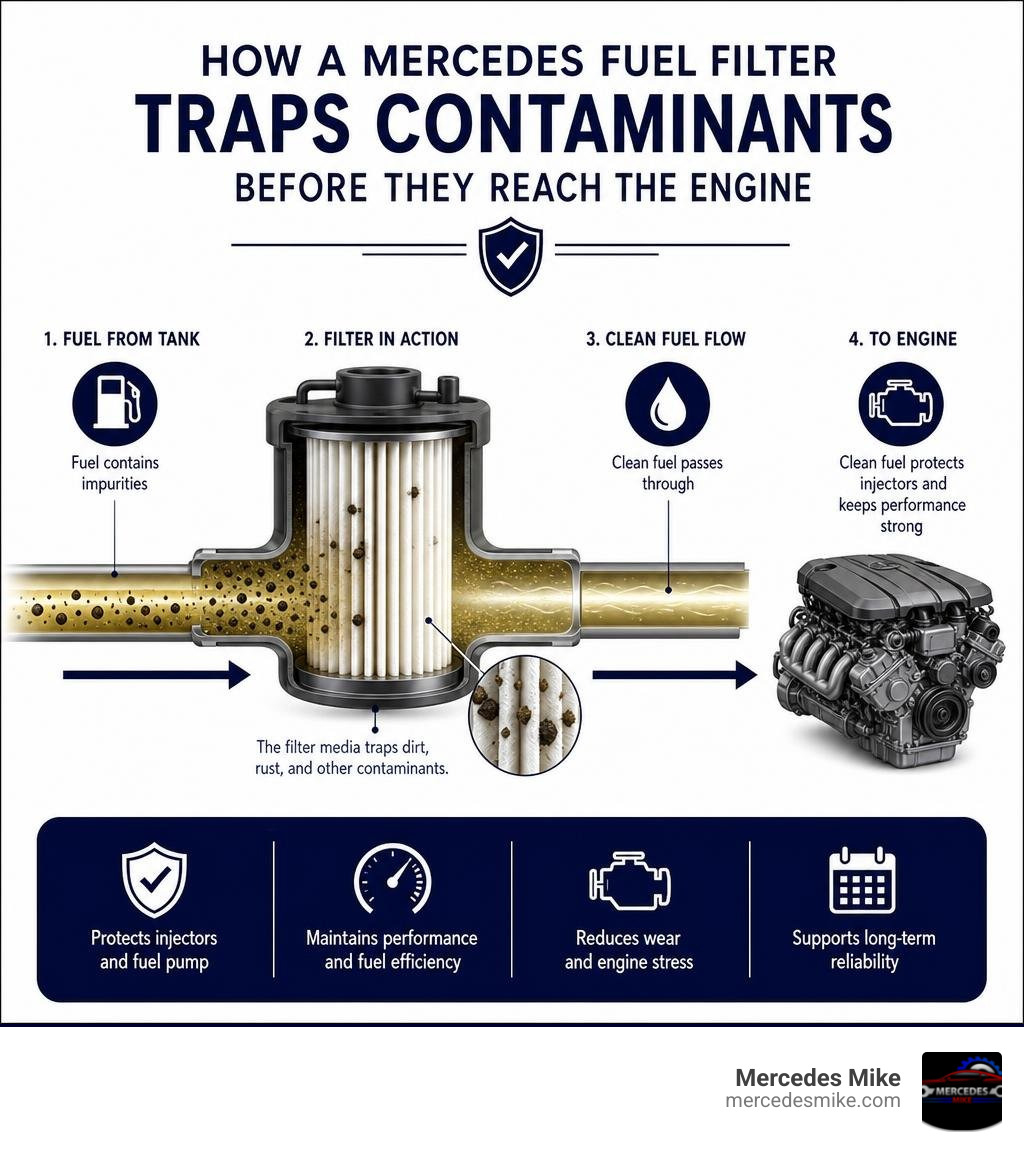
To appreciate why a clean filter is so critical, it helps to understand how fuel moves through your Mercedes-Benz. In most modern models, the fuel system is pressurized to incredibly high levels. This is especially true for direct-injection gasoline engines and Common Rail Diesel (CDI) systems.
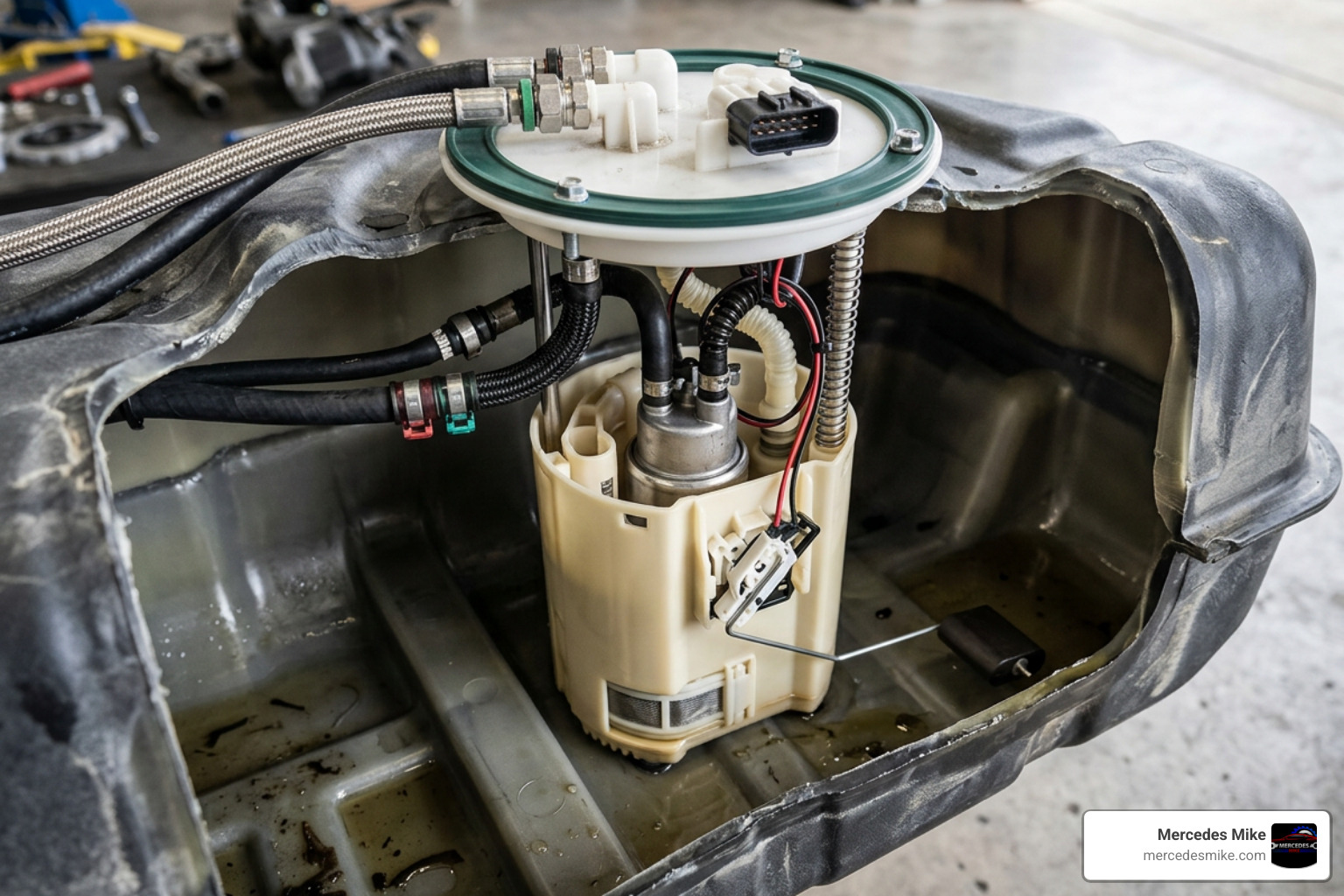
In these setups, gasoline or diesel is drawn from the fuel tank by an electric fuel pump. Before the fuel even leaves the tank, it passes through a coarse fuel strainer. This strainer acts as the first line of defense, catching large rust flakes, sediment, or debris that might have entered the tank during fill-ups.
From there, the fuel enters the main fuel line and passes through the primary fuel filter. This filter is packed with a dense, pleated paper element designed to trap microscopic particles down to just a few microns in size. If these tiny particles were allowed to reach your high-precision fuel injectors, they would quickly erode the delicate spray nozzles, causing uneven fuel delivery, poor combustion, and eventually, total injector failure.
Many modern Mercedes-Benz models utilize a "saddle-style" fuel tank. Because the tank is shaped like a saddle to clear the vehicle's driveshaft, it is divided into two distinct halves. The electric fuel pump sits on the passenger side (right side), while the fuel filter and fuel pressure regulator are integrated into a secondary module on the driver's side (left side). This dual-chamber design relies on a series of internal plastic lines to transfer fuel back and forth.
Keeping up with this system is a core part of your vehicle's upkeep. For a complete overview of how this fits into your overall service schedule, take a look at our Scheduled Maintenance Guide 2026. If you are wondering whether to swap your filter now or wait for a symptom to appear, our breakdown of Scheduled Maintenance vs Preventive Maintenance outlines why proactive care always wins.
Fuel Filter Locations Across Different Mercedes Models
Before you grab your wrenches, you need to know where your filter is hiding. Mercedes-Benz has changed its fuel system architecture multiple times over the years. Here is where you will find the filter on the most common models:
W211 E-Class (2003–2009): The fuel filter is located inside the fuel tank on the left (driver) side. It is accessible by removing the rear seat cushion and opening a metal service port.
W204 C-Class (2008–2014): Similar to the W211, the filter is integrated into the fuel sender unit under the rear seat on the left side, completely separate from the fuel pump on the right side.
W203 C-Class (2001–2007): On these older models, the fuel filter is mounted externally on the undercarriage of the car, near the rear axle. It is protected by a plastic cover panel.
W169 A-Class (2004–2013): The fuel filter is integrated directly into the fuel pump assembly inside the tank. Servicing it requires lowering and completely removing the fuel tank from the vehicle.
Sprinter W906: If you drive a diesel Sprinter, your fuel filter is located in the engine bay. It sits right on top of the engine, nestled between the cylinder banks for relatively easy access.
Signs You Need a Mercedes Fuel Filter Replacement
Because the fuel filter does its job out of sight, it is easy to forget about it until it starts to fail. As the filter element fills with contaminants, fuel flow becomes restricted. This causes the fuel pump to work twice as hard, dropping the fuel pressure delivered to the engine.
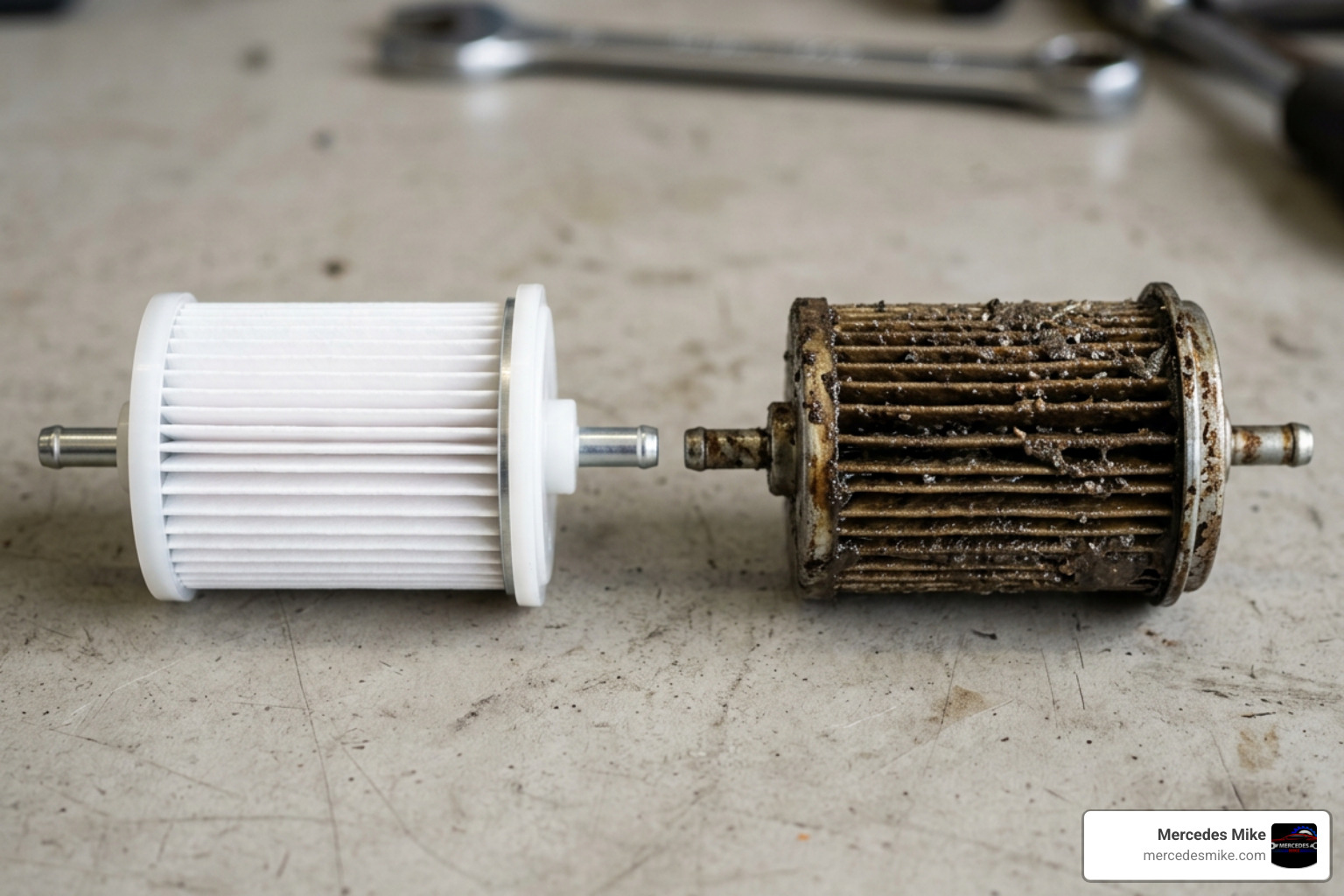
When your engine is starved of fuel, it will let you know through several clear warning signs:
Hard Starting: If your engine cranks for an unusually long time before firing up, it may be struggling to build up sufficient fuel pressure through a restricted filter.
Engine Shuddering or Rough Idle: A clogged filter restricts fuel flow at idle, causing the engine to shake, vibrate, or run unevenly when you are stopped at a red light.
Engine Lag and Hesitation: When you step on the gas pedal to merge onto the highway, the engine requires a sudden burst of fuel. A clogged filter cannot supply this demand, resulting in a noticeable delay, hesitation, or "flat spot" in acceleration.
Random Misfires: Under load, fuel starvation can cause individual cylinders to misfire, triggering a flashing or solid Check Engine light.
Stalling While Driving: In severe cases, the fuel flow drops so low that the engine simply dies while idling or driving at low speeds.
Diagnostic Trouble Codes (DTCs): A restricted filter often triggers codes like P008A (low fuel pressure system pressure too low) or lean-mixture codes.
Regularly replacing your filter prevents these issues from developing into costly road-side breakdowns. To keep your vehicle running smoothly, make sure to follow the recommended Factory Scheduled Maintenance intervals.
Step-by-Step DIY Guide for Various Models
Replacing a Mercedes-Benz fuel filter is an excellent project for an intermediate DIYer. However, because you are working directly with highly pressurized and volatile gasoline or diesel, you must take the proper precautions.
Before starting, gather the following essential tools:
A high-quality replacement fuel filter (always use OEM or premium brands like Mahle, Mann, or Bosch)
Safety glasses and fuel-resistant nitrile gloves
A fire extinguisher (keep it within arm's reach)
A fluid drain pan to catch spills
A basic socket set (specifically 8mm and 10mm sockets)
Flathead and Phillips screwdrivers
A fuel line clamp or hose pinch pliers (for external filters)
A specialized locking ring tool (or a brass punch and rubber mallet)
New copper sealing washers and replacement hose clamps
If you happen to drive a B-Class model, you can find model-specific tips in our Mercedes B Class Fuel Filter Replacement guide.
Preparing for Your Mercedes Fuel Filter Replacement
Safety is the absolute priority when working on any fuel system. Gasoline vapors are highly explosive and can be ignited by the smallest spark—even static electricity from your clothing.
Work in a Well-Ventilated Area: Always work outdoors or in an open garage with plenty of airflow. Never work near water heaters, pilot lights, or anyone smoking.
Let the Engine Cool: Wait for the engine and exhaust system to cool down completely to avoid any risk of fuel spraying onto hot metal.
Reduce the Fuel Level: If your model has an in-tank filter, try to perform this job when your fuel tank is nearly empty (ideally when the reserve light has just turned on). If the tank is more than half full, fuel will spill out of the access port directly into your vehicle's interior.
Relieve Fuel System Pressure: Modern fuel lines remain pressurized even when the engine is off. To safely relieve this pressure, locate the fuel pump fuse or relay in your fuse box, pull it out, and then start the engine. Let the engine run until it sputters and stalls. Crank it a few more times to ensure all pressure is gone, then turn off the ignition.
Disconnect the Battery: Disconnect the negative battery cable in the trunk or engine bay. This eliminates the risk of an accidental electrical spark during the procedure.
For a deeply detailed look at this preparation phase for E-Class owners, consult the classic Mercedes-Benz W211 Fuel Filter Replacement guide.
Executing the Mercedes Fuel Filter Replacement
Because the steps vary depending on where your filter is located, we have broken down the execution phase into three common styles:
Method A: In-Tank Fuel Filter Module (e.g., W211, W204, W212)
Access the Cover: Remove the rear seat cushion by pulling the release tabs or unscrewing the mounting bolts. Fold back the carpeting and insulation to expose the round metal access covers.
Remove the Access Plate: Use an 8mm socket to remove the bolts securing the left-side (driver's side) access cover. Lift off the cover to expose the top of the fuel filter module.
Clean the Area: Vacuum or wipe away any dirt, dust, or rust around the locking ring. You do not want any of this debris falling into your open fuel tank.
Disconnect Electricals and Lines: Carefully unplug the electrical harness. Wrap a clean rag around the quick-disconnect fuel line and squeeze the release tabs to pull it off. Expect a small amount of fuel to drip out.
Spin Off the Locking Ring: Use a specialized Mercedes collar tool, or gently tap the ridges of the metal locking ring counterclockwise using a brass punch (brass does not create sparks) and a rubber mallet. Remove the ring.
Extract the Filter Module: Slowly lift the fuel filter module out of the tank. Internal fuel lines connect this module to the fuel pump on the opposite side of the tank. Tie a piece of mechanics wire or string to these lines before pulling them through the tank—this will make routing the new lines back to the passenger side incredibly easy.
Transfer Sensors and Reinstall: Transfer your fuel pressure sensor and fuel level float sensor to the new filter assembly if they were not included. Install a brand-new rubber O-ring seal around the tank opening. Lower the new filter into place, route the transfer lines back to the pump using your guide wire, tighten the locking ring, reconnect the lines, and bolt down the access cover.
For a visual breakdown of this specific process, you can read the Mercedes-Benz W204 Fuel Filter Replacement guide.
Method B: External Undercarriage Filter (e.g., W203, W124)
Raise the Car: Safely support the rear of the vehicle on jack stands or a professional lift.
Remove the Shield: Locate the plastic aerodynamic cover near the rear axle on the driver's side and remove the 10mm plastic nuts securing it.
Clamp the Lines: Use hose pinch pliers to clamp the rubber inlet and outlet lines. This prevents fuel from continuously siphoning out of the tank.
Swap the Filter: Loosen the hose clamps, disconnect the lines, and unscrew the mounting bracket. Install the new filter, making absolutely sure the arrow on the filter housing points in the direction of fuel flow (toward the engine). Use new hose clamps and copper sealing washers where applicable.
Method C: Engine Bay Diesel Filter (e.g., Sprinter W906)
Remove Engine Cover: Pop the hood and remove the plastic engine beauty cover using a Torx T25 screwdriver.
Disconnect Lines: Disconnect the fuel lines from the top of the filter. On diesel models, these are often secured with click-clamps that require round-nose pliers to release.
Replace and Prime: Loosen the mounting bracket screw, pull the old filter out, and slide the new one in. Reattach the lines. Because diesel engines cannot tolerate air in the fuel system, use a hand primer bulb pump to fill the new filter with diesel before starting, or turn the key to the "ON" position for 5 seconds several times to let the electric pump prime the system.
If you are looking for additional model-specific factory procedures, you can explore these technical documents:
For W212 and similar engines: Fuel Filter Replacement Guide for Engines | PDF
For the W169 A-Class: w169 wis replace fuel filter.pdf download (67.9 kB) - Repair manuals - English (EN)
For the W203 C-Class: w203 replace fuel filter.pdf download (291 kB) - Maintenance - Repair manuals - English (EN)
For Sprinter vans: How to change fuel filter on MERCEDES-BENZ SPRINTER 3,5-t Box (906) – replacement guide
For G-Wagen enthusiasts: Photo DIY- Fuel Filter Replacement W463 - Mercedes-Benz Forum
Frequently Asked Questions About Mercedes Fuel Filters
Deciding whether to tackle this job yourself or hand the keys to a professional often comes down to cost and comfort level. Here is a quick comparison of what you can expect to pay:
Model DIY Cost (Parts Only) Professional Cost (Parts & Labor) Mercedes E350 $100 – $140 $305 – $385 Mercedes C300 $90 – $130 $280 – $360 Mercedes Sprinter $50 – $80 $180 – $250 National Average (Standard Vehicle) $35 – $60 $90 – $207
If you prefer to lock in your maintenance costs ahead of time and avoid surprise repair bills, look into our Mercedes Prepaid Maintenance plans. For a broader look at national averages and cost breakdowns, you can check out the Mercedes-Benz Fuel Filter Replacement Prices - Kelley Blue Book page.
How often should I replace my Mercedes fuel filter?
For the vast majority of gasoline-powered Mercedes-Benz cars and SUVs, the factory-recommended replacement interval is every 5 years or 50,000 miles (some newer models push this to 60,000 miles).
However, if you drive a diesel-powered vehicle, such as a CDI BlueTEC sedan or a Sprinter van, the rules are different. Diesel fuel naturally holds more moisture and organic impurities than gasoline. Because of this, diesel fuel filters feature built-in water separators and must be replaced much more frequently—typically every 12 months or 15,000 miles to keep the high-pressure fuel system from corroding.
Should I replace the fuel pump at the same time as the filter?
In most cases, no. If your vehicle has separate fuel pump and fuel filter modules (like the W211 or W204), you only need to replace the filter module.
However, on certain models—like the W169 A-Class—the fuel filter is permanently integrated into the fuel pump assembly. On these cars, you cannot buy or replace the filter separately; you must replace the entire fuel pump module. Additionally, if your vehicle has very high mileage (well over 120,000 miles) and you are already opening up the fuel tank to replace an in-tank filter, replacing the fuel pump at the same time can be a smart piece of preventative maintenance, saving you from paying for the same labor twice down the road.
What are the most common mistakes to avoid during replacement?
Even experienced DIYers can run into trouble when working on Mercedes fuel systems. Keep these common pitfalls in mind:
Buying the Wrong Part: Many Mercedes models have VIN-specific fuel filters. Two cars built in the same year might use completely different filter configurations. Always check your exact VIN before ordering parts.
Bending the Fuel Level Float Arm: When extracting or inserting an in-tank filter module, be incredibly gentle. If you accidentally bend the thin metal rod holding the fuel level float, your dashboard fuel gauge will read incorrectly.
Reusing Old Seals and Washers: Always use the fresh rubber O-rings and copper sealing washers included with your new filter. Reusing old, compressed seals is a guaranteed recipe for high-pressure fuel leaks.
Failing to Prime the System: If you try to start your engine immediately after installing a dry filter, you will subject your fuel pump to excessive wear as it struggles to push air out of the lines. Always cycle the ignition key to "ON" for 5 seconds several times to prime the system before cranking the engine.
Conclusion
Whether you are looking to tackle a mercedes fuel filter replacement in your own driveway or want the peace of mind that comes with professional service, keeping this critical system clean is non-negotiable for the life of your engine.
If you live in South Florida and would rather leave the fuel handling to the experts, we are here to help. At Mercedes Mike, located at 882 NE 41st Court in Pompano Beach, FL (just off N Dixie Hwy), our decades-experienced technicians use the absolute latest diagnostic tools to handle everything from simple filter swaps to complex engine diagnostics. We proudly serve drivers across Pompano Beach, Deerfield Beach, and the surrounding South Florida area.
Ready to schedule your next service or need help diagnosing a fuel system issue? Explore our Mercedes Mike Professional Services or stop by our shop today to keep your German machine running exactly the way the engineers intended.