
A Comprehensive Guide to Mercedes Transmission Diagnosis
What You Need to Know About Your Mercedes Transmission
A mercedes transmission is one of the most sophisticated — and most expensive — components in your vehicle. Whether you're noticing a subtle shudder at highway speeds, a hesitation when pulling out of Park, or nothing at all yet, understanding how your gearbox works can save you thousands of dollars.
Here's a quick overview of what this guide covers:
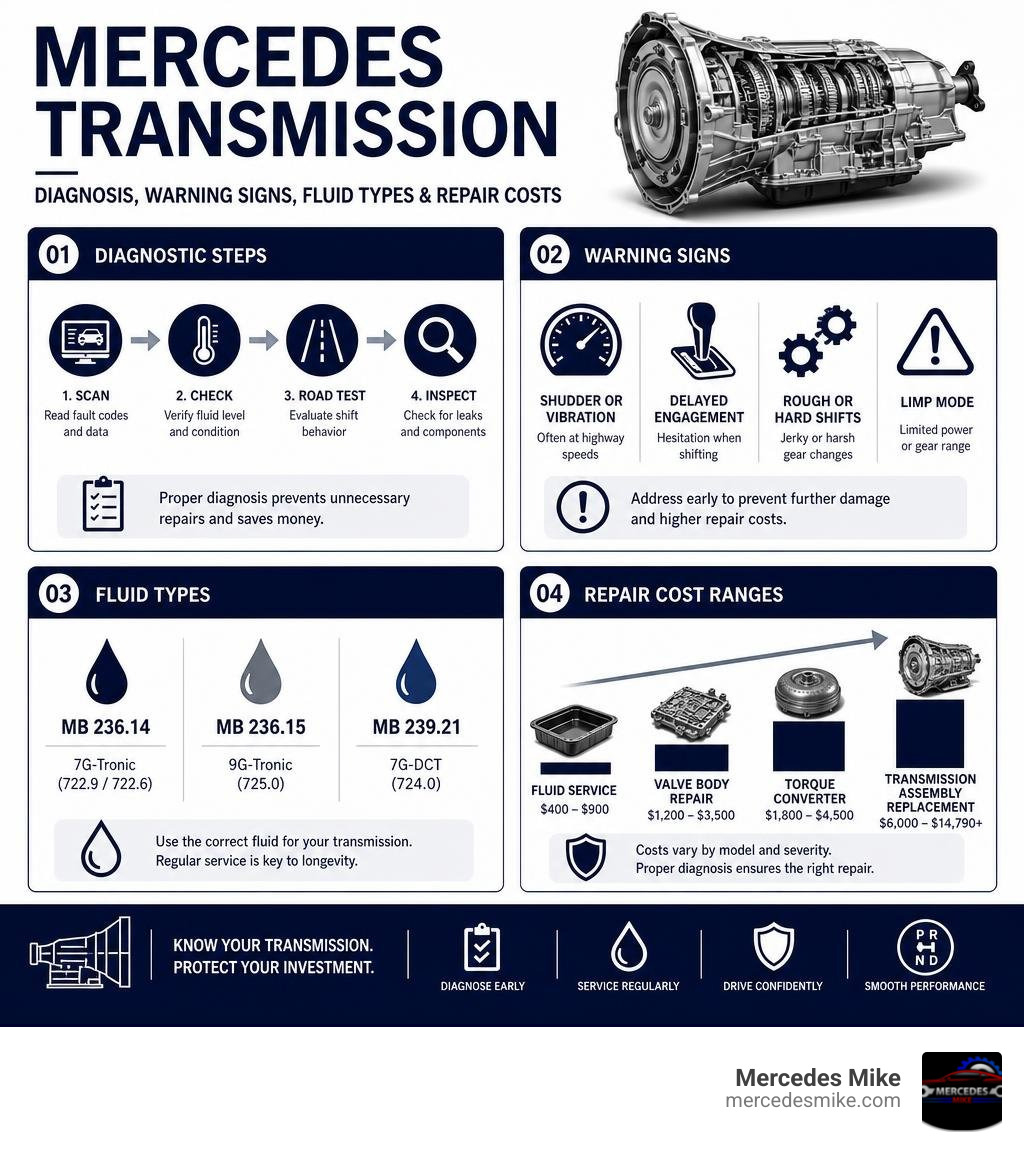
Topic What You'll Learn Transmission types 722.6, 722.9 (7G-Tronic), 725.0 (9G-Tronic), 724.0 (7G-DCT) Warning signs Shudder, delayed engagement, rough shifts, limp mode Fluid service Why "lifetime" fluid isn't actually lifetime Repair costs $400 fluid service up to $14,790+ for OEM assembly replacement 7G vs. 9G Key differences, reliability, and known failure points Used car buying What to check before you buy
Mercedes-Benz has been engineering its own transmissions in-house since 1961 — and by 1975 had already produced its millionth automatic-equipped vehicle. That long history means the technology is refined, but it also means there are several distinct generations on the road today, each with its own quirks and failure patterns.
The challenge for most owners is this: modern Mercedes transmissions are adaptive. They quietly compensate for internal wear over time, masking problems until the system simply can't keep up anymore. By the time you feel something wrong, the issue has often been building for tens of thousands of miles.
This guide walks you through every major transmission type, how to spot trouble early, what diagnostic procedures actually reveal, and what repairs realistically cost — so you can make informed decisions instead of expensive ones.
Understanding the Mercedes-Benz Gearbox Lineup
To properly diagnose any shifting issue, we first have to identify exactly which mercedes transmission is sitting under your car's floorboards. Unlike many automakers who purchase gearboxes from third-party suppliers, Mercedes-Benz has historically built almost all of its passenger car transmissions in-house.
Let's look at the foundational automatic gearboxes that paved the way for today's high-tech systems:
The K4A.025 (1961): This was the first fully-automatic transmission produced by Mercedes-Benz. Instead of a modern torque converter, it utilized a fluid coupling hydraulic start-up clutch. It set the standard for smooth luxury shifting in its era.
The 722.6 (5G-Tronic): Introduced in the mid-1990s, this 5-speed electronically controlled automatic is widely regarded by enthusiasts as one of the most robust and reliable transmissions Mercedes-Benz ever built. It features a longitudinal layout (designed for rear-wheel-drive configurations) and uses electronic controls for its 5th-gear overdrive, while gears 1 through 4 utilize hydraulic controls. It was so tough that it was used in everything from standard sedans to high-torque V12 AMG models.
While older models relied on these rear-wheel-drive longitudinal setups, modern compact Mercedes vehicles use a transverse engine layout. This brings us to the MFA (Modular Front Architecture) platform, which utilizes a completely different gearbox design to package power into a front-wheel-drive or transverse all-wheel-drive footprint.
The Evolution of the Automatic Mercedes Transmission
As fuel economy regulations tightened and engines became more power-dense, the number of gears inside the automatic mercedes transmission multiplied.
The immediate successor to the 5-speed 5G-Tronic was the 7G-Tronic (722.9), which debuted in 2003. This seven-speed automatic was widely used from 2004 through 2016 across nearly the entire Mercedes lineup. It brought a wider gear ratio spread, lighter magnesium casings, and faster shift times.
However, in 2013, Mercedes raised the bar again by introducing the Mercedes-Benz 9G-Tronic transmission (designated internally as the 725.0 or NAG3). This highly advanced 9-speed automatic has largely replaced the 7-speed across the 2016–2023 lineup, spanning from the C-Class through the GLS.
The 9G-Tronic is a marvel of computer-aided design: engineers analyzed over 85 billion theoretical gearset configurations before settling on its layout of four simple planetary gearsets and six shifting elements. It is incredibly compact, weighing 1 kg less than its 7-speed predecessor while supporting a massive maximum input torque of up to 700 Nm.
Troubleshooting the Dual-Clutch Mercedes Transmission (7G-DCT)
For front-wheel-drive and transverse all-wheel-drive vehicles built on the MFA platform — such as the A-Class, CLA, and GLA — Mercedes took a different path. Instead of a traditional torque-converter automatic, they deployed the 7G-DCT (724.0), a 7-speed preselective robotic dual-clutch transmission co-developed with Getrag.
You can learn more about its technical specifications, gear ratios, and lubrication requirements in this comprehensive guide to the Gearbox Mercedes 724.0 (7G-DCT): specifications, gear ratios, oil.
Unlike a standard automatic, the 7G-DCT uses two wet clutches to pre-select the next gear, offering lightning-fast shift times and highly engaging performance. However, this design comes with unique troubleshooting challenges:
Mechatronics Failures: The mechatronics unit (which houses the computer and hydraulic solenoids) manages all clutch engagements. If a mechatronics solenoid begins to fail or gets clogged with debris, it can cause severe shifting jolts.
Double Clutch Wear: Driving with a faulty mechatronics unit or skipping fluid changes will directly accelerate wear on the double clutch unit, eventually requiring a complete clutch replacement.
Dual-Pump System: The 7G-DCT utilizes both a mechanical oil pump and an auxiliary electric oil pump to maintain hydraulic pressure, particularly during start-stop cycles. A failure in the electric pump or its cooling circuit will trigger immediate transmission fault codes.
Diagnostic Guide for Your Mercedes Transmission
When a mercedes transmission begins to fail, the symptoms can range from subtle vibrations to a complete refusal to move. Catching these signs early is the difference between a simple fluid swap and a multi-thousand-dollar replacement.
Identifying Early Warning Signs of Failure
How do you know if your gearbox is crying out for help? Look out for these classic warning signs:
Engine Revving (Gear Slippage): If you step on the gas and the engine revs up but the vehicle doesn't accelerate proportionally, your transmission gears are slipping.
Delayed Engagement: If you shift from Park to Drive or Reverse and have to wait 1 to 3 seconds before the transmission actually engages, hydraulic pressure is dropping.
Rough Shifting or Downshift Clunks: Harsh, jarring gear changes — especially when the vehicle is cold — indicate that the adaptation limits of the transmission control module have been exceeded.
Fluid Leaks and Burning Smells: Mercedes transmission fluid has a distinct sweet or burnt odor when compromised. If you spot red, blue, or yellow/gold fluid pooling under your car, address it immediately.
Limp-Home Mode: This is a safety and diagnostic feature built into the transmission software. If the computer detects a critical fault, it locks the transmission into a single gear (usually 2nd or 3rd) to allow you to safely navigate to a repair shop without destroying the internal gearset.
If you are experiencing any of these issues, it is critical to seek professional diagnostic help. Learn more about our repair options on our Transmission Repair page.
Diagnostic Procedures and Reading Adaptation Values
At our shop in Pompano Beach, we don't guess; we test. Modern Mercedes diagnostics require specialized, factory-level equipment like the Xentry Diagnostics system.
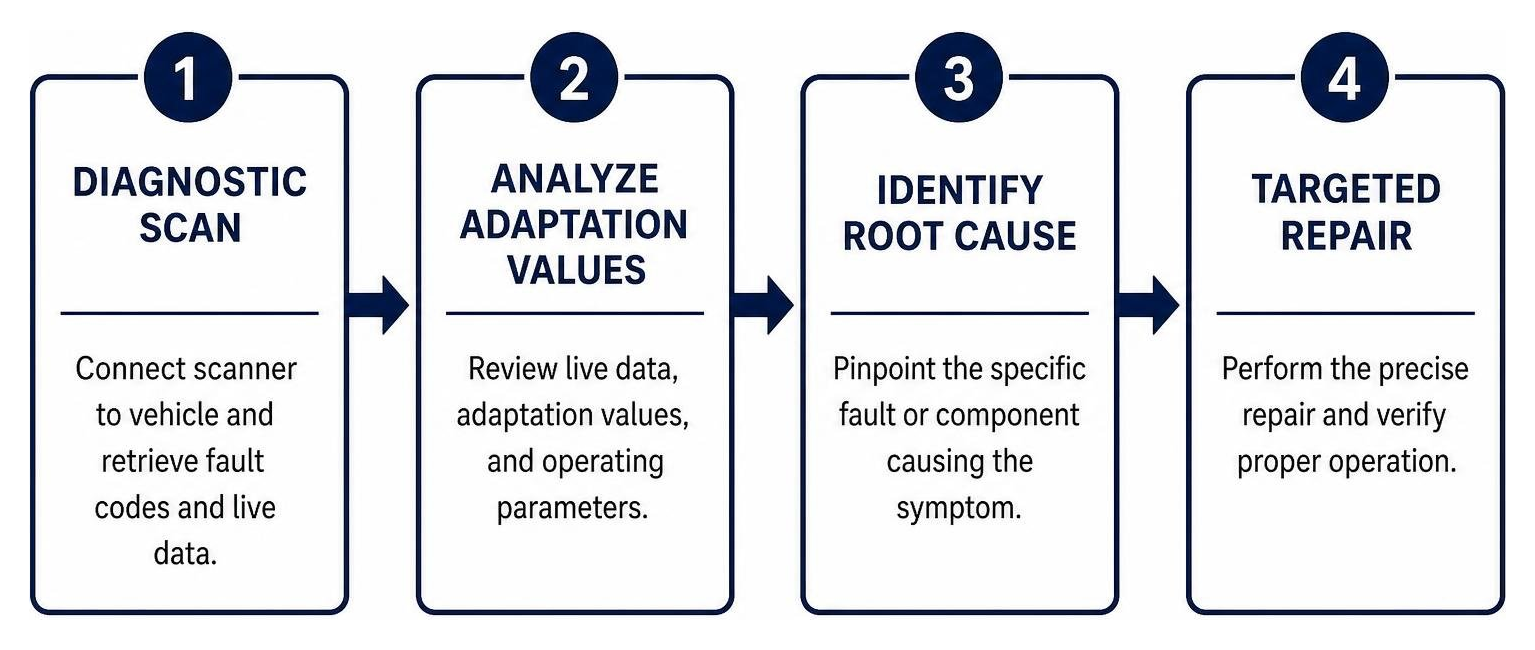
When we plug in our diagnostic tools, we look far beyond basic fault codes. We dive deep into the transmission's adaptation values.
Because modern Mercedes gearboxes are adaptive, the transmission control unit (TCM) constantly adjusts the fill times and pressures of the hydraulic clutches to compensate for physical wear. By reading these adaptation values, we can see exactly how hard the computer is working to keep shifts smooth. If the adaptation numbers for a specific clutch pack are highly positive, it tells us that the corresponding solenoid is wearing out or the physical clutch friction material is almost gone.
This precise data helps us pinpoint the root cause of a problem, preventing unnecessary parts-guessing. For a breakdown of how diagnostic findings translate into repair bills, read our guide on How Much to Repair Mercedes Transmission.
7G-Tronic (722.9) vs. 9G-Tronic (725.0): A Technical Comparison
Comparing Mercedes' two most common modern automatic gearboxes reveals a massive leap in engineering. While both are highly capable, they behave very differently on the road and suffer from distinct failure modes.
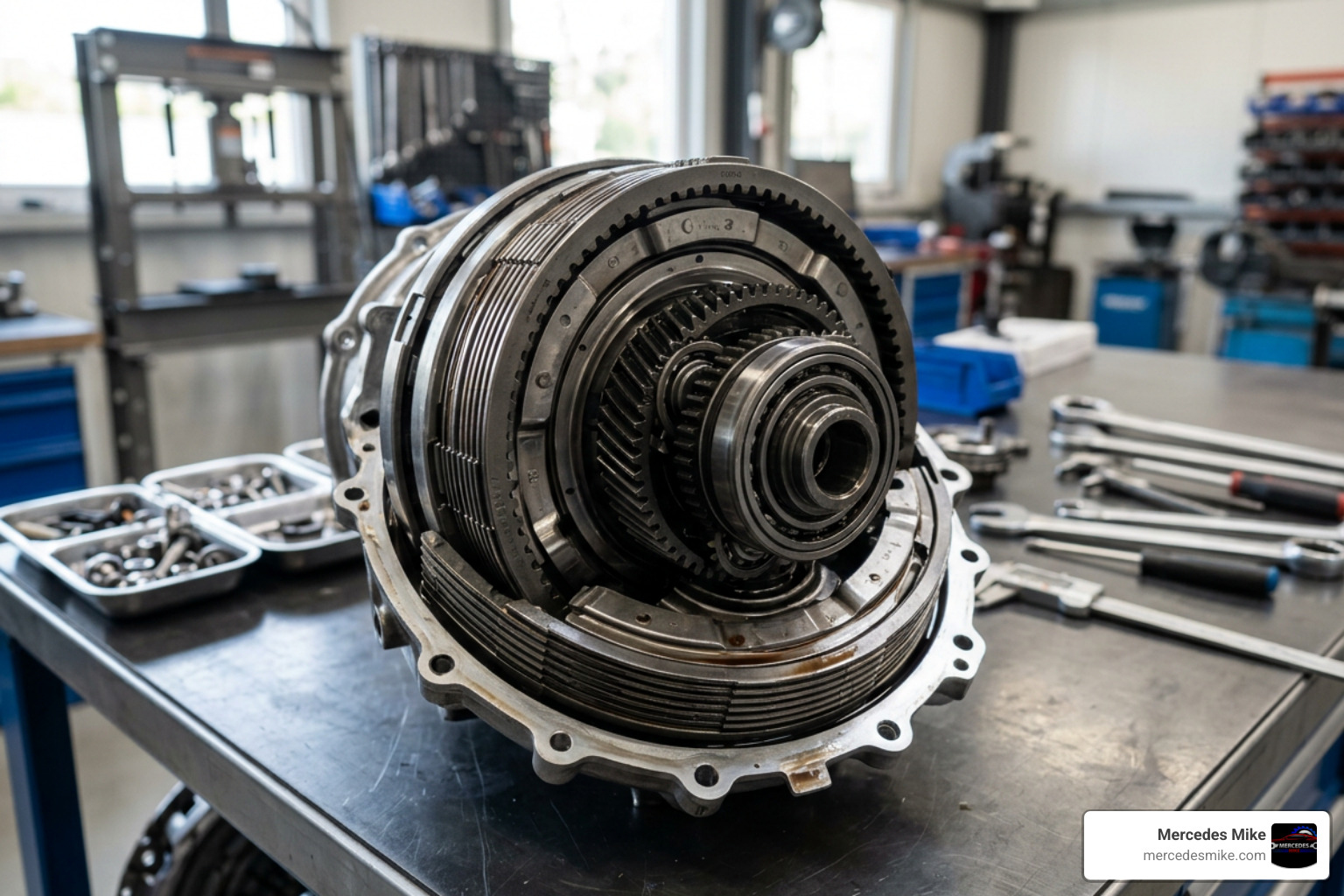
To visualize how these two gearboxes stack up mechanically, let's look at their core technical specifications:
Specification 7G-Tronic (722.9 / NAG2) 9G-Tronic (725.0 / NAG3) Forward Gears 7 9 Gear Ratio Spread 6.01 9.15 Casing Material Magnesium / Aluminum Magnesium Primary Fluid Type ATF Red (Early) / ATF Blue (Late) Yellow/Gold GTL (Gas-to-Liquid) Fluid Capacity ~9.0 Liters ~10.0 Liters Torque Capacity Up to 700 Nm (standard config) Up to 700 Nm (up to 1000+ Nm for AMG) Fuel Economy Impact Baseline ~6.5% reduction in consumption
Common Issues in the 722.9 7-Speed Gearbox
The 7G-Tronic is a highly capable gearbox, but it has a few famous weak points that every owner should keep in mind:
Conductor Plate & Speed Sensor Failure: The transmission control module (TCM) is fully integrated inside the gearbox on a plastic "conductor plate" submerged in hot transmission fluid. Over time, the speed sensors on this plate fail, causing the car to suddenly drop into limp mode.
Transfer Case Bearing Pitting (4Matic): On early W204 C-Class and W221 S-Class 4Matic (all-wheel-drive) models, the rear of the transmission doubles as the transfer case and shares its fluid. The internal tapered roller bearings are prone to pitting, which creates a loud whirring or humming noise at all speeds.
Fluid Mix-ups: Early 722.9 gearboxes used a high-viscosity red fluid. Around 2011, Mercedes transitioned to the 7G-Tronic Plus, which uses a lower-viscosity blue fluid (Option Code A89). These fluids are not backward compatible. Mixing them can cause severe shifting issues.
For a deeper dive into extending the life of your 7-speed, including upgrading to the deeper pan and high-efficiency Filtran triple-media filter, check out the Mercedes-Benz 7G-TRONIC (722.9) Transmission Service Recommendations & Modifications | FCP Euro guide.
Common Issues in the 725.0 9-Speed Gearbox
The newer 9-speed 9G-Tronic has proven to be mechanically robust, but its pursuit of absolute fuel efficiency has introduced new challenges:
Torque Converter Shudder: To maximize efficiency, the 9G-Tronic uses a micro-slip strategy for its torque converter lock-up clutch. This is aided by a Centrifugal Pendulum Vibration Absorber (CPVA). If the ultra-low viscosity fluid degrades, owners will feel a distinct shudder or vibration (similar to driving over rumble strips) under light acceleration between 25 and 45 mph.
Integrated Mechatronics Failures: Like the 7-speed, the 9-speed integrates its speed sensors directly into the mechatronic module. If a single internal speed sensor fails, the entire electrohydraulic actuator (EHS) assembly must be replaced as a single unit.
Ultra-Low Viscosity Fluid Wear: The yellow/gold GTL (Gas-to-Liquid) fluid is incredibly thin to reduce drag. Under the intense thermal loads of South Florida stop-and-go traffic, this thin fluid degrades faster than traditional fluids, necessitating strict adherence to service intervals.
For a mechanical deep-dive into the torque paths and engineering trade-offs of this 9-speed gearbox, see the Mercedes 725.0 9G-Tronic Automatic Transmission Deep Dive (NAG3 / W9A 700) | Tech | Dr Jiulin Teng analysis.
Frequently Asked Questions
Maintaining a high-end luxury vehicle comes with plenty of questions. Here are the answers to the most common queries we receive about the mercedes transmission.
Is "lifetime" gearbox fluid actually lifetime?
In a word: No.
When Mercedes-Benz or any other manufacturer claims a transmission has "lifetime" fluid, they are defining "lifetime" as the duration of the factory warranty period (typically 50,000 to 80,000 miles).
In reality, transmission fluid is subject to extreme thermal loads and mechanical shearing. Over time, the fluid loses its lubricating properties, and the integrated filters clog with friction material debris. This is especially true here in South Florida (including Pompano Beach and Deerfield Beach FL), where ambient heat and heavy stop-and-go traffic place an incredibly high thermal load on the gearbox.
To keep your transmission shifting smoothly for 150,000 miles and beyond, we recommend the following real-world service intervals:
7G-Tronic (Red Fluid): Every 30,000 miles.
7G-Tronic Plus (Blue Fluid): Every 77,000 miles.
9G-Tronic (Yellow/Gold GTL Fluid): Between 60,000 and 80,000 miles.
7G-DCT Dual-Clutch (MB 236.21 Fluid): Every 60,000 kilometers (approx. 37,000 miles).
Regular fluid and filter exchanges prevent mechatronics wear and torque converter shudder. To understand how preventative maintenance saves you from massive repair bills down the road, read our Transmission Replacement Guide 2026.
What should a buyer look for when purchasing a used Mercedes?
If you're shopping for a pre-owned Mercedes in South Florida, the transmission should be your primary focus during the pre-purchase inspection. Here is what to check:
Service Records: Verify if the transmission fluid has been changed at the recommended mileage intervals. If the car has 90,000 miles and is still on its original "lifetime" fluid, proceed with extreme caution.
The Cold Test Drive: Make sure to drive the car when the engine and transmission are completely cold. Harsh shifts, gear hunt, or delayed engagement from Park to Drive are most apparent before the fluid warms up.
The Shudder Test: Drive the vehicle on a smooth road, accelerating gently between 25 and 45 mph. Listen and feel for any low-frequency vibrations or "rumble strip" sensations, which indicate torque converter clutch slippage.
Diagnostic History: Have a specialist pull the TCM fault codes and adaptation values. If the adaptation parameters are near their limits, a costly rebuild is likely in your near future.
To learn how prepaid maintenance plans can help cover these costs on newer pre-owned models, read about Mercedes Prepaid Maintenance.
How much does a gearbox replacement or rebuild cost?
The cost to repair, rebuild, or replace a mercedes transmission varies wildly depending on the model, the type of gearbox, and whether you choose OEM parts or aftermarket upgrades.
Fluid & Filter Service: A proper fluid and filter exchange at an independent specialist typically ranges from $400 to $700. On the 9G-Tronic, the oil filters are permanently integrated into the plastic oil pan, meaning the entire pan must be replaced during service.
Performance Rebuilds: For AMG owners looking to support modifications, high-performance rebuild kits (such as the SHR Type II rebuild for the 722.9, which supports 40% more torque than stock using upgraded Raybestos GPZ friction materials) cost around $4,849 plus labor.
Standard Replacement: According to RepairPal, a standard transmission replacement ranges from $5,270 to $5,470 or more.
New OEM Assemblies: If you purchase a brand-new complete transmission assembly directly from Mercedes-Benz, the parts alone can range from $8,300 to $14,790, with labor adding an additional $500 to $1,200.
If you are looking to squeeze more performance out of your upgraded gearbox, explore our options on our Mercedes Tuning page.
Conclusion
Your Mercedes-Benz is a masterpiece of German engineering, and its transmission is the heart of its performance. Ignoring early warning signs like a subtle shudder, delayed engagement, or rough shifts can quickly turn a minor fluid service into a major financial headache.
At Mercedes Mike, we specialize in the maintenance, diagnosis, and repair of advanced German gearboxes. Located at 882 NE 41st Court on N Dixie Hwy in Pompano Beach, our shop serves drivers across Pompano Beach, Deerfield Beach, and the broader South Florida region. Our decades-experienced, factory-trained technicians use the latest diagnostic tools — including factory-level Xentry systems — to pinpoint issues accurately, saving you time and money.
Don't wait for a warning light to leave you stranded on I-95. Whether you're due for a preventative fluid flush or need a complex mechatronics diagnosis, we are here to help.
Schedule your Mercedes transmission service at Mercedes Mike today and experience dealership-level expertise without the dealership prices.