

Don't Skip a Beat with Your Porsche Routine Maintenance Schedule
Why Your Porsche Service Schedule Deserves Your Full Attention
Following the Porsche service schedule is one of the most important things you can do to protect your investment. These cars are engineered to tight tolerances — and they reward owners who keep up with maintenance.
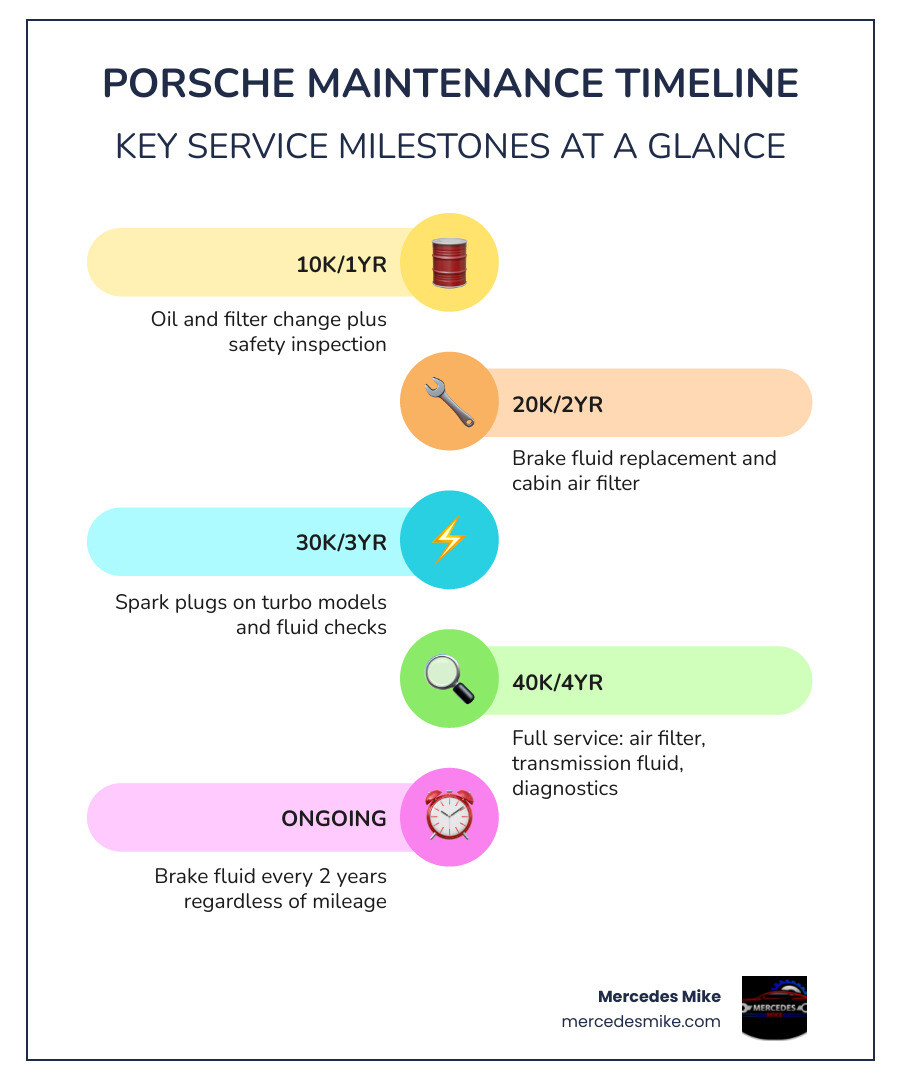
Quick answer: Here is the core Porsche service schedule at a glance:
Interval Service Type Key Tasks Every 10,000 miles or 1 year Oil Service Oil and filter change, safety inspection Every 20,000 miles or 2 years Intermediate Maintenance Brake fluid, cabin air filter, brake inspection Every 30,000 miles or 3 years Oil Service + Spark Plugs Spark plugs (turbo models), fluids check Every 40,000 miles or 4 years Full Maintenance Engine air filter, transmission fluid, spark plugs (non-turbo), full diagnostics Every 2 years (regardless of mileage) Brake Fluid Mandatory brake fluid replacement
A few things to keep in mind:
Time triggers apply even if you drive low mileage. Fluids age, seals dry out, and batteries lose charge whether or not the odometer moves.
Major service intervals are set at 40,000 miles or 4 years — whichever comes first.
Brake fluid must be replaced every 2 years, no exceptions.
Schedules vary by model — the 911, Cayenne, Macan, and 718 each have specific requirements.
Below, we break down exactly what happens at each milestone, how schedules differ by model, and what to watch for between services.
Understanding the Official Porsche Service Schedule
Every Porsche is a masterclass in automotive engineering. To keep that mechanical symphony playing perfectly, Porsche engineers have established a strict dual-trigger maintenance framework. This means your service intervals are prompted by either mileage or time—whichever comes first.
If you own a classic 911 that only leaves your South Florida garage for weekend cruises, you might think you can skip your annual service because you’ve only driven 1,500 miles. However, engine oil degrades and absorbs moisture over time, rubber seals dry out, and delicate electronics require routine diagnostic checks. Conversely, if you use your Cayenne or Macan as a daily commuter along the North Dixie Highway, you will hit your mileage triggers long before the calendar year is up.
Adhering to these factory-recommended intervals is crucial for warranty compliance. If a major powertrain component fails and you cannot prove that the vehicle was serviced according to the manufacturer's guidelines, you risk having your warranty claims denied. To help owners manage these milestones seamlessly, Porsche offers structured programs like the Porsche Scheduled Maintenance Plan Options, which outline the necessary services for both internal combustion engines (ICE) and battery electric vehicles (BEV).
By understanding these timelines, you can transition from reactive repairs to proactive care. For a deeper dive into why these factory guidelines are so strict, explore our comprehensive guide on Factory Scheduled Maintenance.
Minor vs. Major Milestones in Your Porsche Service Schedule
Porsche maintenance is generally divided into three distinct categories: Oil Service, Intermediate Maintenance, and Full Maintenance. Each level builds upon the last to ensure every system is thoroughly inspected and refreshed.
1. Oil Service (Every 10,000 Miles or 1 Year)
This is the foundational baseline of your Porsche's health. It must be performed at least once a year, even if your car has spent most of its time parked.
What’s Included: Engine oil drainage and refill with factory-approved synthetic oil, oil filter replacement, drain plug inspection, and a multi-point safety inspection (checking tires, brake pads, and basic fluid levels).
2. Intermediate Maintenance (Every 20,000 Miles or 2 Years)
Often referred to as the "intensive" service, this milestone dives deeper into the vehicle's safety and cabin comfort systems.
What’s Included: Everything in the 10,000-mile oil service, plus a mandatory brake fluid flush and replacement (using only original Porsche brake fluid), replacement of the cabin dust and pollen/allergen filter, and detailed inspections of the underbody, suspension, steering, and brake lines.
3. Full Maintenance (Every 40,000 Miles or 4 Years)
This is the major milestone where your Porsche receives a comprehensive overhaul of its wear-and-tear components to preserve its signature performance.
What’s Included: All intermediate services, plus engine air filter replacement, spark plug replacement (for non-turbo models), and transmission fluid service (including PDK transmission oil and clutch fluid changes where applicable). Technicians will also perform deep diagnostic scans of all onboard control modules.
To plan your long-term ownership journey, you can read our updated Scheduled Maintenance Guide 2026 to see how modern service practices keep high-performance German cars running flawlessly.
Model-Specific Variations in the Porsche Service Schedule
While the general 10k/20k/40k framework applies across the board, Porsche’s diverse lineup means that service schedules are highly customized by model and drivetrain.
Porsche 911
The legendary rear-engine sports car requires meticulous attention. Standard 911 Carrera models follow the traditional 40,000-mile spark plug interval. However, high-performance track-oriented variants like the GT3, GT3 RS, Speedster, and S/T have much tighter requirements. For these models, spark plugs must be replaced every 20,000 miles (or 2 years), and drive belts must be inspected and replaced at 40,000 miles due to the high-revving nature of their naturally aspirated engines.
Porsche Macan & Cayenne
As versatile luxury SUVs, the Macan and Cayenne have robust all-wheel-drive systems that require specialized care. Intermediate maintenance (every 20,000 miles) includes detailed suspension, drive shaft, and boot inspections. Crucially, the transfer gear oil and Tiptronic automatic transmission fluid (ATF) must be serviced to prevent costly drivetrain wear—with transfer gear oil services typically recommended by 160,000 miles or 16 years, though heavy towing or sporting use in South Florida traffic can shorten this.
Porsche 718 Cayman & Boxster
The mid-engine 718 models require full synthetic oil to protect their turbocharged four-cylinder or naturally aspirated flat-six powerplants. Spark plug replacement intervals differ between the turbo and non-turbo variants. Non-turbo 718 models require spark plug replacement every 30,000 miles or 4 years, while high-performance turbo variants should have their plugs replaced at 30,000 miles or 3 years to prevent high-boost misfires.
Porsche Panamera
Porsche’s luxury sport sedan combines executive comfort with sports car performance. Because of its complex electrical systems and active chassis dynamics (like PDCC), the Panamera requires extensive control unit scans and hydraulic system fluid checks during its major 40,000-mile service intervals.
Why Sticking to Your Maintenance Plan Matters

Skipping a service on a high-performance vehicle is never a good idea. Porsche vehicles are built with high-compression engines, advanced dual-clutch transmissions (PDK), and sophisticated multi-link suspensions. Every component is designed to work in perfect harmony. When one part of the system is neglected, it creates a domino effect.
Sticking to your official porsche service schedule provides several key benefits:
Preserving Resale Value: Porsches hold their value exceptionally well, but buyers in the pre-owned market are incredibly discerning. A fully documented service history with stamps from a reputable shop can add thousands of dollars to your car's resale value.
Ensuring Safety: During routine inspections, technicians check critical safety components like brake pad thickness, brake disc wear, tire tread depth, and steering rack play. Catching a worn suspension bushing early prevents dangerous handling characteristics at highway speeds.
Maintaining Peak Performance: Fresh fluids, clean filters, and new spark plugs ensure your engine breathes easily and combusts fuel efficiently, maintaining the throttle response and horsepower you fell in love with.
Preventing Catastrophic Failures: A simple oil change is also an opportunity for a trained eye to spot early signs of oil leaks, cooling system weeping, or belt fraying before they turn into engine-destroying failures.
To understand the difference between simply reacting to broken parts and staying ahead of wear, check out our guide on Scheduled Maintenance vs Preventive Maintenance. Additionally, staying informed about The Most Common Problems with German Cars and How to Prevent Them can save you thousands of dollars in avoidable repairs.
Documenting Your Service History
When it comes to warranty coverage and resale value, "if it isn't written down, it didn't happen." To protect your investment, you should maintain a meticulous paper trail of all work performed on your vehicle.
Keep a Physical Maintenance Log Book: Ensure your service technician stamps and dates your vehicle's official maintenance booklet at every interval.
Save Every Receipt: Keep detailed, itemized invoices showing the exact parts used (such as OEM filters and Porsche-approved oil grades), the mileage at the time of service, and the date.
Digital Backups: Scan your physical receipts and save them in a dedicated digital folder.
DIY Records: If you perform minor maintenance yourself, keep the receipts for the purchased OEM parts and write a detailed log of the date and mileage when the work was completed. For major warranty claims, manufacturers heavily favor documentation from professional, certified repair facilities.
Factors That Alter Your Service Intervals
The factory service schedule is designed as a general guideline for vehicles driven under average conditions. However, very few of us drive in "perfectly average" conditions. Several environmental and operational factors can accelerate component wear, requiring you to service your Porsche more frequently.
South Florida Climate: Operating a high-performance vehicle in Pompano Beach, Deerfield Beach, or the wider South Florida region presents unique challenges. The intense heat and high humidity put extra strain on your cooling system, degrade engine oil faster, and accelerate the wear of rubber belts, hoses, and suspension bushings.
Stop-and-Go Traffic: Commuting in heavy local traffic means your engine experiences more idle time and operating cycles per mile. This type of driving is considered "severe duty" and may require more frequent oil changes.
Track Days and Sporting Driving: If you enjoy taking your 911 or 718 to local track events, your vehicle will experience extreme temperatures and loads. Under these conditions, tire wear, brake pad/disc consumption, and fluid degradation occur at an exponential rate. Engine oil, brake fluid, and transmission fluids should be checked and changed much more frequently than the standard intervals dictate.
Dusty Roads and Salty Air: Coastal driving exposes your car to corrosive salt air, while construction zones and unpaved roads introduce dust. In these environments, engine air filters and cabin filters clog quickly and must be replaced ahead of schedule to protect engine health and cabin air quality.
Warning Signs Your Porsche Needs Immediate Attention
You shouldn't always wait for the dashboard maintenance light to turn on. If your Porsche exhibits any of the following symptoms, it’s time to schedule an inspection immediately:
Unusual Vibrations: Shaking in the steering wheel, seat, or brake pedal can indicate wheel imbalance, suspension wear, or warped brake rotors.
Dashboard Alerts: Never ignore a check engine light, ABS warning, or fluid level alert. Even a minor sensor issue can lead to limp mode if left unaddressed.
Spongy Braking or Poor Steering Response: If the brake pedal feels soft or the car pulls to one side when braking, your brake fluid may be contaminated or your pads may be dangerously thin. Loose or unresponsive steering indicates steering rack or tie-rod issues.
Fluid Leaks: Puddles of oil, coolant (usually sweet-smelling and pink/orange), or transmission fluid under your car are clear signs of a failing seal or hose.
Strange Noises: Squealing brakes, ticking engine sounds, or whining transmission noises are early warnings of mechanical wear.
Frequently Asked Questions About Porsche Maintenance
How often does a Porsche need an oil change?
Porsche recommends changing your engine oil and filter every 10,000 miles or 1 year, whichever comes first. Always use high-quality, factory-approved synthetic oils that meet Porsche's strict oil standards (such as A40 or C30 specifications) to maintain proper lubrication, manage engine heat, and prevent internal carbon buildup.
When should Porsche spark plugs be replaced?
For most standard Porsche models, spark plugs should be replaced every 40,000 miles or 4 years. However, high-performance turbo models experience higher combustion pressures and require spark plug replacement every 30,000 miles or 3 to 4 years to prevent misfires and maintain optimal fuel efficiency. Always consult your specific model manual for exact intervals.
Can I use an independent shop for Porsche scheduled service?
Yes, absolutely! Under federal law (the Magnuson-Moss Warranty Act), you are not required to take your vehicle to a dealership to maintain your warranty. You can use an independent specialty shop as long as the services are performed according to factory specifications using OEM-equivalent parts and fluids.
Choosing an experienced independent specialist often provides a more personalized experience, direct communication with the technician working on your car, and highly competitive pricing. For a complete look at what to look for in a specialized shop, read our Porsche Service Center Complete Guide.
Conclusion
Your Porsche is a precision instrument designed to deliver an unparalleled driving experience. By staying on top of your porsche service schedule, you ensure that every drive is as thrilling and safe as the first.
At Mercedes Mike, we specialize in the maintenance and repair of elite German vehicles, including Porsche, Mercedes-Benz, BMW, and Audi. Located at 882 NE 41st Court in Pompano Beach, we proudly serve Porsche owners throughout Pompano Beach, Deerfield Beach, and the broader South Florida area. Our shop features decades-experienced, highly trained technicians who utilize the latest advanced diagnostic tools and strictly adhere to factory service guidelines. Whether you need a simple 10,000-mile oil service, a complex PDK transmission flush, or a comprehensive 40,000-mile major service, we deliver dealership-level precision with the care and value of an independent shop.
Don't wait for a warning light to disrupt your drive. Contact us today or visit our Services page to schedule your next Porsche maintenance appointment and keep your vehicle performing at its absolute best.