

Step-by-Step Guide to Fixing Your AC Condenser Leak
When Your Car's AC Stops Cooling: What You Need to Know About AC Condenser Repair
AC condenser repair is one of the most common fixes needed when a car's air conditioning suddenly stops blowing cold air — especially in German luxury vehicles like Mercedes-Benz and BMW.
Quick answer: How to fix an AC condenser leak
Identify the problem — Look for oily residue on fins, warm air from vents, or hissing sounds
Get a professional leak test — Technicians use UV dye or electronic detectors to pinpoint the leak
Choose repair or replacement — Minor leaks can be sealed; major damage usually means full replacement
Evacuate the system — Refrigerant must be legally removed before any repair begins
Recharge with the correct refrigerant — R-134a and R-1234yf are not interchangeable
Verify performance — Pressure and temperature checks confirm the repair worked
The condenser sits at the front of your car, just ahead of the radiator. Its job is to release heat from the refrigerant so your cabin stays cool. When it leaks or fails, the entire AC system stops working.
The bad news: A leaking condenser won't fix itself. Even a small refrigerant leak will eventually drain the system completely — and can damage more expensive components like the compressor along the way.
The good news: Not every condenser problem means a full replacement. Many issues — like a minor leak or a damaged line — can be repaired at a fraction of the cost.
This guide walks you through exactly how professionals diagnose and fix condenser leaks, what repairs cost, and how to know when replacement is the smarter call.
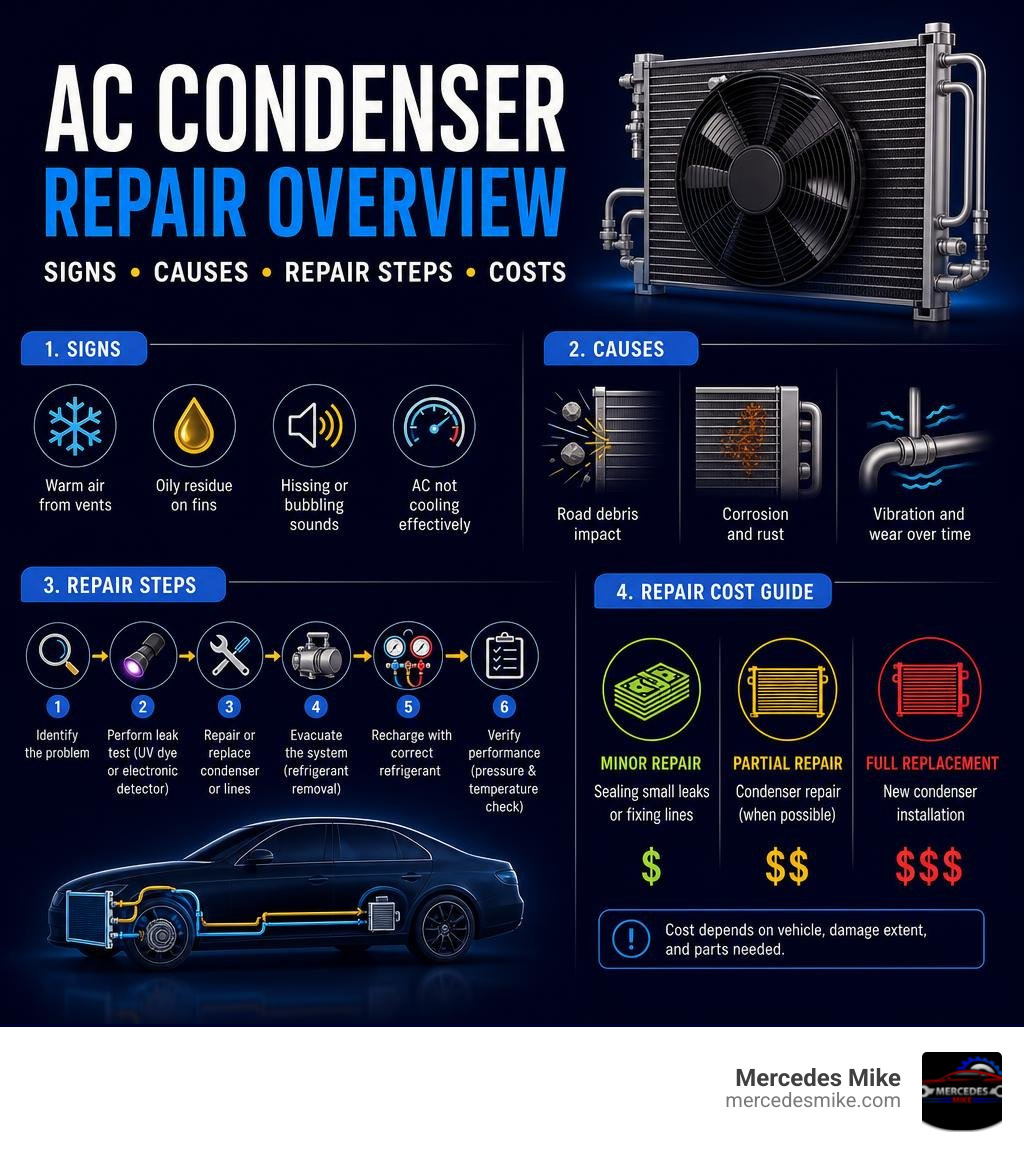
Signs Your Vehicle Needs AC Condenser Repair
Living in South Florida, a fully functioning air conditioning system isn't a luxury—it's a survival tool. When your AC system starts failing, it rarely happens silently. Because the AC condenser is constantly exposed to pressurized refrigerant, even a microscopic breach will trigger noticeable symptoms.

If you suspect your system is losing its cool, keep an eye (and ear) out for these common warning signs:
Warm Air Blowing from the Vents: The most obvious sign. If your climate control is set to "max cool" but feels like a hair dryer, your condenser is likely failing to release heat, or your system is low on refrigerant.
Reduced Cooling Performance at Idle: Does your car cool down when cruising on N Dixie Hwy but blow lukewarm air when you're stopped at a red light? When a condenser is dirty, blocked, or has bent fins, it relies on the vehicle's movement to force air through the core. At a standstill, the lack of airflow causes cooling performance to plunge.
Hissing Sounds Under the Hood: When pressurized refrigerant escapes through a cracked tube or seam, it can produce a distinct hissing sound. This is often audible for a brief moment after you turn off the engine and the pressures equalize.
Visible Oily Residue on the Condenser Fins: Refrigerant is mixed with a specialized lubricating oil (PAG oil) to keep the compressor lubricated. When a leak occurs, this oil escapes alongside the gas, leaving dark, sticky, dust-attracting wet spots on the condenser's aluminum fins.
System Shutting Down Completely: Modern luxury vehicles use high-tech pressure sensors. If a leak drops your system's pressure below a safe threshold, the computer will automatically disable the compressor clutch to prevent it from running dry and seizing.
If you notice any of these signs, ignoring them can lead to a much larger repair bill. Addressing a leak early with a professional Refrigerant Leak Repair is the best way to protect your compressor from catastrophic failure.
Common Causes of AC Condenser Leaks and Damage
Because your AC condenser is mounted directly behind your car's front grille, it acts as a shield for the radiator. Unfortunately, this prime real estate also makes it highly vulnerable to environmental hazards and mechanical stress.
Here are the primary culprits behind condenser damage:
Road Debris and Punctures: Driving at high speeds leaves your condenser vulnerable to flying gravel, road salt, and stray debris. A single small pebble thrown by a truck can easily puncture the thin aluminum tubes of the condenser, creating an instant high-pressure leak.
Corrosion from Coastal Air: In South Florida locations like Pompano Beach and Deerfield Beach FL, salt-heavy ocean air is a constant threat. Salt accelerates the oxidation of aluminum, leading to corrosion, metal fatigue, and pinhole leaks along the condenser's seams and fins.
Metal Fatigue and Thermal Stress: The condenser constantly cycles between extreme heat and rapid cooling. Over years of driving, this continuous expansion and contraction weakens the metal, eventually causing cracks near the weld joints and mounting brackets.
Factory Defects and Known Design Flaws (TSBs): Some vehicles are simply more prone to condenser failures due to manufacturer layout choices. For example, technical service bulletins like those detailed in the 2019-2025 Silverado & Sierra 1500 A/C Condenser: Leaks, TSBs, and Replacement Guide | Go-Parts.com highlight issues ranging from internal bypass defects to receiver plug leaks.
Line Rubbing and Seal Failures: Vibration from daily driving can cause nearby hoses, wiring harnesses, or heat shields to rub against the aluminum AC lines. Over time, this friction wears through the metal. Additionally, rubber seal washers at the line connection blocks naturally dry out, shrink, and leak.
Luxury European models are not immune to these issues. For example, owners of German SUVs often require specialized Audi Q5 AC Repair to address pressure sensor seal failures, debris punctures, and condenser blockages that are unique to their complex cooling stacks.
Repair vs. Replacement: Making the Right Choice
When faced with a failing condenser, the big question is: Should you repair it or replace it entirely?
Historically, radiator shops could weld or braze damaged aluminum tubes. However, modern multi-flow condensers feature incredibly thin, micro-channel tubes that are nearly impossible to patch reliably. In almost all cases of core punctures or widespread corrosion, replacing the unit is the only permanent solution.
To help you decide, we use the 50 percent rule: If the cost of repairing the current condenser (including labor, refrigerant recovery, and recharging) exceeds 50% of the cost of a brand-new replacement assembly, we highly recommend installing a new unit.
Factor AC Condenser Repair Full AC Condenser Replacement Typical Cost $150 – $600 $1,000 – $2,800+ (varies by vehicle) Best Suited For Failing fan motors, bad capacitors, worn relays, leaking connection seals Punctured core tubes, extensive corrosion, age over 10–12 years Durability Moderate (extends life of existing components) High (restores factory performance with a new warranty) Refrigerant Impact Often requires no system opening for electrical fixes Requires complete recovery, vacuum, and recharge
Refrigerant type also plays a massive role in your decision. Older vehicles use R-134a, which is relatively inexpensive. However, vehicles built after 2018 typically use R-1234yf—an environmentally friendly refrigerant that is substantially more expensive per pound. If your car uses R-1234yf, a leak means a costly recharge, making a highly reliable, permanent replacement much more practical than a risky patch.
For a deeper dive into residential and automotive pricing frameworks, check out the AC Condenser Repair vs Replacement Cost Guide (2026) .
When to Choose AC Condenser Repair
Repairing is the smartest and most economical path when the condenser core itself is structurally sound, but an auxiliary component has failed. This includes:
Replacing a faulty condenser fan motor that has stopped spinning.
Replacing a failed run capacitor, electrical relay, or worn wiring connector.
Replacing dried-out rubber O-rings or seal washers at the line connection points.
For these minor electrical and seal issues, a targeted AC Repair will quickly restore your ice-cold air without the expense of a brand-new core.
When Full Replacement is Necessary
Patching a physically leaking aluminum condenser core is rarely a long-term fix. You must replace the condenser assembly if you experience:
Extensive Corrosion: If South Florida's salt air has caused the aluminum fins to crumble, the condenser can no longer transfer heat efficiently.
Punctured Core Tubes: High-pressure channels cannot reliably hold up to 350 PSI of pressure when patched with epoxies or temporary sealants.
Internal Blockages: If your AC compressor has previously failed internally, it likely sent metallic debris directly into the condenser. Because of the micro-channel design, this debris cannot be flushed out and will starve your new compressor of oil, destroying it.
Step-by-Step Guide to Professional AC Condenser Repair Methods
Fixing an AC condenser leak requires specialized equipment, technical expertise, and strict adherence to environmental laws.
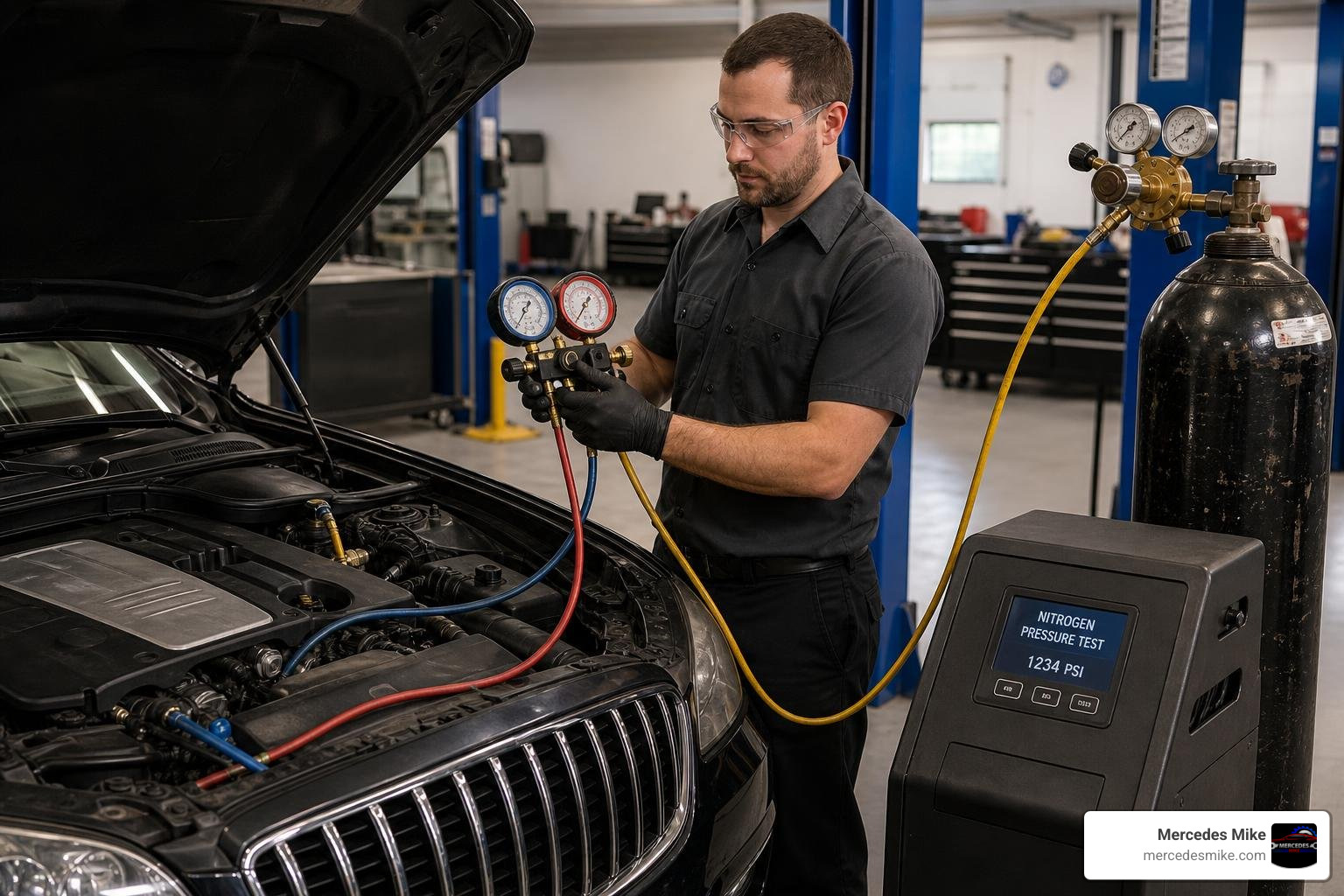
Here is how our master technicians at Mercedes Mike handle the process:
Diagnostic Testing & Leak Detection: We begin by performing a nitrogen pressure test. Nitrogen is an inert gas that allows us to pressurize the system safely without releasing harmful refrigerants. We then use electronic leak detectors (capable of finding leaks as small as 0.5 ounces per year) and UV dye to pinpoint the exact source of the leak.
Refrigerant Recovery: By federal law, refrigerant must never be vented into the atmosphere. We use certified recovery machines to safely evacuate the remaining gas from the system.
Component Removal & Preparation: We carefully disassemble the front bumper, grille, and air ducting to access the condenser. Once removed, we inspect the surrounding lines. If the damage is localized to an aluminum line, specialized repair sleeves can sometimes be integrated, as discussed in Condenser Coil Leak Repair Methods for Optimal Performance .
Replacing the Condenser & Receiver/Drier: We install the new OEM or high-grade aftermarket condenser. Crucial Step: We always replace the receiver/drier (or desiccant bag) at the same time. Once an AC system is opened to the air, moisture enters. The receiver/drier absorbs this moisture; if left unchanged, moisture will mix with refrigerant to create a highly corrosive acid that destroys your compressor from the inside out.
Pulling a Deep Vacuum: Before refilling, we connect a vacuum pump to pull the system down to 500 microns. This boils off any trace moisture and ensures there are absolutely no remaining leaks.
Recharging the System: We recharge the system by weight, strictly adhering to the vehicle manufacturer's specifications. Whether your car requires R-134a or R-1234yf, we use precise automated scales during our Air Conditioning Recharge service to ensure optimal cooling performance.
The Risks of DIY AC Condenser Repair
While we love a good weekend project, car AC work is not a DIY-friendly task.
First, venting refrigerant into the air is illegal and subject to heavy EPA fines. Second, the specialized equipment required—including recovery machines, vacuum pumps, micron gauges, and manifold sets—costs thousands of dollars.
Furthermore, off-the-shelf "leak sealer" cans are highly dangerous for your car. These chemical sealants react with moisture to form hard clogs. While they might temporarily plug a tiny hole, they will also permanently clog your expansion valve, ruin your condenser's micro-channels, and destroy professional recovery machines when your car is eventually brought to a shop.
Maintenance Practices to Prevent AC Condenser Damage
Preventive maintenance is the absolute best way to ensure your AC system survives the intense South Florida heat year after year.
By following these simple practices, you can dramatically extend the lifespan of your condenser:
Keep the Grille Area Clean: Check the front of your vehicle regularly. Remove leaves, plastic bags, and insects that block airflow.
Gently Wash the Condenser Fins: During your regular car wash, spray water gently through the front grille to rinse away salt buildup, dirt, and road grime. Note: Never use a high-pressure pressure washer up close, as it will instantly bend and crush the delicate aluminum fins.
Maintain a Safe Following Distance: Staying back from large trucks on the highway reduces the risk of flying gravel puncturing your condenser core.
Schedule an Annual AC Inspection: Having our certified technicians perform a preventative Mercedes Air Conditioning Service once a year ensures your system pressures are balanced, your cabin filters are clean, and minor leaks are caught before they turn into major component failures.
Frequently Asked Questions About AC Condenser Repair
How long does an AC condenser typically last?
On average, a well-maintained automotive AC condenser lasts between 10 to 15 years. However, in coastal areas like Pompano Beach and Deerfield Beach FL, salt air corrosion can shorten this lifespan to 7 to 10 years if the unit is not regularly rinsed and maintained.
How much does it cost to fix an AC condenser leak?
Minor repairs like replacing O-rings, electrical relays, or a fan motor typically cost between $150 and $600. A full automotive condenser replacement on a luxury German vehicle generally ranges from $1,000 to $2,800+, depending on the model, accessibility, and whether your car uses the newer, more expensive R-1234yf refrigerant.
Can I drive my car with a leaking AC condenser?
Yes, it is physically safe to drive your vehicle. A broken AC condenser does not affect your engine's mechanical drivability or safety systems. However, running the AC system with low refrigerant can cause the compressor to overheat and fail, so it is highly recommended to keep the AC system turned off until the leak is fixed.
Conclusion
When the South Florida heat strikes, a broken AC system can quickly turn your daily drive into an unbearable oven. Whether your vehicle needs a simple seal replacement or a complete high-pressure system overhaul, the team at Mercedes Mike is here to help.
Located at 882 NE 41st Court in Pompano Beach, we specialize in expert diagnostic, maintenance, and repair services for German luxury vehicles, including Mercedes-Benz, BMW, Audi, and Porsche. Our decades-experienced technicians utilize the latest factory-grade tools to ensure your luxury vehicle gets back on the road with ice-cold air.
Don't sweat through another hot afternoon. Schedule Your AC Service with Mercedes Mike today and experience the difference of true automotive expertise!