

How to Keep Your Audi A4 Happy and Healthy on the Road
Why the Audi A4 Service Schedule Is the Key to Long-Term Reliability
Following the audi a4 service schedule is the single most important thing you can do to protect your investment and avoid costly repairs down the road.
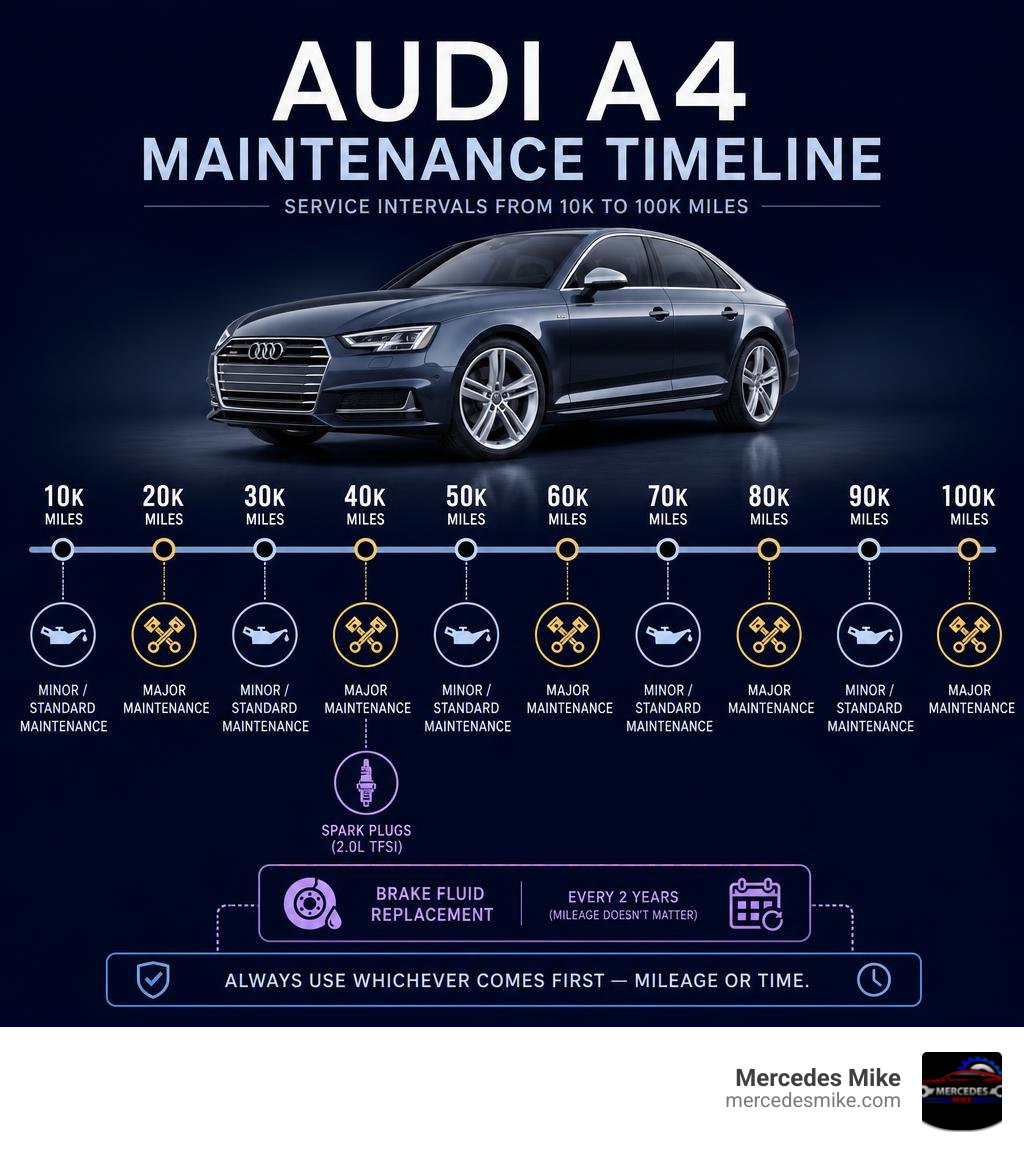
Here is a quick overview of the core service intervals:
Service Type First Due Repeats Every Minor/Standard Maintenance 10,000 miles or 1 year Every 10,000 miles or 1 year Major Maintenance 15,000–20,000 miles or 2 years Every 20,000 miles or 2 years Brake Fluid Replacement Every 2 years Every 2 years (mileage doesn't matter) Spark Plugs (2.0L TFSI) 35,000–40,000 miles or 6 years Every 30,000–40,000 miles
Always use whichever comes first — mileage or time.
The Audi A4 is a precision-engineered machine. It rewards owners who stay on top of maintenance and punishes those who don't. Miss a service window and you can find yourself dealing with worn brakes, degraded oil, or transmission problems that cost far more to fix than a routine service ever would.
The good news? Audi's factory maintenance schedule is well-structured and predictable. Once you understand how it works, staying ahead of it is straightforward.
Understanding the Audi A4 Service Schedule
To keep your Audi A4 running smoothly on the roads of South Florida, you need to understand the structural logic behind its maintenance program. Audi divides its service milestones into three main categories: minor maintenance, standard maintenance, and major maintenance.
Staying on top of these milestones is the ultimate way to practice preventive care. If you want to dive deeper into the general philosophy of keeping European vehicles in peak shape, check out our comprehensive Scheduled Maintenance Guide 2026.
Many drivers ask us about the difference between simply reacting to problems versus staying ahead of them. To get a clear picture of why scheduled visits save you thousands of dollars compared to emergency repairs, read our guide on Scheduled Maintenance vs Preventive Maintenance. By sticking to a strict schedule, you ensure that minor issues—like a tiny fluid leak or a slightly worn bushing—are caught and resolved before they turn into catastrophic failures.
Minor vs. Standard Audi A4 Service Schedule Intervals
Depending on the model year of your vehicle, the exact terminology and mileage intervals can vary slightly. For older models, such as those built in the mid-2000s, Audi recommended shorter 5,000-mile cycles. However, for modern Audi A4 models (typically 2017 and newer), the factory interval has been standardized to 10,000-mile or 1-year increments, whichever comes first.
The alternating pattern looks like this:
10,000 Miles (or 1 Year): Your first Minor Maintenance service. This is designed to refresh your engine oil, swap out the filter, and perform basic safety checks.
20,000 Miles (or 2 Years): Your first Standard Maintenance service. This includes everything in the minor service, plus deeper physical inspections of your brakes, suspension, and electrical systems.
30,000 Miles (or 3 Years): Minor Maintenance.
40,000 Miles (or 4 Years): Standard Maintenance (plus critical major items like transmission fluid replacement).
This alternating pattern continues for the life of the vehicle. For a broader look at how manufacturers structure these milestones, explore our breakdown of Factory Scheduled Maintenance.
Major Milestones in Your Audi A4 Service Schedule

As your Audi A4 ages and accumulates miles, certain service milestones carry much more weight than a basic oil change. The 40,000-mile and 80,000-mile marks are particularly critical.
At 40,000 miles, your Audi A4 requires a transmission fluid flush if it is equipped with the dual-clutch S-Tronic (DSG) gearbox. Neglecting this service can lead to rough shifting, electronic control module faults, and eventually, total transmission failure.
Once your vehicle crosses the threshold into six-figure mileage, the maintenance needs shift again. High-mileage wear items like control arm bushings, engine mounts, and cooling system plastics require close observation. To learn how to safely navigate this stage of your vehicle's life, read our expert advice on 100,000 Mile Maintenance.
Standard vs. Major Maintenance: What is Included?
To help you understand exactly what our technicians do when your vehicle is on the lift, we have broken down the specific tasks performed during Standard versus Major Maintenance visits.
Maintenance Task Standard Maintenance (Every 20k Miles / 2 Years) Major Maintenance / Additional Items (Intervals Vary) Engine Oil & Filter Change Yes Yes Multi-Point Safety Inspection Yes Yes Brake System & Pad Thickness Check Yes Yes Tire Rotation & Pressure Check Yes Yes Dust & Pollen (Cabin) Filter Replacement Yes (Every 20k miles) Yes S-Tronic DSG Transmission Fluid Flush No Yes (Every 40k miles) Engine Air Filter Replacement No Yes (Every 60k miles / 6 years) Spark Plug Replacement No Yes (Every 30k–40k miles)
For official factory documentation detailing these exact tasks across different model years, you can reference the 2019 Audi Maintenance Schedule - All Models. For older models, you can also view the 2004 Scheduled Maintenance Intervals. If you are looking for UK-specific schedules or global guidelines, the Recommended service schedules | Owners page offers additional context.
During a standard maintenance visit, the focus is on maintaining basic engine health and conducting a thorough visual inspection of the car's undercarriage. We check the thickness of your brake pads, inspect the rubber dust seals on your suspension ball joints, check the battery health, and run a diagnostic scan of the on-board computer systems to catch any pending fault codes.
A major maintenance visit includes all of these checks but adds intensive component replacements. We replace the engine's air filter element to keep the intake system free of debris, flush out the high-tech dual-clutch transmission fluid, and install fresh spark plugs to maintain optimal combustion efficiency.
Time-Sensitive Maintenance and Severe Driving Conditions

One of the most common mistakes Audi owners make is assuming that maintenance is dictated solely by the odometer. In reality, time can degrade vital fluids and rubber components just as quickly as physical mileage.
The prime example of this is your brake fluid. Audi specifies that brake fluid must be replaced every 2 years regardless of mileage across all models, including the A4. Brake fluid is hygroscopic, meaning it naturally absorbs moisture from the surrounding air over time. In the humid, salty air of South Florida, this moisture absorption happens rapidly. If left unchanged, the water content lowers the boiling point of the fluid, leading to a spongy brake pedal feel and internal corrosion of your ABS/ESP control modules.
Severe driving conditions also play a massive role in how often you should service your vehicle. Stop-and-go traffic on the Dixie Highway, idling in the summer heat of Pompano Beach, and short trips that don't allow the engine to reach full operating temperature all classify as severe operating conditions.
Under these circumstances, engine oil breaks down faster, and dust and pollen filters clog much more quickly. To protect your car from these local environmental stressors, we highly recommend reading about The Most Common Problems with German Cars and How to Prevent Them.
Spark Plugs and Timing Belts
If your Audi A4 is powered by the incredibly popular 2.0L TFSI turbocharged engine, pay close attention to your spark plugs. Healthy spark plugs are essential for preventing engine misfires, maintaining fuel economy, and protecting your ignition coils from premature failure.
For modern 2.0L TFSI engines, Audi recommends replacing spark plugs at 35,000 miles or 6 years for the first interval, and then every 30,000 or 40,000 miles (or 6 years) thereafter.
For older model years, spark plug changes were often scheduled at 35,000-mile or 3-year intervals. You can verify older specifications in the 2005 Audi All-new A4 Maintenance Service Circular (USA Vehicles Only).
When it comes to timing belts, modern Audi A4 models with TFSI engines utilize robust timing chains designed to last the lifetime of the engine (though the chain tensioner should still be inspected regularly). However, if you drive an older A4 or a specialized variant like an early TDI, you may have a rubber timing belt that requires physical replacement. For comparison, high-performance models like the Audi TTS require timing belt replacements at 110,000 miles to prevent catastrophic engine failure.
Engine Oil Specifications and Capacities
Using the correct oil is non-negotiable for an Audi engine. Modern Audi engines utilize highly advanced variable valve timing and turbocharger systems that rely on precise oil pressure and viscosity to function.
Capacity: The typical 2.0L TFSI engine in a modern Audi A4 requires 5.2 liters (5.49 quarts) of engine oil with a fresh filter.
Specifications: You must use synthetic oil that explicitly meets VW 504 00 or VW 508 00 factory standards. Using generic off-the-shelf oil that lacks these approvals can lead to oil sludge build-up, piston ring wear, and voided warranties.
To find the exact oil specification, capacity, and service schedule for your specific model year, you can use the official online Audi Maintenance Schedule tool.
Frequently Asked Questions about Audi A4 Maintenance
How often does an Audi A4 need an oil change?
Under normal driving conditions, an Audi A4 requires an oil and filter change every 10,000 miles or 1 year, whichever comes first. However, if you frequently drive in heavy stop-and-go South Florida traffic or make short trips under 10 miles, we recommend shortening that interval to every 5,000 to 7,500 miles to keep the engine pristine. Always use premium synthetic oil meeting VW 504 00 or 508 00 specifications.
Where can I find my specific Audi A4 owner's manual and schedule?
You can access your specific maintenance schedule through the official myAudi portal by entering your vehicle's unique 17-digit VIN. Additionally, the printed owner's manual located in your glovebox contains a comprehensive maintenance booklet detailing the exact requirements for your specific engine and transmission configuration.
Does the Audi A4 have a timing belt or timing chain?
Almost all modern Audi A4 models (specifically those built after 2009 with the 2.0L TFSI engine) use a timing chain rather than a timing belt. While timing chains do not have a scheduled replacement interval, the chain tensioners and guides should be inspected for wear and play as the vehicle accumulates high mileage. Older, vintage A4 models may still utilize a timing belt that requires replacement every 75,000 to 110,000 miles.
Conclusion
At the end of the day, keeping your Audi A4 happy and healthy comes down to consistency. By adhering to the factory audi a4 service schedule, you ensure your sedan remains a reliable, high-performing companion for years to come.
When you want to compare prepaid maintenance structures or look at how luxury brands handle upkeep packages, you can read our comparison on Mercedes Prepaid Maintenance. While that guide focuses on prepaid options, the core philosophy of proactive, professional care remains identical for your Audi.
When it's time for your next minor, standard, or major service, you don't have to navigate the process alone. At Mercedes Mike, located at 882 NE 41st Court in Pompano Beach (just off N Dixie Hwy), we specialize in the maintenance and repair of premium German vehicles. Our team of decades-experienced technicians uses the latest diagnostic tools and OEM-quality parts to ensure your Audi receives the exact care it deserves. Whether you live in Pompano Beach, Deerfield Beach, or anywhere else in South Florida, we are here to help.
Ready to book your next scheduled service? Visit our Services page to schedule your appointment today!