C180 Kompressor Tuning and Pulley Upgrades Explained
What You Can Actually Gain from C180 Kompressor Tuning
If you're researching C180 Kompressor tuning, here's what you need to know upfront:
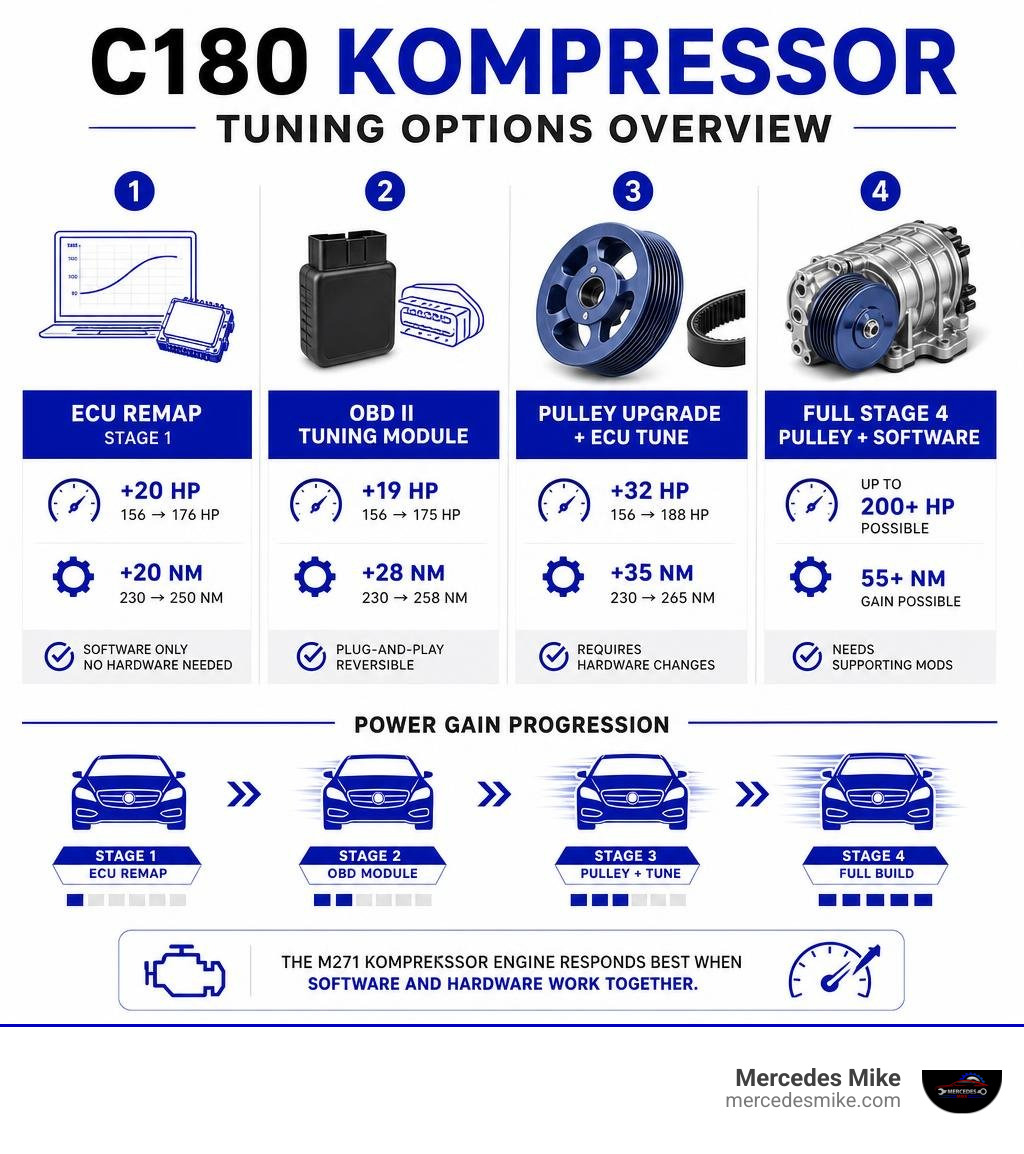
Quick Summary — C180 Kompressor Tuning Options and Gains:
Tuning Method Power Gain Torque Gain Notes Stage 1 ECU remap +20 hp (156 to 176 hp) +20 Nm (230 to 250 Nm) Software only, no hardware needed OBD II tuning module +19 hp (156 to 175 hp) +28 Nm (230 to 258 Nm) Plug-and-play, reversible Pulley upgrade + ECU tune +32 hp (156 to 188 hp) +35 Nm (230 to 265 Nm) Requires hardware changes Full Stage 4 pulley + software Up to ~200+ hp possible 55+ Nm gain possible Needs supporting mods
The Mercedes C180 Kompressor is a genuinely tuneable car — but how you tune it matters a lot. A simple plug-in chip won't do much on its own. The M271 supercharged engine responds best when software and hardware work together. Get that combination right and you can unlock meaningful real-world performance. Get it wrong and you risk running the engine lean, wearing out the timing chain early, or worse.
This guide covers every tuning path available — from a straightforward Stage 1 remap to a full supercharger pulley upgrade — so you can make an informed decision before spending a cent.
I'm Mike Ibrahim, and with decades of hands-on experience with German vehicles right here in Pompano Beach, I'll walk you through exactly what works, what doesn't, and what to watch out for.
Understanding the M271 Engine and Stock Performance
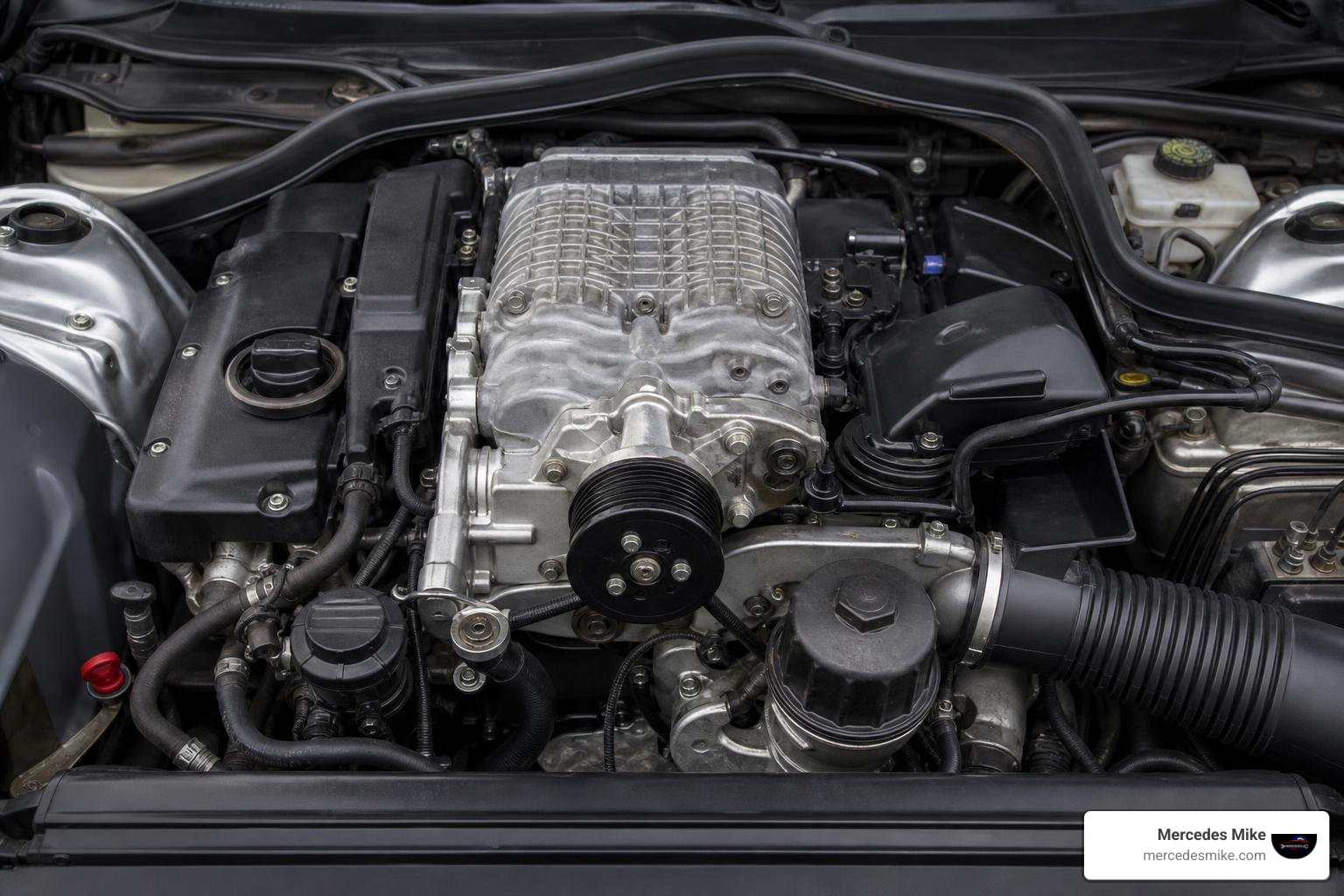
To get the most out of c180 kompressor tuning, we first need to understand the heart of the machine. The Mercedes-Benz C180 Kompressor models (spanning across generations like the W203 and W204) primarily rely on the resilient but highly specific M271 engine family.
Depending on the exact year of your vehicle, you are likely running one of two displacements:
M271 KE 18 ML (1.8L Supercharged): This is the most common variant. In its stock form on the W204 C180, it produces 156 hp (115 kW) and 230 Nm of torque. In older W203 models, a slightly detuned version produced 143 hp (105 kW) and 220 Nm of torque.
M271 KE 16 ML (1.6L Supercharged): Introduced to some markets to improve efficiency, this downsized 1597 cc engine still managed to output 156 hp and 230 Nm of torque thanks to a highly optimized supercharger setup. You can view the Detailed specifications of the 1.6L M271 engine to see how its bore, stroke, and compression ratio compare to its larger sibling.
Regardless of whether you have the 1.8L or the 1.6L variant, both engines utilize a belt-driven Roots-type supercharger (hence the German name "Kompressor") to force air into the cylinders. The engine management is handled by a sophisticated Siemens/Continental SIM271KE or SIM271DE ECU.
These factory ECUs are programmed with conservative parameters. Mercedes-Benz designed this engine to operate reliably in extreme cold, blistering desert heat, and with varying qualities of fuel worldwide. For enthusiasts in South Florida, this conservative factory calibration means there is a significant amount of untapped potential waiting to be unlocked. If you want to build a foundational understanding of modifying these vehicles, you can read our guide on mercedes tuning.
Core Options for C180 Kompressor Tuning
When it comes to modifying your C180, we categorize the tuning options into three distinct tiers: software-only, plug-and-play modules, and hardware-software combinations.
1. Stage 1 ECU Remapping (Chiptuning)
A Stage 1 ECU remap involves rewriting the software on your factory Siemens SIM271 ECU. A professional tuner reads your stock map using specialist tools (like Alientech KESS3 or Autotuner) and optimizes the ignition timing, fuel-to-air ratios, and throttle response.
For a stock 1.8L or 1.6L C180 Kompressor, a high-quality Stage 1 map safely increases output to approximately 171 hp to 176 hp and bumps torque to 250 Nm. This is a modest but very noticeable 10% performance jump that completely transforms how the car pulls in the mid-range. You can explore the Stage 1 ECU tuning files and database options/180/156hp) to see how these map structures are safely designed.
2. Plug-and-Play OBD II Tuning Modules
If you are looking for a reversible option that doesn't permanently alter your ECU's flash memory, an OBD II tuning box (such as the GÄN GA/GA+ module) is a popular alternative. These modules plug into your vehicle’s OBD port and intercept sensor data, correcting signals in real-time to command more performance safely. Typically, they offer a power increase of around +19 PS (+19 hp) and +28 Nm of torque, and they can be deactivated instantly via a smartphone app.
3. Stage 2+ Hardware-Based Tuning (The Pulley Upgrade)
Because the Kompressor is mechanically driven by the engine's crankshaft, software alone cannot increase the physical speed of the supercharger. To get genuine, neck-snapping power gains, you have to change the physical pulley ratio.
By shrinking the supercharger pulley or enlarging the crankshaft pulley, you force the supercharger to spin faster at any given engine RPM, creating more boost. When you pair this mechanical modification with a custom ECU remap to supply the extra fuel required, the M271 engine easily wakes up, pushing far past 185 hp. To see how this concept applies across other supercharged Mercedes models of this era, you can also Explore CLK 200 Kompressor tuning options.
The Mechanics of Supercharger Pulley Upgrades
If you want to move beyond basic software limits, a supercharger pulley upgrade is the gold standard for the M271 engine.
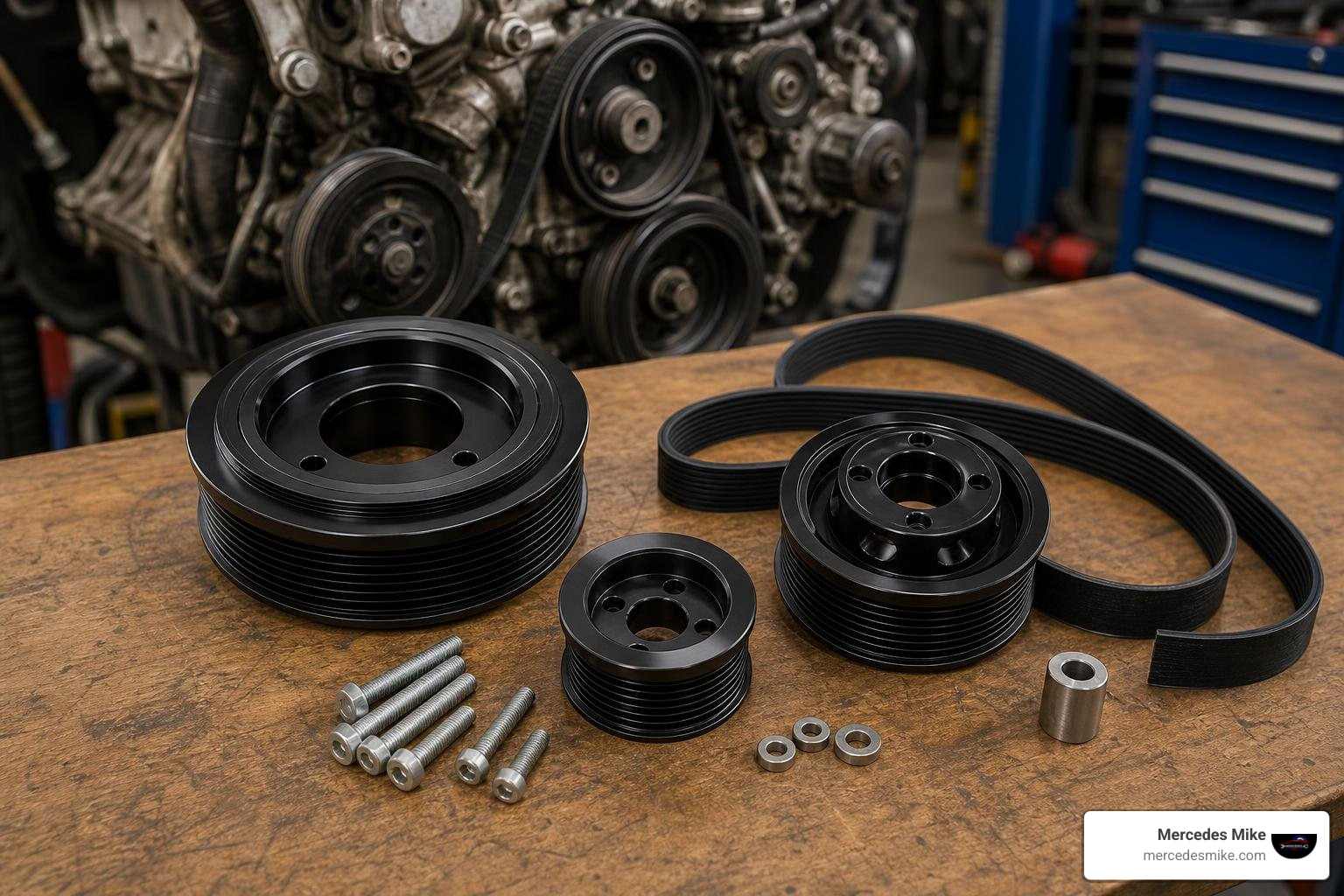
To understand how this works, we have to look at the drive ratio. In a stock setup, the crankshaft pulley drives the supercharger belt. The ratio between the size of the crankshaft pulley and the supercharger (compressor) pulley determines how fast the supercharger spins.
A comprehensive upgrade kit (like an RTMG Stage 4 kit) alters these ratios using three main components:
Enlarged Crankshaft Pulley: The stock crankshaft pulley is 175 mm. Upgrading this to a larger 192 mm performance pulley immediately increases the speed of the entire belt drive accessory system.
Downsized Water Pump Pulley: Because the crankshaft pulley is now larger, the water pump would normally spin too fast, which can cause coolant cavitation and cooling system failures. To prevent this, quality kits include a downsized water pump pulley (reduced from 140 mm to 119 mm) to balance the rotational speeds and keep your cooling system operating in its sweet spot.
Smaller Compressor Pulley: Alternatively, or in addition to the crank pulley, the supercharger's own pulley can be reduced to a 62mm or 65mm size.
By spinning the supercharger faster, you compress more air into the engine, resulting in a substantial boost increase. However, you must never run a physical pulley upgrade without a matching ECU tune.
More air requires more fuel. If you change the pulleys without recalibrating the ECU, the engine will run dangerously lean, leading to high exhaust gas temperatures and catastrophic engine knock. High-end kits, such as those from VÄTH, include both the physical pulley components and a tailored software map designed to run on SuperPlus (98 octane) fuel. You can look at the Mercedes C-Klasse Kompressor-Tuning-Kit C180 W204 | Mercedes-Benz Tuning & AMG Tuning von VÄTH - Ihr Spezialist für Mercedes-Benz und AMG Tuning to see how professional German tuners package these systems for daily use.
Supporting Modifications for 200+ HP
If your goal is to push your C180 Kompressor past the 200 hp mark, you cannot rely on pulleys and software alone. To keep the engine reliable under sustained load, you need supporting modifications to manage heat and fuel delivery.

Upgraded Intercooler: Compressing air naturally heats it up. When you spin the supercharger faster with upgraded pulleys, intake air temperatures (IATs) skyrocket. A larger, high-efficiency front-mount intercooler is essential to cool the intake charge, keeping the air dense and preventing the ECU from pulling ignition timing due to high heat.
High-Flow Air Filter: The stock paper air filter is a major restriction once you increase the supercharger's volumetric demand. A high-flow sport air filter insert or intake system allows the supercharger to draw in air with less resistance.
Upgraded Fuel Injectors: While the stock fuel injectors can handle a basic Stage 1 tune, they run close to their maximum duty cycle under high boost from a dual-pulley setup. Installing larger injectors ensures your engine always has access to the fuel volume it needs to maintain safe air-fuel ratios.
Exhaust Manifold & Decat: To get the exhaust gases out of the engine quickly and reduce backpressure, a free-flowing exhaust manifold or sport catalytic converter is highly recommended.
If you're interested in how these mechanical limits compare to the massive potential of AMG platforms, read our analysis on Upgrading to larger turbochargers and superchargers. And if you are cross-shopping or also own a diesel cruiser, check out our guide on the c350 cdi remap to see how turbo-diesels compare.
M271 Reliability, Maintenance, and Common Risks
Before we perform any C180 Kompressor tuning, we always stress the importance of preventative maintenance. The M271 is a great engine, but it has known weak points that must be addressed before you add extra stress to the powertrain.
We highly recommend completing this pre-tuning checklist:
Inspect the Timing Chain and Hydraulic Tensioner: This is the single most critical failure point on the M271 engine. The single-row timing chain is prone to stretching over time, and the hydraulic tensioner can leak or lose pressure. If the chain jumps a tooth, it will cause catastrophic valve-to-piston contact. We recommend inspecting the chain every 6 months or 110,000 km (approx. 68,000 miles).
Check for Oil Leaks at the Camshaft Adjusters: The camshaft adjuster magnets are notorious for leaking oil into the engine wiring harness. If left unchecked, oil can migrate all the way to the ECU, ruin the electronics, and cause misfires.
Service the Supercharger (Kompressor): The supercharger contains internal oil that lubricates its gears. This oil degrades over time. Before spinning the supercharger faster with a pulley upgrade, have the supercharger oil changed and inspect the supercharger clutch/coupling for wear.
Replace Spark Plugs: Upgraded boost pressures require a strong, consistent spark. Install a fresh set of one-step-colder spark plugs gapped correctly to prevent spark blowout under high boost.
Tuning an engine that is not 100% healthy is a recipe for disaster. If you are in South Florida and want to make sure your car is ready for modifications, you can find our shop by searching for Find professional ECM tuners near me to get a comprehensive pre-tuning health check.
Frequently Asked Questions about C180 Kompressor Tuning
Can I achieve 200+ hp with a basic c180 kompressor tuning setup?
Realistically, you cannot reach 200+ hp with a "basic" software-only setup. While some generic online maps claim massive jumps, a stock C180 Kompressor will top out around 175 hp on software alone.
To break the 200 hp barrier safely, you must install a physical supercharger pulley upgrade, a high-flow intake, a larger intercooler, and back it up with a custom dyno-tuned ECU map. You can see the realistic steps and hardware-software packages by reviewing the Mercedes C 180 Kompressor 105KW/143PS – RMT-TUNING specifications, which highlight the massive leap in gains when combining software with pulley upgrades (+40 PS and +55 Nm over stock).
What is the difference between c180 kompressor tuning and M271 EVO turbo tuning?
The older M271 Kompressor engine uses a mechanical supercharger to build boost. The later M271 EVO engine (found in face-lifted W204 models) dropped the supercharger in favor of a turbocharger (CGI models).
Turbocharged engines are generally easier to tune for cheap horsepower because the ECU directly controls the wastegate to increase boost. However, the supercharged Kompressor engine offers a much more linear, immediate throttle response with zero "turbo lag," making it incredibly rewarding to drive once the pulley ratio is upgraded.
How does tuning affect fuel consumption and daily drivability?
When driven normally, a high-quality Stage 1 tune or OBD module can actually improve your fuel economy by up to 15%. This is because the optimized ignition timing and combustion efficiency allow the engine to produce more torque down low, meaning you don't have to step on the gas pedal as hard to get moving.
However, because the M271 suffers from factory drive-by-wire throttle lag, a proper remap or tuning module will sharpen up throttle response significantly. For a detailed breakdown of how these modules manage fuel economy gains, you can read the OBD II tuning module specifications and fuel savings documentation.
Conclusion
Tuning your Mercedes C180 Kompressor is one of the most cost-effective ways to inject some modern performance into a classic, dependable German chassis. Whether you opt for a smooth, daily-driver-friendly Stage 1 ECU remap or go all-out with a Stage 4 supercharger pulley upgrade, the key to success is pairing your modifications with meticulous maintenance.
At Mercedes Mike, we have decades of experience servicing and upgrading German performance cars in Pompano Beach, Deerfield Beach FL, and the wider South Florida area. Our master technicians use the latest factory diagnostic tools to ensure your engine's timing chain, supercharger, and cooling systems are in prime condition before we ever flash a map or swap a pulley.
If you're ready to unlock the true potential of your Mercedes-Benz safely, don't leave it to chance or cheap eBay chips. Schedule a professional Mercedes tuning consultation with our team at our Pompano Beach workshop today!