

Mercedes Service Schedule: Find Your Model's Maintenance Plan
Why Your Mercedes Service Schedule Is More Important Than You Think
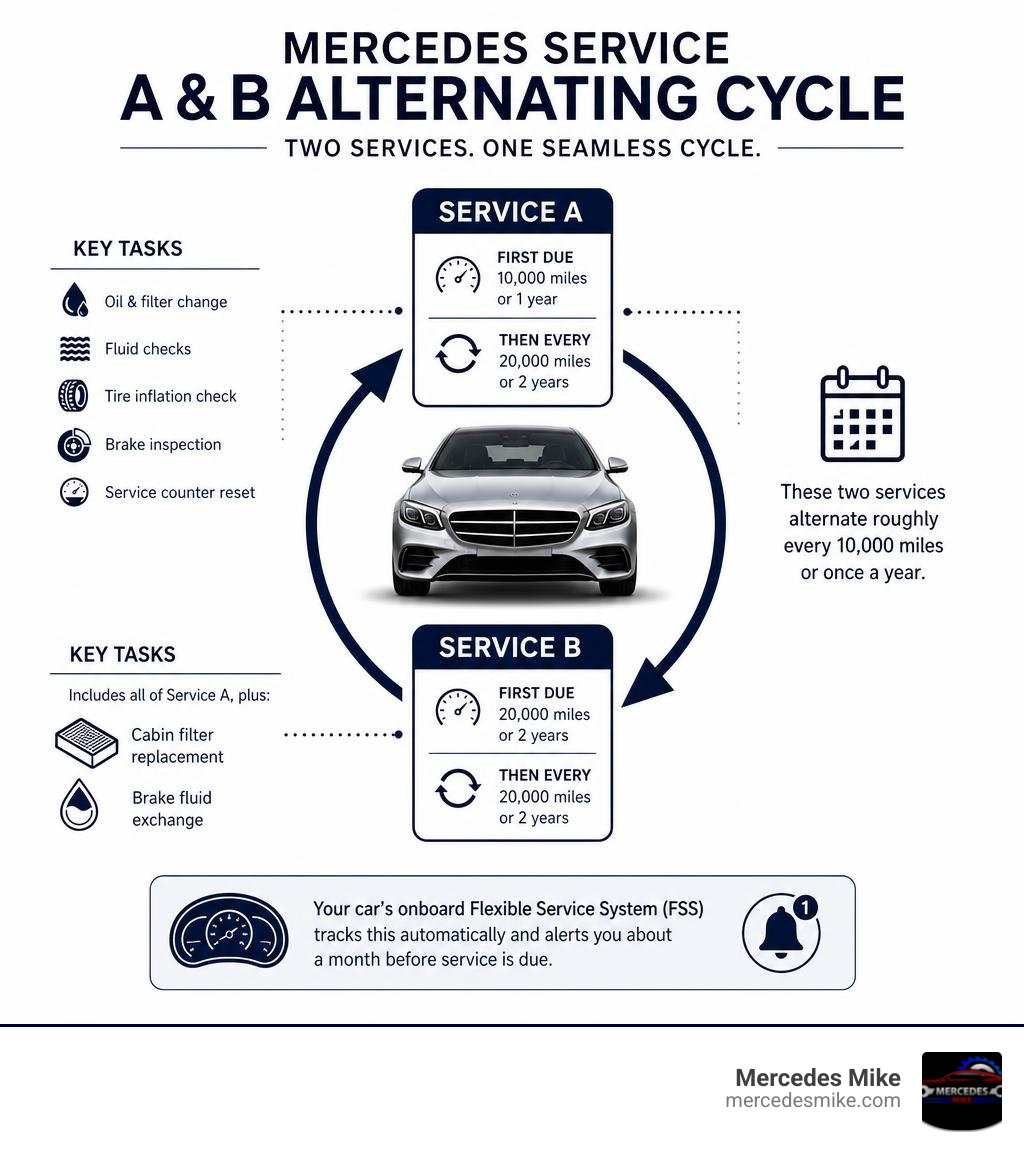
The Mercedes service schedule is built around two alternating visits — Service A and Service B — that keep your engine, brakes, and cabin systems in top shape. Here's the quick version:
Service First Due Then Every Key Tasks Service A 10,000 miles or 1 year 20,000 miles / 2 years Oil & filter change, fluid checks, tire inflation, brake inspection, counter reset Service B 20,000 miles or 2 years 20,000 miles / 2 years All of Service A + cabin filter replacement + brake fluid exchange
These two services alternate roughly every 10,000 miles or once a year.
Your car's onboard Flexible Service System (FSS) tracks this automatically and alerts you about a month before service is due.
Skipping a scheduled service isn't just bad for your car — it can void your factory warranty. Mercedes-Benz is explicit: failing to change your oil within the specified intervals and using the wrong oil or filter can result in engine damage that is not covered under the New Vehicle Limited Warranty.
For busy professionals who depend on their vehicles every day, falling behind on maintenance is a risk that simply isn't worth taking.
Understanding the Mercedes Service Schedule: Service A vs. Service B
To keep your German luxury vehicle operating at peak performance, you must understand how the foundational service tiers operate. Since model year 2009, Mercedes-Benz has utilized a streamlined, alternating maintenance system designed to simplify ownership while ensuring no critical component is neglected.

At the heart of this system are Service A and Service B. These services are not identical, nor are they interchangeable. Instead, they are engineered to complement each other. Our Scheduled Maintenance Guide 2026 explains that alternating these services ensures your vehicle receives both light, frequent check-ups and deeper, comprehensive system overhauls exactly when needed.
By adhering to this alternating cycle, you protect the high-tolerance mechanical systems of your vehicle from premature wear. Let us break down exactly what happens during each of these essential shop visits.
Maintenance Task Service A (Every 10k Miles / 1 Year) Service B (Every 20k Miles / 2 Years) Synthetic Motor Oil & Filter Replacement Yes Yes Fluid Level Checks & Corrections Yes Yes Tire Inflation Check & Correction Yes Yes Brake Component Inspection Yes Yes Maintenance Counter Reset Yes Yes Cabin Dust/Combination Filter Replacement No Yes Brake Fluid Exchange No Yes
What is Included in Service A?
Service A is your vehicle's first major appointment, occurring at approximately 10,000 miles or 1 year of ownership, whichever comes first. After this initial visit, Service A is performed every 20,000 miles (or 2 years) thereafter, alternating with Service B.
Think of Service A as a highly focused, precision health check. It is designed to refresh your engine's vital fluids and catch minor wear before it turns into an expensive repair. When you bring your vehicle to us for Factory Scheduled Maintenance, Service A includes the following essential tasks:
Mercedes-Benz Synthetic Motor Oil Replacement: Modern German engines run hot and under high pressure. We use only approved synthetic oils meeting strict MB sheet specifications (such as MB 229.5 or 229.51) to ensure maximum thermal stability and component protection.
Genuine Oil Filter Replacement: We replace your oil filter with an OEM-quality filter to keep microscopic debris from circulating through your engine.
Fluid Level Checks and Corrections: We inspect and top off all critical fluids, including coolant, power steering fluid, and windshield washer fluid, according to your specific model-year requirements.
Tire Inflation Check and Correction: Correct tire pressure is vital for safety, fuel economy, and handling. We check and adjust all tires, including the spare (if equipped).
Brake Component Inspection: Our technicians perform a visual inspection of your brake pads, rotors, calipers, and lines to ensure your stopping power is uncompromised.
Maintenance Counter Reset: We reset your vehicle's internal computer so it can accurately track your next service interval.
What is Included in Service B?
Service B is a more comprehensive maintenance visit. It is first performed at approximately 20,000 miles or 2 years (which is 1 year or 10,000 miles after your first Service A), and then every 20,000 miles or 2 years after that.
Because your vehicle has traveled further by the time Service B is due, it requires deeper maintenance to protect both the mechanical systems and your health inside the cabin. Understanding the difference between Scheduled Maintenance vs Preventive Maintenance helps highlight why Service B is so critical. It includes all the standard items found in Service A, plus these crucial additions:
Cabin Dust/Combination Filter Replacement: This filter cleans the air entering your vehicle’s climate control system, trapping pollen, South Florida road dust, and allergens. In our humid climate, a fresh cabin filter is essential to prevent musty odors and maintain strong airflow.
Brake Fluid Exchange: Brake fluid is hygroscopic, meaning it naturally absorbs moisture from the air over time. In South Florida's high humidity, this moisture absorption happens rapidly. If left unchanged, moisture lowers the boiling point of your brake fluid, leading to a spongy pedal feel and potential internal corrosion of your ABS and traction control systems. Service B mandates a complete brake fluid flush and exchange every 2 years to keep you safe.
How the Flexible Service System Tracks Your Mercedes Service Schedule
Have you ever wondered how your car knows exactly when it needs attention? Modern Mercedes-Benz vehicles do not just rely on a simple odometer countdown. Instead, they utilize the Flexible Service System (FSS).
The FSS is a sophisticated onboard computer algorithm that constantly monitors your driving habits and vehicle operating conditions. It tracks variables such as:
Engine operating temperatures
Average vehicle speeds
Stop-and-go driving patterns vs. highway cruising
Total engine revolutions
Elapsed calendar time
If you primarily drive short distances in stop-and-go traffic around Pompano Beach or Deerfield Beach, your oil will degrade faster than if you frequently cruise down the highway. The FSS recognizes this and may prompt you for service slightly before the 10,000-mile mark. Conversely, under ideal driving conditions, the system will allow you to go the full interval.
The system displays a clear alert on your dashboard console approximately one month or 1,000 miles before your service is due, showing a message like "Service A in 1,200 miles" or "Service B Due." For older models, you can consult the Official Mercedes-Benz Service Booklet to understand how the early iterations of this system calculated your service intervals.
Beyond the Basics: Additional Mileage-Based Maintenance Milestones
While alternating between Service A and Service B covers your routine oil changes and basic inspections, your vehicle requires deeper mechanical attention as it ages. High-tolerance German engines rely on a series of filters, spark plugs, and fluids that operate on longer lifespans but are absolutely critical to performance.
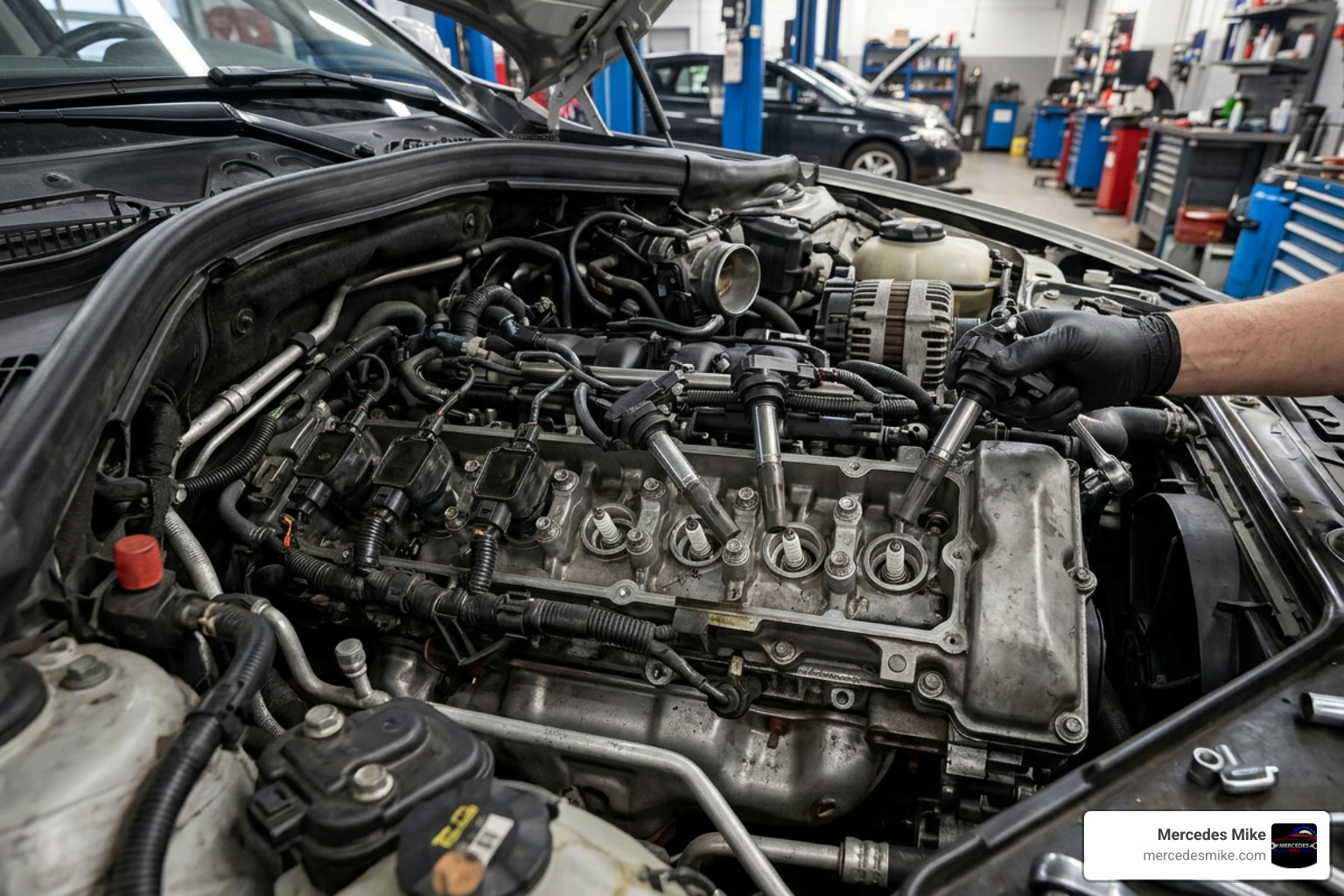
Neglecting these longer-term milestones is one of the leading causes of sudden performance loss, poor fuel economy, and unexpected breakdowns. Let’s look at the major mileage-based milestones you need to plan for:
Engine Air Filter Replacement (Every 40,000 Miles or 4 Years): Your engine needs to breathe clean air to maintain its precise air-to-fuel ratio. Under normal dust conditions, the engine air filter should be replaced every 40,000 miles (except for specialized V12 engines like type 275, which require replacement every 60,000 miles or 6 years). A clogged air filter forces your engine to work harder, robbing you of horsepower and reducing gas mileage.
Spark Plug Replacement (Every 50,000 to 100,000 Miles): Spark plugs are responsible for igniting the fuel in your engine's cylinders. Over time, the electrodes wear down, widening the gap and causing engine misfires, rough idling, or hard starts. The exact interval depends heavily on your engine model. However, severe operating conditions—such as frequent short trips in high South Florida heat—can require sooner replacement.
Fuel Filter Replacement:
Gasoline Engines: The fuel filter should typically be replaced every 150,000 miles or 15 years to protect your fuel injectors from microscopic tank sediment.
Diesel Engines: Diesel fuel is naturally heavier and more prone to water contamination. Therefore, diesel fuel filters must be replaced much more frequently—every 20,000 miles or 2 years.
Transmission Fluid and Filter Service: Your transmission operates under immense heat and pressure. Replacing the transmission fluid and filter at the manufacturer-specified interval (often between 60,000 and 70,000 miles depending on the transmission type) is the single best way to prevent costly transmission failures.
To help you budget and plan for these deeper services, we have put together detailed cost breakdowns in our guides on the Mercedes Benz 60k Service Cost and our comprehensive guide to 100,000 Mile Maintenance.
Customizing the Mercedes Service Schedule for High-Performance AMG and Diesel Models
If you drive a high-performance AMG model or a highly efficient BlueTEC diesel, your maintenance schedule looks a bit different. High-performance engineering and specialized emissions systems demand tailored care.
High-Performance AMG Models
AMG engines are hand-built masterpieces designed to operate at the absolute limit of automotive performance. Because of the extreme tolerances inside these vehicles, they require a specialized AMG 2,000-Mile Break-In Service. During this initial break-in period, the rear axle differential fluid must be completely drained and replaced to remove any microscopic metallic shaving debris generated as the gears seat together. Skipping this early service can permanently damage your high-performance differential.
BlueTEC Diesel Models
For diesel models (specifically those from model years 2009-2014), emissions compliance and fuel system health require strict maintenance. These models utilize BlueTEC technology, which relies on AdBlue (Diesel Exhaust Fluid) to neutralize harmful nitrogen oxide emissions.
AdBlue Replenishment: AdBlue must be topped off at every scheduled service interval (every 10,000 miles).
Fuel Filter Replacement: As mentioned, the diesel fuel filter must be replaced every 20,000 miles or 2 years to keep water and contaminants from reaching the high-pressure fuel pump. You can review these specific requirements in the Official 2014 Maintenance Booklet.
Tire Rotation and Wear Guidelines
Tires are the only point of contact between your luxury vehicle and the road. To get the maximum lifespan out of your tires and ensure safe handling during South Florida's frequent rainstorms, regular tire maintenance is non-negotiable.
The 5,000-Mile Rotation Rule
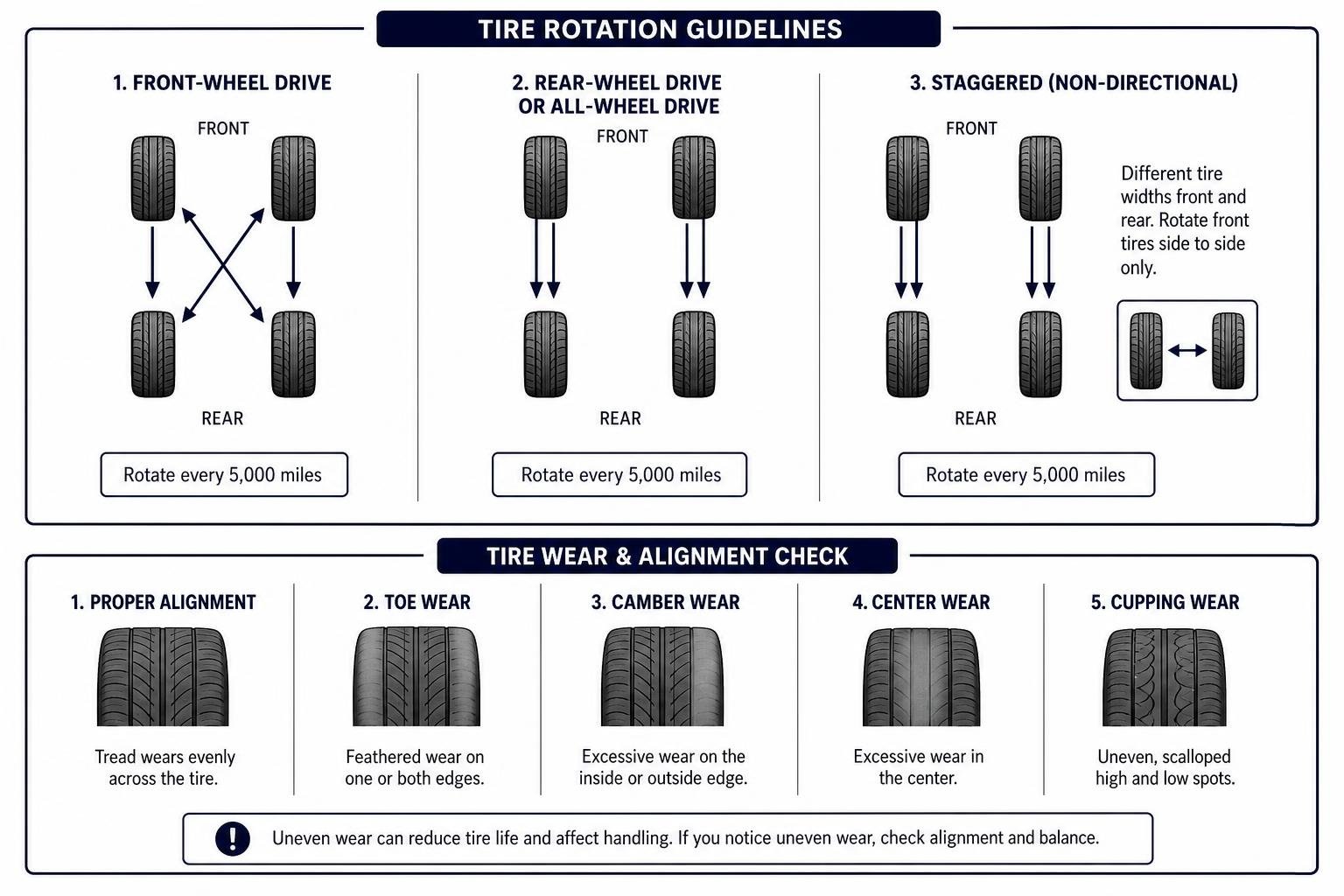
We recommend rotating your tires every 5,000 miles—essentially midway between your scheduled Service A and Service B appointments. Regular rotation ensures that front and rear tires wear down at an even rate, extending the life of your tread.
The Staggered Tire Exception
Many high-performance Mercedes-Benz sedans, coupes, and SUVs feature a staggered tire configuration. This means the rear wheels and tires are physically wider than the front wheels to provide better traction under acceleration.
Because the front and rear tires are different sizes, you cannot rotate them from front to back. Doing so would compromise safety and vehicle clearance. If your vehicle has a staggered setup, your tires cannot be rotated. Instead, you must monitor individual tire wear closely and perform regular wheel alignments to prevent premature inner-shoulder wear.
For more details on tire warranty coverage limits and wear requirements, consult the official Mercedes-Benz Service and Warranty Information booklet.
Modern Mercedes Maintenance: EVs, Hybrids, and Convenience Services
The automotive landscape is changing rapidly, and Mercedes-Benz is leading the charge with its advanced lineup of EQ electric vehicles and plug-in hybrids. If you have transitioned to an electric vehicle, you might think your maintenance days are over. While it is true that you can say goodbye to oil changes, spark plugs, and emission tests, your EV still requires structured, professional care.
Electric vehicle maintenance is typically structured around 2-year service packages. Instead of internal engine components, EV maintenance focuses on:
Replacing cabin dust and activated charcoal combination filters to keep your interior air pure.
Performing comprehensive multi-point inspections of the electric drive motors, cooling systems, and battery packs.
Exchanging the brake fluid every 2 years (critical because EV regenerative braking means traditional brakes are used less, making fluid health checks even more important).
Inspecting high-voltage suspension components and electrical connections.
For hybrid owners, safety is paramount. High-voltage hybrid cables are colored bright orange to indicate they carry lethal electrical currents. Our technicians are fully trained in high-voltage safety protocols, ensuring your hybrid system is serviced safely and correctly.
Whether you drive a traditional gas model, an EV, or a hybrid, managing these costs is easy. You can learn about your coverage options in our guide to Mercedes Prepaid Maintenance, or read our real-world cost breakdown of specific luxury models in the Mercedes GLS 450 Maintenance Cost guide.
Dealership Convenience vs. Certified Independent Specialists
Dealership service departments often promote proprietary convenience options such as Express Service (completing basic maintenance in under 60 minutes using two technicians), Mobile Service vans, Night Drop boxes, and vehicle Pick-Up and Delivery. While these options sound appealing, they often come with a massive premium added to your repair bill.
Many owners believe they must take their vehicle to a dealership to keep their factory warranty intact. This is a myth.
Under the federal Magnuson-Moss Warranty Act, you have the legal right to have your vehicle serviced at any independent repair facility using certified equivalent parts. A manufacturer cannot void your warranty simply because you chose not to use their dealership service center.
By choosing a Certified Mercedes Benz Mechanic at an Independent Mercedes Repair shop like Mercedes Mike, you receive:
The exact same high-level diagnostic tools and factory-approved fluids.
Decades of specialized mechanical expertise.
A much more personalized, transparent customer experience.
Significant cost savings compared to dealership labor rates.
Frequently Asked Questions About Mercedes Maintenance
To help you stay fully informed, we have gathered answers to some of the most common questions we hear from luxury vehicle owners in South Florida.
Can I service my Mercedes at an independent shop without voiding the warranty?
Yes, absolutely. Under federal law, you are not required to visit a dealership for routine maintenance or emission control services to keep your warranty valid. You can have any qualified independent shop perform these services using certified parts.
The key is documentation. You must follow the factory-specified intervals and keep clear, detailed service records and receipts proving that the correct approved fluids and filters were used. For older models, you can verify these guidelines in the Official 2010 Maintenance Booklet.
What happens if I reset the maintenance counter without performing the service?
Resetting your maintenance counter without actually performing the required service is highly risky. The onboard computer will assume fresh oil and filters are present and will adjust its engine management parameters accordingly.
Over time, degraded oil will lose its viscosity, leading to severe internal engine wear, sludge buildup, and potential engine failure. Furthermore, if you experience an engine malfunction and the dealer discovers the maintenance log was reset without physical service records to back it up, your warranty claim will be denied.
How often should the cabin air filter and brake fluid be replaced?
Both the cabin air filter and the brake fluid must be replaced every 2 years or 20,000 miles, which aligns with your Service B interval.
Brake fluid must be exchanged because it naturally absorbs moisture over time, which can corrode internal brake components and lower your boiling point. The cabin air filter should be replaced to protect your health, especially in dusty or highly humid environments where mold and allergens can quickly clog the filter media.
Conclusion: Trust Your Mercedes to South Florida's Specialists
Adhering to your Mercedes service schedule is the single most important thing you can do to protect your investment, maintain your warranty, and enjoy the legendary performance of your luxury vehicle for years to come.
At Mercedes Mike in Pompano Beach, we specialize in the maintenance and repair of fine German automobiles, including Mercedes-Benz, BMW, Audi, and Porsche. Serving Pompano Beach, Deerfield Beach, and the broader South Florida area, our team of decades-experienced technicians utilizes the latest diagnostic tools and strictly adheres to factory service sheets. We use only approved synthetic fluids and OEM-quality parts to ensure your vehicle runs exactly as the engineers intended.
Don't pay dealership prices for premium service. Visit our Mercedes Mike Services page today to learn more or schedule your next Service A or Service B appointment with our local experts!