
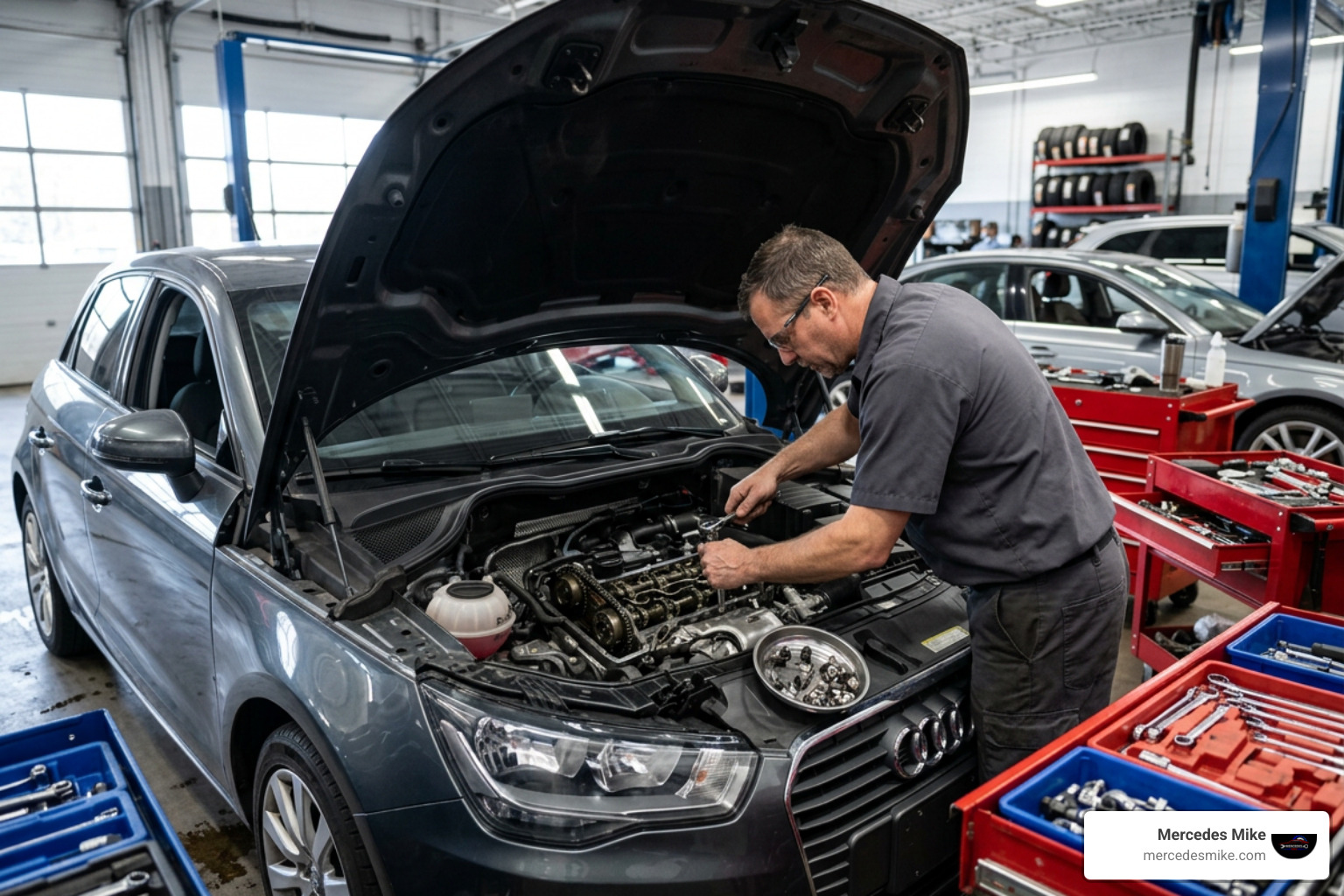
What You Will Pay for an Audi A1 Timing Chain Replacement
Audi A1 Timing Chain Replacement Cost: What to Budget
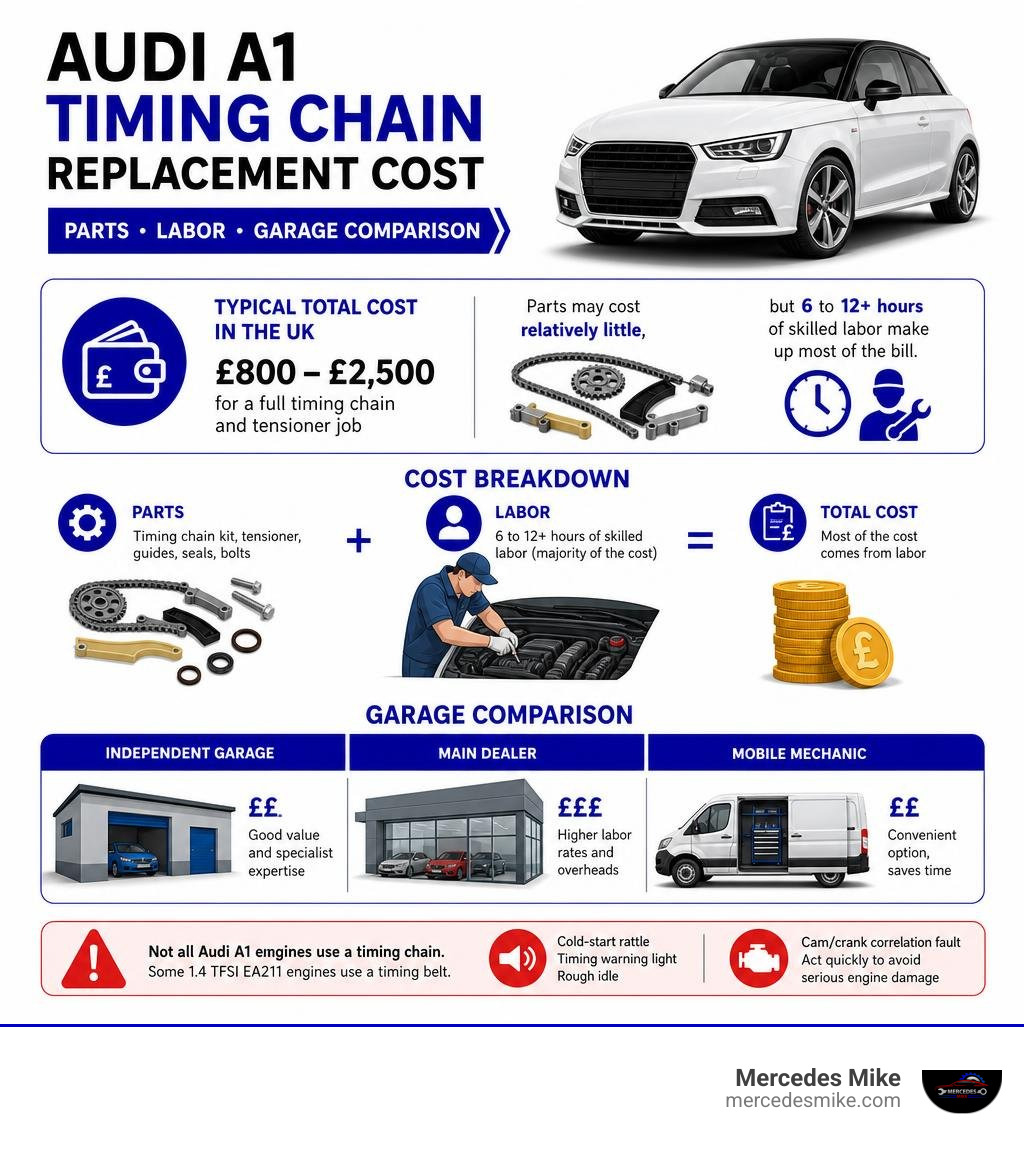
For a chain-driven Audi A1, expect a typical timing chain replacement cost of about £800 to £2,500 in the UK. A 1.2 or 1.4 TSI EA111 usually falls around EUR700 to EUR1,400 for a full chain and tensioner job. The parts may cost relatively little, but 6 to 12 or more hours of skilled labor make up most of the bill.
Before booking a repair, confirm your engine type. Not every Audi A1 has a chain: some later 1.4 TFSI EA211 engines use a timing belt instead. A cold-start rattle, timing-related warning light, rough idle, or camshaft/crankshaft correlation fault code should be checked quickly. Waiting can turn a planned service into expensive valve and piston damage.
I am Mike Ibrahim, and the next sections break down the likely costs, engine differences, and choices that matter before you approve the work.
Audi A1 Timing Chain Replacement Cost Breakdown
When you take your Audi A1 into a workshop for timing work, the total bill represents a blend of specialized parts and extensive mechanical labor. Because the timing assembly synchronizes your engine's internal combustion cycle, accessing and setting these components requires absolute surgical precision. Understanding how the numbers break down helps you plan your maintenance budget effectively and avoid unexpected surprises.
Engine Variant | Shop Type | Estimated Parts Cost | Estimated Labor Cost | Total Estimated Cost Range |
|---|---|---|---|---|
1.2 / 1.4 TFSI (EA111) | Independent Specialist | $150 – $350 / £120 – £280 | $650 – $1,050 / £500 – £800 | $800 – $1,400 / £620 – £1,080 |
1.2 / 1.4 TFSI (EA111) | Franchised Dealership | $300 – $550 / £250 – £450 | $1,200 – $1,950 / £950 – £1,550 | $1,500 – $2,500 / £1,200 – £2,000 |
1.8 TFSI (EA888 Gen 3) | Independent Specialist | $250 – $450 / £200 – £350 | $850 – $1,350 / £650 – £1,050 | $1,100 – $1,800 / £850 – £1,400 |
1.8 TFSI (EA888 Gen 3) | Franchised Dealership | $450 – $750 / £350 – £600 | $1,550 – $2,250 / £1,250 – £1,800 | $2,000 – $3,000 / £1,600 – £2,400 |
Whether you are budgeting for standard upkeep or dealing with urgent engine repair, timing chain jobs skew heavily toward labor due to the tight clearance inside the Audi A1 engine bay.
Parts vs Labor Hours on TFSI Engines
The physical components needed for a timing chain replacement—the link chain itself, guide rails, and hydraulic tensioner—often cost between €80 and €150 ($100 to $200) for standard aftermarket kits, or up to $300 to $500 for comprehensive OEM kits. However, labor represents roughly 70% to 80% of the final invoice.
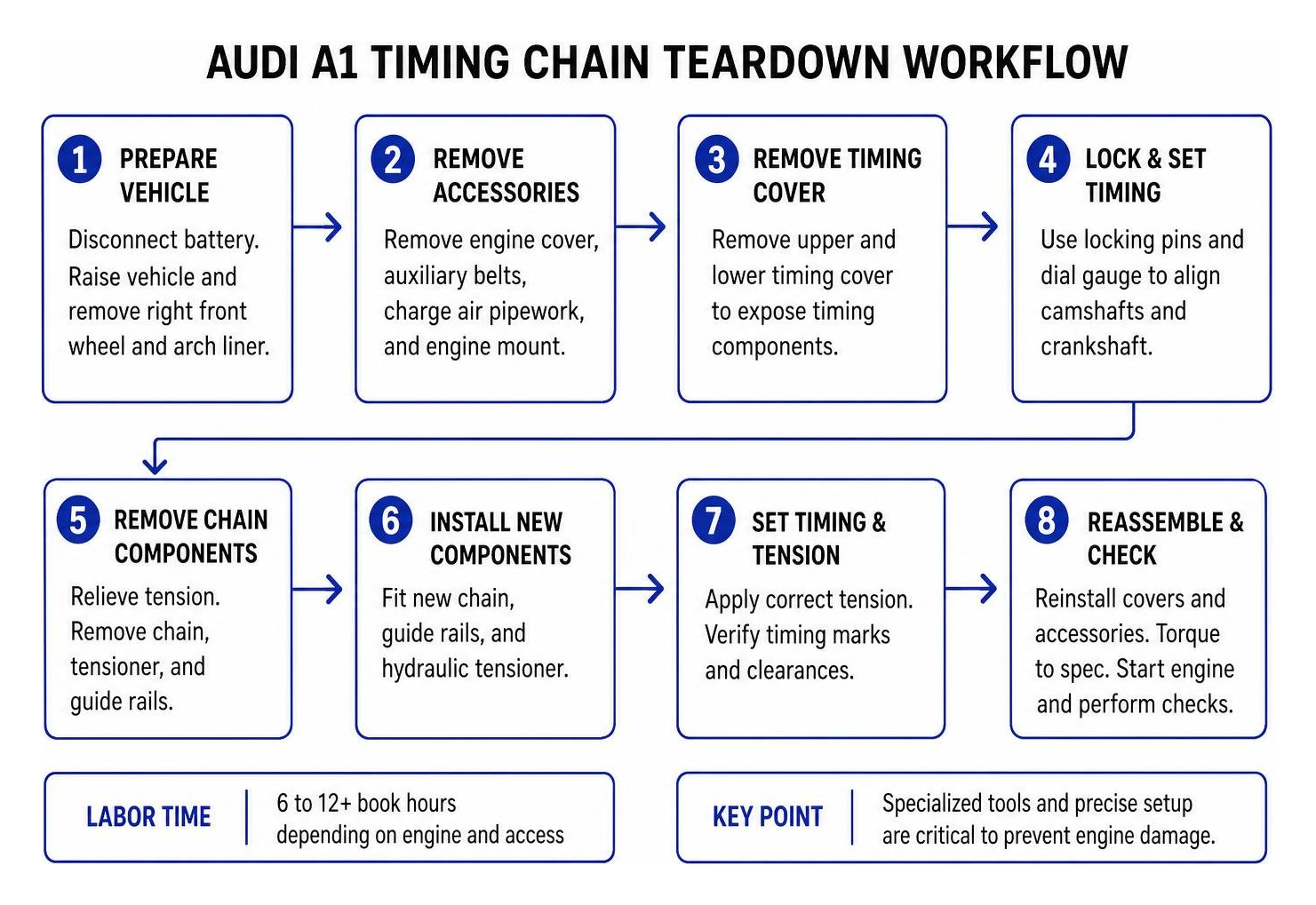
Replacing a timing chain on a transverse TFSI engine requires between 6 and 12+ book hours. Technicians must remove engine mounts, auxiliary belts, wheel arch liners, charge air pipework, and the timing cover casing. Because there is virtually zero margin for error when setting camshaft-to-crankshaft timing, specialized locking pins, dial gauges, and tensioning tools are necessary to torque every bolt to factory tolerances.
Independent Specialist vs Dealership Audi A1 Timing Chain Replacement Cost
Main franchised Audi dealerships routinely charge between $180 and $250+ (£150 to £200+) per hour in labor. On a 10-hour timing chain teardown, dealership labor alone quickly reaches $1,800 to $2,500.
Working with an independent German vehicle specialist provides significant financial relief without compromising service quality. Independent workshops utilize the same OEM-grade diagnostic scanners, timing alignment rigs, and genuine parts while offering lower hourly shop rates. Addressing these wear items early is essential for understanding the most common problems with german cars and how to prevent them before small mechanical issues escalate into catastrophic repair bills.
Factors That Drive Your Audi A1 Timing Chain Replacement Cost Up
When a technician uncovers the timing assembly, secondary components often require attention to ensure the new chain runs cleanly:
Camshaft Sprockets and VVT Phasers: If gear teeth exhibit rounding, new sprockets must be pressed on.
Timing Cover Gaskets and Crank Seals: Reusing hardened rubber or stamped steel covers leads to severe engine oil leaks.
Fresh Synthetic Engine Oil and OEM Filter: Metal shavings and degraded oil must be flushed out completely.
Coolant System Refill and Bleed: Draining cooling lines during front-end disassembly requires clean G12/G13 antifreeze.
ECU Adaptation Diagnostics: Electronic calibration clears stored fault codes and re-zeros variable valve timing parameters.
Engine Variations: Does Your Audi A1 Have a Timing Chain or Belt?
One of the most frequent sources of confusion for Audi A1 owners is whether their specific car relies on an internal metal chain or an external rubber belt. The answer depends strictly on the engine generation, displacement, and production year.
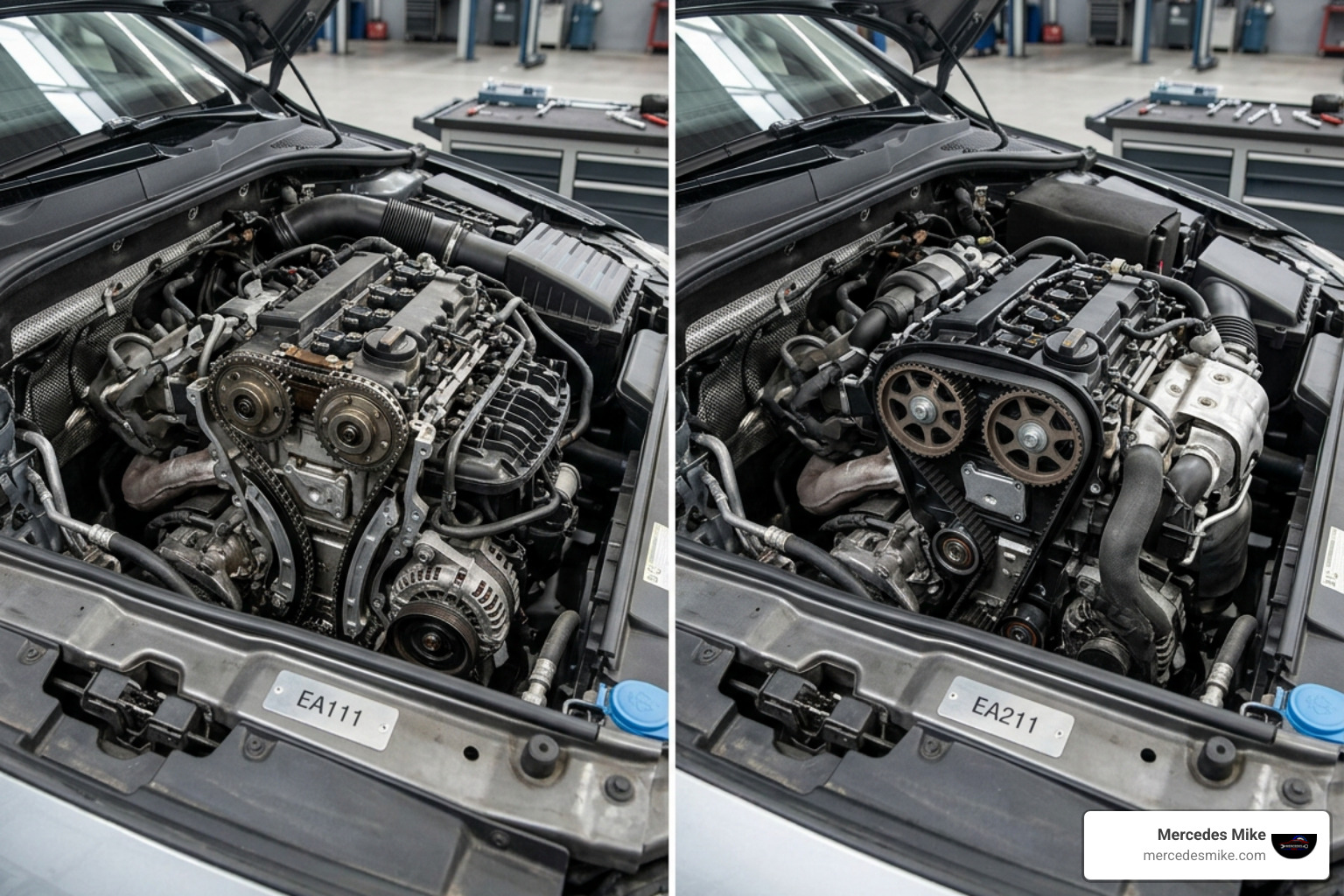
Knowing your exact setup ensures you follow the appropriate service guide. For owners with belt-driven configurations, consulting a detailed Haynes Manuals UK timing guide provides accurate step-by-step procedures for belt tensioning and water pump replacements.
EA111 vs EA211 1.4 TFSI Engines
The early first-generation Audi A1 (built from 2010 through roughly 2013–2014) features the EA111 1.4 TFSI petrol engine (such as the CAXA engine code). This unit uses a chain-driven camshaft system.
Beginning around late 2013 and widespread by 2015, Audi phased in the updated EA211 1.4 TFSI engine family. The EA211 eliminated the internal chain in favor of a toothed rubber timing belt designed for lower friction and reduced weight. If your A1 has an EA211 engine, you must track rubber belt aging intervals rather than chain stretch; to budget accordingly, review our breakdown on the cost to replace timing belt.
1.2 TFSI, 1.8 TFSI, and TDI Differences
1.2 TFSI (EA111): Employs an internal metal timing chain and hydraulic tensioner. Like the 1.4 EA111, it is prone to cold-start rattle if oil changes have been neglected.
1.8 TFSI (EA888 Gen 3): Found in higher-output A1 variants, this dual-overhead-cam engine uses a primary timing chain, a balance shaft chain, and an oil pump drive chain. Enthusiasts often fit uprated EA888 timing components featuring reinforced link plates and revised anti-skip tensioners to eliminate slack under load.
1.6 TDI and 2.0 TDI: All diesel Audi A1 models utilize heavy-duty rubber timing belts paired with water pumps, requiring regular replacement based on strict mileage and year thresholds.
Warning Signs and When to Replace an Audi A1 Timing Chain
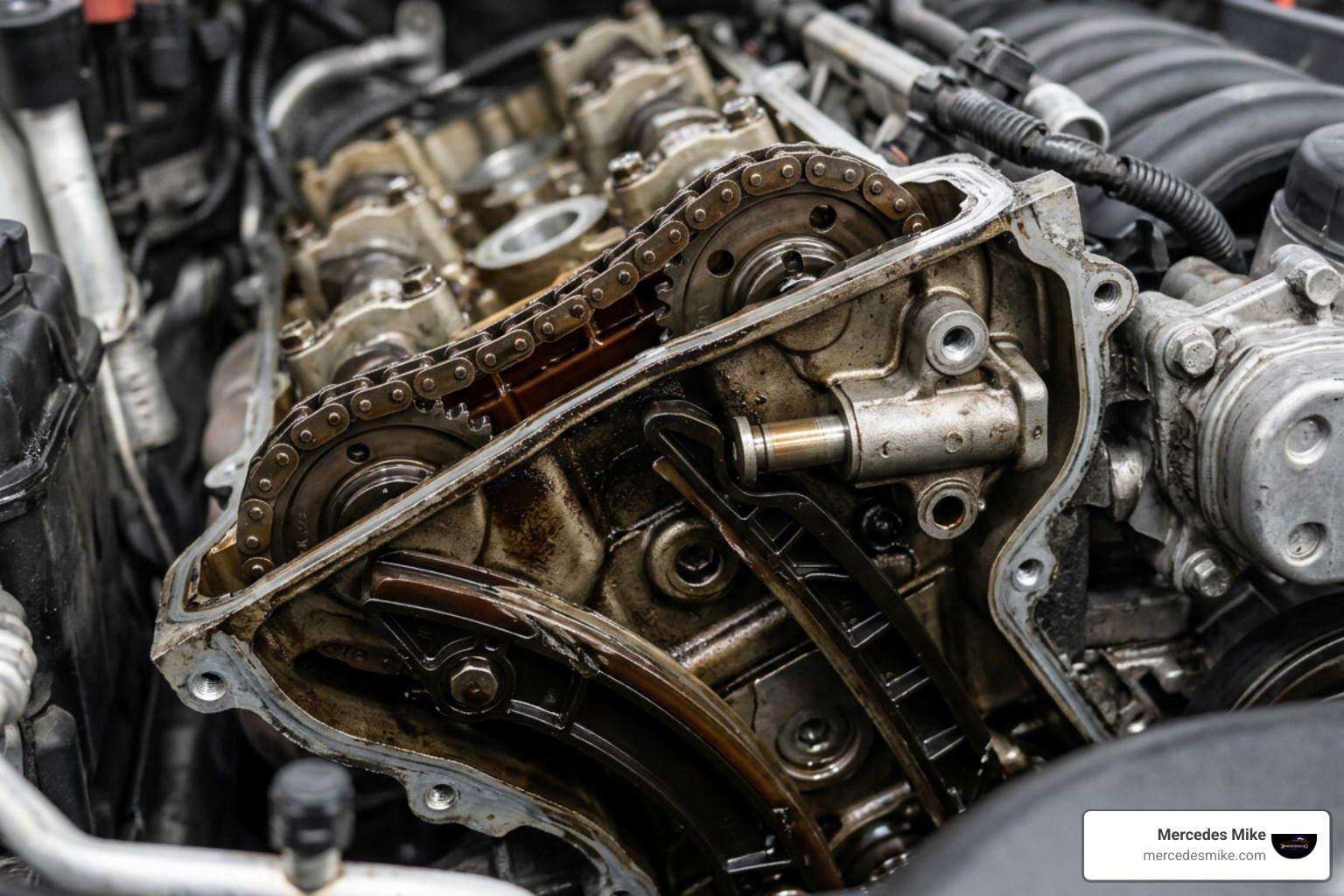
Unlike rubber timing belts that can snap without prior symptoms, metal timing chains typically exhibit progressive mechanical warning signs as they stretch and wear out guide rails.
Cold-Start Rattle and Diagnostic Trouble Codes
The most telltale sign of timing chain trouble is a distinct metallic rattling or slapping sound lasting 1 to 3 seconds immediately after a cold startup.
When your A1 sits parked overnight, engine oil drains out of the hydraulic chain tensioner. Upon startup, the tensioner relies on immediate oil pressure to push the guide rail firmly against the chain. If the chain has stretched or the tensioner's internal check valve has degraded, the chain slaps against the plastic casing until sufficient oil pressure builds.
As wear advances, the camshaft phase angle drifts out of synchronization with the crankshaft. This triggers the Check Engine Light and logs standard OBD-II trouble codes:
P0016: Camshaft/Crankshaft Correlation (Bank 1 Sensor A)
P0017: Camshaft/Crankshaft Correlation (Bank 1 Sensor B)
P0011: Camshaft Timing Over-Advanced or System Performance
Replacement Mileage Intervals and Driving Risks
While automotive manufacturers occasionally market timing chains as "lifetime" parts, physical friction, oil shear, and thermal cycles make them wear items. On Audi A1 TFSI engines, timing chains commonly require replacement between 60,000 and 100,000 miles.
To maximize timing chain longevity, perform synthetic oil and filter changes every 5,000 to 6,000 miles (or annually) rather than adhering to extended 15,000-mile schedules. Clean oil prevents sludge buildup in the tensioner's micro-screen feed. If your vehicle is approaching major milestones, factor chain checks into your overall 100,000 mile maintenance routine to prevent catastrophic engine failure.
Is It Worth Replacing the Chain or Facing Engine Failure?
When facing a repair bill exceeding $1,000, many owners wonder whether investing in a timing chain replacement makes financial sense on an older Audi A1.
Interference Engine Damage Risks
Every modern Audi TFSI engine uses an interference design. In this layout, the clearance between the open intake/exhaust valves and the top of the rising piston is razor-thin. Synchronization is preserved entirely by the timing chain.
If a stretched chain skips two or more teeth on the cam sprocket—or if a plastic guide rail shatters—the engine falls out of time instantly. The pistons strike the valves at thousands of revolutions per minute, bending valves, puncturing pistons, and scoring cylinder bores.
When catastrophic timing failure occurs, a simple timing chain service escalates into a full cylinder head rebuild or engine swap. At that stage, you must evaluate the complete audi a1 engine replacement cost, which typically ranges between $3,500 and $6,500+—frequently exceeding the market value of the car. Investing in preventative chain service protects your vehicle's resale value and avoids total mechanical write-offs.
Complete Timing Kit Components to Install
To prevent recurring teardown labor, a proper timing service should always include a full overhaul kit:
Replacing all adjacent wear components at once aligns with standard factory scheduled maintenance practices and guarantees the timing assembly lasts for another 80,000+ miles.
Frequently Asked Questions About Audi A1 Timing Chains
Can I drive my Audi A1 with a rattling timing chain?
No. A rattling timing chain indicates that the hydraulic tensioner has reached the limit of its mechanical stroke or the chain has developed severe slack. Continued driving exposes the engine to sudden tooth skipping during hard acceleration or startup, leading to catastrophic valve-to-piston contact. If you hear continuous or loud cold-start rattling, have the vehicle towed to a repair facility rather than driven.
How long does an Audi A1 timing chain replacement take?
A professional timing chain replacement on an Audi A1 typically takes 1 to 3 shop days (representing 6 to 12 billable labor hours). The duration depends on whether auxiliary components like cooling lines, engine mounts, or front fascia panels require removal to gain clear physical access to the timing cover.
What is included in a complete Audi A1 timing chain kit?
A comprehensive Audi A1 timing chain kit includes the main camshaft timing chain, primary hydraulic tensioner, elongated plastic guide rails, tensioning arm, lower crankshaft timing gear, timing cover replacement gaskets, crankshaft oil seal, and single-use stretch bolts for the camshaft adjusters.
Conclusion
A timing chain service on an Audi A1 is a precision mechanical repair where labor accounts for the largest portion of the total cost. By diagnosing cold-start rattles early, checking diagnostic trouble codes like P0016, and confirming whether your 1.4 TFSI uses an EA111 chain or an EA211 belt, you can budget effectively and avoid multi-thousand-dollar engine rebuilds.
At Mercedes Mike, our decades-experienced technicians use the latest specialized locking tools, diagnostic computers, and OEM-spec components to service German vehicles with factory-level precision across South Florida, including Pompano Beach and Deerfield Beach FL. Whether you need routine timing inspections or full mechanical overhauls, explore our expert German auto repair services to schedule your engine diagnostic today.