
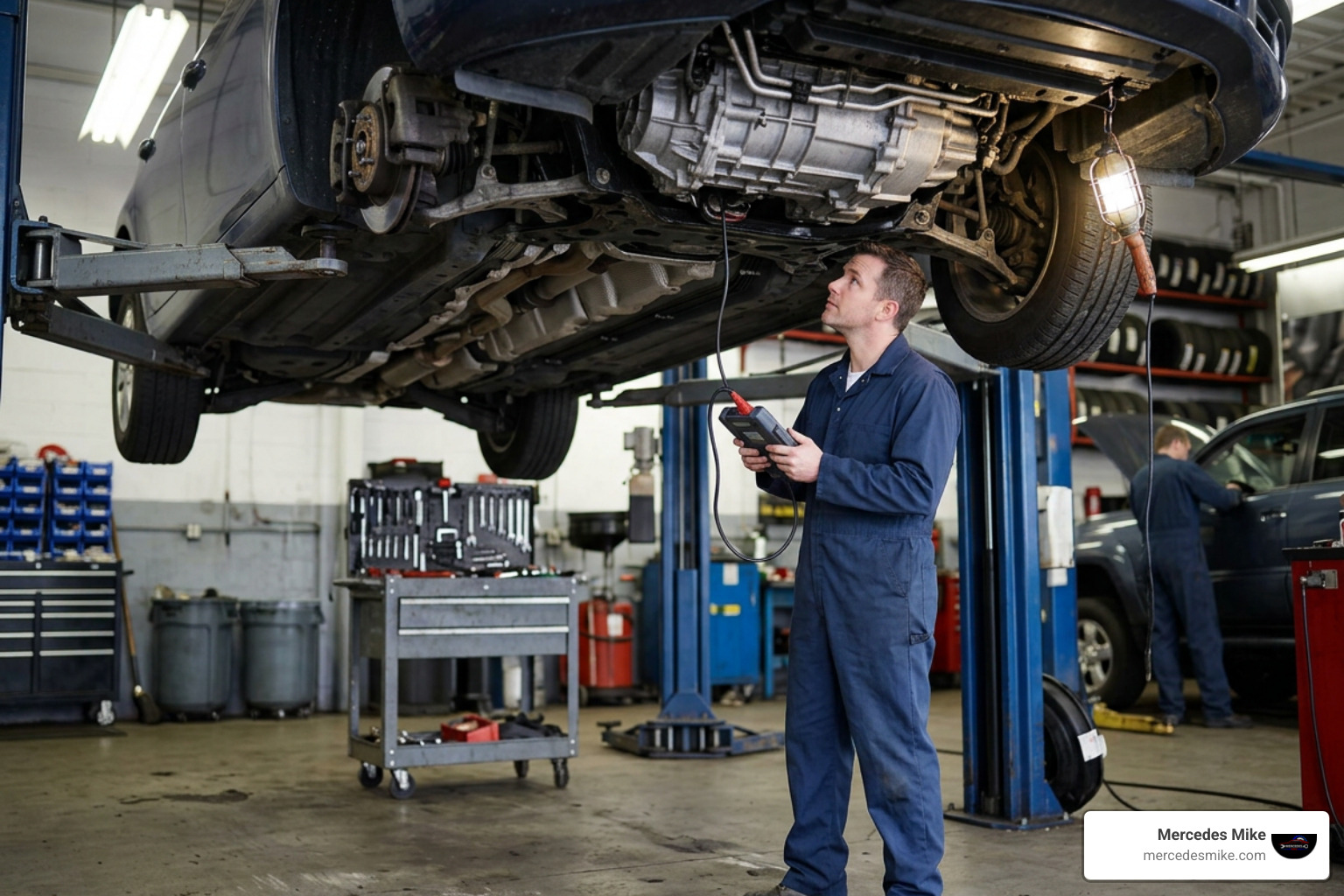
The Best Mercedes Gear Repair and Drivetrain Fixes in Town
Mercedes Gear Repair Starts With the Right Diagnosis
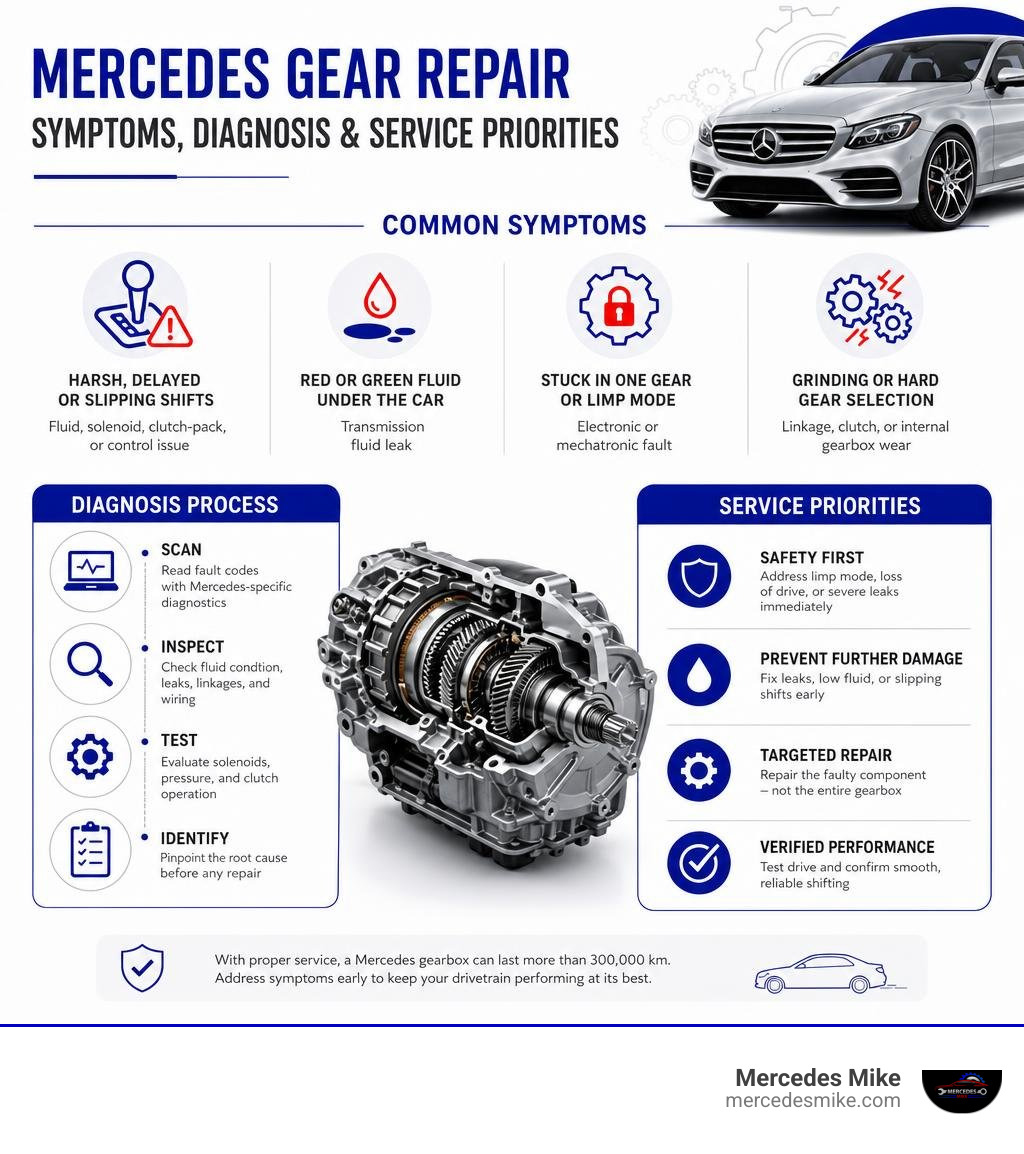
Mercedes gear repair should begin with a specialist diagnosis, not an automatic transmission replacement quote. If your Mercedes hesitates, jerks between gears, leaks red or green fluid, makes grinding noises, or enters limp mode, arrange an inspection promptly. Many faults can be repaired at the component level, including fluid leaks, solenoids, shift linkages, valve-body parts, and mechatronic controls.
What you notice What it may mean Best next step Delayed, harsh, or slipping shifts Fluid, solenoid, clutch-pack, or control issue Schedule diagnostics soon Red or green fluid under the car Transmission fluid leak Avoid extended driving and have it inspected Stuck in one gear or limp mode Electronic or mechatronic fault Get a Mercedes-specific computer scan Grinding or hard gear selection Linkage, clutch, or internal gearbox wear Have a drivetrain specialist assess it
Mercedes gearboxes are complex systems of mechanical parts, hydraulic pressure, fluid, and electronic controls. With proper service, a Mercedes gearbox can last more than 300,000 km. But ignored fluid problems and shifting faults can turn a focused repair into a much larger rebuild.
I am Mike Ibrahim, and the sections ahead explain what your Mercedes is telling you before you commit to a repair plan.
Common Symptoms and Root Causes of Transmission Failure
When your Mercedes starts behaving strangely during gear shifts, it rarely happens without warning. Modern German engineering equips these vehicles with sophisticated adaptive algorithms, meaning the car's computer will try to compensate for internal wear long before a total breakdown occurs. However, once physical symptoms become noticeable to the driver, immediate attention is required to avoid permanent drivetrain damage.
Whether you drive an elegant C-Class sedan, a high-performance AMG model, or a heavy-duty Sprinter, understanding early warning signs is the best defense against catastrophic failure. Early intervention often means the difference between a simple electronic component fix and an expensive full overhaul. To help distinguish between different drive system setups, here is how failure symptoms typically present across transmission types:
Symptom Category Manual Gearbox & Clutch Automatic Transmission (5G, 7G, 9G-Tronic) Shifting Response Hard gear engagement, pedal resistance, clutch slipping Delayed gear engagement, sudden revving without acceleration Acoustic Warning Grinding or crunching noise when pressing clutch or changing gears Whining, humming, or heavy clunking during upshifts/downshifts System Behavior Gear popping out into neutral under load Vehicle entering "Limp Home Mode" (locked in 3rd gear) Fluid Appearance Dark, burnt-smelling gear oil from manual case Red or green hydraulic fluid pooling under front/mid chassis
Recognizing these symptoms early allows our team to perform targeted transmission repair before hydraulic or gear tooth destruction takes place.
Identifying Shifting Jerks and Limp Mode
One of the most frequent complaints we encounter from Mercedes owners is harsh shifting or sudden jerking when the transmission changes gears. This jerky behavior typically stems from degraded hydraulic fluid, worn internal clutch packs, sticking shift solenoids, or electronic control module degradation.
Inside 7-speed (722.9 / 7G-Tronic) and 9-speed (9G-Tronic) gearboxes, hydraulic pressure is regulated by precision solenoids mounted directly to the valve body. When metal debris or burnt oil clogs these solenoids, hydraulic pressure spikes or drops unexpectedly, causing the transmission to slam into the next gear.
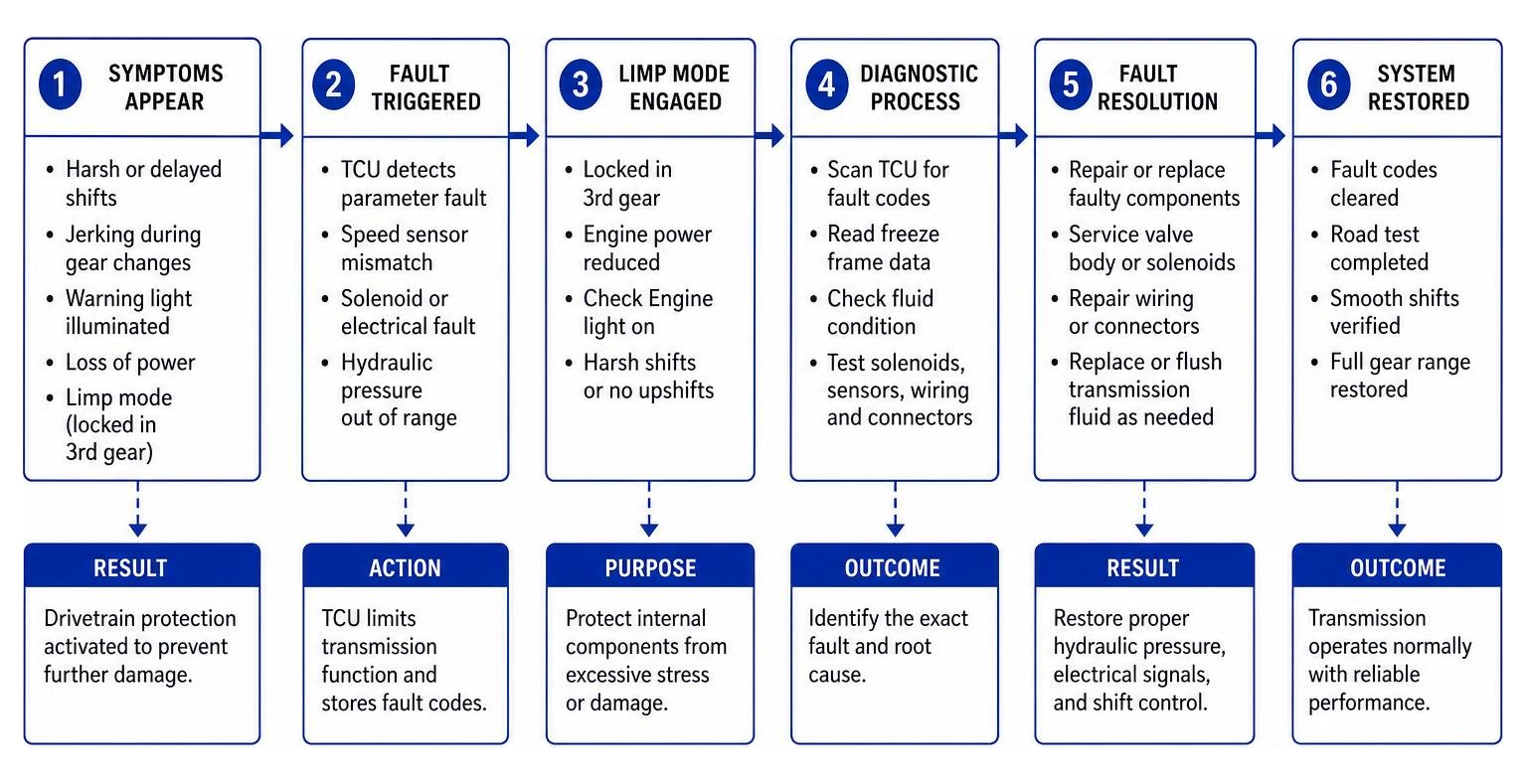
If the transmission electronic control unit (TCU or VGS conductor plate) detects a critical parameter variance—such as speed sensor mismatch or electrical short circuit—it triggers Emergency Limp Home Mode. When your vehicle enters limp mode:
The transmission locks itself into a single gear (usually 3rd gear) to prevent further mechanical grinding.
Engine power is reduced to safeguard internal planetary gear sets.
The "Check Engine" light or drivetrain warning appears on your instrument cluster.
Diagnostic trouble codes (DTCs) are logged in the TCU memory for specialist computer extraction.
Transmission Fluid Leaks and Maintenance
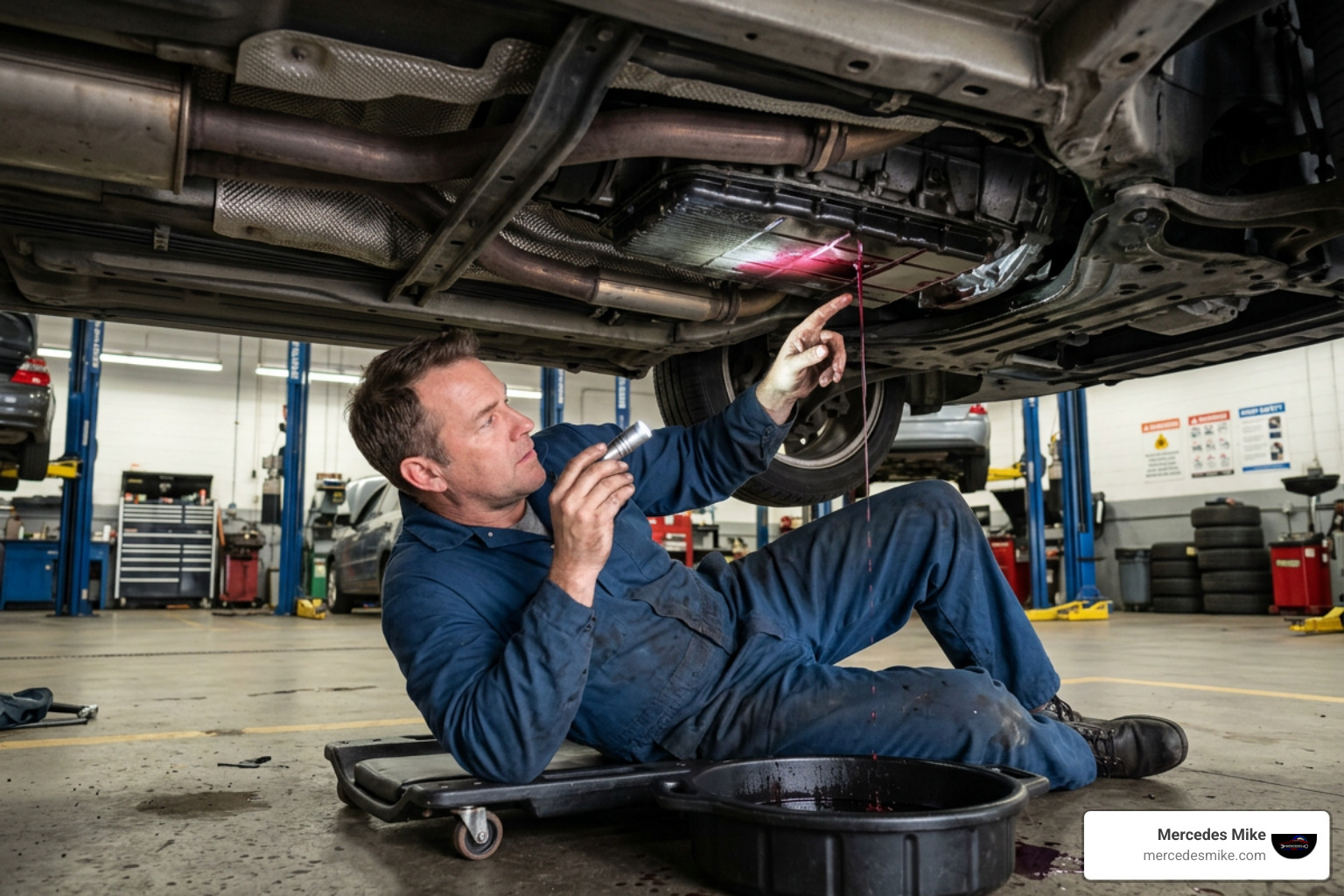
Transmission fluid in a Mercedes is not just a lubricant; it serves as hydraulic fluid to push valve body spools and as a coolant to pull thermal energy away from gear sets and clutch plates. Mercedes-Benz specifically colors its transmission fluids red or green to differentiate them from dark brown engine oil or clear brake fluid.
Up to 90% of all automatic transmission failures in luxury European vehicles are directly linked to poor fluid condition or fluid starvation. When fluid breaks down over time, it loses its viscosity and anti-friction additives.
To maintain peak shifting performance:
Standard Factory Recommendation: Change transmission fluid and filter every 40,000 miles or 5 years.
Extreme Thermal Conditions: In warmer climates like South Florida, high ambient heat accelerates fluid breakdown. Replacing fluid closer to every 30,000 miles provides superior protection against premature valve body and clutch wear.
Fuel Efficiency Impact: Keeping fresh fluid in a clean gearbox optimizes hydraulic efficiency, reducing engine strain and improving fuel economy by 5% to 10%.
Following a strict maintenance plan aligned with your overall mercedes service schedule ensures your transmission fluid stays clean and your hydraulic valves operate smoothly.
Comprehensive Diagnostics and Options for Mercedes Gear Repair
Accurate diagnosis is the cornerstone of effective Mercedes gear repair. Because modern Mercedes gearboxes rely heavily on integrated electronics, attempting to diagnose a gear issue purely by mechanical inspection is like trying to solve a puzzle with half the pieces missing.
At our facility in Pompano Beach, our technicians perform multi-stage digital scans using dealer-level diagnostic equipment. These scans analyze over 50 specific transmission fault codes across 5G-Tronic (722.6), 7G-Tronic (722.9), and 9G-Tronic systems. Before jumping to expensive replacement options, we evaluate whether component-level repair can restore complete functionality, helping you understand how much to repair mercedes transmission setups without unnecessary expenses.
Electronic Mechatronics vs Physical Mercedes Gear Repair
In modern Mercedes automatics, the electronic brain and hydraulic muscles are combined into a single assembly known as the mechatronic unit (comprising the valve body and the VGS conductor plate).

When shifting issues arise, distinguishing between an electronic fault and mechanical gear wear is essential:
Electronic & Mechatronic Issues: Faulty speed sensors on the 722.9 conductor plate often cause shifting hesitations or limp mode. In many cases, the original conductor plate can be serviced or remanufactured. Opting for targeted conductor plate repair eliminates the need for complex, high-cost SCN coding at a dealership while fully restoring smooth electronic shift execution.
Physical Mechanical Issues: If internal planetary gear sets, torque converter lock-up clutches, or mechanical bearings have suffered severe physical wear, electronic repairs alone will not suffice. In those instances, replacing the torque converter and renewing friction plates during an overhaul restores structural integrity.
Mechanical Linkages and Mercedes Gear Repair Kits
Not every gear selection issue originates deep inside the transmission casing. Quite often, the problem is situated directly in the gear shift selector mechanism inside the cabin or along the external shift linkage.
Over time, plastic and composite bushings in the selector assembly loosen, wear out, or snap. This leads to a loose gear lever, difficulty engaging Park or Reverse, or a car that refuses to start because the safety switch cannot confirm the lever position.
Rather than purchasing an entirely new gear shifter unit, specialized repair kits provide an efficient, factory-spec solution:
For selector linkage wobbles, installing a dedicated Gear Selector Lever Repair Kit - Mercedes | 6552680074-FEB – UroTuning restores firm, precise gear engagement.
On late-model vehicles equipped with electronic shift actuators, using a high-precision 236-906-16-01 - Genuine Mercedes-Benz REPAIR KIT, GEAR MOTOR fixes motor drive actuation failures using genuine OEM parts.
Understanding Mercedes Transmission Repair and Replacement Costs
Understanding repair economics helps every Mercedes owner make confident decisions. Transmission costs vary significantly based on vehicle model, engine pairing, labor rates, and whether the service involves targeted component replacement or a complete transmission build.
A standard maintenance service or minor leak fix is a small investment that protects against catastrophic failure. In contrast, ignoring warning signs until mechanical gears grind themselves to pieces leads to full transmission replacement, where the automatic transmission replacement cost reflects extensive labor and complete unit renewal.
Minor Component Fixes vs Complete Transmission Rebuilds
The financial difference between proactive component repair and major rebuilds is substantial:
Minor Component Fixes: Resolving fluid leaks, replacing shift solenoids, changing pan gaskets, or renewing external linkage kits typically requires 1 to 2 days of turnaround time.
Complete Transmission Rebuilds: A complete gearbox overhaul requires removing the unit, dismantling all internal planetary gear sets, replacing clutch packs, renewing torque converters, and reassembling the casing. This process usually takes 3 to 5 business days.
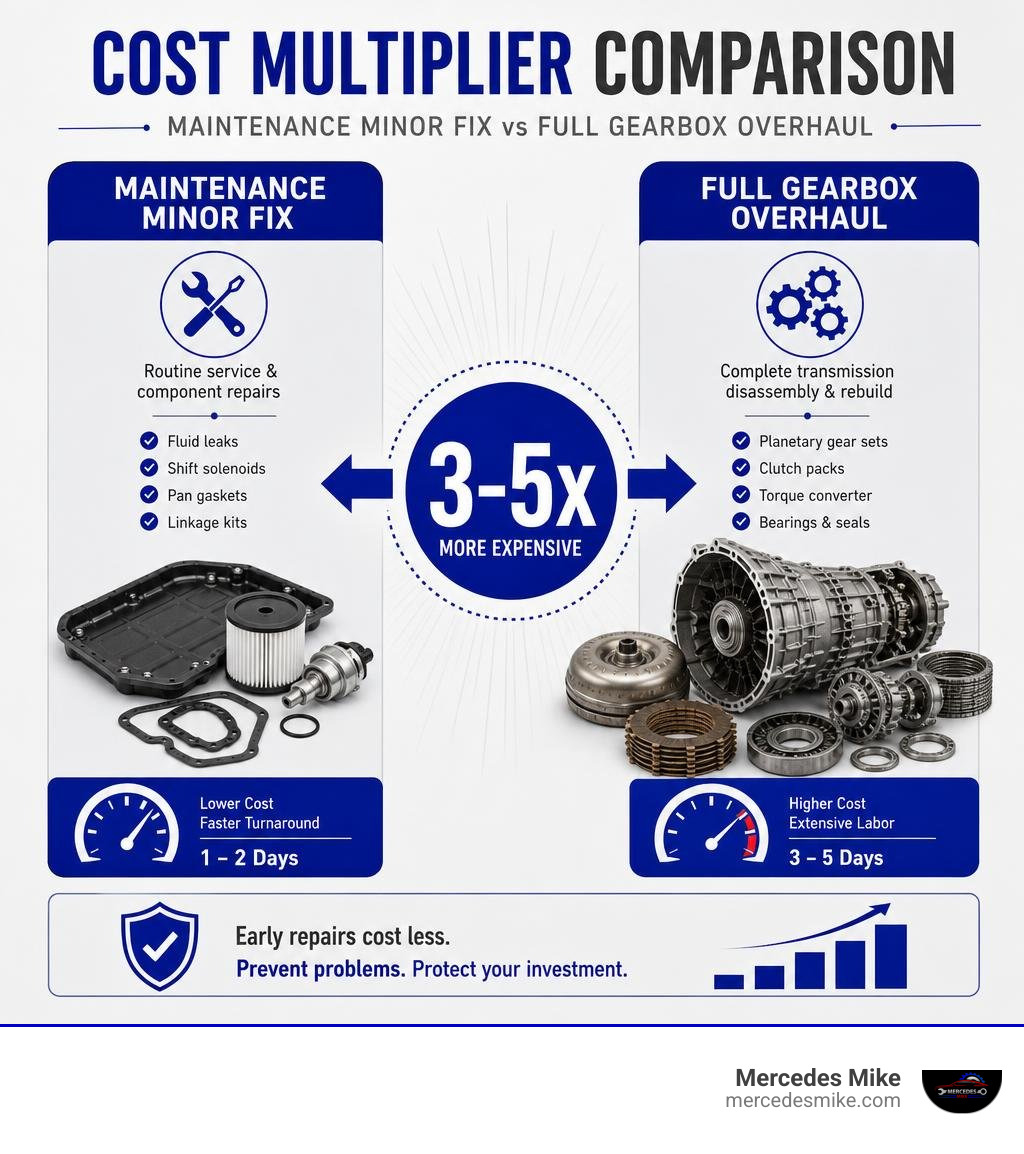
A full rebuild can cost 3 to 5 times more than routine service and component repairs. Evaluating your options through our comprehensive average cost to replace transmission breakdown and updated transmission replacement guide 2026 highlights why early diagnostic checks save thousands over the life of your vehicle.
Insurance Coverage and Warranty Protection
A common question car owners ask is whether auto insurance will cover Mercedes gear repair.
Standard comprehensive and collision auto insurance policies do not cover mechanical wear and tear, fluid degradation, or internal electrical module failure. Insurance only covers transmission damage if it occurred directly as a result of a covered accident or collision.
When seeking long-term peace of mind for out-of-pocket repairs:
Choose repairs backed by robust labor and parts warranties (such as 2-year / 24,000-mile warranties on major overhauls).
Partner with a certified mercedes benz mechanic who utilizes advanced factory diagnostics, high-grade fluids, and OEM-spec components.
Independent specialists offer dealership-level expertise using modern diagnostic equipment while providing transparent pricing and personalized customer care.
Frequently Asked Questions About Mercedes Drivetrain Maintenance
Can a Mercedes transmission be repaired instead of fully replaced?
Yes, in the vast majority of cases, a Mercedes transmission can be successfully repaired without replacing the entire assembly. Component-level solutions—such as valve body reconditioning, solenoid replacement, VGS conductor plate service, seal replacement, and torque converter rebuilding—resolve most shifting complaints. Full replacement is only necessary if internal hard parts, such as planetary gear carriers or the main outer casing, have suffered structural failure.
Is it safe to drive with a leaking or slipping Mercedes transmission?
No, it is not safe to drive with a leaking or slipping transmission. Operating a vehicle with low fluid causes rapid friction buildup, thermal overheating, and severe clutch plate burning. Slipping gear teeth can suddenly disengage while driving on highways, resulting in an unexpected loss of acceleration that puts you and your passengers at risk. If you notice fluid spots under your vehicle, address the leak immediately.
How often should Mercedes transmission fluid be changed?
Mercedes-Benz generally recommends changing transmission fluid and filters every 40,000 miles or 5 years. However, under high operating temperatures, urban stop-and-go driving, or frequent heavy loading, changing the fluid every 30,000 miles provides optimal protection against fluid degradation. Aligning this task with your overall 100 000 mile maintenance milestones ensures your drivetrain remains smooth and responsive for years to come.
Conclusion
A well-maintained Mercedes gearbox is engineered to exceed 300,000 km of smooth performance, delivering precise power and optimizing fuel efficiency by 5% to 10%. By addressing shifting hesitations, fluid leaks, and electronic fault codes early, you protect your vehicle's mechanical integrity and avoid high-cost overhauls.
At Mercedes Mike in Pompano Beach, our experienced technicians specialize in master-level German automotive diagnostics, preventative fluid services, and targeted Mercedes gear repair. Whether your vehicle needs a quick shift linkage kit or advanced mechatronic reconditioning, we deliver top-tier craftsmanship tailored to South Florida drivers.
To keep your car running at peak factory performance, trust our team for honest, high-precision independent mercedes repair. Schedule Expert Mercedes Drivetrain Repair with us today and experience smooth shifting on every drive!