

How to Get Your Audi Gear Repair Done Without Losing Your Mind
When Your Audi Starts Shifting Wrong, It's Time to Pay Attention
Audi gear repair is one of the most common — and most stressful — service issues luxury car owners face. A strange shudder when changing gears, a burning smell on the highway, or a warning light that suddenly appears can all point to a transmission problem that won't fix itself.
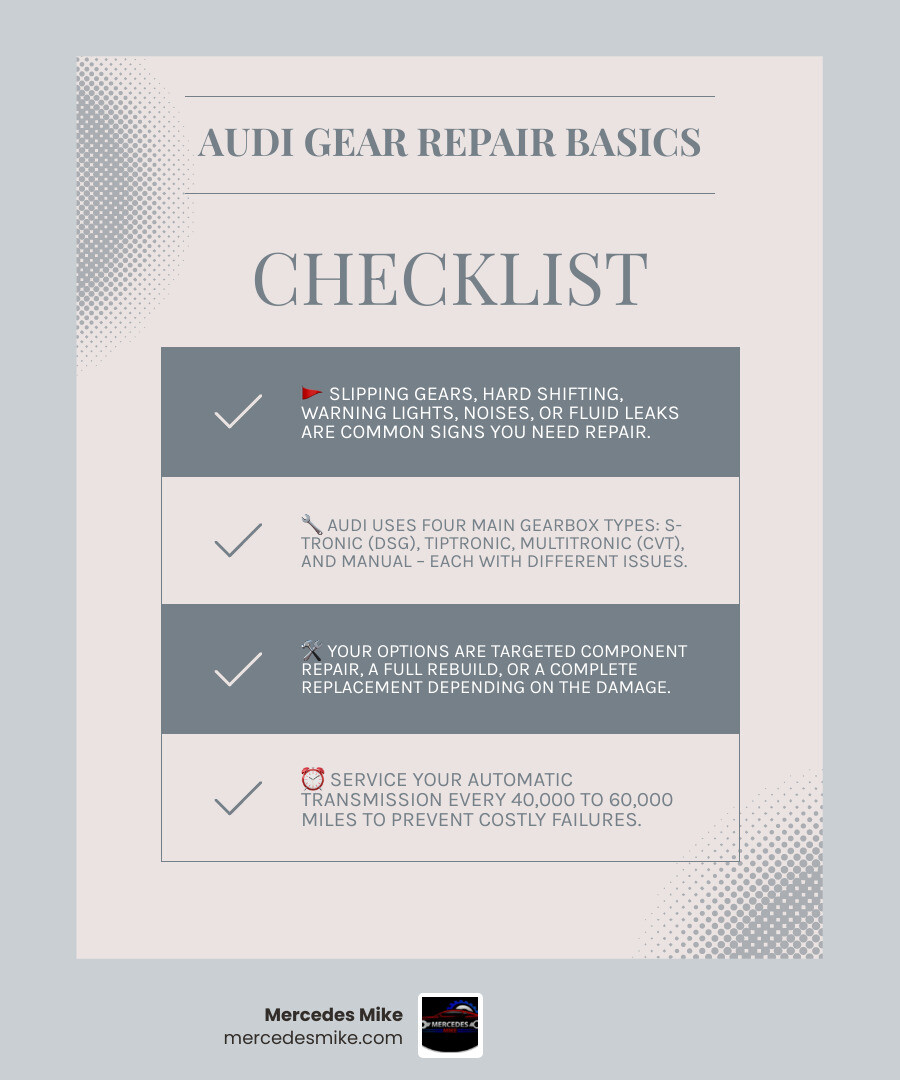
Here's a quick overview of what you need to know:
Common signs you need repair: slipping gears, hard or delayed shifting, warning lights, unusual noises, fluid leaks
Main types of Audi gearboxes: S-Tronic (DSG), Tiptronic, Multitronic (CVT), and manual
Your repair options: targeted component repair, full rebuild, or complete replacement
Typical service interval: every 40,000 to 60,000 miles for automatic transmissions
Cost range: from a few hundred dollars for a fluid flush to several thousand for a rebuild or replacement
Who to see: a certified specialist with Audi-specific diagnostic tools, not a general mechanic
Audi transmissions are sophisticated systems. The DSG dual-clutch gearbox alone combines two manual gearboxes inside a single housing. When something goes wrong, the damage can escalate fast — and so can the repair bill.
The good news? Catching the problem early almost always means a simpler, cheaper fix.
Understanding Your Transmission: Types of Audi Gearboxes
To understand why your Audi is acting up, we first need to look at what kind of gearbox is sitting under your floorboards. Audi has engineered several distinct transmission systems over the years, each designed for a different driving feel. Consequently, their maintenance requirements and common failure points differ wildly.
1. S-Tronic (Direct-Shift Gearbox / DSG)
The S-Tronic is Audi’s famous dual-clutch transmission. Structurally, it consists of two manual gearboxes and two clutches combined in a single housing. One clutch controls the odd gears, while the other controls the even gears. This allows the transmission to pre-select the next gear, facilitating near-instantaneous shifting.
While it offers incredible performance, the DSG is a highly complex mechanical and electronic system. It relies heavily on a specialized electro-hydraulic control unit known as the mechatronic unit. Because of this complexity, the DSG requires precise, specialized maintenance to avoid costly failures.
2. Tiptronic
The Tiptronic is a more traditional automatic transmission that utilizes a torque converter. It is highly durable and designed to handle high-torque engines, which is why you will often find it in larger Audi SUVs and high-performance sedans. While it is generally more forgiving than the DSG, it still features an array of electronic solenoids and a complex valve body that can wear out over time.
3. Multitronic (CVT)
The Multitronic is Audi’s continuously variable transmission (CVT). Instead of traditional gears, it uses a heavy-duty chain running on variable-width pulleys to provide an infinite number of gear ratios. This results in incredibly smooth acceleration and excellent fuel economy. However, CVTs are highly sensitive to fluid degradation and require strict adherence to service schedules to prevent the chain from slipping and damaging the pulleys.
4. Manual Transmissions
For the purists, Audi's manual gearboxes are legendary for their crisp feel. They have roughly half the moving parts of an automatic transmission, making them simpler and less expensive to repair. However, they are still prone to standard wear-and-tear issues like worn clutch discs, failing pressure plates, and degraded gear synchronizers (synchros).
No matter which system your vehicle uses, regular maintenance is the key to preventing catastrophic failure. To keep your system running smoothly, make sure to schedule regular Audi Gearbox Service with a specialist who understands these unique German designs.

Common Signs You Need Audi Gear Repair
Your Audi is a highly communicative machine. When something begins to fail within the drivetrain, it will let you know. Ignoring these early warning signs is the fastest way to turn a simple sensor replacement into a multi-thousand-dollar transmission overhaul.
Keep an eye (and an ear) out for these common symptoms:
Slipping Gears: If your engine revs up but your car doesn't accelerate, or if the transmission unexpectedly drops out of gear while you are driving, your clutch packs or torque converter are slipping.
Hard or Delayed Shifting: If you experience a harsh "clunk" or "jerk" when shifting from Park to Drive, or if the car hesitates before executing a gear change, there is likely a hydraulic pressure issue.
Unusual Noises: Whining, humming, grinding, or clunking sounds specifically when accelerating or shifting gears are clear indicators of mechanical wear. Whining often points to worn bearings or a failing differential, while grinding in a manual indicates worn synchros.
Fluid Leaks: Transmission fluid in an Audi is typically dyed red or green to distinguish it from amber engine oil or blue coolant. If you spot red or green fluid pooling on your driveway, you have a leak that needs immediate attention.
Dashboard Warning Lights: Modern Audis have sophisticated onboard diagnostics. If your Malfunction Indicator Light (MIL) comes on, or if you see a transmission-specific warning light, your car’s computer has flagged an issue.
For DSG owners, specific diagnostic trouble codes like P173500 and P173600 are classic indicators of clutch position sensor faults or mechatronic unit failures. If you notice any of these signs, it is critical to seek professional Transmission Repair immediately before secondary damage occurs.
Why Transmission Fluid Matters for Your Audi Gear Repair
Many modern car manufacturers claim their automatic transmissions are filled with "lifetime" fluid. In the real world — especially under the hot, humid driving conditions of South Florida — there is no such thing as lifetime fluid.
Transmission fluid serves a dual purpose:
Lubrication: It coats the spinning gears, bearings, and shafts to prevent metal-on-metal friction and wear.
Cooling: It carries heat away from the delicate electronic solenoids and friction clutches, dissipating it through the transmission cooler.
Over time, extreme heat and pressure break down the fluid's chemical properties, reducing its viscosity and lubricating ability. Furthermore, as clutches naturally wear, microscopic friction material and metal shavings contaminate the fluid. This contaminated fluid acts like sandpaper, wearing down internal valves and clogging the tiny passages inside the mechatronic unit or valve body.
To keep your vehicle running like new, refer to the Audi A4 Service Schedule (or the specific maintenance guide for your model) to ensure you are changing your transmission fluid and filters at the correct intervals.
Can You Drive with a Faulty Gearbox Before Getting an Audi Gear Repair?
We get this question all the time: "My gearbox is acting a little strange, but can I keep driving it until my next service appointment?"
Our honest advice? No.
Continuing to drive your Audi with a known transmission issue is highly discouraged. What starts as a simple, inexpensive repair — like replacing a leaking pan gasket or a faulty electronic solenoid — can quickly escalate. If you drive with low fluid levels, the internal components will overheat and friction clutches will burn out, leaving you with no choice but to replace the entire transmission.
Furthermore, a failing gearbox presents real safety risks. If your transmission suddenly drops into neutral or loses power while you are merging onto I-95 or driving down Federal Highway, you could easily find yourself in a dangerous collision. If your gearbox is acting strange, play it safe and contact a professional Auto Transmission Repair Near Me center to have your vehicle properly diagnosed.
Repair, Rebuild, or Replace: What Are Your Options?
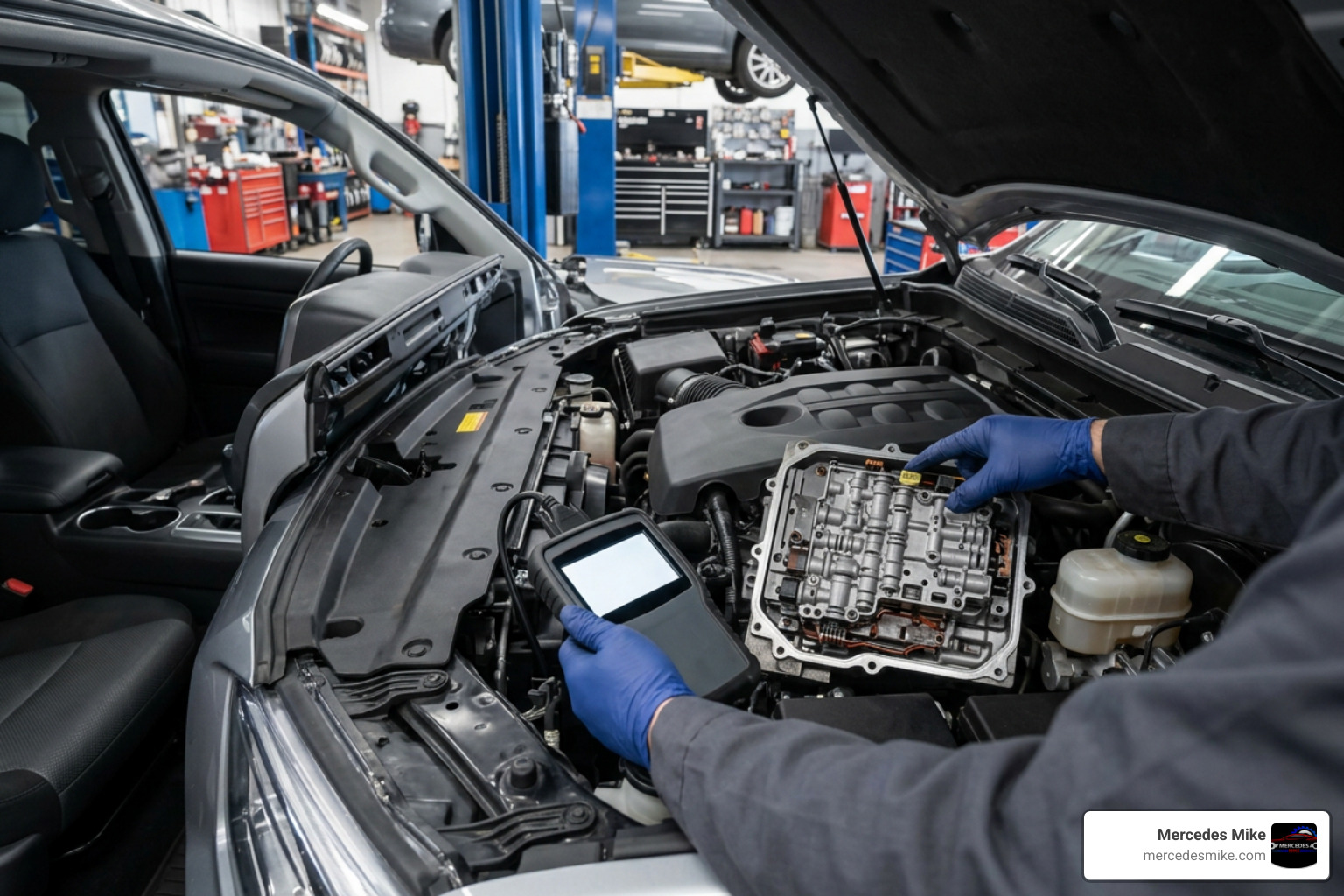
If your technician confirms that your gearbox has internal damage, you will generally face three paths forward. The right choice depends on the specific failure, the age of your vehicle, and your budget.
Service Option What It Involves Best For Pros Cons Component-Level Repair Replacing only the specific failed part (e.g., a solenoid, sensor, or seal) without removing the entire transmission. Minor leaks, electrical faults, or mechatronic failures. Most affordable; fast turnaround times. Does not address wear on other internal parts. Gearbox Rebuild Removing the transmission, dismantling it completely, cleaning all parts, and replacing all worn components (clutches, bands, seals) before reassembly. Worn-out clutch packs or internal physical damage where the main gear castings are still intact. Restores transmission to like-new condition at a lower cost than a brand-new unit. Labor-intensive; requires highly skilled technicians. Complete Replacement Removing the old transmission and installing a brand-new, rebuilt, or remanufactured unit. Severe mechanical failures, cracked cases, or when a rebuild is more expensive than a replacement unit. Maximizes long-term reliability; often comes with the best warranty. Most expensive option; can take longer to source parts.
In many cases, you don't need to replace the entire unit. For minor mechanical issues in the gear selector assembly, a targeted kit like the 1K0-498-970-A - Genuine Audi Gear Assembly Repair Kit can resolve shifting play without requiring a complete teardown. However, if your transmission has suffered catastrophic internal damage, you may need to prepare for the Automatic Transmission Replacement Cost.
Typical Costs and Warranty Coverage
Let's address the elephant in the room: how much is this going to cost?
Because Audi transmissions are highly engineered, repairs are generally more expensive than those for standard domestic vehicles.
Minor repairs (such as replacing a solenoid, fixing a minor fluid leak, or executing a fluid flush) typically run between $300 and $1,200.
A complete gearbox rebuild or remanufactured replacement can range from $3,500 to $7,500+, depending on your specific model and whether you have a complex Quattro all-wheel-drive system.
To help you understand the broader market, you can check out the Average Cost to Replace Transmission across various luxury brands.
When investing in a major repair, warranty coverage is essential for peace of mind. Reputable independent specialists typically offer warranties ranging from 12 months/12,000 miles to 3 years/36,000 miles on completed work. Always ask your service center about their specific warranty terms before authorizing any major repairs.
Dealership vs. Independent Specialist for Audi Gearbox Service
When your Audi needs transmission work, you have two primary options: take it to the local franchise dealership or visit an independent European auto repair specialist.
While the dealership has a shiny waiting room, they also have massive overhead costs that are passed directly to you in the form of incredibly high labor rates. Furthermore, dealership technicians are often trained to replace entire assemblies rather than performing component-level repairs. If your mechatronic unit fails, a dealership may quote you for a complete transmission replacement, whereas an independent specialist might be able to rebuild or replace just the mechatronic unit itself, saving you thousands of dollars.
By choosing an independent shop that specializes in German luxury brands, you get:
Highly specialized expertise: Technicians who spend all day, every day working specifically on Audi, BMW, Mercedes, and Porsche systems.
Advanced diagnostic tools: Factory-level software capable of performing precise programming and calibration updates on your transmission control module.
Significant savings: Labor rates that are often up to 50% cheaper than the main dealer.
Personalized customer service: Honest, transparent recommendations without the high-pressure sales tactics.
If you are located in South Florida, you can find world-class care at a specialized German Auto Repair Pompano Beach center. For local drivers, our highly trained team at our Auto Service Shop Pompano Beach location is ready to provide the expert diagnostics and repairs your vehicle deserves.
Frequently Asked Questions About Audi Transmission Care
To help you keep your vehicle running smoothly, we've compiled answers to some of the most common questions we hear from local Audi owners.
How often should I service my Audi's transmission?
For most automatic Audi models (including S-Tronic/DSG and Tiptronic systems), we recommend a comprehensive transmission service — which includes a fluid flush, new filter, and pan gasket replacement — every 40,000 to 60,000 miles (or roughly every 60,000 to 100,000 kilometers). If you drive your car aggressively or frequently sit in stop-and-go South Florida traffic, sticking to the shorter end of that interval is highly recommended. For manual drivers, while the gearbox is simpler, you should still keep an eye on clutch wear and prepare for an Audi A1 Clutch Replacement or similar clutch service as your mileage climbs.
What causes an Audi gearbox to fail?
The leading cause of transmission failure is a simple lack of regular maintenance. When fluid is left unchanged, it loses its ability to lubricate and cool, leading to internal overheating. Other common causes include fluid leaks (which starve the system of lubrication), aggressive driving habits, heavy towing, and manufacturer defects (such as electronic solder joints failing inside the mechatronic unit). For a complete breakdown of what to expect when a transmission reaches the end of its lifespan, check out our Transmission Replacement Guide 2026.
How do I know if my transmission fluid needs to be changed?
Because modern Audis feature sealed transmissions that lack a traditional under-hood dipstick, you cannot easily pull a stick to check the fluid level or color yourself. Instead, you must rely on:
Electronic sensors: Your dashboard will display a warning if the fluid temperature gets too high or if pressure drops.
Physical symptoms: Slipping gears, delayed shifts, or a distinct burning smell from under the car.
Professional inspection: A technician can raise the vehicle, safely access the transmission fill plug, and inspect the fluid's color and smell. (Fresh fluid is clear red or green; degraded fluid is dark brown or black and smells burnt).
While you are having your transmission checked, it is always a good idea to address other vital systems, such as scheduling an Audi Q5 AC Repair to keep your cabin cool during the hot summer months.
Conclusion
Getting your Audi gear repair done doesn't have to be a nightmare. By paying attention to the early warning signs of transmission wear — such as slipping gears, unusual whining noises, or fluid leaks — you can address minor issues before they turn into major mechanical failures.
At Mercedes Mike, we specialize in providing dealer-level maintenance and repair services for German luxury cars (including Mercedes, BMW, Audi, and Porsche) throughout Pompano Beach, Deerfield Beach, and the surrounding South Florida communities. Our shop is conveniently located at 882 ne 41st Court (just off N Dixie Hwy), making us easily accessible to drivers across the region.
With decades of hands-on experience, our master technicians utilize the latest factory-grade diagnostic tools and genuine OEM parts to ensure your vehicle is repaired correctly the first time — all at a fraction of the dealership's cost.
Don't wait for a minor shifting hesitation to turn into a complete transmission breakdown. Schedule your Audi service today and let our family take care of yours!