
Shift Happens: BMW Transmission Solenoid Replacement DIY
Symptoms of a Failing BMW Transmission Solenoid
BMW transmission solenoid replacement is the process of removing the transmission oil pan, lowering the valve body (or mechatronics unit), and swapping out the small electro-hydraulic valves that control gear changes inside your ZF automatic gearbox.
Here's what you need to know at a glance:
Symptoms: Erratic shifting, gear slippage at high RPMs, a "thump" when braking or selecting reverse, or an RPM flutter around 1,500 RPM
Applies to: ZF 5HP19 (5-speed) and ZF 6HP19/6HP26 (6-speed) transmissions found in BMW E46, E39, E60, E9x, and more
DIY cost: Roughly $400–$800 in parts (solenoid kit + fluid + filter), versus thousands for a full mechatronics replacement
Difficulty: Intermediate — time-consuming but very doable with basic tools and patience
Key steps: Drain fluid to remove oil pan to lower valve body to swap solenoids to refill fluid at correct temperature to reset transmission adaptations
The ZF 5HP19 and 6HP19 transmissions are found in a huge number of BMWs from the early 2000s onward — and many of those cars are still on the road today. When shifting starts to feel rough, delayed, or unpredictable, most owners assume the worst: a full transmission replacement. But in many cases, the culprit is simply a worn or clogged solenoid — a part that costs a fraction of a new gearbox.
The good news? You can fix this yourself. This guide walks you through the entire process, from diagnosis to the final fluid level check.
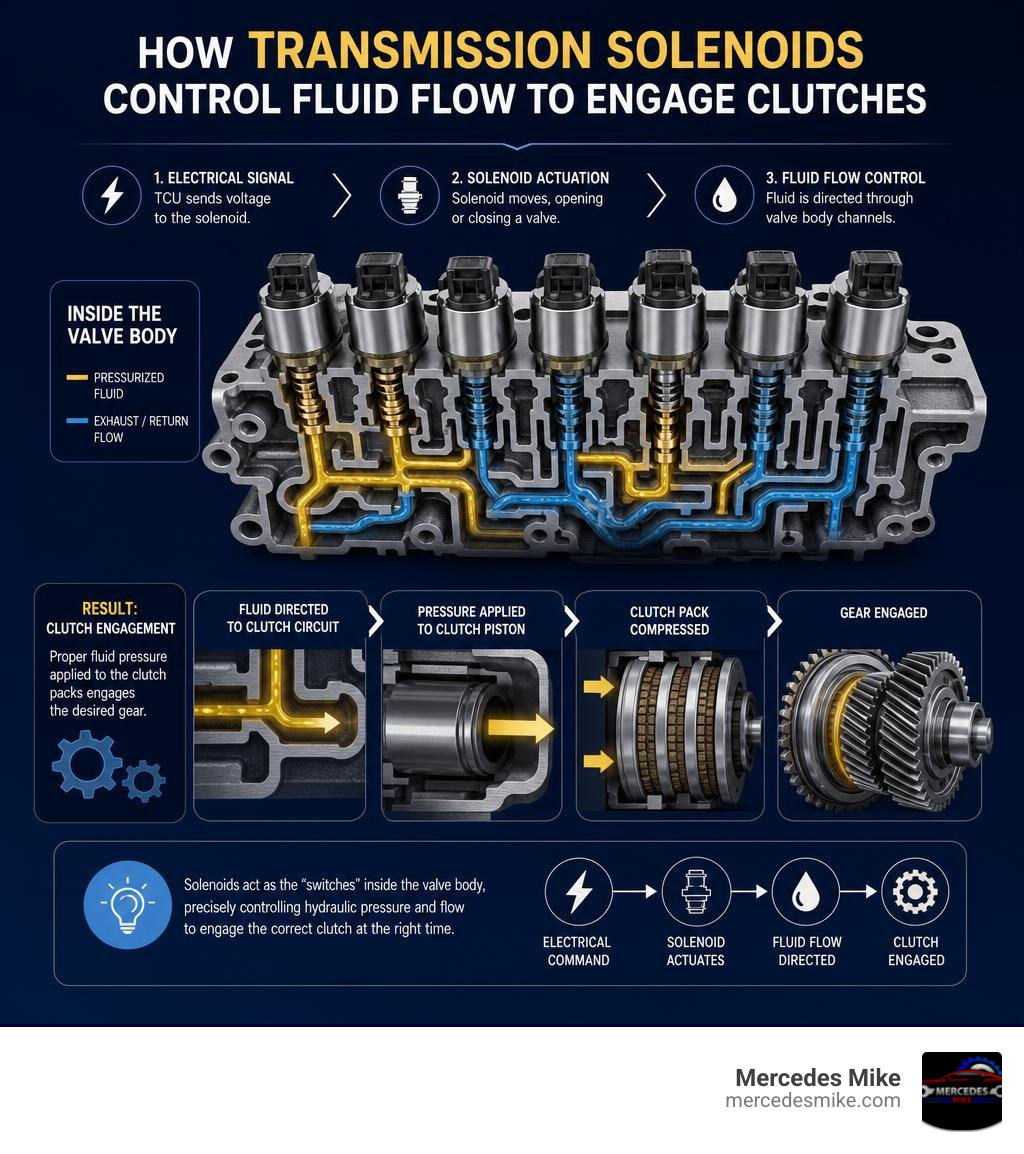
When transmission solenoids begin to fail, they stop routing pressurized hydraulic fluid through the valve body channels efficiently. Dirty fluid, metal shavings, or simple electrical wear can cause the internal plungers to stick. This directly translates to poor shift quality.
If you are experiencing shifting issues, diagnosing them early can save you from requiring a complete transmission repair.
Recognizing ZF 5HP19 and 6HP19 Failure Signs
The classic symptoms of a bad solenoid include:
The Deceleration "Thump": As you slow down to a stop, the transmission downshifts into first gear with a violent jolt or "thump." This is also common when shifting into Reverse.
High RPM Slippage: The engine revs up during a gear change, but the car doesn't accelerate immediately. The transmission slips before finally slamming into the next gear.
RPM Flutter: A subtle but annoying 150 to 200 RPM fluctuation while cruising at a steady speed (typically around 1,500 RPM in 2nd or 3rd gear).
Delayed Shifts: Hesitation when you step on the gas before the transmission decides to change gears.
These issues are highly prevalent in the ZF 5HP19 five-speed transmission (found in early 2000s E46 325i and E39 525i models) as well as the ZF 6HP19 six-speed gearboxes. Because the 5HP19 was highly popular, it was also used by manufacturers like Audi, Porsche, VW, Jaguar, and Range Rover. If you are working on a 5-speed unit, refer to our detailed BMW 5HP19 Solenoid Replacement - 5 Speed ZF Transmission resource for step-by-step specifications.
When to Choose a BMW Transmission Solenoid Replacement vs. a Full Mechatronics Unit
Should you replace just the solenoids or the entire mechatronics unit?
In most cases, replacing the solenoids is highly effective and saves thousands of dollars. A brand-new replacement mechatronics unit can easily cost upwards of $3,000, which dramatically increases the overall average cost to replace transmission components. If your transmission mechanics are fundamentally solid, a solenoid kit is the smart choice.
However, you should consider a full mechatronics replacement if:
The Integrated Transmission Control Unit (ITCU) is damaged: If you have internal processor codes, speed sensor failures, or communication errors, new solenoids won't fix a dead computer.
Your vehicle is affected by known manufacturing defects: For example, certain 2023 models faced a safety recall due to a weld seam defect that allowed oil to leak directly into the control unit (see the official list of AFFECTED VEHICLES ).
The valve body housing is physically worn: If the internal aluminum bores are deeply scored, hydraulic pressure will bleed off even with brand-new solenoids.
For older models with high mileage, trying a solenoid replacement first is usually the most cost-effective gamble before looking into full automatic transmission replacement cost options.
Preparation: Tools, Parts, and Solenoid Identification
Before turning a wrench, you must identify exactly which transmission is in your BMW and secure the correct solenoid kit.
Transmission Model Number of Solenoids Common Color Codes Key Applications ZF 5HP19 7 Black, Yellow, Green E46 3-Series, E39 5-Series (Early 2000s) ZF 6HP19 / 6HP21 7 Yellow, Blue, Black (or Orange) E90 3-Series, E60 5-Series (Mid-2000s to 2013)
Identifying the Correct ZF Solenoid Kit for Your BMW
Solenoid kits are highly specific. For example, the ZF 6HP19 and 6HP21 transmissions use different generation solenoids depending on whether they are "M-shift" (mechanical shifter) or "E-shift" (electronic joystick) units.
Always check your VIN to match the exact ZF part number:
For E9x 335i models, you will often need the BMW 335i Solenoid Valve Kit | 1068298046 .
For F10 5-Series models, ensure you source the BMW F10 Transmission Solenoid Valve Kit | 1087298388 .
Other 6-speed applications may require the 6HP21 6HP28 1068298047 Transmission Solenoid Kit ... .
Essential Tools and Replacement Parts Checklist
To perform this DIY smoothly, gather the following gear:
T40 Torx bit: Used for the oil pan bolts and the valve body bolts.
Low-profile Torx socket: Essential for accessing the transmission fill plug, which sits in a tight space near the transmission tunnel.
New sealing sleeve (mechatronics plug sleeve): This plastic sleeve prevents fluid from leaking out of the electrical connector. It must be replaced during this job.
New bridge seal (adapter grommet): The rubber adapter between the transmission case and the valve body. These dry out and crack, causing severe shifting issues.
Lubrication pipe O-rings: Replace these small plastic pipe seals to maintain perfect hydraulic pressure.
ZF Lifeguard fluid & new pan/filter: ZF pans have integrated filters and must be replaced as a unit.
If you are planning to refresh the entire system, check out our comprehensive transmission replacement guide 2026 for deeper insights into parts compatibility.
Step-by-Step BMW Transmission Solenoid Replacement
This repair should only be performed on a completely cold transmission. Hot transmission fluid can cause severe burns, and aluminum casings expand when warm, increasing the risk of stripping delicate threads.
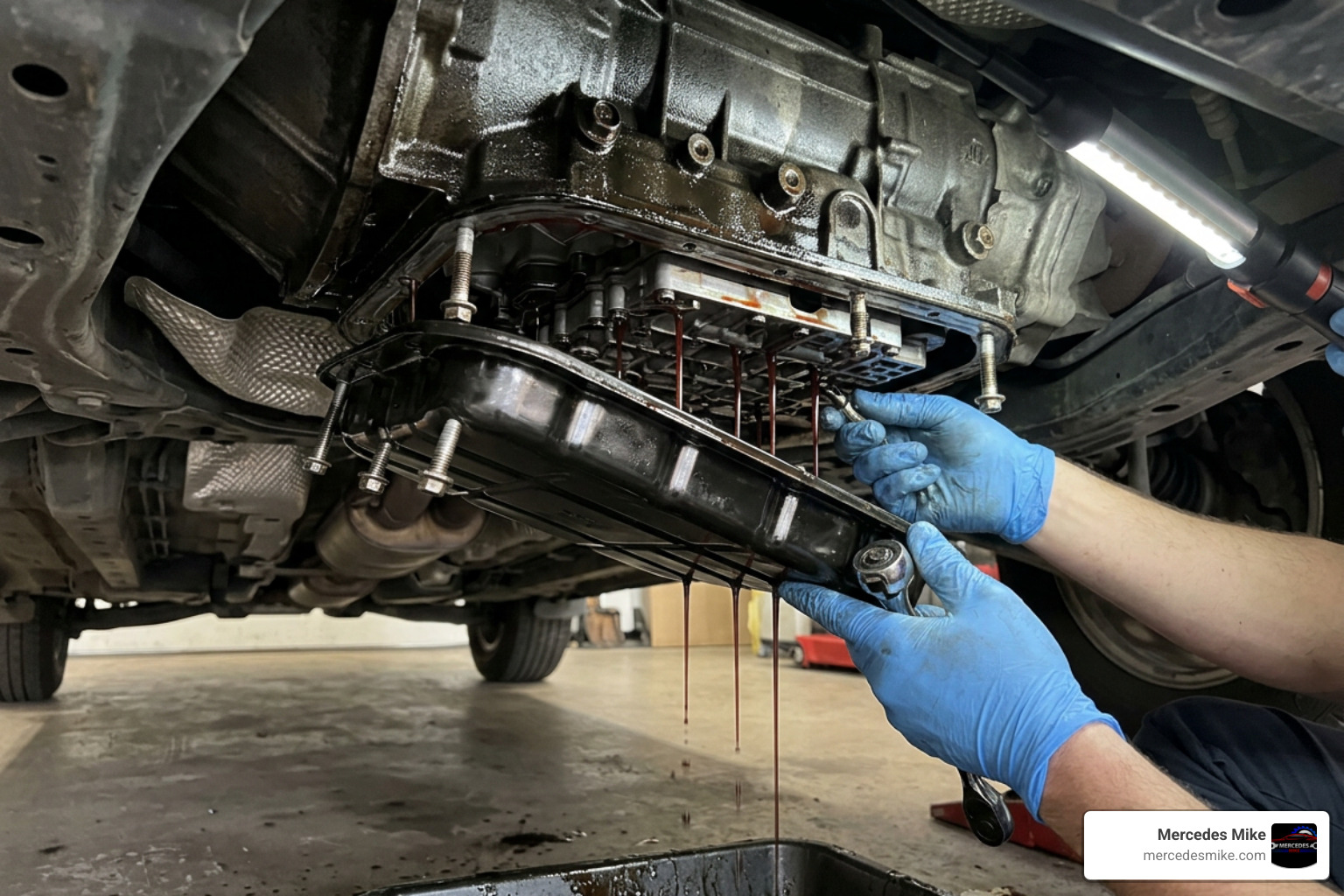
Draining the Fluid and Removing the Oil Pan
Loosen the fill plug first: Always remove the fill plug before draining the oil. If the fill plug is seized and you drain the fluid first, you will have a car stuck on jack stands with an empty transmission.
Drain the oil: Place a large fluid catch pan underneath and remove the drain plug. Expect about 6 to 7 liters of fluid to drain from the pan.
Remove the pan bolts: Use your T40 Torx bit to remove the oil pan bolts. On older ZF 5HP19 and 6HP19 models, these bolts are notorious for stripping. If a bolt head strips, you may need to use screw extractors or carefully drill the head off.
Remove the pan: Carefully lower the pan. Keep it level, as there will still be residual fluid inside.
For a detailed visual guide on managing the pan removal on 6-speed models, see the BMW Transmission Solenoid Replacement - ZF 6HP-19X Six Speed Trans. walkthrough.
Removing the Valve Body and Replacing the Solenoids
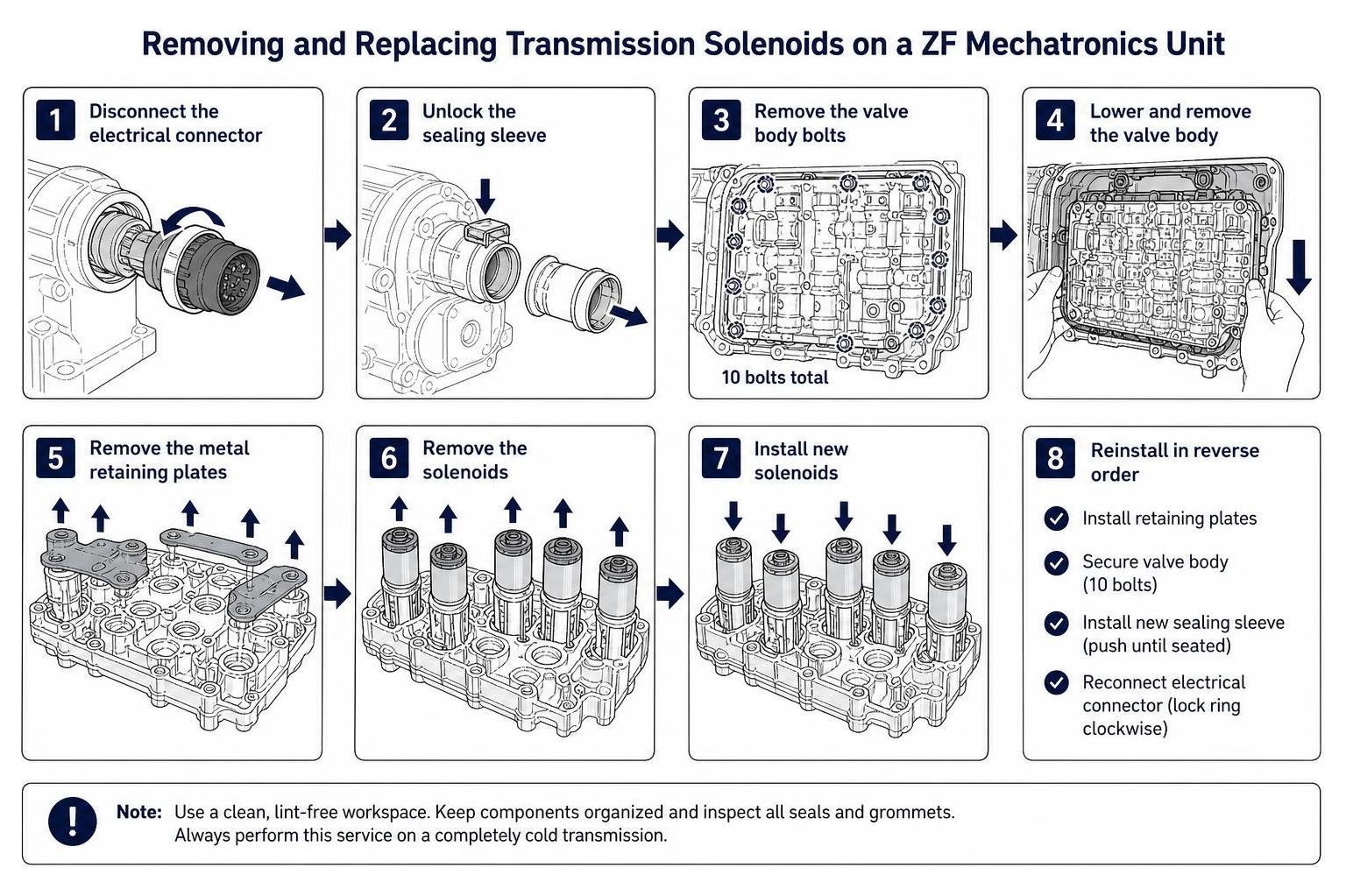
Disconnect the electrical connector: Locate the round wiring harness plug at the rear of the transmission. Twist the locking ring counterclockwise and pull the connector out.
Unlock the sealing sleeve: Reaching inside the transmission case, pull down the white or black plastic locking tab on the mechatronics unit. Once unlocked, push the sealing sleeve out of the rear of the transmission case.
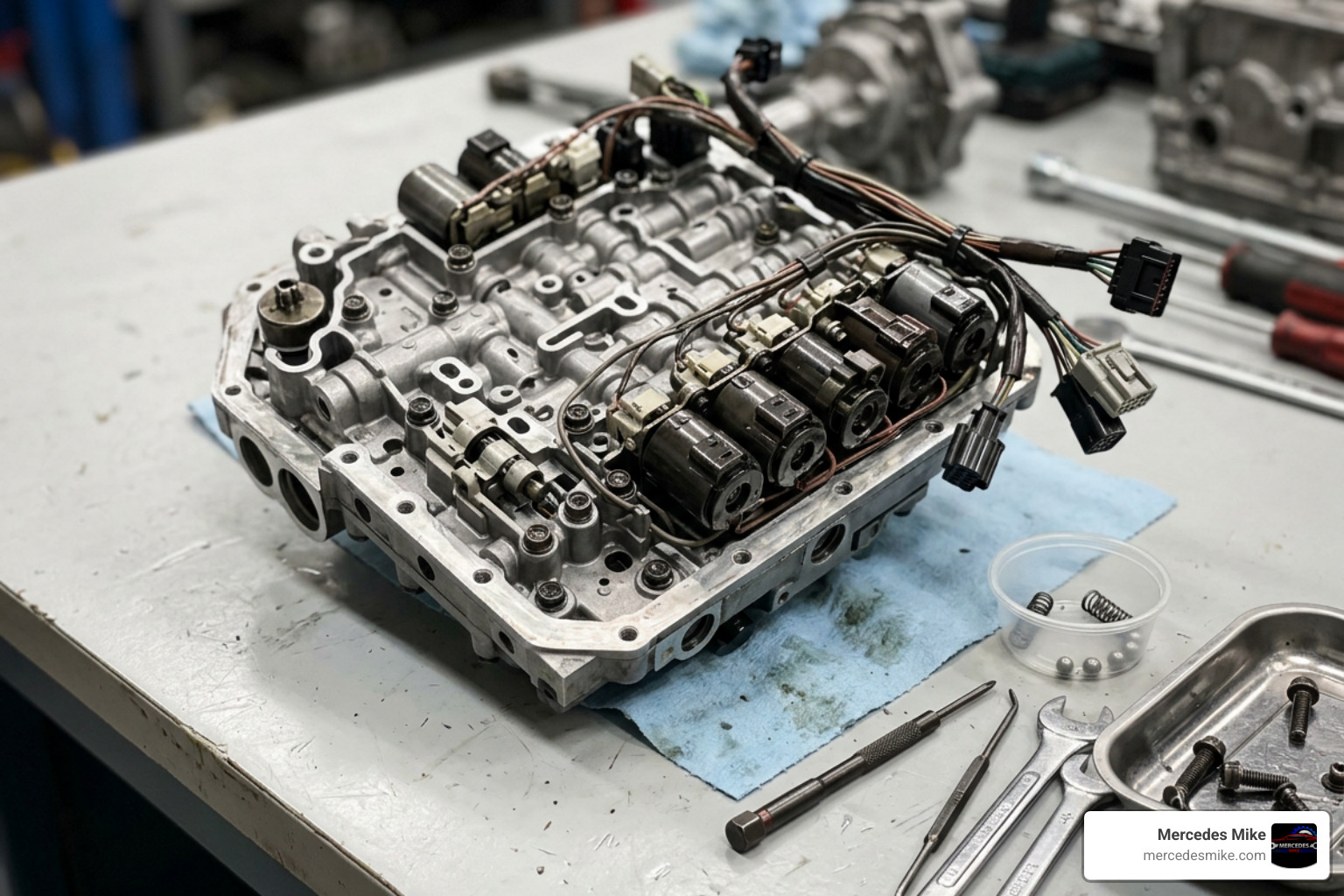
Remove the valve body bolts: Support the valve body with one hand (or have a helper assist you). Remove the designated T40 mounting bolts. On a 6HP, there are 10 main bolts securing the mechatronics unit. Leave two bolts threaded in slightly on opposite corners to prevent the heavy unit from falling, then carefully lower it down.
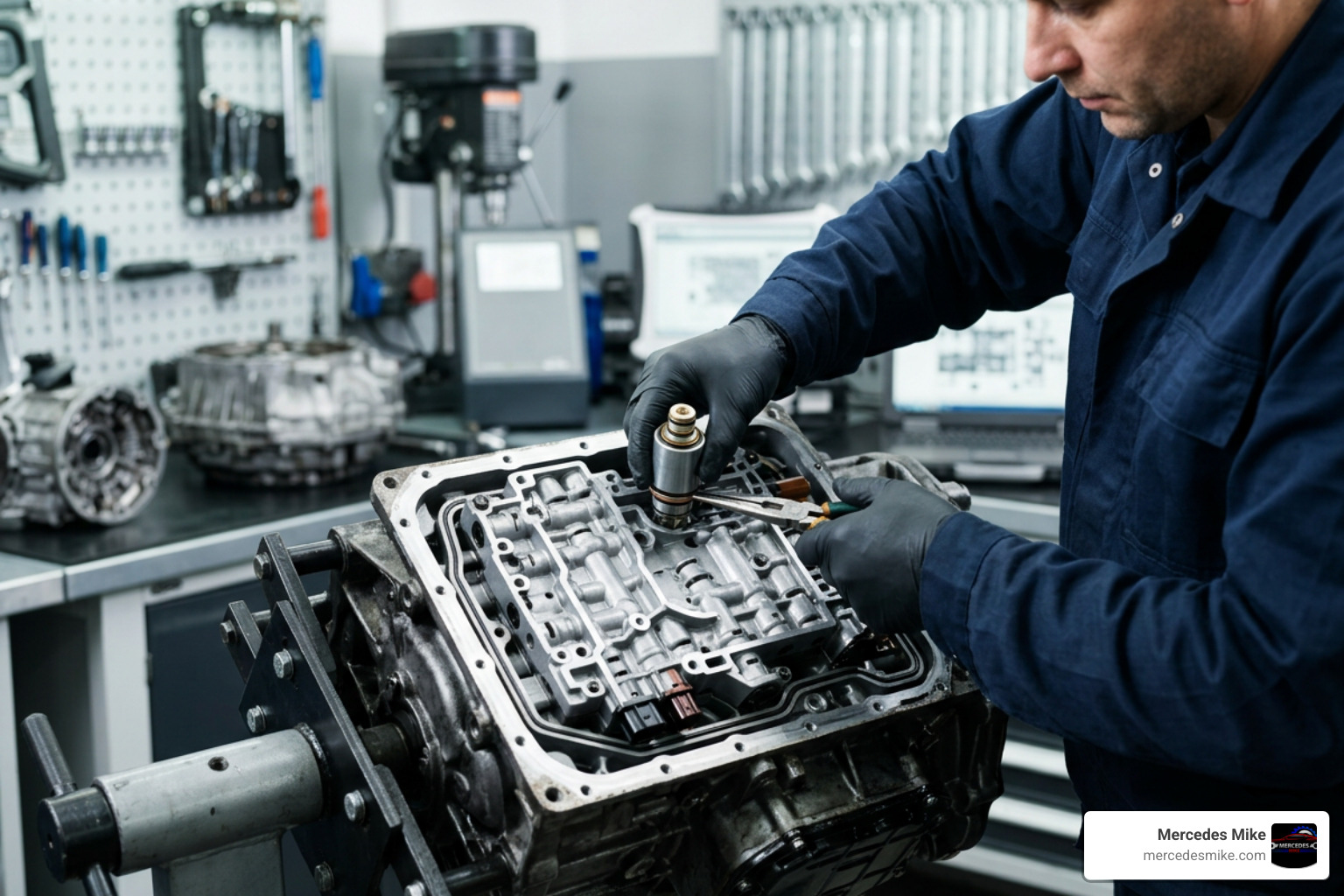
Swap the solenoids: Place the valve body on a clean, lint-free workspace.
Remove the metal retaining plates holding the solenoids in place.
Carefully pull the solenoids straight out. Never pry them out with a screwdriver, as you can score the aluminum bores.
Crucial Tip: If you are working on the MV2 black solenoid, pay close attention to the black cap/bushing orientation. The side of the bushing with the 4 small tabs must face toward the solenoid body to maintain correct spring tension.
Lubricate the O-rings on your new solenoids with fresh transmission fluid and press them firmly into their designated slots. Re-secure the retaining plates.
For more community tips and real-world experiences with this step, check out the automatic transmission ZF 6HP19-21 solenoids replacement thread on E90Post.
Reinstalling the Mechatronics Unit and Sealing Sleeve
Replace the bridge seal and O-rings: Pop the old rubber bridge seal out of the transmission case and press a new one in. Replace the plastic lubrication pipe O-rings.
Align the manual shift valve: When lifting the valve body back into place, you must align the plastic manual shift slider pin on the mechatronics with the metal piston rod inside the transmission. If you miss this alignment, your gear selector will not work.
Torque the valve body: Install the mounting bolts hand-tight, then torque them in a crisscross pattern to 8 Nm (6 ft-lb).
Install the new sealing sleeve: Push the new sleeve in from the rear of the case and push the white locking tab back up to lock it to the mechatronics unit.
Reinstall the oil pan: Clean the mating surface, place your new pan (with integrated filter and gasket), and torque the pan bolts in a sequence to 10 Nm (7 ft-lb).
Refilling Transmission Fluid and Resetting Adaptations
Refilling a ZF transmission is not as simple as pouring oil down a dipstick tube. It requires a specific, temperature-controlled process. While we specialize in BMWs, this exact hydraulic precision is also required during our audi gearbox service and porsche transmission rebuild procedures.
The Temperature-Controlled Fluid Refill Procedure
Initial fill: With the engine off, pump fresh ZF Lifeguard fluid into the fill hole until it starts to spill out. Thread the fill plug back in loosely.
Start the engine: Start the car while it is still securely raised on jack stands. Keep your foot on the brake and slowly cycle the gear selector through Reverse, Neutral, Drive, and manual gears, holding each gear for about 3 seconds to distribute fluid.
Final fill at temperature: With the engine running in Park, connect a diagnostic scanner to monitor the transmission fluid temperature.
Check the level: Once the fluid temperature reaches 100°F (38°C) (do not let it exceed 122°F), remove the fill plug. Pump more fluid in until a thin stream or steady dribble runs out of the hole.
Seal it up: Reinstall the fill plug and torque it to 32 Nm (24 ft-lb). Turn off the engine.
Resetting Adaptations After BMW Transmission Solenoid Replacement
Your BMW's transmission control module (TCU) constantly adjusts hydraulic pressures to compensate for worn solenoids. If you install new, free-flowing solenoids without resetting these stored values, the TCU will apply incorrect pressures, resulting in incredibly harsh shifts or even internal clutch damage.
Using a software tool like ISTA or INPA, navigate to the transmission control unit and select "Reset Transmission Adaptations." Drive the car gently for the first 50 miles to allow the computer to learn the new solenoid flow rates.
Frequently Asked Questions about BMW Transmission Solenoids
How long does a BMW transmission solenoid replacement take?
For an experienced DIYer, the job typically takes 4 to 6 hours. The most time-consuming parts of the repair are waiting for the transmission to cool down completely, carefully extracting stubborn oil pan bolts, and executing the temperature-controlled fluid fill procedure.
Can I drive my BMW with a bad transmission solenoid?
We highly advise against it. Driving with bad solenoids causes constant clutch slippage, which generates extreme heat and friction. Over time, this will burn out the clutch packs, turning a simple solenoid fix into a highly expensive rebuild. Persistent slippage can also damage the torque converter, significantly increasing the cost to fix torque converter systems.
Do new transmission solenoids require dealer programming?
No. Individual ZF solenoids are plug-and-play. While ZF flow-tests each solenoid at the factory, new OEM solenoids fall well within the adaptation range of your factory TCU. You only need to reset the adaptations using standard diagnostic software; no expensive dealer programming or serial number matching is required.
Conclusion
Performing a bmw transmission solenoid replacement is one of the most rewarding DIY projects for any BMW owner. It can instantly transform a rough, jerky ride into a buttery-smooth driving experience while saving you thousands of dollars in shop labor.
However, we understand that working underneath a car with dripping transmission fluid and delicate electronics isn't for everyone. If you prefer to leave this high-precision task to the experts, we are here to help. At Mercedes Mike, our decades-experienced technicians use the latest factory diagnostic tools to service German vehicles across South Florida.
Whether you are located in Pompano Beach or Deerfield Beach FL, you can easily find reliable auto transmission repair near me at our shop. Stop by our facility at 882 NE 41st Court (just off N Dixie Hwy), or Schedule a professional transmission service with us today to keep your BMW shifting flawlessly!