
DIY or Cry? What to Know Before Your Porsche Transmission Rebuild
When Your Porsche Gearbox Gives Up: What You're Really Facing
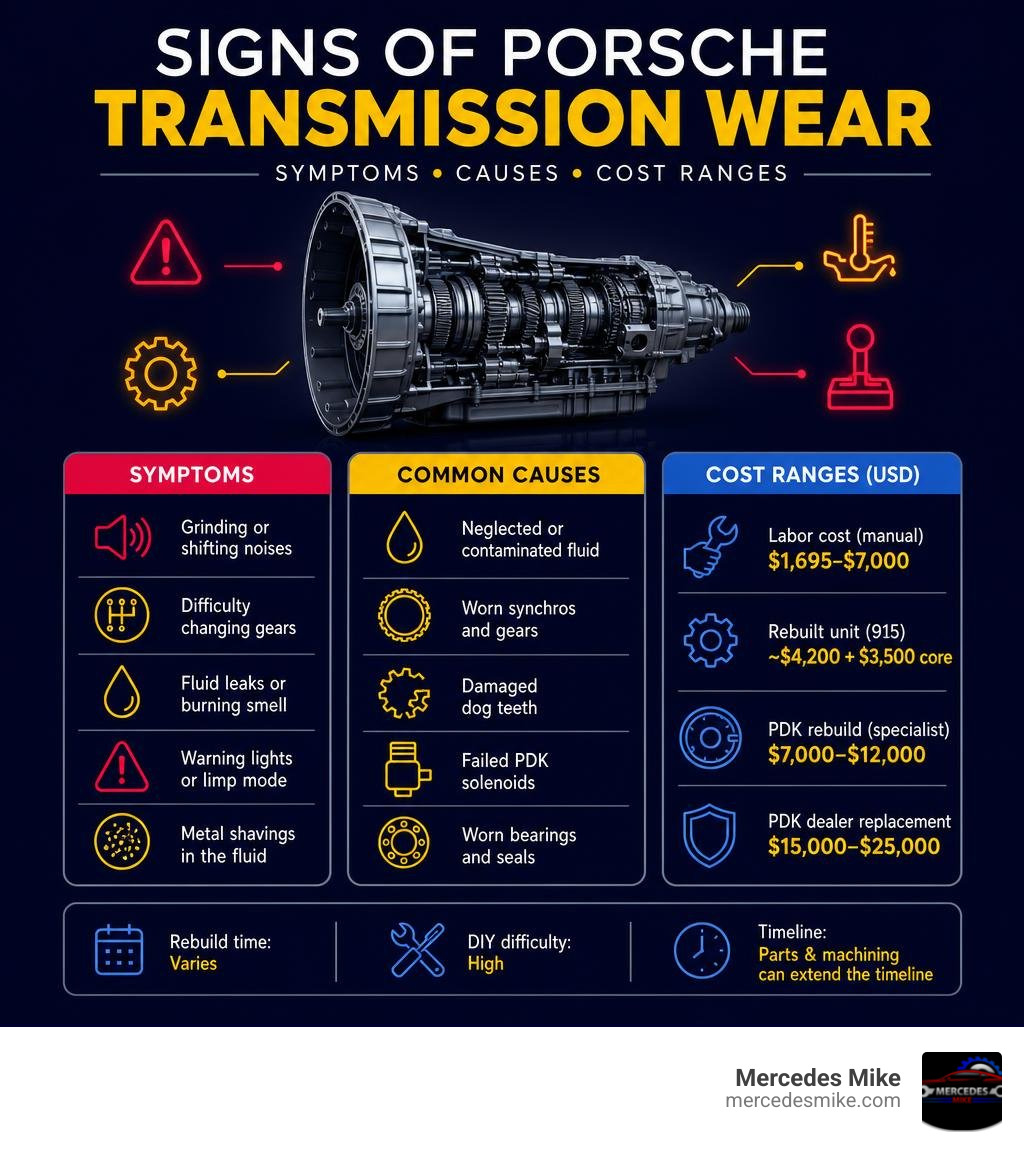
A Porsche transmission rebuild is one of the most involved — and expensive — repairs you'll face as an owner. Before you commit to anything, here's the short version:
Quick Answer: Porsche Transmission Rebuild at a Glance
Factor What to Expect Labor cost (manual) $1,695–$7,000 depending on shop and scope Rebuilt unit (915) ~$4,200 + $3,500 core charge PDK rebuild (specialist) $7,000–$12,000 PDK dealer replacement $15,000–$25,000 Common failure causes Neglected fluid, worn synchros, damaged dog teeth, failed PDK solenoids DIY difficulty High — special tools and precise tolerances required Typical rebuild time Varies; parts sourcing and machining can extend the timeline
Porsche builds some of the world's best transmissions. But they're not bulletproof.
Whether you're driving a classic 911 with a 915 gearbox or a modern 997/992 with a PDK dual-clutch, the symptoms are often the same: grinding gears, metal shavings in the fluid, or a gearbox that simply refuses to cooperate.
The hard part? Knowing what you're actually dealing with. A grinding noise could mean worn synchro rings — or it could mean a much deeper problem inside the differential housing. A PDK warning light might be a $35 temperature sensor fix or a $15,000 dealer quote for a full replacement.
That gap in cost is exactly why this guide exists.
We'll walk you through how to diagnose the problem, what a professional rebuild actually involves, what it should cost, and whether a DIY approach is realistic — or a fast track to an even bigger repair bill.
Diagnosing Your Gearbox: Repair, Service, or Full Overhaul?
Before jumping straight into a full Porsche transmission rebuild, you need to establish whether your gearbox actually needs to be completely gutted. Some symptoms point to internal mechanical failure, while others can be resolved with fresh fluid, a new sensor, or external adjustments.
Here are the primary symptoms we look for when diagnosing a transmission:
Metal Shavings in the Fluid: When you drain the transmission fluid, finding a very fine, grey metallic paste on the magnetic drain plug is relatively normal. However, finding shiny gold brass flakes (from synchros) or actual silver steel chunks (from gear teeth or bearings) is a clear sign of internal damage.
Gear Grinding and Hard Shifting: If your manual Porsche grinds when shifting—especially into first or second gear—your synchronizer rings are likely worn out. If the grinding happens even when the clutch pedal is fully depressed, the clutch itself may not be fully releasing, or the shift linkage might be out of adjustment.
Slipping Clutches (PDK): In a PDK dual-clutch transmission, engine revs rising without a corresponding increase in vehicle speed points to worn clutch packs or low hydraulic pressure.
Sensor and Electronic Failures: PDK transmissions are highly electronic. A "Gearbox Emergency Operation" warning on your dashboard can be highly alarming, but it is frequently triggered by a failed temperature or distance sensor rather than a mechanical failure.
To keep your transmission healthy and catch these issues early, always follow the recommended Porsche Service Schedule. If you are already experiencing any of these red flags, it is critical to have your vehicle evaluated at a dedicated Porsche Repair Center before minor wear escalates into catastrophic failure.
Manual vs. PDK: Choosing Your Porsche Transmission Rebuild Path
The diagnostic and rebuild paths diverge dramatically depending on whether your Porsche has a traditional manual gearbox or a high-tech Porsche Doppelkupplung (PDK) dual-clutch transmission.
Classic manual gearboxes—such as the early 901, the ubiquitous 915 (used from 1972 to 1986), and the later G50—are beautifully simple mechanical assemblies. Their failures are almost entirely mechanical. Synchro rings wear down, dog teeth round off, and bearings develop play. Rebuilding these gearboxes is a highly tactile process of measuring clearances, replacing brass and steel wear components, and occasionally machining the housings to restore factory tolerances.
A PDK transmission is essentially two parallel manual gearboxes housed in a single case, operated by a complex electro-hydraulic valve body. Porsche dealerships historically treated the PDK as a single, non-serviceable unit. If a single $35 sensor failed inside, the dealer's only solution was to replace the entire transmission for $15,000 to $25,000.
Fortunately, the independent specialist community has proven that the PDK is highly serviceable. Most PDK issues occur in the hydraulic and electronic control sections, which can be repaired by replacing individual solenoids or sensors without requiring a complete mechanical overhaul. If you are dealing with PDK issues, reading through this Guide to Repairing a PDK Transmission - Rennlist - Porsche Discussion Forums is an excellent way to understand how these systems are serviced. Whether you drive a manual or an automatic, getting a precise diagnosis is the first step in any successful Transmission Repair.
The Cost Breakdown of a Porsche Transmission Rebuild
Rebuilding a Porsche transmission is a premium service, and the costs reflect the specialized knowledge and high-quality parts required. To help you budget, here is a realistic breakdown of what you can expect to pay for parts, labor, and logistics in 2026.
Transmission Type Labor Cost Parts Cost Range Core Charge Total Estimated Cost Classic Manual (901/911/914) $1,695 - $3,000 $1,500 - $3,500 $3,500 $3,200 - $6,500 (excl. core) G96 / G97 Manual (996/997) $2,500 - $4,500 $2,000 - $5,000 $3,500 $4,500 - $9,500 (excl. core) PDK Dual-Clutch (Specialist) $3,500 - $6,000 $1,500 - $6,000 N/A $7,000 - $12,000 PDK Dealership Replacement Included N/A (New Unit) N/A $15,000 - $25,000
Note: Total costs do not include the core charge, which is fully refunded once your rebuildable old transmission is returned to the builder.
Labor costs for a standard manual overhaul typically start around $1,695 for basic bench labor (disassembly, inspection, and reassembly of a loose gearbox) and can scale up to $7,000+ for complex transaxles or when including "R&R" (removal and replacement labor to pull the transmission out of the car).
When budgeting, it is helpful to compare these figures against general industry standards. You can read more about overall transmission pricing in our guides on the Average Cost to Replace Transmission and the Automatic Transmission Replacement Cost.
Understanding Core Charges and Shipping Logistics
If you decide to purchase a pre-built transmission from a specialist rather than waiting for your exact unit to be rebuilt, you will encounter a core charge.
A core charge is a temporary deposit (frequently around $3,500 for a Porsche 915 or G96 gearbox) that ensures you return your old, rebuildable transmission to the builder. This keeps the supply chain of vintage parts alive. To get your core deposit back, your old unit must meet strict criteria:
It must be the exact same model and specification as the rebuilt unit you received.
The external cases must be free of cracks, welds, or structural damage.
It must be complete, reasonably clean, and completely drained of all fluids before shipping.
Shipping a transmission is not as simple as dropping it off at the local post office. Because gearboxes are heavy (often weighing between 120 and 200 pounds), they must be secured to a wooden pallet or strapped inside a heavy-duty plastic tote and shipped via LTL (Less-Than-Truckload) freight.
Shipping costs typically range from $250 to $600 each way, depending on the distance. When preparing your gearbox for transport, refer to our Transmission Replacement Guide 2026 for best practices on packaging and freight logistics.
Step-by-Step Guide to the Rebuild Process
A professional gearbox rebuild is a highly disciplined, multi-stage process. It requires surgical cleanliness and absolute precision.
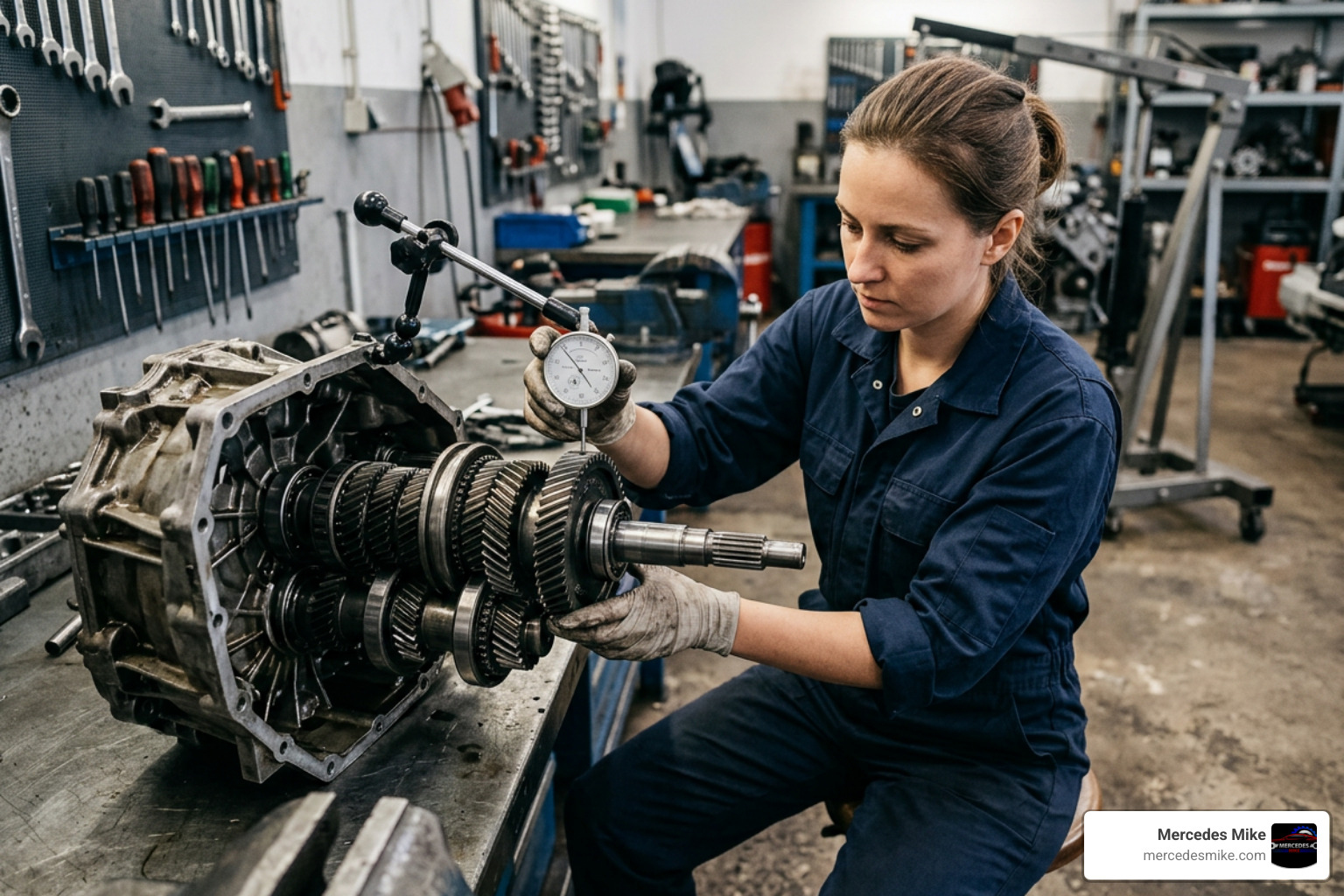
Every professional rebuild follows these four essential phases:
Disassembly and Measurement: The technician carefully disassembles the transmission in a specific sequence. Before any parts are cleaned, critical baseline measurements are taken, including the ring and pinion R-setting, differential bearing preload, backlash, and shift fork positioning. These measurements reveal how much the components have shifted or worn over time.
Cleaning and Inspection: All components are run through an industrial parts washer to remove decades of baked-on gear oil, road grime, and metallic debris. Once clean, parts are inspected under high magnification. Technicians look for hairline cracks in the cases, pitting on the gear teeth, and uneven wear on bearing races.
Machining and Blueprinting: This is where specialist rebuilders set themselves apart. To achieve tighter-than-factory tolerances, technicians use precision surface grinders and lathes. For example, factory spacers may be ground flat to within .0001 of an inch to ensure perfect gear alignment and eliminate shaft play.
Reassembly and Final Setup: The gearbox is carefully reassembled using new bearings, synchros, and gaskets. Every bolt is torqued to exact factory specifications. Subsystems like the shift rails and detents are tested dynamically on the bench before the main case halves are sealed and bolted together.
Step-by-Step Guide to a Manual Porsche Transmission Rebuild
Rebuilding a classic manual Porsche gearbox (like the 915 or 901) is a mechanical art form. Because Porsche utilized a unique split-ring synchro design for decades, setting up these gearboxes requires an understanding of how these mechanical components interact.
Replacing Wear Items: The core of a manual rebuild involves replacing the brass synchro rings, the sliding sleeves (sliders), and the dog teeth (engagement teeth). If you ignore worn synchros for too long, the dog teeth on the gears themselves will round off, requiring expensive gear set replacements.
Upgrading Weak Points: During a rebuild, we recommend installing proven upgrades to prevent future failures. For example, the magnesium cases of early 915 transmissions are prone to wearing out at the rear pinion shaft bearing bore. Installing an upgraded aluminum intermediate plate or a heavy-duty bearing retainer plate permanently resolves this issue.
Setting Differential Preload: The differential bearings must be shimmed with extreme accuracy. Incorrect preload or backlash will cause the ring and pinion gears to whine, wear prematurely, or fail under heavy acceleration.
Finding parts for rarer vintage models can sometimes be challenging, but independent enthusiast communities often step in to manufacture high-quality alternatives. For example, owners of classic transaxle models can find specialized hardware and rebuild components via the 924Board.org :: View topic - G31 & G16 repair kits now available forum threads.
Servicing and Repairing the PDK Dual-Clutch
Rebuilding or servicing a PDK transmission is entirely different from working on a manual. The PDK is split into two distinct, sealed chambers: a hydraulic clutch chamber (which uses dual-clutch fluid / ATF) and a mechanical gear chamber (which uses standard gear oil).
Most PDK failures occur in the hydraulic and electronic control section, not the mechanical gears.
Solenoid Replacement: The valve body contains several electro-hydraulic solenoids (EDS and MV solenoids) that direct fluid pressure to operate the clutches and shift forks. These solenoids can wear out or become clogged with microscopic debris. Instead of replacing the entire $2,800 valve body, we can test the resistance of individual solenoids and replace only the failed units.
Sensor Repairs: The PDK relies on internal sensors to function. The distance sensor (which monitors shift fork position) and the temperature sensor are common failure points. A failed temperature sensor can trigger a false emergency mode even if the transmission is mechanically perfect. Replacing these sensors requires separating the end case of the transmission, a task that requires patience and specialized pullers.
If you are planning to perform routine maintenance to prevent these issues, refer to the Porsche 997.2 PDK Service guide. For DIYers working on newer water-cooled models, utilizing a complete Porsche 992 2020+ PDK Transmission Service Kit - With Extra Fluid For Flush ensures you have the correct integrated pan, filter, and high-performance fluid required for a clean service.
DIY vs. Professional Specialist Rebuilds
The internet is full of forum posts from bold DIYers claiming that rebuilding a Porsche transmission "isn't rocket science." While it is true that a manual gearbox operates on basic mechanical principles, attempting a DIY rebuild without the proper equipment is highly risky.
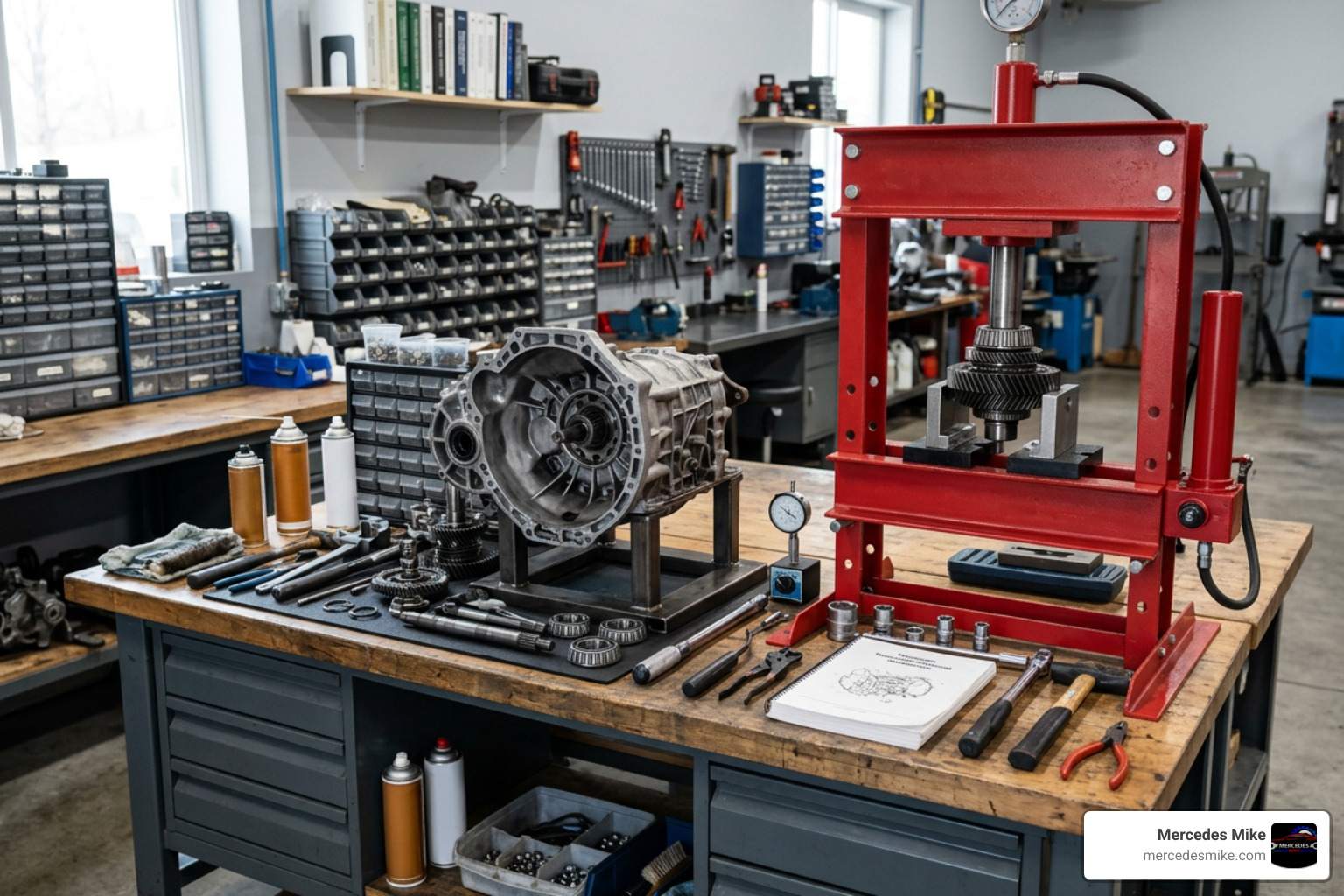
A successful rebuild requires several highly specialized tools:
A Hydraulic Press: Essential for pressing bearings and gear sets on and off the transmission shafts without bending or gouging the metal.
Precision Measuring Equipment: You will need dial indicators accurate to .001 of an inch, micrometers, and specialized depth jigs to set the ring and pinion depth and bearing preloads.
Specialized Pullers and Sockets: Many Porsche shaft nuts require unique, thin-walled, multi-point sockets and heavy-duty pullers to remove without damaging the shafts.
If you lack these tools or do not have experience measuring gear backlash and shaft runout, a DIY attempt can quickly result in ruined parts, a noisy gearbox, or complete mechanical lockup at highway speeds. For most owners, partnering with a trusted local shop is the safest and most cost-effective path. If you are in South Florida, finding a qualified specialist via Auto Transmission Repair Near Me will save you time, stress, and potential heartbreak.
Frequently Asked Questions About Porsche Transmissions
What are the most common reasons a Porsche transmission fails?
The primary cause of Porsche transmission failure is neglected fluid changes. Over time, gear oil loses its viscosity and ability to cushion the gear teeth, leading to accelerated wear on the synchros and bearings.
In manual cars, aggressive shifting, "riding" the clutch, and skipping gears during downshifts put immense stress on the dog teeth and synchro rings. In PDK transmissions, heat is the main enemy; high operating temperatures degrade the clutch fluid, leading to solenoid sticking and sensor failures. To prevent transfer case and all-wheel-drive system binding, regular Transfer Case Fluid Replacement is also highly recommended.
How long does a professional transmission rebuild take?
The hands-on labor to rebuild a manual Porsche transmission is typically around 10 to 15 hours. However, the total turnaround time is usually between 2 to 4 weeks. This timeline depends on parts availability (especially for rare vintage gearboxes), the workload of the machine shop performing case repairs, and shipping transit times if you are sending your gearbox to a national specialist.
Is a rebuilt transmission better than a used or dealer-replaced unit?
In almost all cases, a professionally rebuilt transmission from a specialist is superior to a used unit and far more cost-effective than a dealer replacement. A used transmission is an unknown variable; it may have the exact same worn synchros or failing sensors as your current unit.
A professional rebuild restores the gearbox to factory specifications and allows you to install upgraded aftermarket components (such as stronger side covers, upgraded intermediate plates, or a Wavetrac limited-slip differential). If you are weighing your options across different German brands, you can compare these costs with our guide on How Much to Repair Mercedes Transmission.
Conclusion
A Porsche transmission rebuild is a highly technical undertaking that requires precision, patience, and specialized tools. Whether you are preserving a classic air-cooled 911 or keeping a modern water-cooled PDK performing at its peak, the key to a long-lasting gearbox is proactive maintenance and accurate diagnosis.
At Mercedes Mike in Pompano Beach, our team of highly experienced German automotive technicians is dedicated to keeping your Porsche running flawlessly. Serving Pompano Beach, Deerfield Beach, and the greater South Florida area, we combine decades of hands-on expertise with the latest diagnostic tools to handle everything from routine fluid services to complex gearbox overhauls.
Don't wait for a minor gear grind to turn into an expensive mechanical failure. Schedule Your Porsche Service with us today, or explore our Porsche Service Center Complete Guide to learn more about how we keep your favorite German sports car performing exactly as Stuttgart intended.