E200 Kompressor Tuning Guide for Daily Drivers
E200 Kompressor Tuning for More Usable Daily-Driver Power
E200 Kompressor tuning can make a W210 or W211 E-Class feel much quicker in normal traffic, especially when pulling away, joining a highway, or passing slower cars. The best results usually come from matching the upgrade to the exact engine, whether it is the older 2.0L M111 or the 1.8L M271 Kompressor.
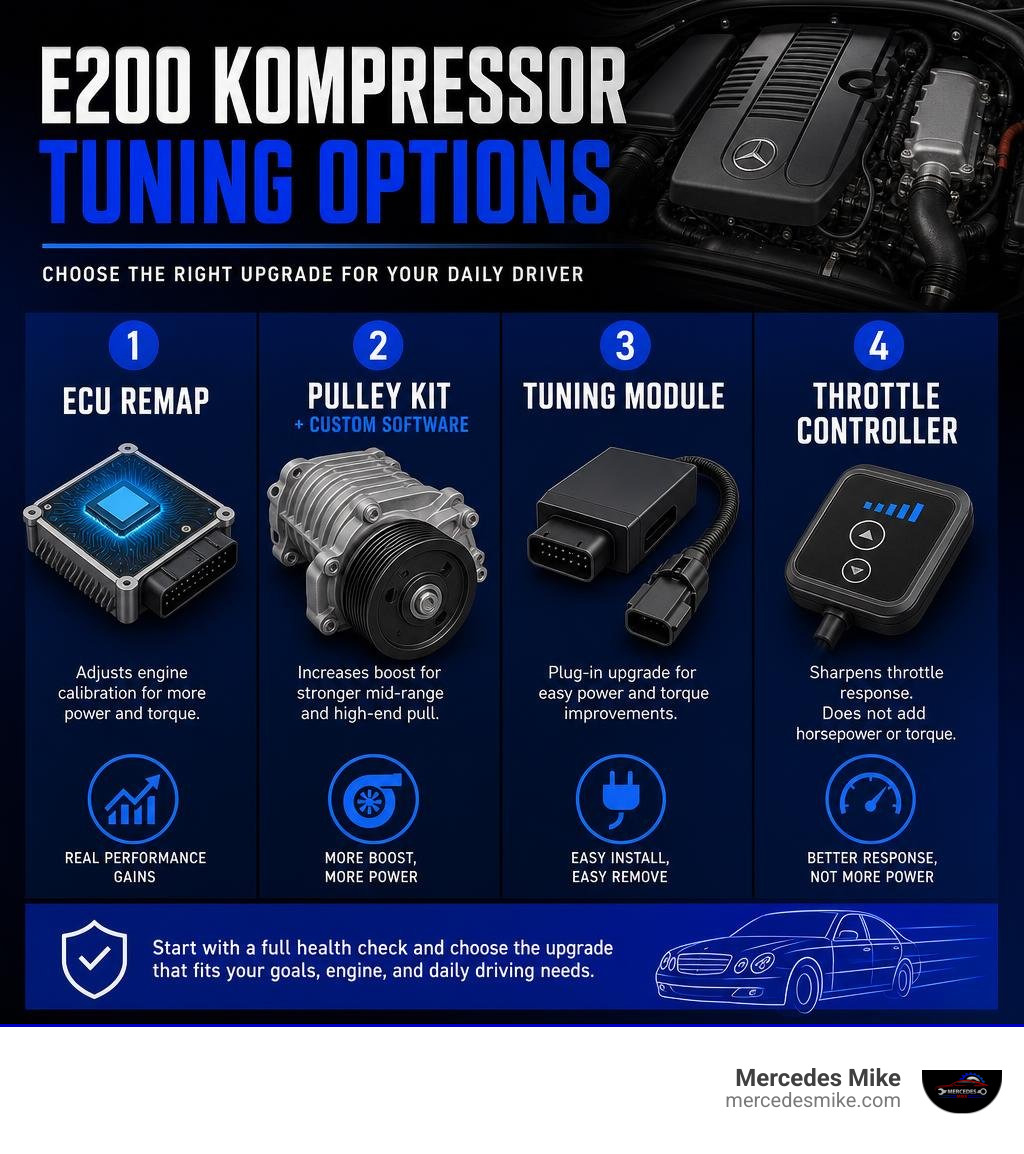
Quick answer: Start with a full health check, then choose tuning based on your goal:
ECU remap: Adds real horsepower and torque by adjusting engine calibration. A well-matched tune for the 184 hp M271 can reach roughly 205-230 hp, depending on the software and vehicle condition.
Supercharger pulley and custom software: A more serious route that raises boost. It can produce stronger mid-range pull, but requires careful heat, fueling, and knock control.
Plug-in tuning module: Easy to install and remove, with typically smaller claimed gains than a custom ECU calibration.
Throttle controller: Makes the pedal feel sharper but does not add engine horsepower or torque.
The goal is not simply a bigger peak number. For a daily-driven Mercedes, the worthwhile gains are smoother throttle response, stronger low-rPM torque, and safer overtaking without sacrificing reliability. The 163 hp and 184 hp M271 versions are not identical, so the same tune or pulley setup should never be assumed safe for both.
I am Mike Ibrahim, and the next sections break down which E200 Kompressor upgrades suit a dependable daily driver and which ones need extra care.
Hardware vs Software Options for E200 Kompressor Tuning
When unlocking extra performance from a supercharged Mercedes, deciding where to start can feel overwhelming. Owners often ask whether they should start turning wrenches on mechanical components or plug into the factory computer first. Achieving effective e200 kompressor tuning comes down to balancing software adjustments with physical hardware modifications.
Before diving headfirst into mechanical upgrades, it helps to understand what each approach accomplishes. Software modifies the instructions given to the engine management system, while hardware upgrades alter how much air physically moves through the intake and exhaust. Combining both provides the ultimate result, but many daily drivers discover that choosing targeted Performance Upgrades delivers plenty of punch without over-stressing mechanical components.
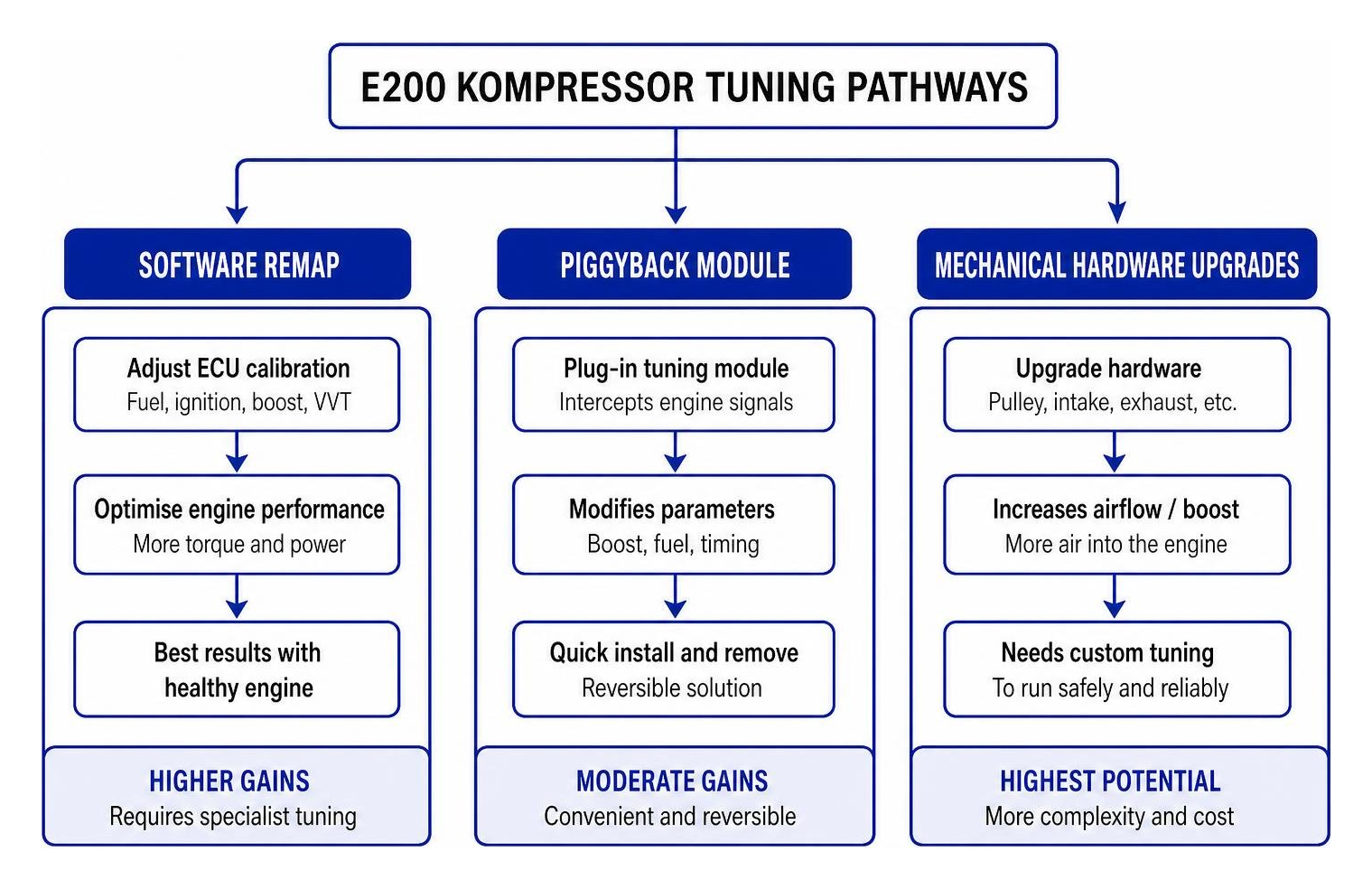
ECU Remapping for E200 Kompressor Tuning
ECU remapping (often referred to as Stage 1 software tuning) adjusts the factory Engine Control Unit (ECU) parameters directly. Mercedes-Benz designed the factory ECU mapping with wide safety margins to handle low-quality fuels, extreme arctic temperatures, and neglected maintenance across worldwide markets.
By rewriting the software maps governing air-fuel ratios, ignition timing advance, and supercharger bypass valve behavior, a recalibrated ECU unlocks dormant power. In engines like the 184hp M271 variant, precision Stage 1 software updates can increase engine output up to 205hp and 280Nm torque, with more aggressive calibrations reaching up to 230hp and 390Nm torque as detailed in the W211 E200 Kompressor Stage 1 Data Sheet.
There are three primary ways to adjust software:
Custom Dyno Remapping: Flashing the ECU on a chassis dynamometer allows real-time adjustment of ignition and fuel curves specifically tailored to your exact engine condition.
Plug-and-Play OBD2 Tuning Modules: Piggyback modules like GAN or Monte plug directly into the OBD2 diagnostic port under the dash. These modify sensor signals in real time without overwriting factory firmware. They are easy to install, completely trace-free upon removal, and often offer selectable driving modes (ECO, Dynamic, Stock) via smartphone apps.
Throttle Response Controllers: Plug-in pedal units (such as the DTE PedalBox) remove factory pedal latency. While they deliver up to 10% faster pedal signal delivery and sharper off-the-line response, it is important to remember that throttle controllers alter input sensitivity—they do not add actual horsepower or torque to the engine output.
If you are searching for experienced ECM Tuners Near Me, ensure they understand the delicate air-fuel balancing required for forced-induction Mercedes engines.
Hardware Upgrades for E200 Kompressor Tuning
While software extracts latent energy built into the factory setup, hardware modifications physically increase the volume of compressed air delivered to the combustion chambers.
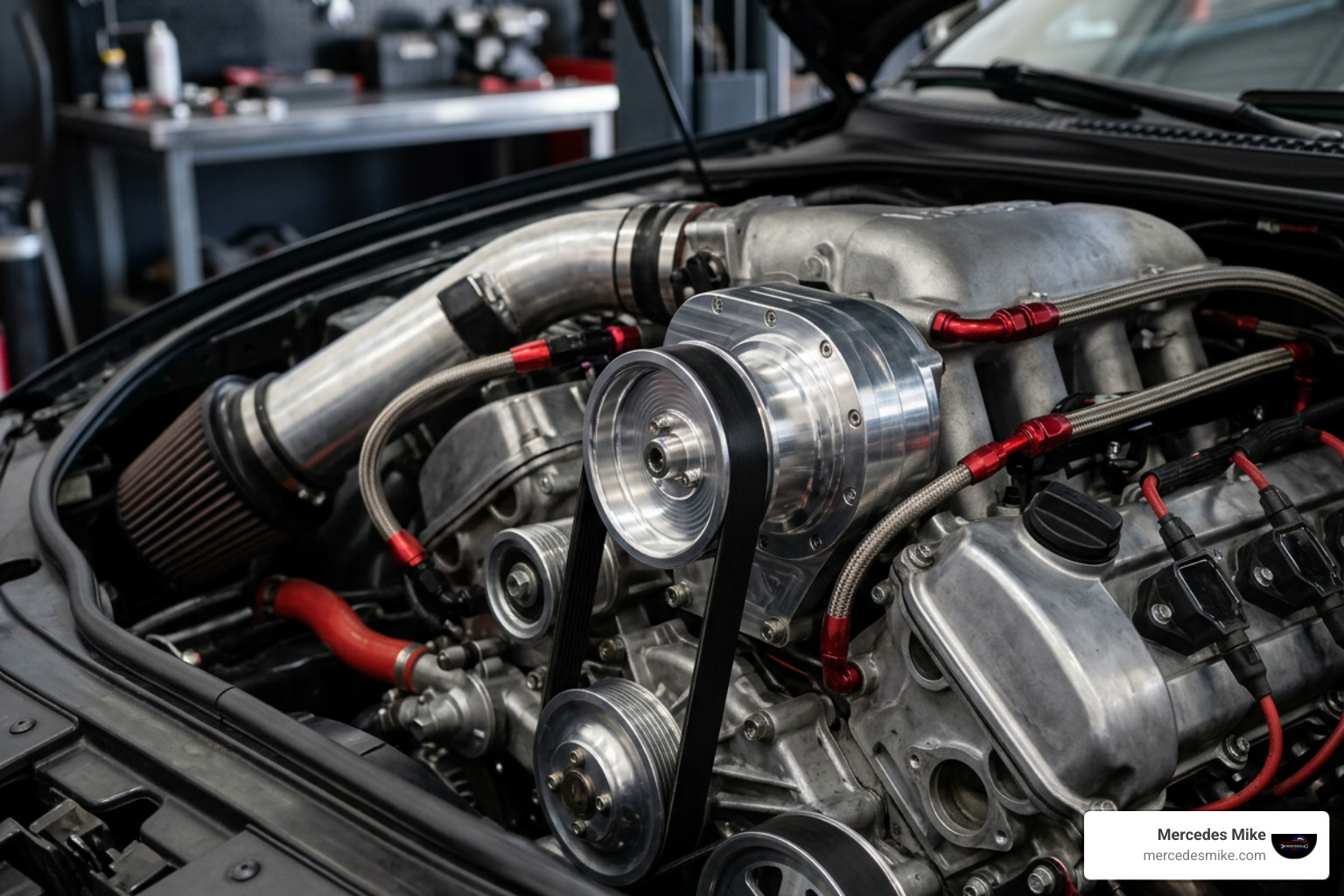
The premier mechanical modification for any supercharged Mercedes-Benz engine is a supercharger pulley ratio modification. By installing a smaller supercharger pulley (or a larger crank pulley), the mechanical Eaton supercharger spins faster relative to engine RPM, creating higher boost pressure earlier in the rev range.
However, mechanical changes require supporting hardware consideration:
Exhaust Headers and Catalysts: As discussed in the 2003 E200 Kompressor Tuning Discussion, upgrading the exhaust on the M271 engine is tricky because the factory catalytic converter is physically integrated into the exhaust manifold header assembly. Completely removing or gutting the catalytic converter without oxygen sensor modification causes fault codes and erratic air-fuel metering.
Intercooling: Compressing air creates heat. Spinning the supercharger faster generates elevated intake air temperatures (IATs). Upgrading to a high-efficiency front-mount intercooler ensures cold, dense air reaches the cylinders, preventing power loss during hot South Florida summers in Pompano Beach and Deerfield Beach.
High-Flow Air Filters: Upgraded panel air filters reduce intake restriction, allowing the Kompressor to draw incoming air with less resistance.
Realistic Power Gains and Daily Driving Performance
Understanding realistic performance figures prevents disappointment and ensures you choose modifications that match your daily commute. Supercharged engines respond remarkably well to basic tuning because forced induction offers straightforward power scalability.
Tuning Setup Horsepower (HP) Torque (Nm) 0-100 km/h (0-60 mph) Change Key Advantages Stock E200K (163hp M271) 163 hp 240 Nm ~9.6 seconds Factory reliability baseline Stage 1 Remap (163hp Base) 182 - 190 hp 265 - 290 Nm -0.48 seconds Smooth power delivery, zero hardware changes Stage 2 (Pulley + Software) 200 hp 300 Nm -1.0 to -1.2 seconds Strong low-end grunt, rapid highway merging Stock E200K (184hp M271) 184 hp 250 - 300 Nm ~9.1 seconds Factory refined base Stage 1 Remap (184hp Base) 205 - 230 hp 280 - 390 Nm -0.40 to -0.80 seconds Massive mid-range torque spike
Stage 1 vs Stage 2 Output Breakdown
The power gains achieved during e200 kompressor tuning depend heavily on your baseline starting point.
For vehicles starting with the 163hp M271 platform, a basic Stage 1 software calibration raises engine output to roughly 182-190hp and 265-290Nm of torque. Adding a supercharger pulley upgrade creates a true Stage 2 setup, elevating output to a healthy 200hp and 300Nm of torque as shown in the Mercedes E200 Kompressor Technical Data. This represents a impressive 22% increase in total engine output!
Vehicles equipped with the later 184hp M271 variant see even higher numbers. A Stage 1 ECU flash alone pushes power output to between 205hp (280Nm torque) and 230hp (390Nm torque).
When evaluating dyno sheets, keep drivetrain loss in mind. Chassis dynamometers measure wheel horsepower (whp), which accounts for rotational friction through the automatic transmission, driveshaft, rear differential, and tires. Wheel torque curves start later on a chassis dyno graph than factory engine bench specs, even though the engine makes torque right off idle.
Acceleration Times and Overtaking Power
How do these horsepower numbers translate to real-world driving on local roads?
In factory trim, a 2003 W211 E200 Kompressor accelerates from 0 to 60 mph in roughly 9.6 seconds—a figure early owners half-jokingly referred to as "sluggish." Stage 1 software tuning knocks approximately 0.40 to 0.48 seconds off the 0-100 km/h (0-62 mph) sprint, raising top speed by 5 to 10 km/h.
Combining a supercharger pulley upgrade with matching ECU software yields a 1.0 to 1.5 second reduction in 0-60 mph sprint times. More importantly for daily driving, mid-range torque increases dramatically between 2,500 RPM and 4,500 RPM. This eliminates low-RPM engine lag when merging onto busy highways or passing slow-moving traffic, making the car feel significantly lighter on its feet. Paired with tuned automatic transmission shift mapping, power delivery feels immediate and linear.
Check out our guide on The Top 5 Performance Upgrades for Your German Car to see how engine tuning complements suspension and brake enhancements.
Comparing W210, W211, and Engine Revisions

Not all E200 Kompressor models are created equal. Mercedes-Benz produced the E200 Kompressor across two major chassis generations (W210 and W211) utilizing two completely different four-cylinder engine families. Understanding your specific chassis and engine code is mandatory before purchasing performance parts. Explore our broader Mercedes Tuning hub for model-wide technical details.
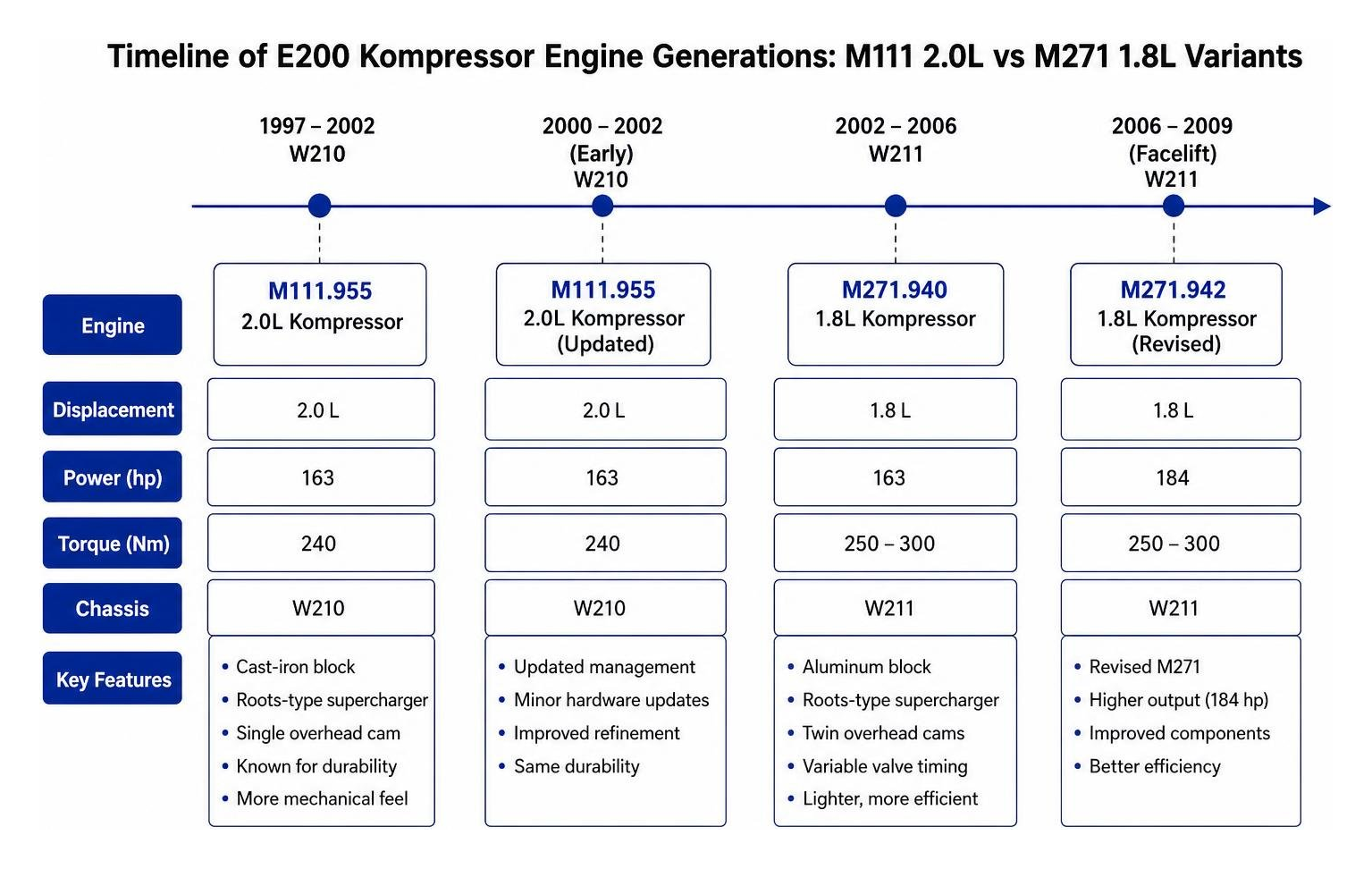
M111 2.0L vs M271 1.8L Supercharged Engines
The early W210 generation and initial 2000-2002 models featured the bulletproof M111 engine family—a 2.0-liter displacement unit featuring a heavy cast-iron cylinder block. The M111 engine is legendary for its iron-clad durability and ability to withstand high boost levels, though it sounds a bit industrial at high RPMs.
Starting in late 2002 with the W211 chassis, Mercedes introduced the M271 engine—a 1.8-liter lightweight aluminum engine block featuring twin overhead camshafts and variable valve timing.
Key structural and tuning differences include:
Displacement: The M111 displacement spans 1,998 ccm, whereas the M271 measures 1,796 ccm.
Supercharger Hardware: M111 engines use larger Roots-type blowers (Eaton M45/M62), while M271 engines utilize smaller, higher-revving Eaton superchargers with integrated recirculating bypass valves.
Maintenance Considerations: The aluminum M271 engine utilizes a single-row timing chain susceptible to stretch over time. Inspecting timing chain tensioners and balance shaft gears is critical before applying high-boost tuning.
Tuning Potential: M111 engines accept aggressive pulley size reductions (yielding up to +49 hp gains) with minimal thermal complaints. M271 engines require careful knock control and precise air-fuel mapping due to higher base operating temperatures.
If you own related chassis models, check out our dedicated guides for C200 Kompressor Tuning Guide 2026, C180 Kompressor Tuning Guide 2026, and C230 Kompressor Tuning Guide 2026.
163 HP vs 184 HP Factory Output Variations
Within the W211 M271 production run (2002–2009), Mercedes released two distinct factory power outputs that confuse many owners: the 163 hp (120 kW) version and the later 184 hp (135 kW) facelift revision.
Many drivers assume the 184 hp version is simply a 163 hp engine with updated factory software. However, as detailed in the technical E200 Kompressor Engine Revisions Discussion, these two engines feature internal mechanical differences:
Compression Ratio: The early 163 hp engine (M271.941) operates with a static compression ratio of 9.5:1. The factory 184 hp engine (M271.956) runs a lower static compression ratio of 8.5:1.
Internal Hardware: To handle higher factory boost pressure without pre-ignition (engine knocking), Mercedes engineered the 184 hp engine with dished pistons, modified cylinder heads, and recalibrated fuel injectors.
Tuning Implications: You cannot flash a 163 hp engine with factory 184 hp software and expect long-term reliability. Software calibrations must account for the static compression ratio of the specific engine code to prevent dangerous cylinder detonation under load.
Fuel Economy, Safety, and Long-Term Reliability
A common concern among daily drivers is whether tuning will compromise engine life or dramatically increase fuel stops. When executed correctly by qualified technicians, performance tuning preserves daily reliability while offering surprising efficiency bonuses.
Thermal Management and Engine Maintenance
Superchargers compress intake air, generating heat as a byproduct. Managing heat build-up is critical when tuning an engine for daily driving, especially in warm climates like South Florida.
To keep your modified E200 Kompressor running dependably, follow these key maintenance practices:
Spark Plug Selection: When increasing boost pressure via pulley upgrades, step down one heat range colder on spark plugs to dissipate cylinder heat faster and prevent pre-ignition.
Cooling System Health: Inspect coolant pumps, radiator efficiency, and intercooler air ducts regularly. High intake air temperatures (IATs) prompt the ECU to pull ignition timing, robbing you of the power you just paid for.
Supercharger Maintenance: Replace supercharger synthetic oil every 50,000 miles to keep the internal bearings running smoothly at elevated shaft speeds.
Intake Leak Inspections: Inspect the valve cover gaskets, vacuum lines, and supercharger bypass actuator hoses for air leaks before tuning. Boost leaks cause lean fuel conditions that degrade performance.
Owners interested in coupe models can review our guide on CLK 200 Kompressor Tuning for overlapping supercharger maintenance protocols.
MPG Optimization and Daily Efficiency
Can tuning an E200 Kompressor actually save gas? Surprisingly, yes!
Factory ECU software contains rich fuel mixtures designed to protect engine components under worst-case global conditions. Custom ECU remapping optimizes ignition timing advance and part-throttle air-fuel ratios. Because the engine produces substantially higher low-end torque, the automatic transmission shifts into higher gears sooner and holds them longer during highway cruising.
As highlighted in the E200 Kompressor Stage 2 Specifications, optimizing engine mapping yields fuel savings between 8% and 13.3% under comparable daily driving conditions. Over 15,000 annual driving miles, an 8% to 10% reduction in fuel consumption puts real money back in your wallet—helping offset your initial performance upgrade cost over time. However, to achieve these efficiency gains and protect your engine against knock, always run high-octane premium unleaded fuel (91–93 octane).
DIY Installation vs Professional Shop Calibration
Deciding between DIY installation and professional workshop calibration depends on the type of upgrade you choose.
Plug-and-play OBD2 performance modules (such as GAN or Monte tuners) and pedal response controllers are straightforward for car owners to install at home. They plug into the vehicle diagnostic port or pedal sensor cluster in roughly 5 to 10 minutes without specialized tools. These devices adjust real-time signal telemetry without modifying permanent ECU memory, making them 100% trace-free if unplugged.
Conversely, physical supercharger pulley reduction kits, downpipe installs, and bench ECU remapping require specialized equipment. Replacing a supercharger pulley requires puller tools, belt tensioning knowledge, and precise torque specifications. Furthermore, custom ECU software remapping requires reading factory microcontrollers (using professional tools like Alientech KESS3 or Autotuner), verifying baseline engine wear, and checking sensor diagnostics.
For drivers in Pompano Beach, Deerfield Beach, and across South Florida, working with a specialized repair facility guarantees your vehicle is thoroughly inspected for vacuum leaks, timing chain wear, and supercharger health before any software calibration takes place.
Frequently Asked Questions About E200 Kompressor Modifications
What is the average 0-60 mph acceleration improvement after tuning?
A standard Stage 1 ECU remap reduces 0-60 mph (0-100 km/h) sprint times by roughly 0.40 to 0.48 seconds. Upgrading to a Stage 2 setup (combining a smaller supercharger pulley with custom ECU remapping) shaves 1.0 to 1.5 seconds off the standard ~9.6-second sprint, while dramatically sharpening off-the-line pedal responsiveness.
Can tuning an E200 Kompressor actually improve fuel economy?
Yes. By optimizing ignition timing curves and enhancing mid-range torque delivery, the engine operates more efficiently under part-throttle loads. Depending on your driving habits and fuel quality, ECU remapping can reduce fuel consumption by up to 10% to 13.3% during steady highway cruising.
Do supercharger pulley upgrades cause excessive engine wear?
When paired with proper software calibration and regular maintenance, supercharger pulley upgrades do not cause premature engine failure. However, spinning the supercharger faster elevates intake air temperatures. Maintaining cooling system efficiency, running premium fuel, and changing supercharger oil on schedule ensures your engine remains dependable for miles to come.
Conclusion
Tuning your Mercedes-Benz E200 Kompressor unlocks hidden horsepower and torque, transforming a comfortable sedan into an responsive, engaging daily driver. Whether you select a plug-and-play OBD module for crisp throttle delivery or opt for a full Stage 2 supercharger pulley and ECU calibration, matching upgrades to your specific M111 or M271 engine variant is essential for long-term reliability.
Prioritize routine maintenance—including timing chain inspections, cooling system checks, and high-quality spark plugs—before adding boost. At Mercedes Mike, our team of experienced technicians brings decades of specialized German automotive knowledge to every vehicle we service. If you are located in Pompano Beach, Deerfield Beach, or anywhere in South Florida, visit our Mercedes Service Specialists to schedule a comprehensive pre-tuning diagnostic inspection or routine maintenance check today!