

Why Your Bimmer is Blowing Hot Air and Needs a German Auto AC Recharge
Your Bimmer Is Blowing Hot Air — Here's What That Means
A German auto AC recharge is the process of restoring refrigerant levels in your BMW, Mercedes-Benz, Audi, or Porsche air conditioning system so it blows cold air again. If your luxury car's climate control is pushing warm air, this is almost always where the diagnosis starts.
Quick answer for BMW and Mercedes owners:
What it is: Removing old refrigerant, checking for leaks, and refilling to the manufacturer's exact specification
When you need it: Every 2-3 years, or whenever cooling performance drops noticeably
Cost range: Around $80 DIY vs. up to $250 at a dealership — but German cars often need more than just a top-up
Right refrigerant: Vehicles made before 2017 typically use R134a; post-2017 models use R1234yf
Who should do it: A specialist familiar with German climate control systems — not a generic lube shop
Here's the thing most owners don't realize: German cars lose refrigerant even without a visible leak. Seals and O-rings slowly allow small amounts to escape over time. Add a South Florida summer to the mix, and your climate control system works harder than almost anywhere else in the country.
That extra strain accelerates wear on the compressor, condenser, and other precision components that make European climate systems so effective — and so expensive to fix when neglected.
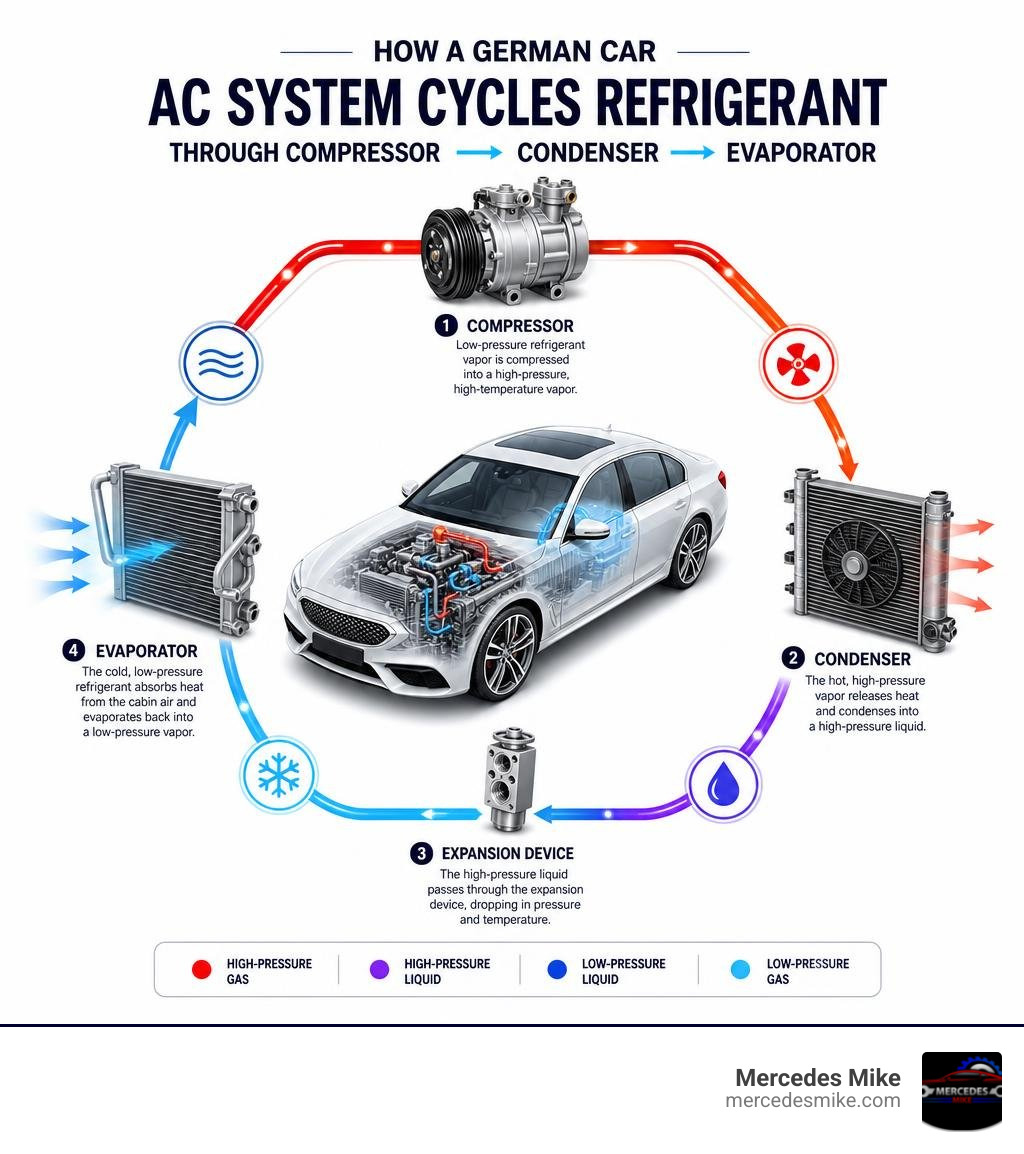
Why German Car Climate Control Systems Are Different
When you buy a German luxury car, you aren't just buying a mode of transportation. You are investing in high-performance engineering. This philosophy extends directly into how your car cools its cabin. Unlike domestic or Japanese commuter cars that rely on basic, cycling on-off compressors, German vehicles use highly complex climate control setups designed to maintain exact temperatures down to the single degree.
To understand why a generic, off-the-shelf quick fix won't work, you must look at how these systems are built. To protect your investment, it helps to understand The Most Common Problems with German Cars and How to Prevent Them, as climate control issues are often linked to broader electrical or mechanical patterns.
The Complexity of European Engineering
BMW, Mercedes-Benz, Audi, and Porsche utilize advanced climate control systems that are heavily integrated with the vehicle’s central computer network (CAN bus).
Instead of a basic clutch that simply kicks the compressor on and off, modern German cars utilize a variable displacement compressor. This type of compressor runs continuously, adjusting its internal displacement via an electronic control valve based on inputs from dozens of cabin, ambient, solar, and humidity sensors.
Because the compressor changes its output dynamically, the flow of refrigerant through the evaporator is perfectly metered. This provides incredibly smooth cabin cooling without the power surges or fuel economy drops associated with traditional systems. However, this high level of precision means the system is exceptionally sensitive to even minor changes in refrigerant volume and pressure.
Why You Need a Specialized German Auto AC Recharge
Because of this extreme precision, a standard "top-off" at a generic lube shop can easily do more harm than good. A proper German auto AC recharge requires specialized diagnostic equipment that can read the exact pressure sensors and communicate with the climate control module.
If the refrigerant level is off by as little as 1 to 2 ounces, the variable displacement compressor may not function correctly. It might run at reduced capacity, or the car’s computer may shut it down entirely to prevent damage. When we perform an Air Conditioning Recharge, we don't just guess the pressure; we vacuum down the entire system, measure exactly what was extracted, and recharge it to the precise gram specified by the manufacturer. This ensures the system calibration remains flawless.
Common Signs Your Bimmer or Benz Needs a German Auto AC Recharge
Recognizing the warning signs of a failing AC system early can save you from a complete system breakdown. In South Florida's brutal climate, a failing AC isn't just an inconvenience; it can quickly turn your morning commute into an unbearable ordeal.

If you are driving a BMW and notice the cabin isn't cooling down like it used to, check out our BMW Air Conditioning Recharge Guide 2026 for a model-specific breakdown of common pressure issues.
Weak Airflow and Warm Air Output
The most obvious sign that your system needs attention is when the air coming out of your vents is lukewarm or downright hot. If the system is low on refrigerant, the evaporator cannot absorb enough heat from the incoming cabin air.
However, weak airflow can also point to a severely clogged cabin air filter or a failing blower motor. A dirty cabin filter restricts airflow, forcing the system to work twice as hard and potentially causing the evaporator coil to freeze over. If you drive a Mercedes, keeping up with a structured Mercedes Air Conditioning Service is the best way to ensure filters are swapped and pressures are verified before the summer heat peaks.
Strange Odors and Unusual Noises
Do you smell a musty, moldy odor when you first turn on your AC? This is a common issue in humid areas like Pompano Beach and Deerfield Beach. Moisture naturally condenses on the evaporator core inside your dashboard. Over time, if the evaporator drain is partially clogged, this standing water becomes a breeding ground for mold and bacteria.
Additionally, keep your ears open for unusual noises. A failing compressor clutch or an overworked variable displacement compressor will often emit a high-pitched whining, buzzing, or clicking sound when you turn on the climate control. For Audi owners experiencing these exact symptoms, our guide on Audi Q5 AC Repair covers how we diagnose noisy compressors and blocked evaporator drains.
R134a vs. R1234yf: Navigating Refrigerant Standards in 2026
The automotive industry has undergone a massive environmental shift regarding the refrigerants used in climate control systems. Depending on the model year of your German vehicle, it will use either R134a or the newer R1234yf.
Feature R134a Refrigerant R1234yf Refrigerant Primary Vehicle Era Pre-2017 Models Post-2017 Models (Standard by 2026) Global Warming Potential (GWP) 1,430 (High environmental impact) < 1 (Highly eco-friendly) Flammability Rating Non-flammable Mildly flammable (Requires specialized handling) Average Service Cost Lower Higher (Due to chemical production costs) System Compatibility Cannot be mixed with R1234yf Cannot be mixed with R134a
Understanding the Shift to Eco-Friendly Refrigerants
The transition from R134a to R1234yf was driven by strict EPA standards and international environmental regulations aimed at reducing greenhouse gas emissions. R134a has a incredibly high Global Warming Potential (GWP) of 1,430, meaning it remains in the atmosphere for years if leaked. In contrast, R1234yf breaks down in the atmosphere in just a few days, boasting a GWP of less than 1.
Because R1234yf is highly sensitive and expensive, many DIYers look for high-capacity alternatives. For instance, products like the COOL5 2in1 SUMMER AC RECHARGE R1234yf 290g - COOL5 provide 290g of refrigerant, which is highly efficient but must be handled with precision to avoid overcharging the delicate European expansion valves.
Choosing the Right Refrigerant for Your German Auto AC Recharge
It is absolutely critical that you never mix these two refrigerants. They require entirely different service ports, system pressures, and compressor lubricants.
This is especially true for hybrid and electric vehicles (EVs). Hybrid and electric German cars use high-voltage, sealed electric AC compressors rather than belt-driven ones. These electric compressors require highly specialized, non-conductive polyolester (POE) synthetic oils instead of the standard PAG oils used in traditional cars. If standard oil or the wrong refrigerant is introduced, it can cause an electrical short circuit inside the compressor, completely destroying the high-voltage system.
If you drive an electric or hybrid vehicle, you must use compatible products such as the Car Aircon Regas For Hybrid/Electric Vehicles R1234yf Compatible Refrigerant x2 - Thompsons to prevent electrical conductivity issues and catastrophic compressor failure.
The Professional Diagnostic and Recharge Process
When you bring your vehicle to Mercedes Mike, we don't just inject refrigerant and send you on your way. If your refrigerant is low, it means there is a leak somewhere in the system. Refilling a leaking system is a waste of money and harms the environment.
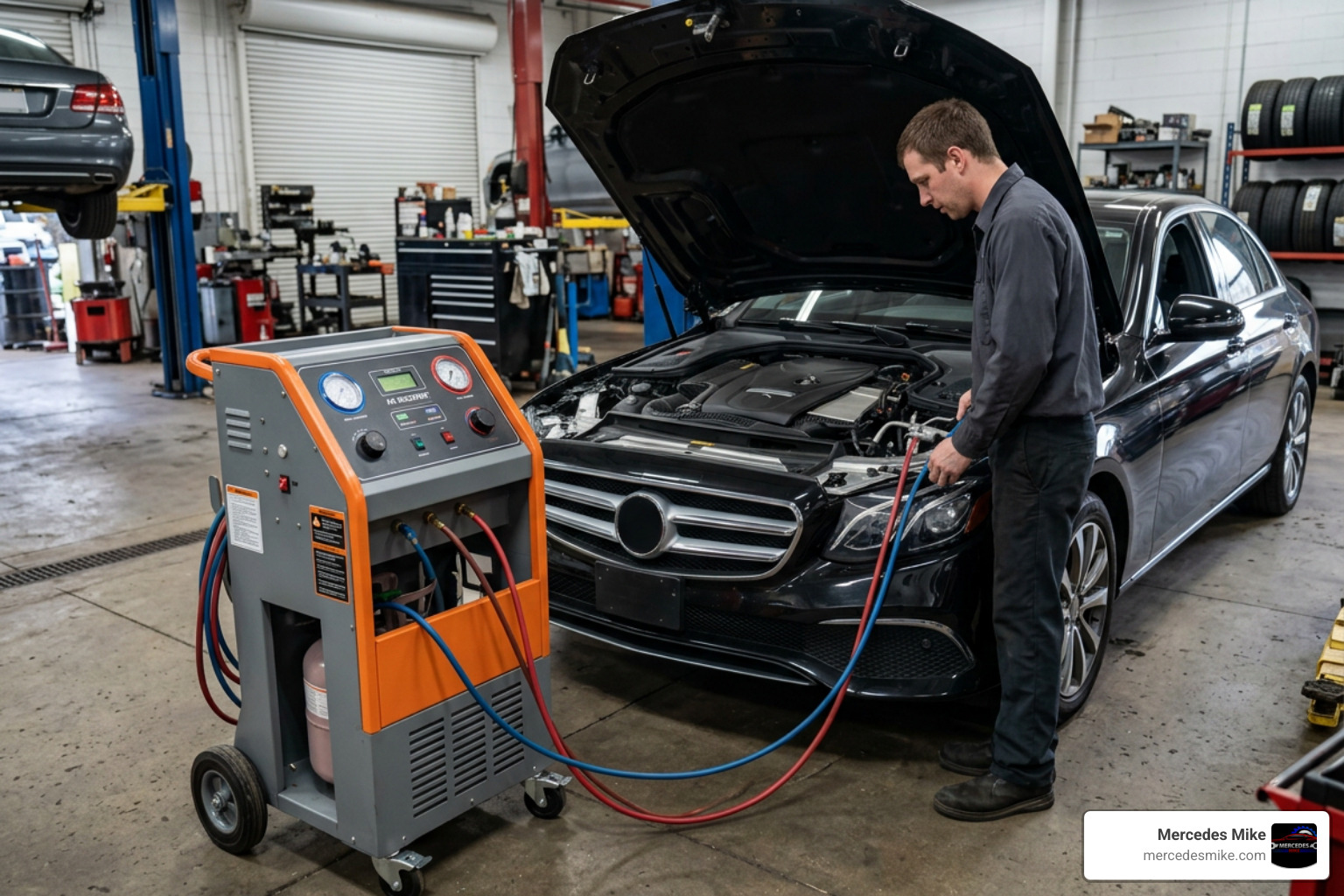
Before we perform any recharge, we conduct a comprehensive leak test. If a leak is found, we perform a thorough Refrigerant Leak Repair to ensure your system remains sealed and cold for years to come.
Why DIY Recharge Kits Can Risk Costly Damage
It can be incredibly tempting to go to a local auto parts store in Pompano Beach and grab an off-the-shelf DIY kit. Products like the A/C Pro R-134a Extreme Refrigerant Kit with Charging Hose and Bluetooth Gauge 19oz | AutoZone , the All-in-One Car AC Refill Kit | Refrigerant, Stop Leak & Pressure Gauge | DIY AC Fix | FreezeCar , or the A/C Pro® Extreme Conditions AC Refrigerant Smart Charge Recharge Kit are heavily marketed as quick, 10-minute fixes.
While these kits may work temporarily on less complex vehicles, they pose a massive risk to German cars:
The Danger of Overcharging: German variable displacement compressors do not tolerate overpressurization. DIY gauges only measure low-side pressure, which does not give a complete picture of system health. Overcharging can instantly blow out seals or lock up your compressor.
The "Stop-Leak" Nightmare: Many of these retail kits contain chemical stop-leak additives. These chemicals are designed to swell rubber seals to stop small leaks. However, inside a German car's AC system, these additives react with moisture and air, turning into a sticky sludge that permanently clogs the incredibly small passages of the thermal expansion valve and the condenser.
Voided Warranties: Once stop-leak is introduced into your system, professional AC recovery machines can detect it. Many specialized shops will refuse to service a car containing stop-leak because it can contaminate their multi-thousand-dollar recovery equipment.
If you want to keep your climate control healthy, leave the DIY cans on the shelf and invest in a professional AC Repair that addresses the root cause of the issue safely.
Step-by-Step Specialized Shop Procedure
Our experienced technicians utilize a highly precise, multi-step process to restore your climate control system to factory specifications:
Step 1: Refrigerant Recovery: We connect our specialized AC recovery machine to both the high- and low-pressure ports. The machine safely extracts all remaining refrigerant and measures the exact amount recovered.
Step 2: Vacuum Decay Test: We pull a deep vacuum on the system for 30 to 45 minutes. This process boils off any moisture inside the lines and tests the system’s ability to hold a vacuum. If the vacuum gauge drops, we know there is a physical leak that must be addressed, such as a damaged condenser. If the condenser is leaking from road debris, we carry out an AC Condenser Repair before proceeding.
Step 3: Oil Injection: We measure the exact amount of lubricating oil that was extracted during the recovery process and inject fresh, manufacturer-approved synthetic oil (PAG or POE) back into the lines.
Step 4: Precision Recharge: We recharge the system with virgin refrigerant, measured down to the exact gram using an integrated, highly calibrated digital scale.
Step 5: Performance & Dye Testing: We inject a small amount of highly concentrated UV dye into the system and run the AC at maximum capacity. We then use a UV light to inspect all lines, connections, and the condenser to guarantee there are no micro-leaks.
Frequently Asked Questions about German Car AC Systems
Why is my car AC blowing warm air?
If your German car is blowing warm air, it is typically caused by a lack of refrigerant due to a slow leak, a failing variable displacement compressor, a blocked condenser, or an electrical issue (such as a blown fuse or a faulty pressure sensor). Because these systems are highly integrated, a professional diagnostic scan is required to pinpoint the exact cause.
How often should I recharge the AC system in my German car?
As a general rule, we recommend having your German car's AC system inspected and recharged every 2 to 3 years. Even in a perfectly sealed system, refrigerant naturally permeates through rubber hoses and seals at a rate of about 5% to 10% per year. Regular maintenance keeps the compressor properly lubricated and running efficiently.
What causes strange smells from the AC vents?
Musty, dirty odors are caused by mold and bacteria growing on the damp surface of the evaporator core behind your dashboard. This is highly common in South Florida’s humid climate. Swapping out a dirty cabin air filter (which should be done every 15,000 to 30,000 miles) and clearing a clogged evaporator drain line will resolve the smell and restore clean air to your cabin.
Conclusion
Your BMW, Mercedes, Audi, or Porsche is a masterpiece of European engineering, and its climate control system deserves the same level of care and precision. Don't let a cheap DIY kit or a generic repair shop ruin your luxury ride's sophisticated AC system with incorrect pressures or damaging stop-leak additives.
At Mercedes Mike, our decades-experienced technicians use the latest factory-grade diagnostic tools and recovery machines to keep your car blowing ice-cold air through the hottest South Florida summers. Conveniently located on N Dixie Hwy at 882 ne 41st Court, we proudly serve drivers throughout Pompano Beach, Deerfield Beach FL, and the surrounding South Florida area.
Protect your vehicle with the specialists who know European engineering inside and out. Explore our specialized German Auto Repair Pompano Beach services and Schedule your professional AC service today to experience the Mercedes Mike difference!